Briggs | Thomas Esmond Alexander


Biography
Thomas Esmond Alexander Briggs was killed in action on 12 October, 1944. He was 24 years of age and was a Lance Sergeant in the 1st Battalion of the Suffolk Regiment (Service No. 5832288). He was initially buried in the Cemetery Th.J. Janssen, Overloon and later re-interred on 20 May 1947 in Grave II.E.2 in the Overloon War Graves Cemetery. His inscription reads “And with the morn those angel faces smile, which I have loved…and lost awhile.”
Family history
Thomas Esmond Alexander Briggs was the son of George Thomas Briggs and Eva Tait who had married in 1919 in Houghton le Spring in County Durham. This lies between Durham and Sunderland in County Durham.
George Thomas Briggs was the son of John and Ann Briggs. John and Ann were both born around 1862 – John in Middlesborough and Ann in Wolferton, Norfolk. They had married in 1881 in Middlesborough and had 14 children all born in North Ormesby, Middlesborough. George was the 6th eldest, born on 5/12/1891. One child died in infancy.
By 1901 John and Ann were living at 8, Moses Street, North Ormesby. John was working as a Fruiterer. Their first ten children were all at home, including George. The three eldest were all working as Fruiter’s Hawkers. John’s father was living with them. He was born in 1837 in Shipley, Yorkshire and was a Machine Engine Turner. John and Ann were at the same address in 1911 with their seven youngest surviving children, one of whom was helping John with the Fruiterer’s business. George was working as an Advertiser and living as a boarder in the household of Ernest and Alice Mary Stevens at 1 Myrtle Street, Middlesbrough.
George Thomas Briggs seems to have served in the Northumberland Fusiliers in WW1 (Service No. 36067). He was discharged on 24 July 1918
Eva Tait was the illegitimate daughter of Eliza Ethel Tait. She was born on 12/1/1901 at Unwin Street, Hetton Le Hole, Houghton le Spring. No father’s name was given. Eliza Ethel Tait was the daughter of George Tait and Mary Ann Robson who had married in Chester le Street in 1864.
George had been born in 1840 in Scotland, possibly near Berwick. Mary Ann was born in 1847 at Appleton Wiske in Yorkshire. George was an Agricultural Labourer. They had at least 9 children between 1865 and 1886 though others may have died in infancy. They were all born in County Durham, with those born in 1872 and after being born in Easington which is near the coast, east of Durham City. Eliza Ethel was born in 1883 at Thorp Moor Farm in Easington.
By 1891 George and Mary Ann were living at West Moor, East Murton, Easington with four of their children including Eliza. By 1901 George Tait had died and Mary Ann Tait was widowed. She was living at Unwin Street, Hetton Le Hole. She was described as running a Boarding House. Her granddaughter, Eva Tait, was living with her grandmother but her mother Eliza wasn’t present. The only others there were Mary Ann’s youngest daughter and a single female boarder who was an Assistant Teacher. By 1911 Mary Ann was living at Mill House Farm, Hetton Le Hole and was described as a Farmer. An adult son was with her and working as a Cartman. Eliza Ethel was also now at home. Eva Tait was still with her and a grandson of Mary’s was also there – Frank Robinson Tait born 1910 at Mill House Farm. It isn’t known which of Mary Ann’s children was his parent.
Thomas’ birth family
George Thomas Briggs married Eva Tait in Houghton le Spring on 12/1/1919. Their marriage certificate lists their ages as George Thomas Briggs 21 and Eva Tait as 18. The latter is consistent with her birth certificate, but that for George is incorrect as he was born in 1891, so was 28. By the time of their marriage in 1919 George was living at 29 Robinson Street, Houghton-le-Spring with his occupation listed as Motorman and Eva was living at 2 Eppleton Terrace, Eppleton, and her father is named as Fred Fairweather, Farmer. They only had the one child, Thomas Esmond Alexander Briggs, born on 21/3/1920 at Warden Law Farm, Low Warden Law in Houghton le Spring. George was working as a Greengrocer. He was a manager at stores.
In 1921 George, Eva and Thomas were living at The Rectory Lodge, Washington, County Durham. George was working as gardener for C. Lomax, the Rector.
George and Eva Briggs seem to have continued to live in the north east until at least 1935. In 1933 they were living at 80 Hugh Gardens, Benwell in Newcastle upon Tyne and in 1935 at 116 Cromwell Street, Elswick, Newcastle.
Sometime in the following few years George and Eva moved to Suffolk, to the Lodge House on the Henniker Estate in Thornham Parva. It was there that Thomas met his future wife, Ellen Smith, who was living a few hundred yards away at 219 Carters Farm Cottages. However, it seems that by September 1939 they had moved to Felixstowe as George and Eva Briggs, were living at The Clock House, Maybush Lane, Felixstowe. George and Eva were both working as School Caretakers at the Independent Girls’ School, Felixstowe College, which had opened a decade earlier in 1929.
Thomas’ Marriage
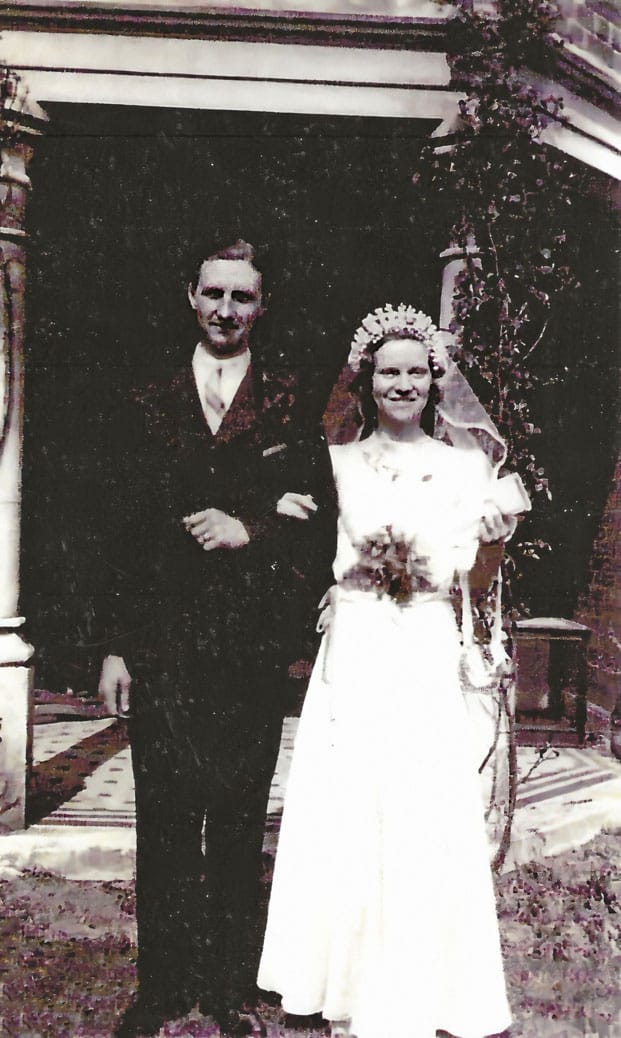
Thomas Esmond Alexander Briggs (age 19, bachelor) married Ellen Elizabeth Smith (age 29, spinster of Trimley St Mary) on 10/4/1939, after banns at the Church of Trimley St Mary. Ellen had been born on 10/1/1910 in Eye in the Hartismere district of Suffolk. Eye is just south of the town of Diss.
Ellen Elizabeth Smith was the daughter of Albert Edward and Emma Maria Knott who had married in the Hartismere district on 31/10/1896. Albert was a Painter and Decorator born in Eye in Suffolk in 1877. Emma was born in nearby Gislingham on 27/8/1871. They had four daughters and two sons, all born in Eye. Ellen Elizabeth Smith was the second youngest. In 1911 Albert and Emma Smith and their first five children were living at Lowgate Street, Eye, Suffolk. By 1921 they were living at Mellis Road, Thornham Parva, Suffolk with their three youngest children, including Ellen. Thornham Parva is just west of Eye. Albert was working as a Painter & Paperhanger for Lord Henniker who owned the Thornham Estate. By September 1939, Albert and Emma were living at 219 Carters Farm, Thornham Parva with their son Edward George.
In September 1939, Thomas Esmond Alexander and Ellen Elizabeth Briggs were living at 30 Mill Lane, Trimley St Martin, Suffolk. This is just outside Felixstowe. Thomas was working as a Grocery Van Driver and Ellen as a Grocer’s Shop Assistant. Earlier that year, on 8/5/1939, Ellen’s sister Edith had died and the Diss Express of 12/5/1939 showed that “Nellie and Esmond” sent flowers, suggesting that Thomas preferred to be known at that time as Esmond and Ellen as Nellie.
Thomas was called up not long after this on 13/6/1940 so did not take part in the invasion of France in 1939 which ended with the evacuation from Dunkirk in May 1940.
The 1st Battalion of the Suffolk Regiment spent the next four years training for the D-Day invasion of Normandy in 1944. During this time, it is understood that Ellen sometimes moved to be near where Thomas was posted.
They had a daughter, Ann Esme Eva Briggs, in 1942. She was born in her grandparent’s cottage in Thornham Parva.
Military Career
On 6 June 1944, D-Day, the Battalion landed on Sword beach and was involved in attacking and taking the Hillman Fortress on D-Day itself. They continued to progress through France, including severe
battles which cost many lives at Chateau de la Londe and at Tinchebray.
Thomas Esmond Alexander Briggs, then a Corporal, is mentioned several times in the attack on Tinchebray in Mark Forsdike’s book “Fighting Through to Hitler’s Germany.”
The 1st Suffolks played their part in this joint attack with the Americans which started on 11/8/1944, though their role only began in earnest at midnight on the 12th. They met with strong opposition in places and the attack was hampered by the loss of many of the Brigade’s leading officers who were injured when a shell landed close to a planning meeting at Brigade HQ. In the early hours of the morning No. 7 Platoon moved into fields behind 9 Platoon to help guard the road to Truttemer-le-Grand. No sooner had they entered the first field than they were challenged in the darkness in English. The accent was undeniably German and Corporal Thomas Briggs fired a short sharp burst from his Sten, killing the challenger. A dead German paratrooper officer was found.
As soon as No. 7 Platoon dug in, a section was sent to try to make contact with the Americans who were believed to be about a mile away in a wood near Truttemer-le-Grand. While it met with opposition from a machine gun which resulted in casualties, Corporal Briggs and Lance Corporal Harlow took a northerly route and reached the wood and contact with the Americans was established.
The Battalion then waited until first light to attack to clear the area. This did not prove easy, but it achieved its objective, only to be told at 1800 hours that they were to prepare for another attack to clear a wood with support from Churchill tanks and an initial artillery barrage. The bombardment began at 2030. There was a lack of clarity as so many of the leading officers were dead or wounded. ”D” Company reached its objective but was ordered to push on further. “B” Company managed to clear the wood but were nearly wiped out in the process. “C” company found itself in an isolated position and were withdrawn to a position astride the main road. “A “ company was sent to secure a crossroads about 400 yards further down the road. They advanced without incident, but German troops were dug in around the junction. Corporal Sellers and one section went forward, but the enemy fire was intense. Meanwhile, 7 Platoon, consisting of only ten men under Sgt Barratt, was now sent to support Corporal Sellers, while 9 Platoon was despatched to clear the gardens and an orchard just to the left of the crossroads. Corporal Briggs’ section with the assistance of a PIAT team destroyed a German machine gun position, while 8 platoon cleared the area to the south and east of the crossroads. “A” Company believed they had taken their objective and dug in.
As night drew on, the temperature fell and the ground was covered in mist. As the new day dawned, 8 platoon suddenly found themselves in an orchard full of German troops. An attempt was made to clear the wood, but the platoon was heavily outnumbered as it was now just fifteen strong and three of those were wounded. It therefore withdrew. In order to counteract an enemy breakthrough, No. 9 Platoon was ordered to assist 8 Platoon in clearing the orchard. Corporal Briggs’ section was ordered to cover the right flank of 9 Platoon and deal with another troublesome German machine gun.
After a short mortar bombardment, 8 Platoon assaulted over a bank and advanced swiftly across a cornfield. The German troops defending this sector threw grenades, but they were quickly overrun. However, it was decided to withdraw to allow an artillery bombardment to take place. As soon as it ended 9 platoon advanced but the Germans had fled.
In those 48 hours the battalion had strengthened its growing reputation. Lt. Colonel Gough who had been injured early in the action later wrote “The Battalion got stuck into the Boche Paratroop Boys and set about them properly. I am told that the 3rd Division is quite the best in France and the First Suffolk easily the best in the Division.”
The Battalion progressed through Belgium before arriving in the Netherlands, reaching Molenhoek just below Nijmegen by 1 October.
From there they swung round to the south, passing through Mook and Rijkevoort to approach occupied Overloon from the north. The aim was to attack Overloon and clear the enemy salient west of the River Maas in what was known as Operation Aintree. The attack on Overloon was delayed by heavy rain and very muddy conditions until noon on 12 October. The plan was that the 1st Suffolk Regiment would attack on the right while the 2nd Battalion of the East Yorkshire Regiment would proceed on the left. The attack began with a creeping artillery barrage, behind which the infantry would follow, with “A” company in the lead. They had to advance over half a mile of desolate land to reach Overloon and were immediately met with mortar fire. A sniper inside a shattered windmill succeeded in picking off the “A” Company Commander, two platoon sergeants and most of the senior NCOs by identifying their rank from their badges. Lance Sergeant Thomas Esmond Alexander Briggs was one of the sniper’s early casualties.
In that attack on that day one officer and 9 men of the 1st Battalion of the Suffolk Regiment were killed and a further 2 officers and 55 men were wounded, though the Battalion met its objectives for the day.
Thomas was awarded the 1939/1945 Star, Defence Medal / France and Germany Star and War Medal 1939/45. His wife, Ellen, also received a certificate from the Army recognising Thomas’ Outstanding Good Service.
Thomas Esmond Alexander Briggs is commemorated on the WW2 War memorial in Trimley St Martin.
The Aftermath
After his death, war records show that his widow, Ellen E Briggs, lived at Thornam Parva, Suffolk and later at 34 Brookfield Road, Ipswich. She married Leonard Ernest Endean on 1/9/1951 at the Registry Office, Eye in the Hartismere District. Following their marriage, they lived at 136 Merton Road, Wandsworth, London, SW 18. Leonard was Ellen’s cousin. He had been born on 5/8/1915 in Fulham, London and was the son of Sarah Jane Knott and Charles Eddy Endean who had married in 1903 in Fulham. Sarah Jane was born in 1882 and was the sister of Ellen’s mother, Emma Smith.
Ellen’s father, Albert Edward Smith, died at 219 Carter’s Farm Cottages, Thornham Parva, Suffolk on 18/2/1955 aged 78. Ellen’s mother, Emma Maria Smith, died on 24/2/1963 whilst living with her daughter, Ellen, in Wandsworth London. Just before her death in 2013, Thomas’ daughter, Ann Esme Eva Briggs, paid for the restoration of the oak staircase leading to the gallery inside the church as a memorial to her Thornham grandparents. A small plaque inside the stair well records this.
Ellen later received a short letter dated 29/10/1961 from a young man in the Netherlands who signed himself as Peter. The letter was from Piet de Bruijn of Bergstraat 8, Bakel. In this letter he sent a gift from Thomas, given to Piet for Ellen before his death. This was a necklace.
Piet was born in 1928 in Beneden – Leeuwen, so he was only 16 when Thomas died. He lived in Kloosterdreef, Woensel in Eindhoven during the war but by October 1944 he was near Overloon.
On 26/11/1961 he replied to a letter which Ellen had written to him on 4/11/1961. In this letter Piet went into much more detail. He began by describing the run-up to the Battle of Overloon, including the liberation of Eindhoven and the entry into Nijmegen as part of Operation Market Garden. He then described the arrival in Overloon of the German 180th Infantry Division under Comm. Lt General Klosterkemper and the 107th Tank Brigade with parts of the 7th Paratroop Division under Comm. General Erdmann and their order for the inhabitants of Overloon to evacuate the village before the Allies started shelling it. He describes the difficulties faced by the 7th US Tank Division as they tried to take the village and then the approach to the village of the 3rd British Infantry Division and parts of the 11th and 79th Tank divisions on 11 October. He then describes the creeping artillery barrage on Overloon on 12 October and the capture of the woods to the north of the village.
In the letter, Piet describes his involvement with Thomas Briggs. He wrote that Thomas was killed in woods north of the village. He had been shot in the leg – a flesh wound. He says he tore Thomas’ trouser leg and “tied his leg with his cane” – by which he may have meant he used his cane to put on a tourniquet. He goes on to say that a first aid man gave Thomas a morphine injection and that Pete then carried him to a tent where a doctor gave him a blood transfusion.
At that point, Thomas gave the necklace to Piet. He told him: “Go to England. George he will know Ellen ..?.. Ellen give this. Remember me to Ellen. Remember me to the family Ellen George and Eva.”
Piet assured Ellen that Thomas had not been in much pain because the wound was numb and helped by morphine. He died peacefully while holding Piet’s hand. He went on to tell her that they had wrapped Thomas in a blanket held around him with pins and buried him with another soldier who had died. He tried to comfort Ellen with the thought that he had died “without noise, without the hell of fire, sand, stones, noise and so on”. His last words were for Ellen, his family and for Piet, who was his friend.
Piet told Ellen why it had taken him so long to contact her. He had no address, just the three names, and also a reference to Thornham Parva which he did not understand. In 1945, he tried to get an address from the War Ministry, then the Dutch, Belgian and French Red Cross, but without success. In 1948, he was sent with his brother to the Dutch East Indies (Indonesia) and returned to the Netherlands in 1950. Then he found out about the Commonwealth War Graves Commission and it seems that a first letter to Ellen was sent via them.
Ellen and Leonard Endean had no children of their own. Ellen died in Wandsworth in London in 1964, just a year after her mother, and is buried in Thornham Parva Churchyard. Leonard died on 6/2/1984 whilst living at 28 Greenhill Road in Herne Bay, Kent. He was described as a retired Telephone Engineer.
Thomas’ mother, Eva Briggs, died on 8/1/1967 aged 66 while living at 15 Exeter Street, Felixstowe, Suffolk. Her husband was named as George Thomas Briggs – a retired gardener. George himself died on 13/12/1978 aged 87 in Ipswich Hospital, Heath Road Wing while living at 11 All Hallows Court, Ipswich.
Thomas’s daughter Annie had lost both her father and her mother by the time she was 22. After school, she went to study theology at Durham University. She took her final exams around 3 weeks after her mother’s death in 1964 but still passed with a good degree. She was a highly intelligent lady, who could read Hebrew and New Testament Greek. She made lifelong friends during her time at Durham.
Annie went on to teach Religious Studies, largely to sixth form students. When the new Religious Curriculum was being devised in the 1960s / 1970s she was heavily involved, including working on the text. She had a deep faith and belonged to the Cathedral at Ely for most of her adult life. She had a great sense of humour, was a reluctant but capable gardener, wrote poetry and loved cats! She never married but had a number of great male friends who all cared for her very much.
It was only in 1971 that Annie’s step-father gave her the package containing the letters which Piet had sent to her mother and found the necklace, Thomas’ cap badge and an old threepenny piece which Ellen had treasured. It seems that Thomas had called Annie “his threepenny bit”, though it isn’t clear whether this was one which her mother had kept or which came from her father at some point.
She and her step-father had little contact after 1974. However, it seems that the Thornham family were very supportive of her, very loving and totally devoted to each other and the whole family. Thornham represented a place of safety to Annie, and she returned many times over the course of her life.
In 1998 Annie visited her father’s grave. Before she went, she wrote to the address she had for Piet saying she would like to contact him. It isn’t known if they made contact. Piet died in Tilburg on 25/1/2020.
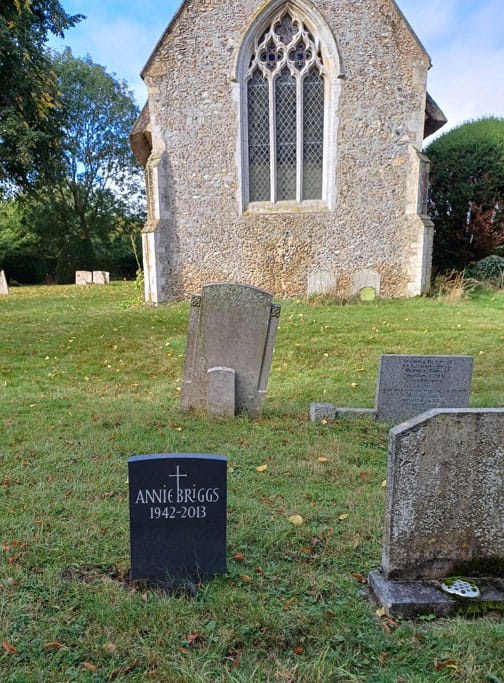
Annie died on 31 May 2013 in March, Cambridgeshire and, according to her wishes, her ashes were interred in Thornham Parva churchyard above the graves of her Thornham grandparents, and just along the row from her mother. Over a hundred friends came to her funeral in Ely Cathedral. A permanent memorial to Annie is in the church at Thornham Parva, designed by John Maddison, Art Historian and Artist, and paid for by her many friends. It has a plaque inside recording this. The memorial is in the form of an octagonal oak font cover, crowned by an acorn. Annie had been born on Oak Apple Day (29th May) and all her life believed that acorns were oak apples!