Churchlow | Alfred Thomas


Biography
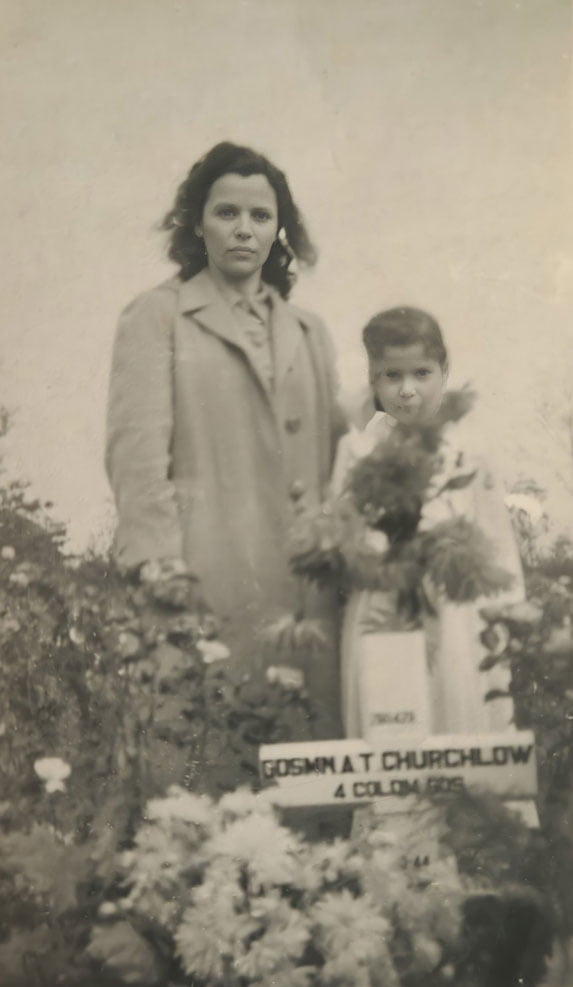
Alfred Thomas Churchlow was killed in action on 14 October 1944 in the vicinity of Overloon. He was aged 36 at the time. He was a Guardsman in the 4th Battalion of the Coldstream Guards (Service No. 2661428). He was initially buried a little to the north of the Molenbeek between Overloon and Venray and re-interred on 28 May 1947 in grave IV. C. 7. in the Overloon CWG Cemetery. The inscription on his grave reads: “In remembrance of my dear husband. Not forgotten by his wife and daughter Maureen.”
Military Career
Alfred was recruited into the Coldstream Guards at Romford on 20 May 1940 and was described as a labourer.
The 4th Battalion was formed in October 1940 for the duration of the war. It first became a motorized battalion in 1940. In November 1942 it switched from cars to Churchill tanks. While the 5th and 1st Battalions had entered France in June 1944, shortly after D-Day, the 4th Battalion remained at home until 20 July 1944 when they landed at Juno Beach. In France, they played their part in the battle at Caumont and assisted in the attacks at Vire and Tinchebray. From 15August until 29 September the 4th Battalion had a relatively quiet time while the 1st and 5th Battalions proceeded through Belgium and the Netherlands to take part in Operation Market Garden. It was only after the failure of that operation to take Arnhem in late September that the 4th Battalion was brought more fully into the conflict.
On 29 September they reached Eindhoven and headed towards Nijmegen the following day, crossing the River Maas and arriving in the forests at Mook that night. The initial plan had been for them to support the 8th and 185th Brigades of the 3rd Division in an attack on the Reichswald forest area to the east. However, this was cancelled on 7 October as higher priorities were given to securing the port of Antwerp and in widening the salient along the River Maas by turning south to capture Overloon and Venraij. It was with this latter task that the 4th Battalion was to assist the 3rd Division. The country was flooded and heavily wooded making reconnaissance difficult. There was incessant rain and impassable roads. The attack was initially scheduled for 11 October but rain flooded the whole district, so it was delayed until 12 October to allow the ground to dry out to some extent.
The operation therefore began with a heavy artillery barrage at midday on 12 October, after the battalion had spent a drenching night in the woods 2 miles north of Overloon. The Coldstream with 8 brigade were to take Overloon. The Royal Engineers had worked hard to prepare approaches for the tanks through the bogs, dikes and copses which barred their path. At first the advance went briskly. However, they soon encountered minefields and fire from enemy tanks and anti tank guns. Despite the loss of two tanks, the village had fallen by 5pm. However, the enemy still held out in a wood on the right flank so the attack continued the following day. It was still impossible for tanks to approach the wood and three tanks were knocked out during the attack and a third blew up on a minefield as it withdrew.
On 14 October the 2nd Squadron advanced with the 1st Norfolks towards the Molenbeek Canal, the country was more open, but Panthers were lying in wait and two tanks were knocked out before they were located. Lt Page-Wood directed four shots from his six pounder at one of them, but these merely bounced off its armour and a Panther replied with four shots which went straight through the Churchill, fortunately, without touching the crew. A second Panther opened fire on Lt Sgt Gough’s troop, but Lt Sgt Gough refused to withdraw and leave his infantry unprotected and sat doggedly in the open until two of his three tanks had been destroyed – a courageous decision for which he won the Military Medal. An air burst killed the driver of Lt Page-Woods remaining tank, but only at nightfall did the squadron retire. It was on his day that Alfred Churchlow died.
It is thought that he was the turret gunner and that the rest of his crew which also died that day were Lance Corporal Frank Sheen (Tank Commander), Eric Gilbert (Driver) and John Wilkinson Dalton (Hull Gunner). The men had named their tank “Caribou” or “Coughar”. They are buried side by side at Overloon.
John Collier also survived the Battle of Overloon from the “Cheetah” and watched the “Caribou” or “Coughar” take a direct hit from a .88 shell. Eric Gilbert and his good friend Johnny (Dolly) Dalton were killed instantly in the explosion that followed and the Churchill tank was knocked out. It seems that Alfred Thomas Churchlow and Frank Sheen were also killed in this explosion.
Family History
Alfred Thomas Churchlow was born on 10 May 1908 in Stepney, London. He was the son of William Thomas Churchlow and Ada Saunders who had married in 1905 in Stepney. Willliam came from a family of market florists. He was born on 9 September 1883 at 25 Buck’s Row, Bethnal Green and Ada in 1884/5 in Stepney. They appear to have had seven children as follows: William Alfred 1907, Alfred Thomas 10/5/1908, Ada Ellen 19/7/1910, Christopher 1912, Sidney 2/11/1913, Catherine 23/8/1915, George Robert 15/2/1917. William was born in Limehouse and the rest in Stepney.
In 1911 they were living at 194 Old Church Road Stepney, Mile End Old Town, London and this seems to have remained the family home through to at least 1940.
In 1911 William was described as working as an Old Clothes Dealer and Ada was assisting with the business. By 1921 William was described as a Wardrobe Dealer and Ada as a Tailor’s Presser. In 1921 their son, William, was working as an Apprentice at Forrest and Sons. All the children were still at home in 1921.
Alfred was still living at home in 1930 and 1931, but by September 1939 neither he nor his parents were at that address, but his siblings Ada, Catherine and George were present. It seems that William T Churchlow had died early that year. Ada (Junior) was working as a florist, Catherine as a tailoress and George as a Motor Mechanic. There too was William Hilton, a Band Knife Cutter born 2 Oct 1909 whom Ada later married. It was also indicated that Catherine later married someone called White. In September 1939 Alfred’s mother, Ada, was living at 12 St James’s Street, Brighton and Hove in the household of Philip J and Edie Banks. She was widowed and working as a Florist. She may just have been visiting as she was still living at Old Church Road in 1940. The East End News and London Shipping Chronicle of 10 May 1940 reported that Mrs Ada Churchlow of Old Church Road Stepney was fined 20s, with others, for consuming intoxicating liquor at other than permitted hours at the “Old Ship” Stepney.
Alfred was recruited into the Coldstream Guards at Romford on 20 May 1940 and was described as a labourer. A little later in 1940, he married Mary Eleanor O’Grady.
Mary had been born on 21 Sep 1913 in Canning Town. Her parents were Patrick John and Annie O’Grady. Patrick, who seems to have been known as John, was born in 1881 in Fulham and Annie in 1877 in Rainham, Essex. In 1921, Mary was living with her parents at 3, St Anne Street, Limehouse. John was a Water Side Labourer but was out of work. With them were three of John’s step children, William, Harriett and Maud Lesurf born between 1908 and 1911. These were Annie’s children by an earlier marriage. It seems that Annie Low had married Henry Lesurf in 1901 in Romford, Essex. He already had eight children by an earlier marriage. It is thought that Annie was initially his housekeeper, then married him. He went on to have five children with Annie, though one died aged 5. All but Henry’s first child had been born in Canning Town, Essex.
By September 1939 Mary was living on her own at 3 St Anne Street, Limehouse, where she and her parents lived in 1921. She was working as a Food Packer in the Canning industry. It was indicated that she married someone called Churchlow then someone called Donkin.
Alfred and Mary Churchlow had a child, registered as Maureen Mary Churchlow, in 1941 in the Perivale Maternity Home near Greenford, though she was baptised as Maureen Alice Churchlow.
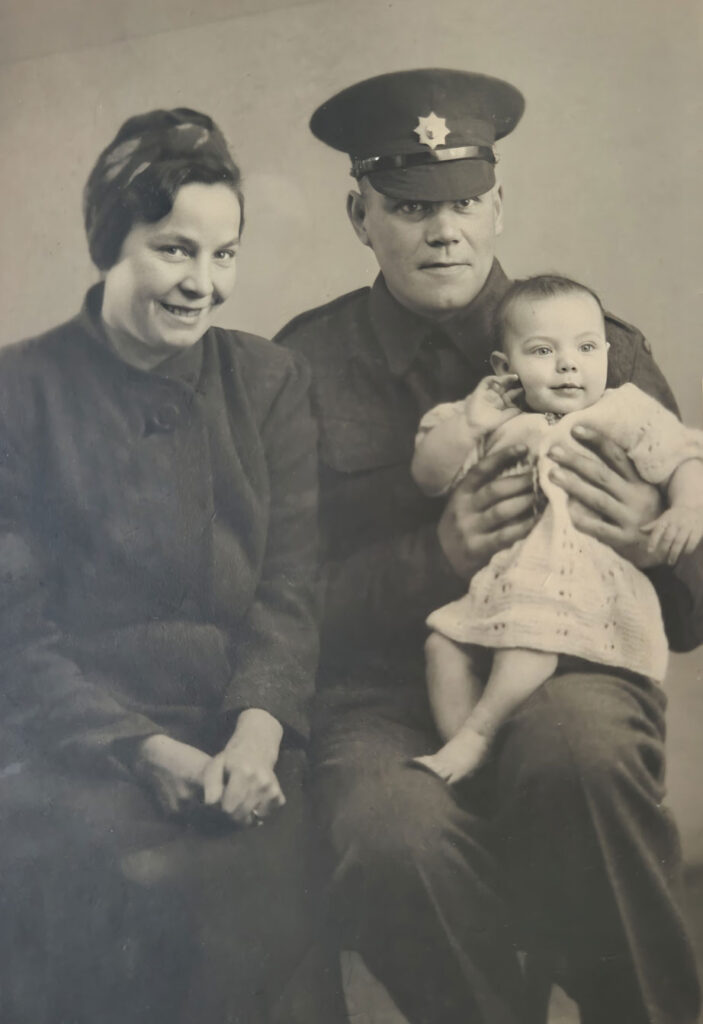
Although Maureen was only 3 when her father died, she found out more about him from her mother and grandmother. He was 6ft 3 inches tall – which is tall for that era. He could turn his hand to anything. He was known to have spent time before the war selling bananas outside Mile End Station and also as a road mender.
Mary Churchlow and her mother Annie were bombed out in attacks on the East End of London. They went to stay with Mary’s sister, Maud, in Greenford. However, the property was declared to be overcrowded, so when Maureen was 1 year old Mary and Annie had to find somewhere else to live. The three of them moved to Hammersmith.
Alfred came home on leave before he went off to Europe. He told his wife “don’t expect me back” as he didn’t think it would go well. When he was in Europe, he sent chocolate by post to Maureen which was scarce in the UK but which he obtained from American troops.
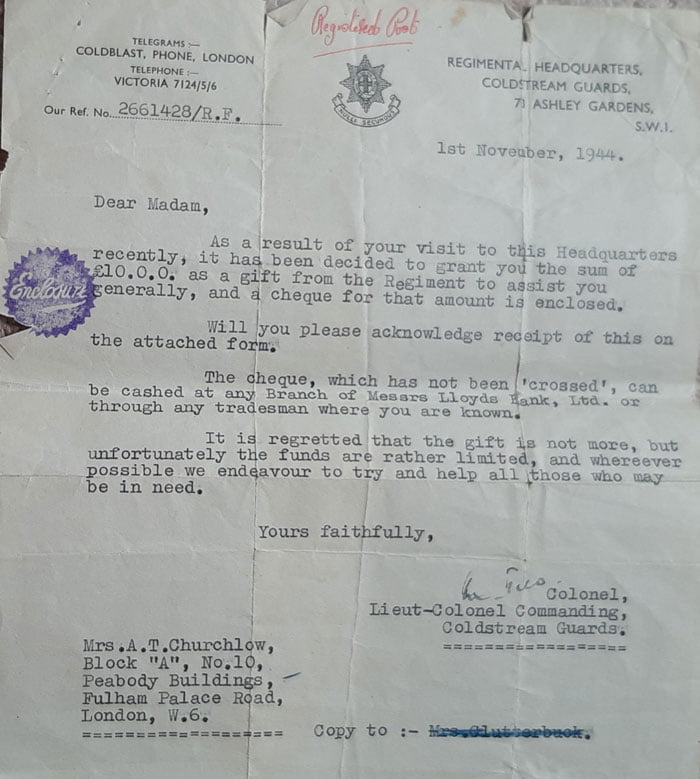
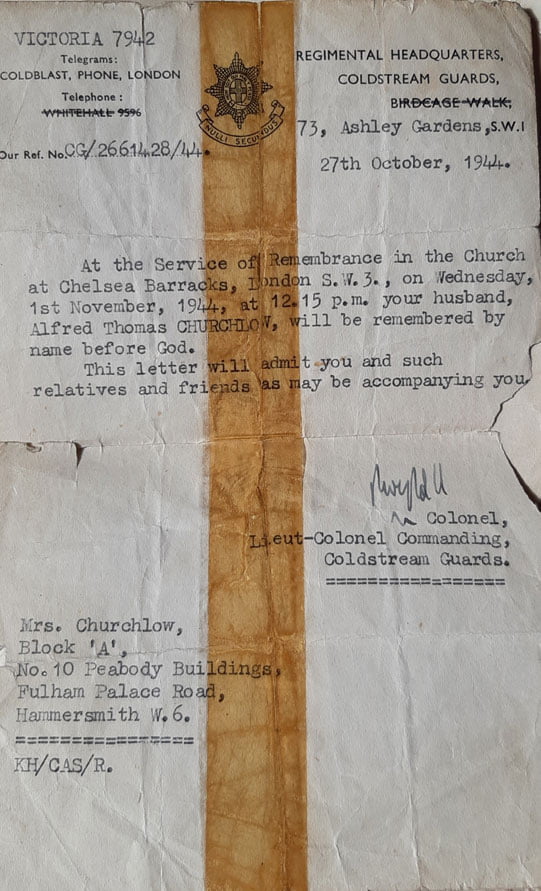
Following Alfred’s death, Mary was invited to Service of Remembrance by the Coldstream Guards on 1 November 1944. They also gave her a gift of £10 with an apology that they couldn’t give more as they did not have much and wanted to ensure that all the widows of their soldiers had something. She was then awarded a pension of 11 shillings a week for herself and Maureen. That was not enough, so she had to take two jobs to make ends meet. Mary went on to marry Francis H Donkin (known as Harry) in 1948 in Hammersmith District. Harry himself had been in the Royal Engineers, working as a Stevedore at the docks, a similar job to that which he did in civilian life. He knew Alfred Churchlow before the war. Alfred’s mother did not want Maureen to be adopted so she kept the name Churchlow. Mary and Harry had no children of their own.
Mary’s mother, Annie O’Grady, died in 1955 and Alfred’s mother, Ada Churchlow, died in 1956 in Maldon, Essex.
Mary Eleanor Donkin died in 1977 in Fulham.
Maureen M Churchlow married Peter MW Lewis in 1961 in Hammersmith district. Peter died in February 2020.
Clara Dalton’s letter
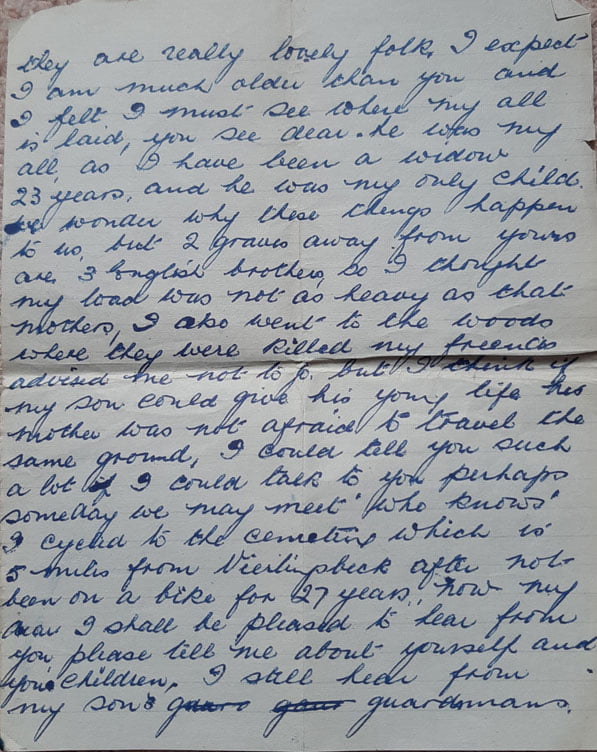
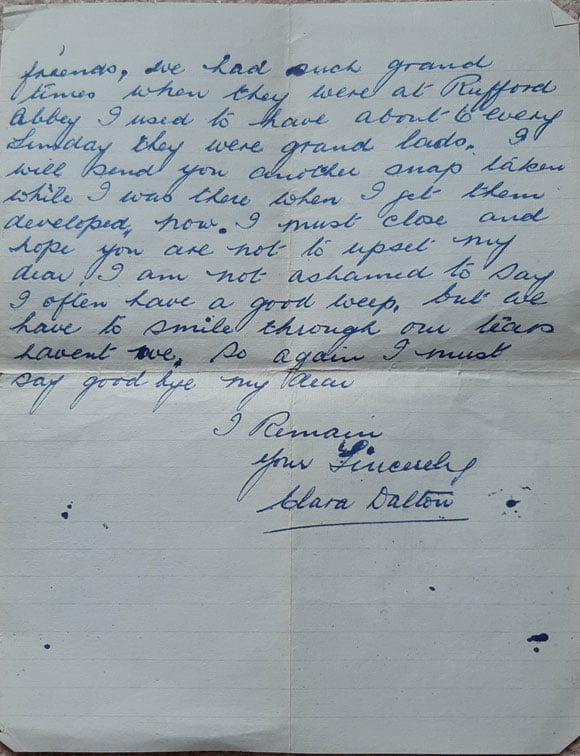
Clara Dalton, the mother of John Wilkinson Dalton who is buried alongside Alfred wrote to Mary in 1949 to commiserate with her about the loss of her husband. Alfred’s daughter, Maureen, has kept the letter. Mary was also in regular touch with Toots Debats who had adopted Alfred’s grave. They exchanged several letters. Maureen and her husband met Toots when they visited Alfred’s grave. Here is Mrs Dalton’s letter:
“Dear Mrs Churchlow,
You will wonder who I am, and I have so often wanted to write to you. My dear son lies next to your dear one in Overloon. Since my friends went to Holland last year and took snaps of their graves I have wanted to send you one and didn’t know how to get your address, but having been to Holland myself, I contacted Miss Debats. She is a lovely girl and keeps your husband’s grave well cared for, and took beautiful blooms on along with me and the girl who has adopted my son’s grave. I stayed with the people who have been so kind as to adopt my dear one’s grave and she and Miss Debats are friends and are coming to England next year. Now if ever you feel you want to go to Holland, please go as you will be made very happy indeed, they are really lovely folk. I expect I am much older than you and I felt I must see where my all is laid. You see, dear, he was my all as I have been a widow 23 years, and he was my only child. We wonder why these things happen to us, but two graves away from yours are three English brothers, so I thought my load was not as heavy as that mothers. I also went to the woods where they were killed. My friends advised me not to go, but I think if my son could give his young life, his mother was not afraid to travel the same ground. I could tell you such a lot if I could talk to you, perhaps someday we may meet, ‘who knows’. I cycled to the cemetery, which is 5 miles from Vierlingsbeck after not being on a bike for 27 years. Now my dear I shall be pleased to hear from you. Please tell me about yourself and your children. I still hear from my son’s Guardsmans friends. We had such grand times when they were at Rufford Abbey. I used to have about 6 every Sunday. They were grand lads. I will send you another snap taken while I was there when I get them developed. Now, I must close and hope you are not too upset. My dear, I am not ashamed to say I often have a good weep. But we have to smile through our tears, haven’t we? So again, I must say goodbye my dear
I remain yours sincerely,
Clara Dalton.”