
Douglas | George Edward


Biography
George Edward Douglas was born on 31 July 1917 in Brentford, London and is the son of Edward Douglas and Sarah Anne (Jennie) Lambourne. He had 3 brothers: Ronald (1920-2002), Eric (1922-1993) and Raymond (1924-1922).
In July 1939, he married Daphne Elizabeth Kate Mulligan in Holderness, Yorkshire East Riding. By 1941, he was living in Middlesex.
It is not known exactly when George joined the Middlesex Regiment 2nd Bn.
MILITARY CAREER
The Middlesex Regiment 2nd Battalion was a support unit during World War II, supplying medium machine guns (Vickers) and 3-inch mortars to other infantry battalions. They were deployed as needed to boost the combat strength of these units and operated under the 3rd Infantry Division.
On 6 June D-Day, they landed on the Normandy beaches at Sword Beach at 07.25 hrs. Here mainly British troops of the 3rd Infantry Division, supported by commando units, landed with the aim of capturing the city of Caen and making contact with Canadian troops on Juno Beach. During June and July, they were involved in the fighting of the Normandy landings, the Battle of Caen and Bourguébus Ridge.
The Battle of Caen was one of the most important battles during the Battle of Normandy. Caen was an important city and a primary objective for the Allies on D-Day, but remained in German hands for over a month due to fierce resistance. The battle consisted of several Allied operations to capture the city and surrounding areas.
The Battle of Bourguébus Ridge was a crucial part of Operation Goodwood, which took place from 18 to 20 July 1944. The British 2nd Army led by General Miles Dempsey tried to force a breakthrough east of Caen and put pressure on the German defences in Normandy. Although the British did not achieve their breakthrough, they forced the Germans to deploy their reserves, which contributed to later Allied successes.
In August, they moved further north and the battalion was involved in the Battle of Mont Pinçon. It is the highest hill in Normandy (365 metres) and a strategically important target. The hill was an important defensive position for the Germans and had to be captured to facilitate the Allied advance to the north. After heavy fighting, the Germans retreated with which the Allies gained control of Mont Pinçon which was a crucial step in the Allied liberation of France.
September was mainly a month of rest and training and they spent it in Belgium and the Netherlands. Their Commanding Officer G.P.L. Weston describes in detail in his War Diaries how his march with the battalion progressed.
In the War Diary on 15 and 17 September, Commanding Officer Weston mentions the fine stay in Le-Thil-En-Vexin: “There is no doubt that our stay in Le-Thil-en-Vexin was a very happy one and the inhabitants were very sorry to see us leave. Throughout the journey the Belgians were most hospitable – troops being cheered throughout the journey and being presented with fruit, eggs etc. “
Around 22 September, the battalion was in the Netherlands in the area of Deurne and Someren, Asten and Helmond. Alternately, they were involved in patrols of the battalions of the 8th and 9th infantry brigades, such as the 1st K.O.S.B (King’s Own Scottish Borderers) and the 2nd Bn Royal Ulster Rifles. From day to day there was shelling. There were few if any losses. The battalion was supplemented by soldiers returning after being wounded, or making their entry from England.
On 28 September, a fatal accident occurred. One of the platoons was based in a monastery near Helmond. Private Gordon Anderson was asked by one of the nuns to remove the red cross from the roof of the convent. As he climbed to the roof, the ladder broke and he fell on his head from a great height. Later that day, he died in hospital.
He was temporarily buried in Geldrop and later reburied in Mierlo War Cemetery on 24 July 1945.
The 29th September is described as complete military chaos. The night before, the 3rd Division was ordered to leave the Gemert, Deurne, Asten area immediately the next morning to make way for the Americans, the 7th US Army Division. There was to be no physical contact between the two divisions, leaving the roads free to move across. However, the Americans had not got this location right and continued their route towards Overloon. Fortunately, the Germans did not take advantage of the resulting weak defence of this area. However, the local population did notice this and felt quite deserted and fearful of a new occupation by the Germans. This feeling was especially fuelled when at the time of the British withdrawal, a stray mortar, killed 2 children and severely wounded 1.
On 30 September, the division was ordered to move north towards the Maas near Grave and Beers to help defend the area because of the construction of a bridge across the Maas at Mook. The first days of October were relatively quiet although they did conduct shelling across the Maas. Patrols were carried out in the Maas area, especially as the Glider Brigade of the 82 Airborne Division was due to land across the Maas at Middelaar, just below Nijmegen. All help was welcome to make this a success.
Again, Commanding Officer Weston wrote in his War Diary on 30 September that the reception in Belgium and Holland was magnificent and that they received the utmost hospitality and generosity wherever they were.
On 8 October, they left for the village of Mill ahead of the attack on Overloon and Venray. On 11 October, the 8th Brigade attacked Overloon, supported by the battalion, which fired 400,000 rounds and 3,500 mortar shells. However, heavy rain delayed the attack.
A fierce battle followed in which many losses were suffered by the regiments operating in the area. Middlesex Regiment losses remained fairly limited compared to the other battalions.
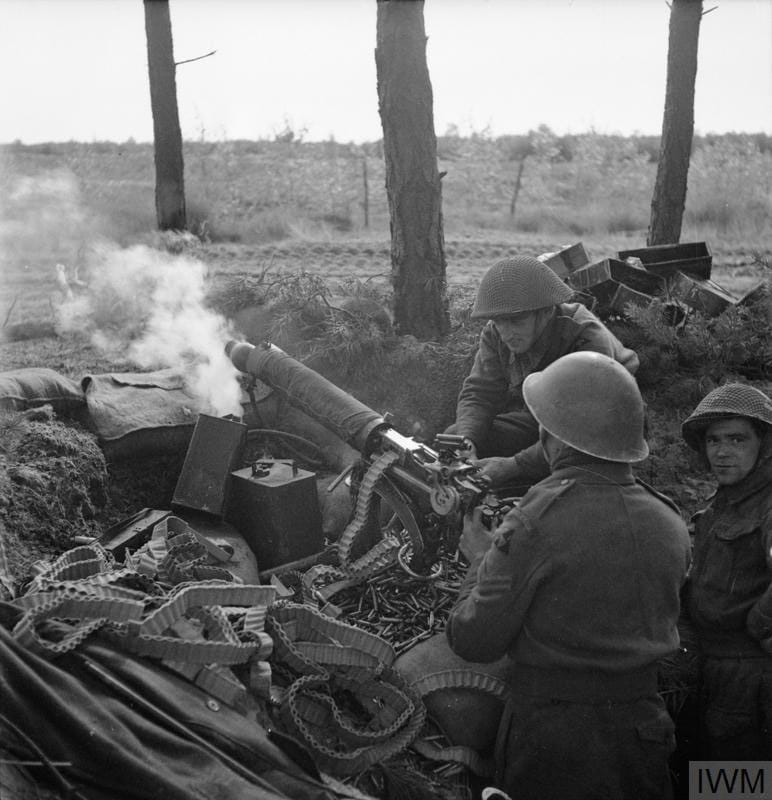
On 12 October, the attack restarted, with the division progressing with difficulty through the mud. Overloon was taken and machine-gun and mortar platoons supported the continued advance towards Venray. Resistance was fierce, and the Allies made only slow progress. A full-scale attack on Venray was planned on 16 October, but heavy rain hampered the advance.
Despite the difficult conditions, the 185th Brigade managed to establish a bridgehead at Brabander. The attack resumed on 17 October, with mortar platoons taking enemy positions under fire. The 11th Armoured Division surrounded Venray from the south-east side, allowing the town to be taken on 18 October.
During the Battle of Overloon and Venray (12-19 October), the battalion fired 8070 mortar bombs and 638,000 rounds of Mk VIIIz.
After the Battle of Overloon in October 1944, the battalion continued its supporting role in the Allied advance through the Netherlands and Germany. As a unit specialising in medium machine guns and mortars, they continued to support other infantry units in various operations.
26 November, a day of relative peace and quiet at the front near the banks of the River Maas, ended with a tragic, fatal accident, in which Corporal George Edward Douglas was killed. In the War Diary, Commanding Officer Weston wrote the following: “There was an unfortunate accident in “A” Coy. during the late evening, when Cpl Douglas, the M.T. Cpl., accidentally shot himself through the heart with his Sten gun, while standing guard outside Coy. H.Q.”
George Edward Douglas was temporarily buried at the Maria Regina Monastery in Stevensbeek and reburied at Overloon War Cemetery on 22 May 1947 in grave III.D.12.
His headstone reads ‘He giveth His beloved sleep’.

