
Football at the front

Royal Ulster Rifles against VIOS I in Beers
The following is a report of a football match of the 2nd Battalion Royal Ulster Rifles against the local team of a small Dutch village during the campaign in the south-eastern Netherlands in October 1944.
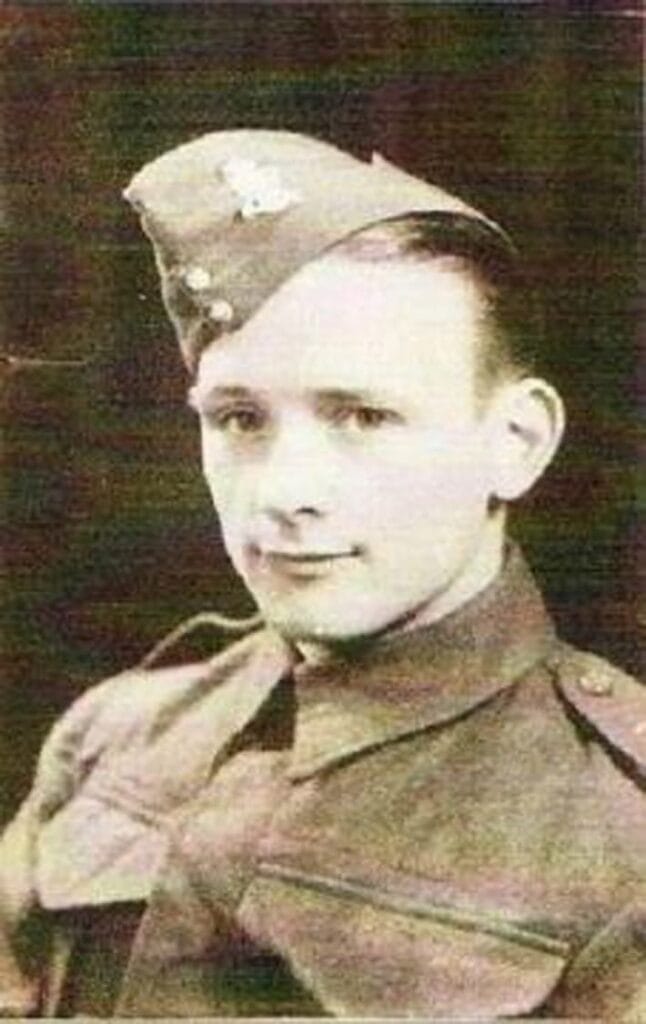
The report comes from the son of Sergeant Alfred Reginald Hammersley, who was team captain on that day.
Dean Hammersley tells a story in 2002 to the then chairman of the Beers football club about his father, a sergeant, in the 2nd World War, which centres on a football match. This match was played in Beers, just before the regiment left to take part in the Battle of Overloon. Although the chronological order in the story is incorrect – the story says that they were in Beers only after Overloon – this does not detract from the essence of the story. It reflects how memories are sometimes unintentionally altered over time.
AN OASIS OF CALM IN BEERS
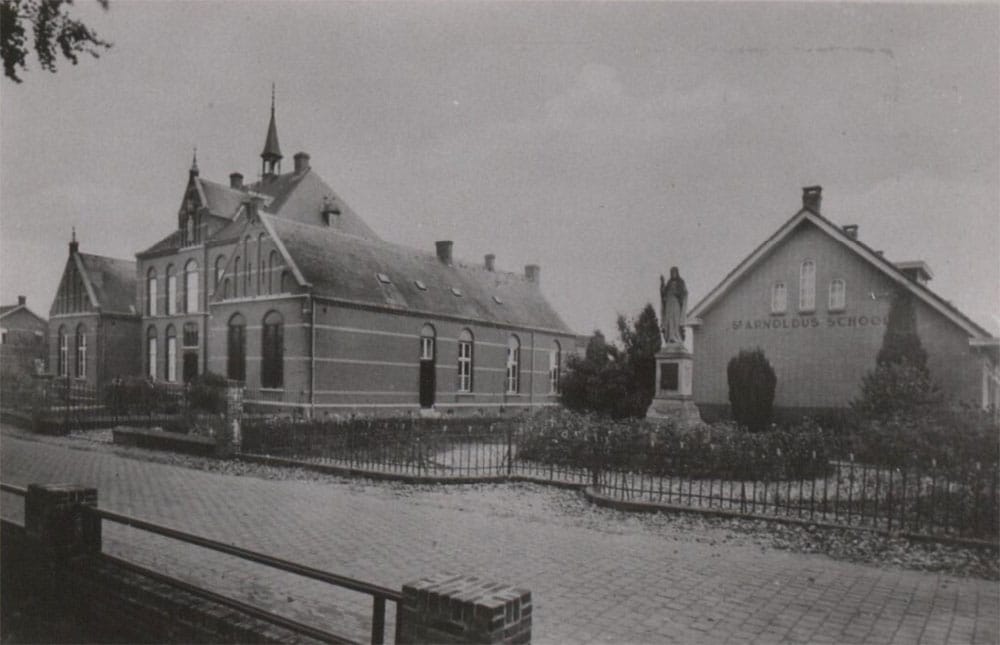
He had expected something very different when he walked down Grotestraat in convoy on 5 October 1944. But for the last twenty kilometres, nothing had really been going on. It was as if the Germans had never been here.
Only a week earlier, the 3rd British Infantry Division had fought a bitter battle for Overloon. That one had indeed been won, but could one speak of victory at this point, his thoughts wandered to the terrible battles on the muddy Peel in which he had seen his life flash by several times.
Beers was a haven of peace and then there was a lovely autumn sun shining. The people here were warm and healthy and in no way resembled the war-traumatised inhabitants of Overloon. There, at the later ‘Blood Brook’, he had looked fear straight in the eye. It had made a huge impression on him.
But he was now in Beers and it had been quiet there for some time. He could see the slender church tower rising far above the peaceful village and resolved to light a candle for his newborn son tomorrow, after the installation of his platoon at the local monastery.
Little Dean, meanwhile, was two months old and growing up in Coventry, in the English Midlands. Sergeant Alfred Reginald Hammersley had been away from home for almost 20 weeks. He had never seen his own son alive.
It all started more than four months ago in Normandy where Alfred Reginald, also known as Reg, and his mates had served as live targets in the Allied invasion on D-day, 6 June 1944. In England, they were waved off as heroes. After the British Air Force’s glorious victory in British airspace, they had to wipe those Germans off the map on land.
The heroic farewell had given the British a sense of invincibility. They were the pride of Britain and the hope of Europe, Winston Churchill had still addressed them over the radio. Queen Elizabeth had added in her closing line. ‘Our brave boys will reunite the free world’. He would not forget the day of the farewell for the rest of his life.
The heavily pregnant Jessica begged him to come back alive. Reg had smiled scornfully and shouted that he would get this job done, to return to Coventry as a war hero and marry Jessica.
Then he and 150 others boarded an open boat, a kind of sloop that could also carry a tank over water. He had only his rifle with him, the rest of his luggage would be dropped on the French coast by large cargo planes already flying eastwards with deafening engine roar. Over The Channel, towards France. About two kilometres before arriving at the Normandy town of Caen, however, the heroic mood turned. The military sloop they had used to cross the Channel had washed up on the northern French beach in a rain of bullets and a storm of shrapnel.
More than half of his mates had not survived D-day. Nineteen-year-old George Eaton, for example, died right before his eyes when a German sniper riddled his chest with heavy bullets from an MG34 machine gun.
Reg Hammersley visibly enjoys the joyous scene unfolding on the football pitch of that small village of Beers in the south-east of the Netherlands where his battalion is currently stationed. It is Sunday, 8 October 1944. And now, for the first time in those more than four months on the European mainland, there is time for relaxation.
A football match. His favourite pastime. The beautiful game. At home, in Coventry, before that miserable war started, he played a game every Saturday with his friends on the field behind the colliery. The seven of them usually played and there were 14 or 15 of them. About a year before he and most of his friends were called up to fight for British royalty, they had put real goals there. Round poles, picked up for next to nothing from the lumberyard across town. A metre into the ground and then carefully painted white. They had no lath. This often led to discussions about whether the ball was in or out. These matches were a matter of life and death. Figuratively speaking, because it was during the Allied liberation march from the northern French coast via the Ardennes to the Netherlands that he had really experienced what fighting on life and death meant.
Here in Beers on Sunday 8 October 1944, the sun was shining. It was a beautiful autumn day. One of those where you hesitate whether to put on a coat or not. The field looked beautiful. Much better than that field in his hometown where he played football with his friends every Saturday back in peacetime. Today, the second battalion of the Royal Ulster Rifles played a proper football match against VIOS. Beers’ football club was at rest. For days, everyone in Beers, but certainly the whole battalion, had been looking forward to this match. It was a wonderful way to forget that nasty war for a day. Sport connects and football certainly does. A universal language spoken all over the world.
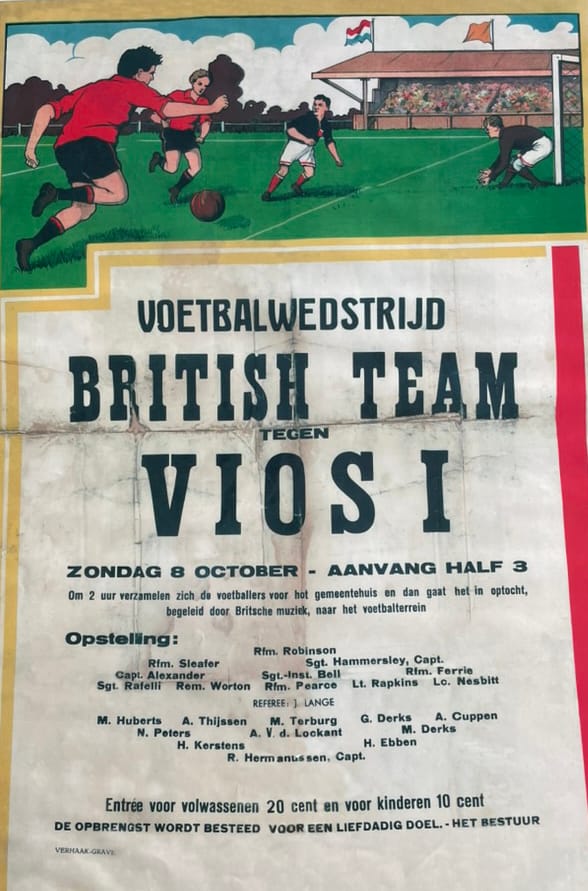
A beautiful poster had been made. It stated that the footballers would gather in front of the town hall at two o’clock, after which the whole procession, accompanied by British music, would make its way to the football pitch at the Gildeweg.
Admission to the match was twenty cents for adults and an old-fashioned dime for children. The VIOS board would donate the profits to charity. The line-up was also on the poster.
The British played with Robinson in goal. Sleafer and himself, Reg Hammersley, also the captain, formed the rearguard. In midfield, Alexander, Bell and Ferrie played. The five-man forward consisted of Rafelli, Werton, Pearce, Rapkins and Nesbitt. This old-fashioned formation with a classic right and left-back no longer exists in contemporary football, but was a common system at the time. Local pride VIOS also played in this 2-3-5 formation.
Rein Hermanussen, the captain, was in goal. Other members of the team included Sjang Siebers, Harry Ebben, Tien Terburg, Albert Thijssen, Martien Huberts, Crist Cornelissen, Tien Derks, Bert van de Lockant, Nico Peters and Hent van de Berg. Illustrious names from a rich Beers football past.
Even though these names did not mean much to Reg Hammersley, there was a clear respect from the Royal Ulster Rifles for Beers players. These boys had lived through years of war. And while here, compared to other places in Holland and the rest of Europe, the deportations, bombings and fighting may not have been so bad, being deprived of freedom is the worst thing that can happen to anyone.
And this is exactly why Reg was so proud of his men. On their long liberation journey, this was what they did it for. Putting happiness back in people’s eyes. Hope was shining, the future was bright again. People laughed, children played, the British pipe band provided a happy note. Reg Hammersley wanted nothing more than to remove all the wartime sadness from the hearts of all those warm-hearted people.
The match attracted many spectators. It was said to be a record number of spectators in the still young history of the Beerse football club. Reg watched the crowd streaming along the line and the proud 21 men lined up next to him. In a veritable flag parade, the British Union Jack was carried to the centre spot along with the Dutch tricolour.
There, the then mayor Antoon van Raay and pastor Van der Heijden waited for them fraternally. The mayor shook Reg’s hand and thanked the British extensively for the liberation and spoke of a special friendship between two allied nations, united on a football pitch. He wished both teams good luck. The priest struck a cross and blessed both teams.
Captain Hermanussen handed captain Hammersley a bouquet, which he immediately presented to the daughter of the president of the Beerse football club as a sign of reconciliation. He was embarrassed that he had not brought a gift for the Beerse captain, but given the applause that rose along the line because of his gesture to the little girl, he suspected he was forgiven.
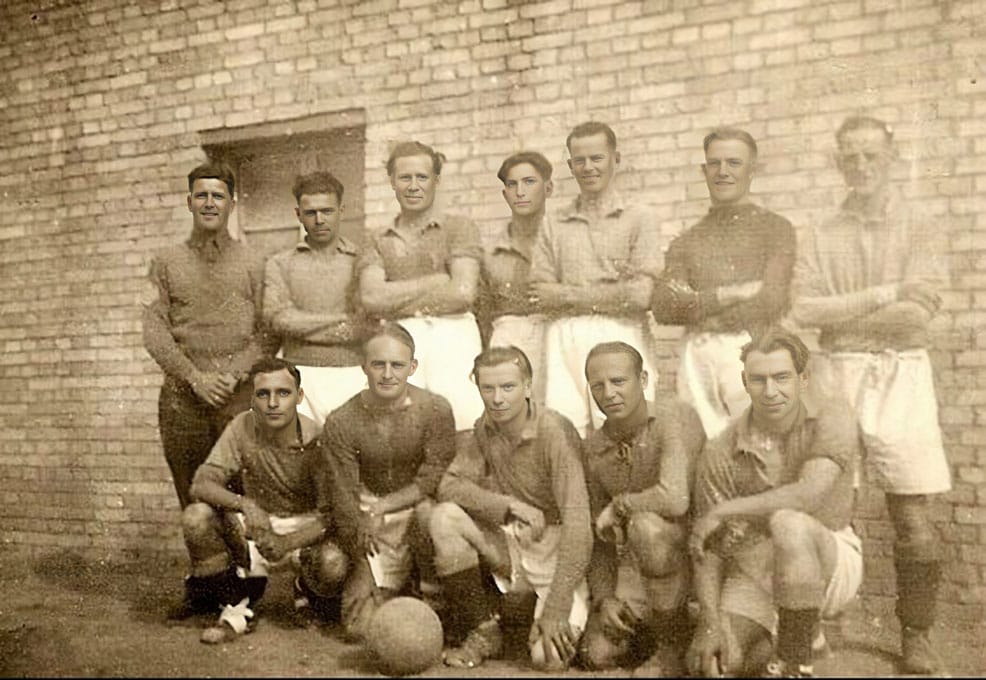
The British played with Robinson in goal. Sleafer and himself, Reg Hammersley, also the captain, formed the rearguard. In midfield, Alexander, Bell and Ferrie played. The five-man forward consisted of Rafelli, Werton, Pearce, Rapkins and Nesbitt. This old-fashioned formation with a classic right and left-back no longer exists in contemporary football, but was a common system at the time. Local pride VIOS also played in this 2-3-5 formation.

It was time for the battle to begin. The sporting battle, that is. Between two allied teams. British soldiers against VIOS from Beers. Immediately after kick-off, the game was up and down. It was almost inevitable that the match was extremely sporting, but still the two teams gave each other nothing as a gift. Both the British and the Beers did not know what to expect from this unknown opponent. And as so often, it turned out to be a true clash of cultures between two completely different styles of football. The British Kick and Rush against the Dutch School. Long balls versus triangles. Physically, the British were stronger and VIOS’ combination football was therefore slowly but surely nipped in the bud. The British rolled up their sleeves even more, took over the initiative from the playful Beersen players and eventually won 5-1.
For the statisticians : Pearce and Bell both scored twice and Rafelli took the fifth English goal. Unfortunately, the annals of the Brits do not mention who scored the Beers’ goal. After the match, the British kept neatly to one of their many traditions: They sat down to a very nice tea in the local pub. Reg sat contentedly at his cup of tea at Café De Tolpost from manager Koos Nabuurs.
During the post-match festivities, the Brits received another open invitation from the mayor on behalf of all the people of Beers. One was always welcome to return to Beers. About sixty years later, Reg Hammersley’s son gratefully took advantage of this invitation. Dean Hammersley followed the route his father took during the liberation of Europe. He ended up in Beers and visited then chairman of the Beers football club Jacques Derks at home. And so this memorable match came back to life.
God save Holland, God save the Queen.
This story is a reality-based retelling of the legendary match between the British military team and the Beers pride VIOS on 8 October 1944. After this match, a hard time started for the 2nd Battalion of the Royal Ulster Rifles. A few days after the match, they headed back to Overloon to fight the climax of the ‘Battle of Overloon’ on 16 October. The Allies suffered heavy losses here, but were eventually victorious and moved on towards Venlo via Venray. Sergeant Hammersley did not come out of the battle unscathed either and was wounded near Wanssum during the march from Overloon to Venlo. He recovered and remained part of the Battalion. In 1945, after liberation, he was promoted to sergeant major. After returning to his homeland, he married his wife and together they started a barber shop in Coventry, England. In 1983, Reg Hammersley died in his hometown of Coventry at the age of 66.
Lieutenant Edgar Charles Rapkins
Just a few days after they left Beers and battle erupted around Overloon, Lieutenant Eddy Rapkins was seriously wounded and died of this on 14 October 1944. He is buried in Mierlo War Cemetery.
It seems very likely that this was Lieutenant Rapkins who was lined up in the football team. This is currently under further investigation.
Sources and credits
Dean Hammersley
Jacques Derks family from Beers
Football club HBV Beers for the football poster
Football club HBV for the Jubilee book celebrating the club’s 100th anniversary.
The book was published in 2013 and the story of the match with the Royal Ulster Rifles was chronicled in it by Thijs Derks and Guus Kennis.
Book title: White trousers and yellow jersey
Beers football immortalised
HBV Beers 1913-2013
Authors Thijs Derks (son of Jacques Derks) and Guus Kennis
Persoonlijke verhalen van Royal Ulster Rifles door Paul Scanlon’s blog
Research Anny Huberts

