Shipp | John Richard

Biography
John Richard Shipp (service number 14660353) was killed in action on 14 October 1944 at the age of 19. He was a private in the 2nd Battalion of the Lincolnshire Regiment.
He was initially buried at De Kleffen Cemetery in Overloon and reburied on 15 July 1946 at Overloon War Cemetery in grave I.B.11.
No photo of John Richard Shipp has yet been found. Should anyone reading this have a photo of him or further information regarding him – or if they are aware of any errors in his biography below can they please contact the Foundation?
Family background
John was the only son born to Richard Shipp (1868–1968) and Mathilda (Tilly) Prior. His parents had been married before and had children from previous marriages. John had eight half-brothers and sisters.
His father Richard had previously been married to Sarah Jane Marshall (1873-1924) and had the following children with her: Albert Shipp (1899-1962), Elsie Mary Shipp (1900-1970), Florence Charlotte Shipp (1901-1980), Bertha Shipp (1903-1985), Ruth Shipp (1906-1985) and Kitty Marion Shipp (1908-1996).
His mother Mathilda was previously married to William Ernest Barker (1884-1916) and had two children with him: Charles William Barker (1908-1914) and Ethyl May Barker (1911-1984).
In April 1917, after the death of her husband William, she married Ernest Thornhill (1882-1923). After Ernest’s death, she married Richard Shipp in October 1924 and they had a son, John Richard Shipp, in April 1925. He was born in Glanford Brigg in Lincolnshire.
Later, John and Mathilda moved to 46 John Street in Scunthorpe, also in Lincolnshire.
Military career
John subscribed to the Territorial Army and was posted to the General Services Corps. On 15th July 1943 he was posted to the 57 Primary Training Wing.
On 26 of August 1943 he was transferred to the Lincolnshire Regiment. From 18th November 1943 he was posted to the 2nd Bn of the Lincolnshire Regiment and according to his Service Record active for the NW Europe theatre from 5th of June 1944. He landed in France in June 1944 at the Normandy beaches.
The 2nd Bn Lincolnshires took part in the D-Day landings in June 1944 and was then engaged throughout the Normandy Campaign, taking part in Operation Charnwood and Operation Goodwood.
They remained in Normandy until 15 September. They then took part in the push up through Belgium and the Netherlands with the aim of supporting the airborne troops engaged in Operation Market Garden which ultimately did not fully succeed following the failure to take the bridge at Arnhem in late September.
Following the failure to take the bridge at Arnhem in Operation Market Garden in late September 1944, the Allied Forces were left in a very precarious narrow salient through the Netherlands. It was the aim of Operation Aintree to widen this salient by heading south from Nijmegen to take Overloon and then Venray before finally eliminating a German bridgehead on the River Maas near Venlo.
On 16 and 17 September the Battalion moved into Belgium near Mons. They found that the civil population were very enthusiastic, particularly in the area of the Belgian frontier. They then joined in the effort to cross the Escaut Canal where all the bridges had been blown by the enemy. They succeeded with other regiments in this difficult task in the face of opposition and a bridge was complete by 19 September. The Battalion moved on to Achel on 20 September where all ranks were able to get a night’s sleep under cover and then Hamont the following day where they remained until 25 September while the 11 Armoured Division took Deurne in the Netherlands. The Battalion moved to Deurne that day and took over from the 11 Armoured Division with the 2nd Battalion Royal Ulster Rifles. They remained in this area, sometimes engaging with the enemy who were on the east side of a canal. On 29 September they moved north to Milheeze and then Haps on 1 October.
The base of the 2nd Lincolnshire Regiment stayed in Haps from the 1st till the 12th of October. From there, attempts were made to clear the west side of the Meuse between Cuijk and Oeffelt. This was done together with 2nd Bn Royal Ulster Rifles, the 1st Bn King’s Own Scottish Borderers and 3rd Reconnaisance Regiment (9th Brigade 3rd Infantry Division).
On the east side of the Meuse, resistance remained strong, particularly in Middelaar, Milsbeek, and Gennep. The stone factory in Milsbeek served as the main center of opposition, as its tall chimney functioned as an observation post from which German artillery coordinated the defense. On the east side of the river, the enemy was also attacked from Plasmolen.
Between 1 and 7 October, the Ferry House in Oeffelt — Het Veerhuis — was repeatedly occupied by the enemy and then retaken by British forces. Patrols of the 2nd Lincolnshire Regiment discovered that the Ferry House had once again fallen into German hands. Despite heavy British artillery bombardments, German troops continued to appear around the stone factory in Milsbeek.
On 4 and 5 October, the chimney of the Milsbeek factory was finally brought down, and the church in Middelaar was reduced to rubble. On 6 October, the 2nd Lincolnshire Regiment launched another attack on the Ferry House — this time successfully. This first week of October the Batallion lost three comrades, who were temporarily buried at the village square in Haps and later in 1946 reburied at Overloon War Cemetery.
On 9 October 1944 the Battalion were ordered to move south to St Anthonis on 11 October, but this was postponed to the following day due to bad weather. The move was completed on 12 October.
They were kept in reserve for the battle that was being fought around Overloon. The 8th Infantry Brigade was tasked with capturing Overloon and advancing to Venray. Shortly before nightfall, they heard that Overloon had fallen and that the battalions of the 8th Division were struggling to hold their ground.
On Friday, 13 October the aim was for the Royal Ulster Rifles, followed by the King’s Own Scottish Borderers and then the Lincolnshires to clear wooded areas just west and south of Overloon in which the Germans had entrenched themselves, then cross a stream called the Molenbeek between Overloon and Venray. They would be supported by Churchill Tanks of the 4th Tank Grenadier Guards. The Lincolnshires therefore moved down to a position just north west of Overloon that day.
In addition to the difficult terrain, two other factors played a crucial role – the Germans had dotted the entire area with their dreaded “Shuhminen.” These wooden mines were difficult to detect. They didn’t tend to kill but inflicted severe injury to the victim’s legs. In addition, the German troops had a strategic observation point from Venray’s church tower. Any Allied troop movement would be watched and relayed to their artillery which would result in a barrage of shells.
The Royal Ulster Rifles and the King’s Own Scottish Borderers began the attack on the forests. However, it soon became apparent that they were barely making any progress, leaving the Lincolnshires out of the battle all day. Nevertheless, the Lincolnshires suffered one man killed and 3 wounded.
On the 14 October, the plan was for B Company to be guided through a wood held by the Royal Ulster Rifles to its front edge from where they would carry out a recce (reconnaissance) to check if a stream was passable and if the north eastern corner of a wood to the south was held by the enemy. However, the guides were late and the move through the wood was slower than expected, so the recce did not take place. At 7.30 am the Company began to advance south out of the wood. Before the Company had advanced 100 yds the enemy opened fire from a track about another 100 yds ahead. The advance continued but came under such heavy fire with so many casualties that the Company Commander, Anthony Frith Smith, issued an order to retreat back to the Royal Ulster Rifles’ position. By this point one Lieutenant and 34 other ranks had been killed or wounded.
Following a reconnaisance by the Company Commanders, it was decided to launch a full battalion attack at 15.30 hours with the support of the whole of the Divisional Artillery and an additional tank division on the right flank. The enemy had been seen moving in the area of the stream in front of the wood. It was thought that the enemy holding the Battalion objective were probably a Company strong. Immediately the attacking force came into the open they were subjected to intense artillery and mortar fire which was just as bad as in the early morning but this time they pressed steadily on to reach their objective. During this action the Battalion suffered very heavy casualties including four officers killed and another four wounded.
It was on this day that sadly, John Richard Shipp was killed in action.
The fallen soldiers were buried the following day at noon on the Vogelsangs family farm on Helderseweg in Overloon. They were later reburied at the British cemetery “De Kleffen”, on the site where the War Museum is now located.
On 15 July 1946, a total of 27 men from the 2nd Battalion of the Lincolnshire Regiment who had died on 14 October 1944 were reburied side by side at the Overloon war cemetery. John is buried in grave I. B.11
John’s medals
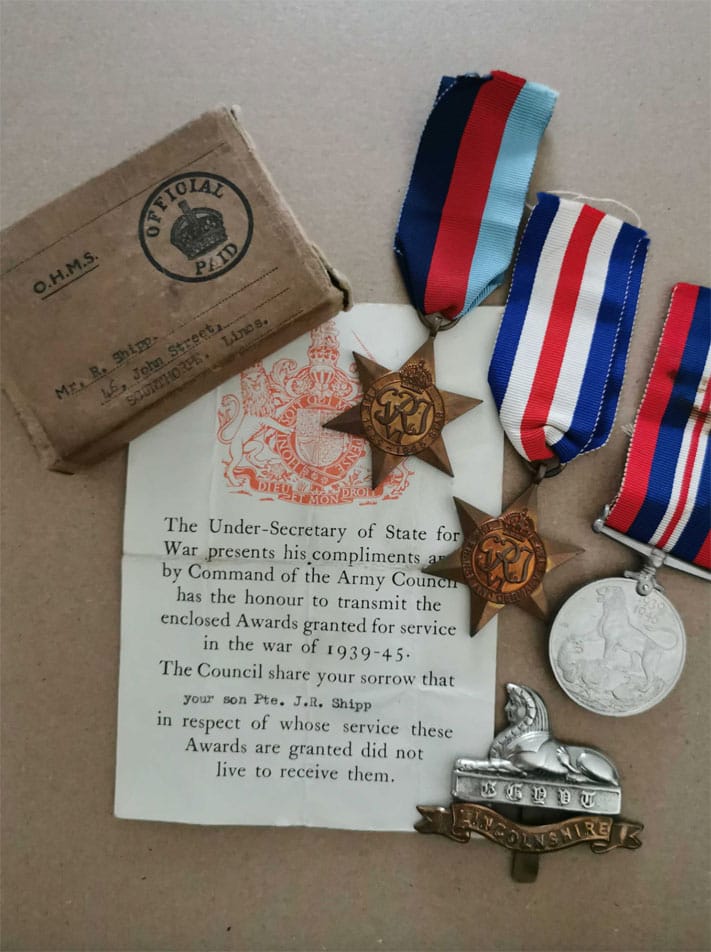
John was awarded several medals. A condolence medal slip, the original box addressed to his father and a Lincolnshire regiment cap badge from his effects.
Medals are:
The 1939-45 Star
The France and Germany Star
The 1939-45 War Medal
These 3 medals are standard for a soldier who landed in France after D-Day and had served less than 3 years. Johns parents received a certificate but there are no extra medals for casualties

