Moore | George


Biography
George Moore (Service Number 3769934) died of his wounds on October 18, 1944. He served with the 1st Battalion, South Lancashire Regiment. He was initially buried at Deurneseweg in Oploo and was reinterred on January 28, 1946, in grave II.A.8 at the Overloon War Cemetery.
FAMILY BACKGROUND
George Moore was born on May 9, 1915, in West Derby, Lancashire, England. His parents were George Moore (1890–1953) and Sarah Alice Moore (née Bateman) (1894–1979). His father was a baker, and his mother was a homemaker. In 1918, during the First World War, his father served with the Royal Army Medical Corps.
George had the following siblings: Alice (1913), Albert Leonard (1918), Esther (1921), Lilian (1924), William Harold (1927), Jennie (1931), and half sister, Jean (1936).
The family lived at 56 Uxbridge Street, Edge Hill, Liverpool, and later moved to 19 Marmaduke Street in Liverpool.
MILITARY CAREER OF GEORGE MOORE
Early Years and the Territorial Army (1934–1937)
On April 17, 1934, the 18-year-old George Moore enlisted in the Territorial Army. He was posted to the 5th Battalion of the King’s Regiment (Liverpool). In 1934, 1935, and 1936, he faithfully attended the mandatory 15-day annual training camps. At the time, he lived at 19 Marmaduke Street and worked as a railway porter.
On October 20, 1936, he was honorably discharged from this battalion, only to be declared officially fit for active service with The King’s Regiment the following day in Seaforth. He listed his father, George Moore of 22 Mozart Street, Lodge Lane, Liverpool, as his next of kin. During his training, George proved to be a dedicated student, obtaining his 3rd Class Education Certificate in 1936 and his 2nd Class Certificate in 1939 while stationed in Peshawar, British India.
A Global Stage of War
During the Second World War, the King’s Regiment was spread across various fronts:
- British India (now Pakistan/India): The 1st and 13th Battalions guarded the borders. They later formed the core of the famous “Chindits”, fighting the Japanese deep in the Burmese jungle.
- England and Europe: The 5th and 8th Battalions defended the home front until participating in the Normandy landings in 1944.
- Mediterranean: The 2nd Battalion fought in North Africa and took part in the invasions of Italy and Greece.
Although the regiment was ceremonially based in Liverpool, its men fought all over the world: from the beaches of France to the mountains of Pakistan and the jungles of Burma.
Service in British India: The Transport Section
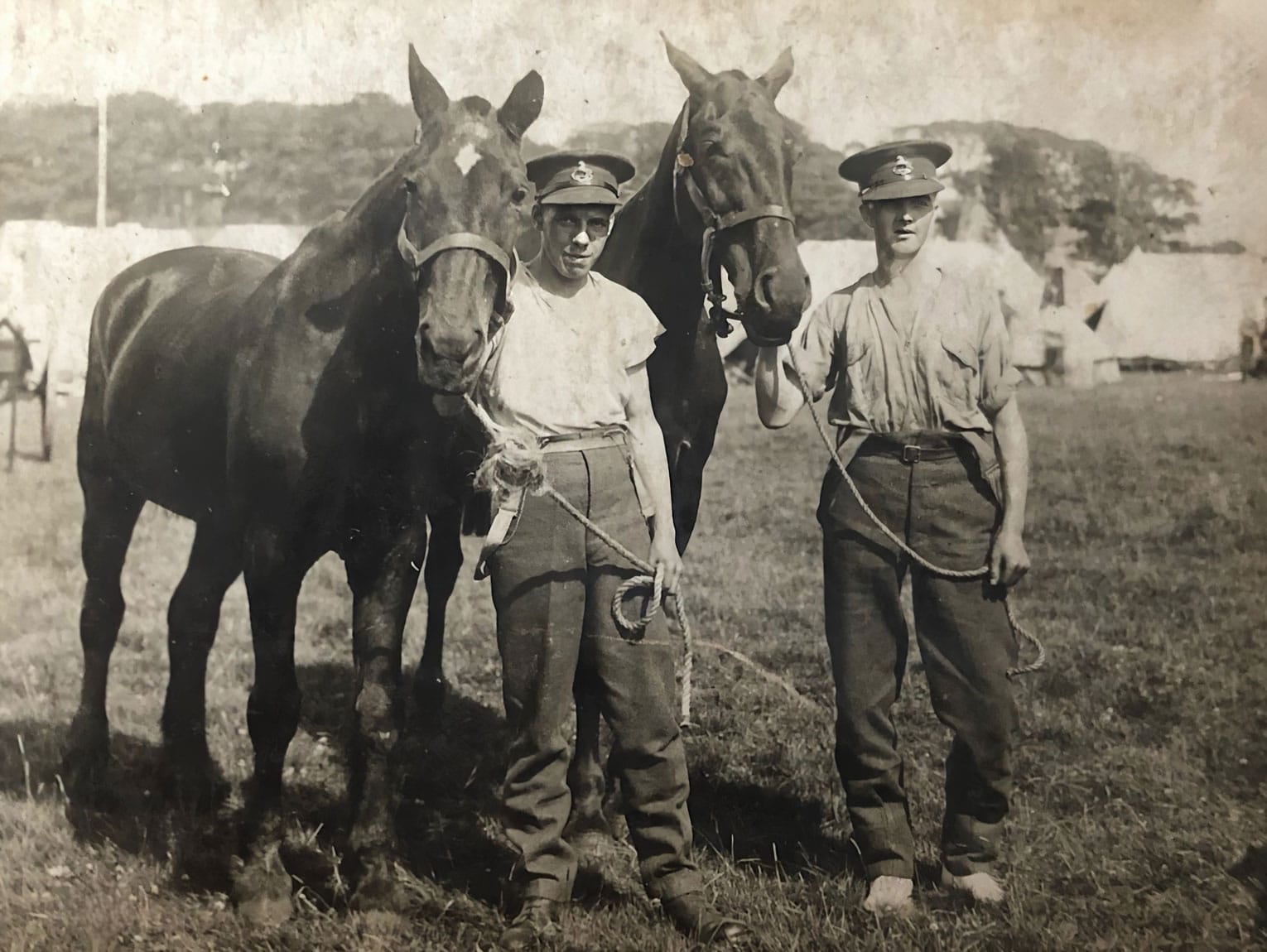
On November 10, 1937, George was assigned as a Private to the 1st Battalion and sent to Peshawar, near the Afghan border. He was placed in the transport section. Because of the rugged, mountainous terrain of the Khyber Pass, trucks were unusable; the unit relied entirely on mules for transporting ammunition and supplies.
Caring for these animals was a demanding daily task. George was described by his superiors as a quiet, respectful, and cheerful worker with excellent prospects. In September 1938, he was officially rated as a skilled rider with “good knowledge of animal management.”
Incidents with Mules
Despite his skill, George seemed to be a magnet for accidents involving these headstrong pack animals:
February 1939: During an exercise, another soldier’s mule bolted, causing a panic. George was thrown from his mule and kicked while on the ground.
July 1939: While riding to the “Grass Farm,” a passing mule reared and kicked George’s right ankle. He had to return to the barracks on his own despite great pain.
August 1941: While walking behind his animal to put away a currycomb, the mule kicked out unexpectedly, striking his right knee and resulting in two days of hospitalization.
Discipline and Promotion
His Service Record also showed the human side of the young soldier. During his early service in Devonport, he once stayed away for four days without leave, which earned him a reprimand. In India, discipline became stricter; minor offences, such as an incomplete uniform or briefly leaving his post, were punished with ‘C.B.’ (Confined to Barracks). Nevertheless, he remained ambitious. His educational certificates led to his promotion to Lance Corporal on 11 March 1943.
From 2 August 1943 to 28 January 1944, he served in India with the 13th Battalion of the King’s Regiment. The 13th King’s provided the bulk of the British contingent for the “Chindits” (Burmese word for Lion). The Chindits, officially known as Long Range Penetration Groups, were special operations units of the British and Indian armies that saw action in 1943-1944 during the Burma campaign of the Second World War. Their operations consisted of long marches through extremely difficult terrain, carried out by malnourished troops who were often weakened by diseases such as malaria and dysentery. Controversy remains about the extremely high number of casualties and the questionable military value of the Chindits’ achievements. George may have been involved in these operations.
THE ROAD TO THE EUROPEAN FRONT
On 28 January 1944, George left the port of Bombay and returned to England. After passing through various training centres, he underwent a medical examination in June 1944 and was found fit for active service in North-West Europe.
In the summer of 1944, administrative changes followed in quick succession:
In July, he was placed on the S.O.S. list (Struck Off Strength) in preparation for a new assignment.
On 11 August, he was added to an S.O.S. Reinforcement Draft group.
On 21 August 1944, he was officially assigned as T.O.S. (Taken On Strength) to the 1st Battalion, South Lancashire Regiment. For this, he gave up his stripes and became a Private again. That same day, he left for France.
Normandy and the Falaise Pocket
George joined a battalion that had already been through heavy fighting. The 1st Battalion had landed on Sword Beach at Colleville-sur-Mer on D-Day. The landing and advance cost the lives of more than 100 Lancashires, including their commander. After fierce fighting at Pegasus Bridge, the bloody battle for Caen and the capture of Chateau de La Londe, the battalion took part in the offensive at the Falaise Pocket.
When George joined his unit on 21 August, the encirclement of German troops had just been completed and the Battle of Normandy was coming to an end. After a short period of rest and training in northern France, the regiment marched through Belgium towards the Dutch border.
Operation Market Garden and the Battle of Overloon
Operation Market Garden commenced on 17 September 1944. The Allies’ plan was to advance rapidly through the Netherlands by dropping airborne troops at the bridges over the Meuse, Waal and Rhine rivers. The aim was to capture and secure these bridges, in combination with a simultaneous armoured attack on a narrow front from Belgium. Both the East Lancashires and the South Lancashires took part in this operation on the flanks of the main axis; the South Lancashires were on the right flank.
To this end, on 18 September, the South Lancashires, together with the Suffolks and Yorkshires, first formed a bridgehead to Sint-Huibrechts-Lille. This was followed by patrols towards Kaulille, where the temporary headquarters were established the following day. In the two days that followed, the Meuse-Scheldt Canal was crossed and on 20 September, the battalion entered Hamont. The plan was to advance to Weert the following day, but that first joint attack failed due to fierce German resistance.
After several days of reconnaissance, George and his battalion arrived in Bakel via Maarheeze, Leende, Heeze, Geldrop and Helmond. This route took them through an area that had already been liberated by the 11th British Armoured Division. They were then deployed on 3 October in Mook, just south of Nijmegen. This was part of the offensive in Operation Market Garden, which ultimately failed because the bridge at Arnhem could not be captured. As a result, the Allies ended up in a narrow corridor through the Netherlands. On 30 September, the American 7th Armoured Division had already attempted to widen this corridor by attacking from their position at Sint Anthonis Overloon, but this attack also failed.
The battalion remained in Mook until 8 October and then moved south towards Wanroij. On 9 October George was promoted again to Lance Corporal. It had been decided that the Americans would withdraw and that the British would take on the task of widening the corridor via Overloon, Venray and Venlo. Initially, the attack on Overloon was to begin on 11 October, but due to the very wet weather and poor soil conditions, it was postponed until 12 October.
On 12 October, the attack began at 12 noon with a very heavy artillery bombardment. The 2 East Yorks led the attack on the area described as “Dog Wood”, west of Overloon, while the 1 Suffolks focused on Overloon itself. Both units reached their objective at 3 p.m., after which mopping-up operations followed. The 1 South Lancs had previously been held in reserve, but at 5 p.m., the A and D companies were ordered to advance to clear a remaining area. Each front company was supported by a troop from the 3 Grenadier Guards. They encountered little resistance and by evening they had taken up their position on the edge of a clearing west of Overloon.
The Attack on Overloon and Venray
The next day, they advanced a little further south. On 14 October, however, they were ordered to go to the road between Rouw and Halfweg (northeast of Overloon) to secure control of a junction leading to Schaartven. Meanwhile, the 1st Suffolks and 2nd East Yorks were struggling to cross the Molenbeek and attack Brabander and Venray. On 17 October, George’s battalion followed the 2nd East Yorks to the north-western edge of Venray, where they were ordered to take the southern part of the town. Although Venray had been almost completely cleared, heavy artillery fire continued and minefields were discovered. On this day, Venray was officially liberated.
However, the planned advance to Venlo had to be abruptly halted a day later, on the orders of Supreme Commander Eisenhower. The liberation of the Scheldt estuary was given priority. The strategy for the advance south was reconsidered and attention shifted to patrols east of Venray. As a result, Venray remained a front-line town for months; despite its liberation, artillery fire continued to be a daily occurrence.
It was on this day, 18 October 1944, that George Moore was wounded and died of his injuries that same day.
He had served for 7 years and 363 days.
He was buried together with a number of comrades on Deurneseweg in Oploo and reburied on 28 January 1946 at Overloon War Cemetery.
George Moore was posthumously awarded the following medals for his service: 1939-43 Star, France & German Star, Defence Medal, and the War Medal.