Culligan | Padraig Joseph


Biography
Padraig is son of Francis Joseph (Frank) Culligan and Marie Ann Marguerite ‘Rita’ Culligan (born Boscolo).
Padraig Joseph Culligan’s father was Francis Joseph Culligan, born in Ennis, County Clare, Ireland in 1882. He graduated as an electrical engineer from the Liverpool Technicon. At that time, universities did not offer engineering courses.
Moving to India
Like many Irishmen, Francis needed to find work elsewhere. Three of his older brothers had already emigrated to the Union of South Africa, then a British colony.
The Calcutta Electric Supply Corporation Limited, registered in London in 1897, was formed to supply electricity to the whole of Calcutta. They needed many Electrical Engineers and probably recruited graduates of the Liverpool Technicon. Francis Culligan moved to Calcutta and was employed by this rapidly growing company and progressed to a top managerial position.
The British East India Company had developed Calcutta as a trading centre by building an artificial river port there in the 18th century. Calcutta grew rapidly in the 19th century and became the second most important city in the British Empire after London. It was the financial (commercial) capital of British India and immensely cosmopolitan. There were enough Catholics – including English, Irish, French and Italians – to initiate the construction of a Catholic church and the establishment of a Catholic school. Calcutta was the capital of British India until 1911, when the capital was moved to Delhi. India was part of the British Empire until 1948.
Francis Culligan must have met his future wife Margherita Anne Boscolo through St Thomas Catholic Church in Calcutta. The Loreto Convent next door was where Margherita and her sisters attended school. (Many years later Sr Teresa joined this convent. She left to became Mother Teresa of Calcutta, and is now a Saint). At that time, it was the only Catholic Church in Calcutta, in the heart of the city. The parish priest was a Jesuit. Margherita Boscolo’s father was Italian, from Mantua, and her mother was French, born in Reunion.
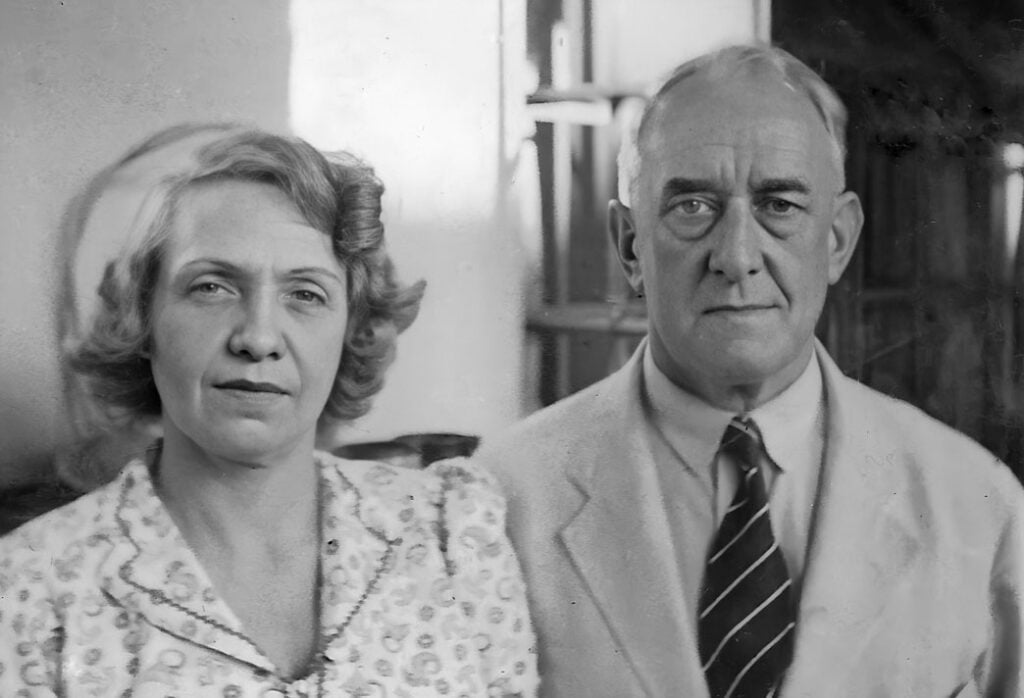
In 1917, 18-year-old Margherita married 35-year-old Francis Culligan. They lived in a huge flat at Chowrinhgee Mansions, in Chowringhee Rd, a prestigious area of Calcutta, with many staff.
The wide Chowringhee Rd was the first major road leading from the British East India Fort to other villages, and an address there was highly desirable. During the early British developments around Chowringhee, they built huge houses along the east side of the road. Over time, some houses became flat blocks. On the western edge of the road was a vast open area called Maidan. St Thomas Church stood in this prosperous area and Margherita’s Italian father, Achille Francesco Boscolo owned a hotel in the area.
Their first child, Denis (Padraig’s brother) was born in Calcutta in 1918.
Moving to South-Africa
Frank had three brothers in the then Union of South Africa, so they moved there in about 1923, when Frank was 41. He made contact with his three brothers and was employed by General Electric. The Headquarters were in Johannesburg.
A second son, Padraig, was born in 1924. This was a traditional family name in Frank’s Irish family. His nickname was Paddy.
When the Great Depression arrived, it was a matter of last in, first out, with no compensatory pay package at all.
Margherita’s father owned a hotel in Calcutta, and she had experience in this, so she and Frank rented a large house in St Andrews Rd, Parktown, Johannesburg and ran it as a boarding house. Parktown was a highly desirable area of Johannesburg. The house and garden remain to this day, and it is now a popular restaurant in St Andrews Rd, in the now-old part of Johannesburg.
School time of the boys
In 1925, eldest son Denis entered the Catholic private school, Sacred Heart College, established by Marist Brothers in Johannesburg’s neighbouring suburb, Observatory. Five years later, the much younger Padraig went to school there.
The Marist Brothers are still involved in educational work all over the world and now have primary, secondary and higher education schools, academies, vocational schools, orphanages and retreat houses in 79 countries on five continents: Europe, Africa, the Americas, Asia and Oceania.
In 1930, Denis Culligan, aged 11, was sent as a boarder to St Aidan’s Jesuit College in Grahamstown , South Africa for his secondary education. The College was founded in 1872 and was the only Jesuit College in South Africa. It was about 1,000km from Johannesburg. However Frank admired the high standard of education offered by the Jesuits greatly, so Denis was sent as a boarder. There was also a Preparatory School called St Bede’s, where younger boys attended, some as boarders. When Padraig was 10 years old in 1934, he was sent there.
In 1934, Frank finally found a job in what was then Salisbury, Southern Rhodesia (now Harare, Zimbabwe). In 1935, both sons were enrolled at St George’s Jesuit College in Salisbury the only Jesuit College in Southern Rhodesia, and were able to live at home with their parents.
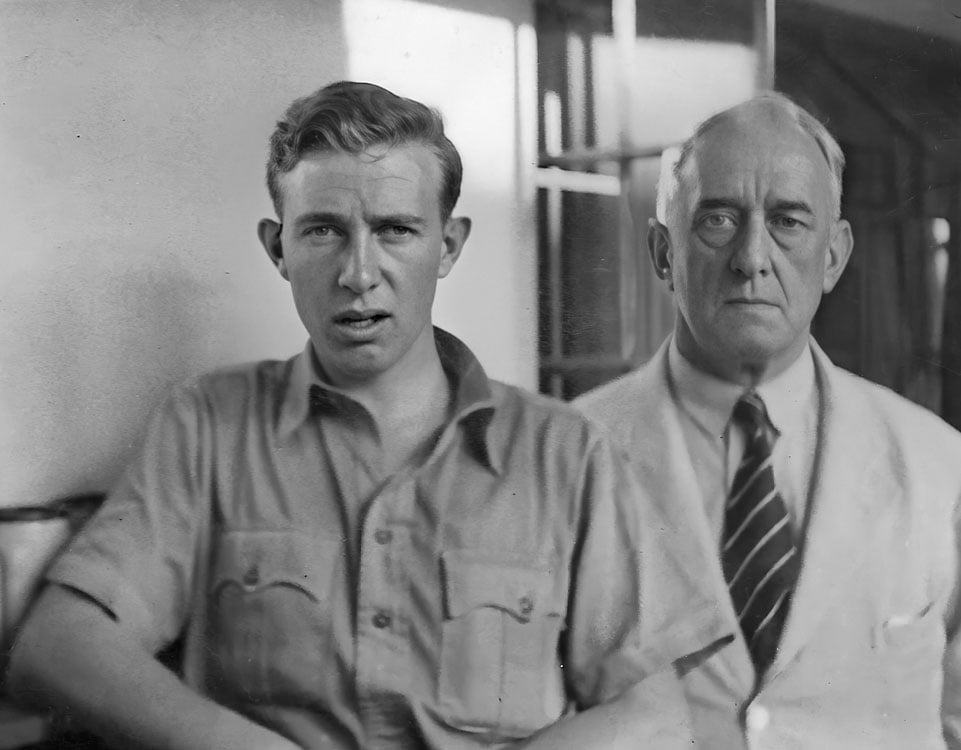
St George’s Jesuit College in Salisbury
In September 1890 the territory that later became Southern Rhodesia (now Zimbabwe) was formally occupied by a column of colonial settlers. It was named after Cecil Rhodes, the Englishman who wanted to ‘paint the map of Africa red from the Cape to Cairo’. That is, he wanted all the land then inhabited by indigenous people to be colonised by Britain, an aim which he came quite close to achieving. It was the era of British imperialism.
St. George’s was founded by the Jesuits in Bulawayo in January 1896, and later relocated to Salisbury (now Harare) in 1927.
At that time, the students were largely taught by Jesuits, so school fees were minimal. Not anymore. The classes then were small – there were eight students in Denis’s class and 14 in Padraig’s class.
In the scout photo below, Padraig Culligan is on the ground, 3rd from left, largely hidden under his scout hat. Of that group, three later joined the RAF, two of whom, Padraig included, became Pilot Officers and sadly lost their lives. Three others became army officers, two of whom were awarded the Military Cross. The boy on the far left on the ground later became a cabinet minister and was one of the signatories of the UDI Declaration in 1965.
The Unilateral Declaration of Independence of Rhodesia (UDI), which was adopted by Rhodesia’s cabinet on 11 November 1965, announced that Southern Rhodesia, a British territory in southern Africa that had governed itself since 1923, now considered itself to be an independent sovereign state. The country eventually gained internationally recognised independence in 1980 under the name Zimbabwe.
Padraig was loved by his fellow pupils. He played cricket and joined the cadet corps. Although, according to his student card, he had a chequered academic career at the school, in his final School Certificate exams in 1941 he achieved credits in five subjects. His card also records that, upon leaving St. George’s he joined the ‘Forces’. He turned 18 in February 1942 .
Military career of Padraig
In May 1940, as part of the Empire Air Training Scheme, the Rhodesia Air Training Group opened an elementary flying training school in Salisbury, to be followed by another 9 sites around the country that specialised in the training of bomb aimers, navigators and air gunners. In all, through the course of WW2, some 10,000 men from all around the British Commonwealth, as well as from Greece, Poland and Hungary were trained, before being sent off to the various theatres of war. One of them was Padraig, who, it is worth recording was one of a substantial number of Old Georgians to join the RAF. It should also be noted that all those signing up from Southern Rhodesia and South Africa were volunteers since there was no conscription in either country.
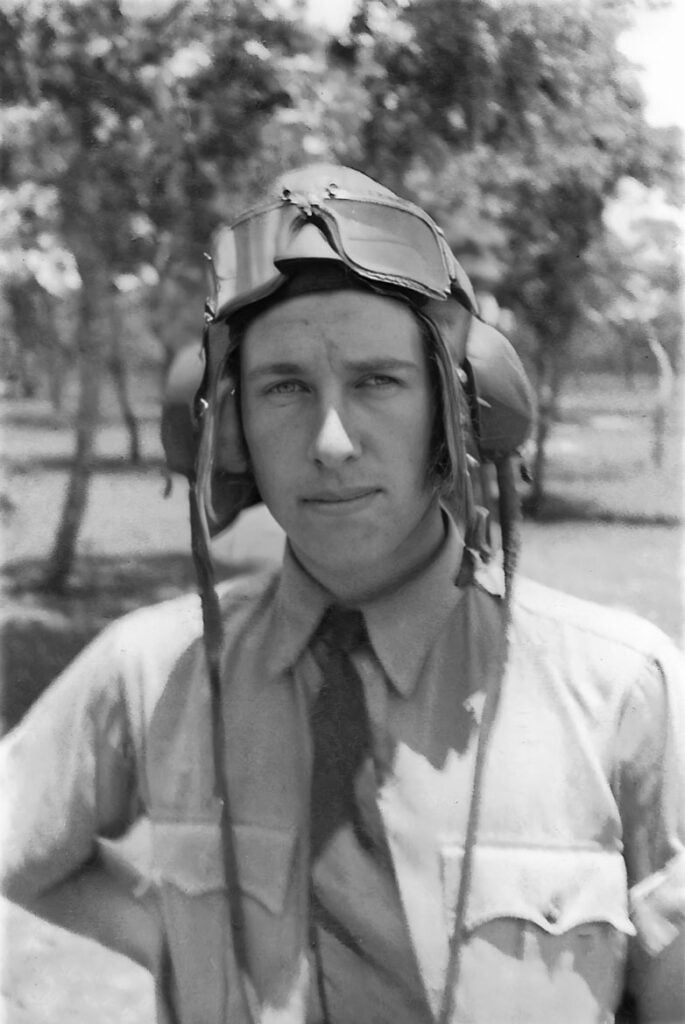
Having completed basic training in Bulawayo, Padraig was posted to the elementary flying school at the Belvedere field in Salisbury in September 1942. From there he moved to the Cranborne base where he earned his ‘Wings’ in February 1943. Thereafter, in May 1943 he was posted to England as a Sergeant Pilot. Quite when he was posted to 266 (Rhodesia) Squadron isn’t clear, but he would appear to have been very much in the thick of things following the Normandy landings in June 1944 and the Allied advance from the beaches, supported by the Second Tactical Air Force, of which 266 Squadron was a key part. The Squadron had initially been re-formed in late 1939 as a Rhodesian gift squadron (hence its name) flying Fairey Battle light bombers, but in January 1940 it was equipped with Supermarine Spitfires and became a fighter squadron.
Having participated in the air over Dunkirk, as well as in the Battle of Britain, the squadron was re-equipped with Hawker Typhoons in January 1942, thus taking on a fighter-bomber role, carrying out reconnaissance, as well as ground-strafing missions in support of the invasion forces. In 1942, Padraig participated in training camps and was deployed with his squadron on various operations in Europe in 1943, 1944 and 1945. The squadron, as part of Second Tactical Air Force, joined No.146 Wing in March 1944.
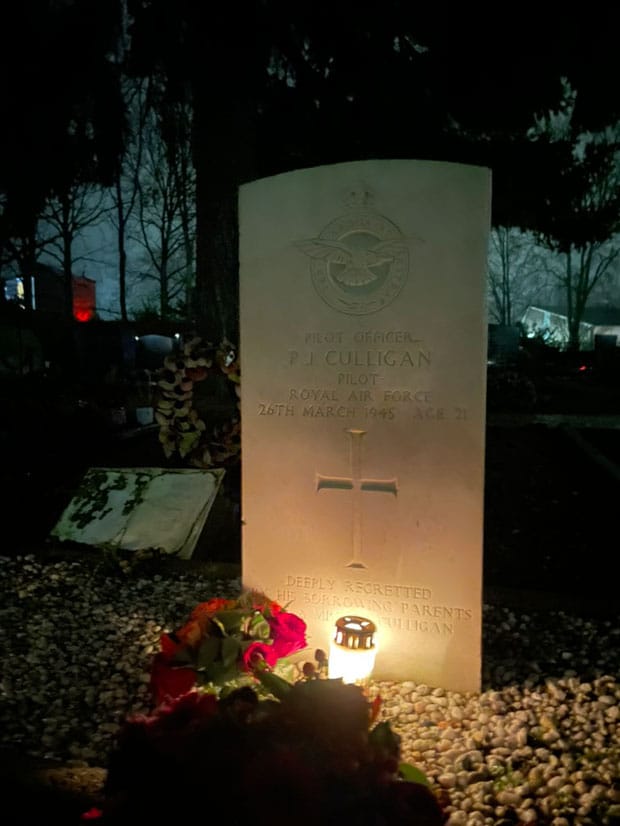
At some point after being posted to 266 Squadron, Padraig was promoted to Pilot Officer and, judging by the remarks made by his commanding officer (see below), became a valuable, as well as popular member. Very sadly, he was killed in a flying accident while taking off from a forward airfield in Mill, in Holland on 26 March 1945, six weeks before the war in Europe ended. He is buried in the main cemetery of the Dutch village of Grave – grave number 586. A Commonwealth Graves Commission grave stone was later erected in his memory.
Airstrip B 89 Mill
The airport on the moors
On Sunday 17 September 1944, Allied paratroopers landed at bridges on the route from Eindhoven to Arnhem. Simultaneously, a land offensive started to force a corridor to contact airborne troops. Field Marshal Montgomery’s plan Operation Market Garden had begun. A daring attempt to rid the Netherlands of the Germans as quickly as possible and end the war soon. As is well known, the plan stalled at Arnhem.
As a result of that stagnation at Nijmegen and Arnhem, the advance came to a halt and, due to the severe winter weather, months hardly progressed and the fighting went back and forth.
To provide air support to the 1st Canadian Army, it was necessary to add airfields in the south-east of the Netherlands. To relieve airfield Volkel and due to the fact that airfields Keent and Rips were no longer usable due to bad weather conditions, new locations were sought.
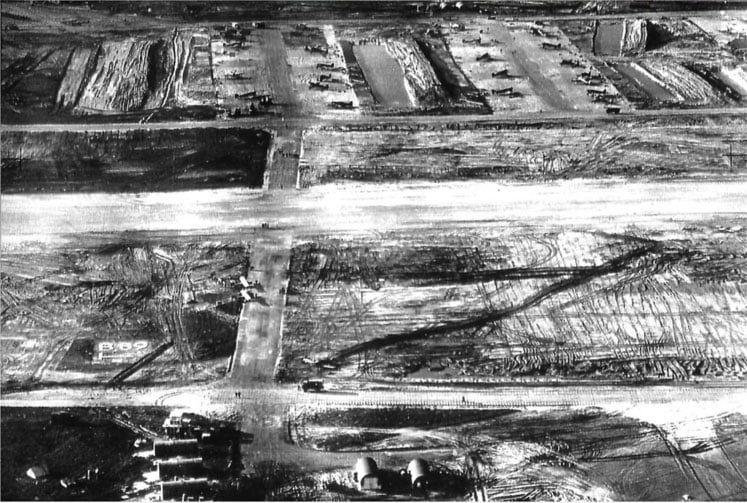
One such field was constructed in the winter of 1944-1945 in Mill, on a spur of a moor and was code-named B 89 (see the map at the bottom of this page). The aim was to make this field more permanent, so reinforcement was needed during construction. That reinforcement was formed by a field company of the 50th HQ Troops Engineers, the 681st Road Construction Company and the 217th Company Pioneer Corps. The neighbouring villages of Zeeland and Langenboom housed the armies, including surrounding farms. A lot of Langenbomers and Millenarians needed to leave hearth and home to make way for the airfield.
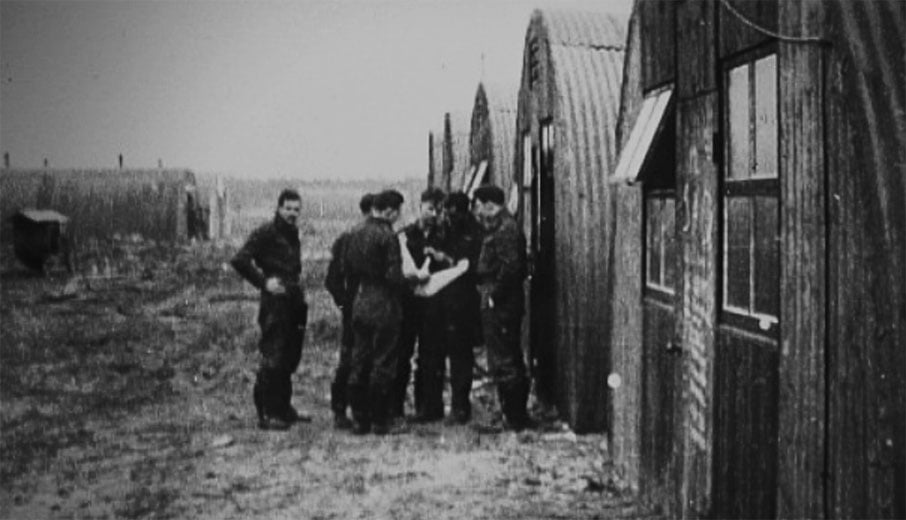
With all hands on deck, the job started on 1 January 1945. Many tractors and scrapers moved over 300,000m3 of soil. 140 alcove huts (a shelter with an arched corrugated iron roof) and 72 barracks were built. Under harsh weather conditions and with the help of local Dutch carpenters, the entire airfield with 1 runway and 2 rolling runways was brought into readiness. On 8 February 1945, 146 Wing arrived and on 8 and 9 March the 35th Army Cooperation and Photographic Reconnaissance Wing.
The RAF Second Tactical Air Force (2TAF), part of the Royal Air Force consisted of 4 Groups, 2, 83, 84 and 85. The Groups were divided into Wings. Each Wing consisted of squadrons. Group 2 and 85 were in Belgium and France. Group 83 and 84 were in the Netherlands.
Group 83 was based, among others, at Keent airfield. Group 84 ended up in Mill, among other places.
One of the squadrons of 146 Wing was the 266 sqn “Rhodesia” with code letters ZH. The squadron of which Squadron leader Padraig Joseph Culligan was part.
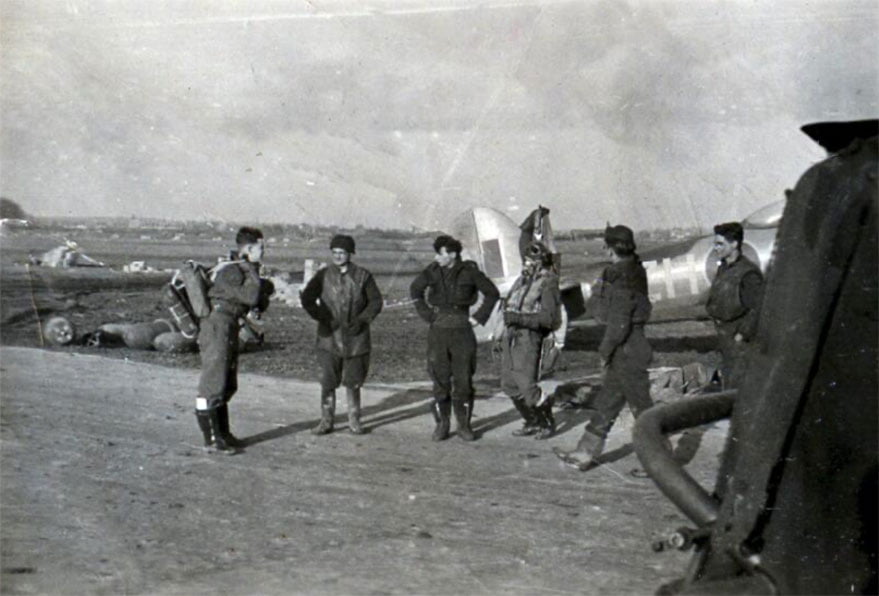
The pilots of the 35th performed many tactical reconnaissance flights over the Rhine with their Spitfires and Mustangs, strafing tugs and other vessels. Albert Henry Collyer was Sergeant at 35 Wing.
The pilots of the 146 Wing attacked many targets with Typhoon fighters, including German headquarters and bases, railway lines, railway bridges, airfields and missions against flak batteries, from which air transports were shelled.
During one of these operations, Patdraig Culligan’s plane suffered a blowout while taking off from the airfield in Mill and sadly he died as a result.
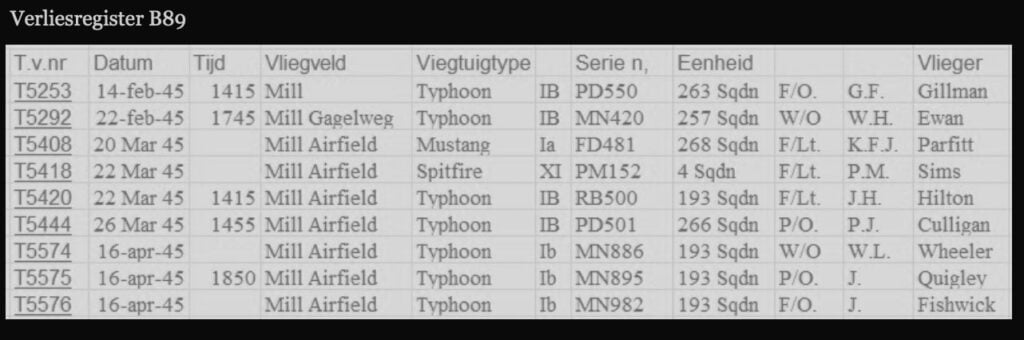
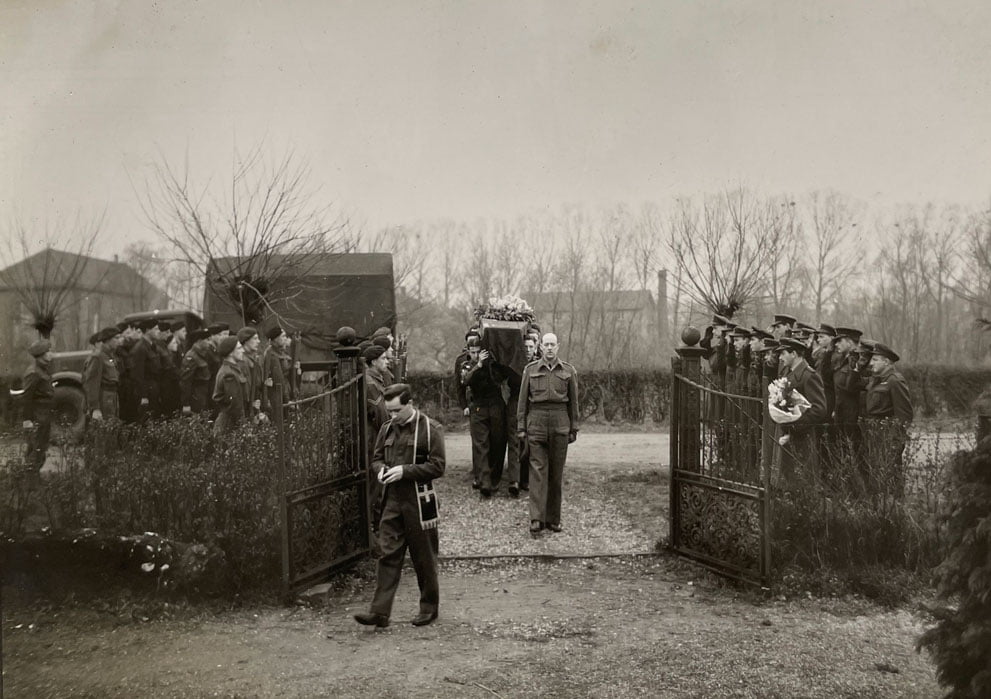
He was transported to the emergency hospital in Grave and buried in Grave General Cemetery in grave 586.
His headstone reads:
Deeply regretted
By his sorrowing parents
Mr. and Mrs. F.J. Culligan
R.I.P.
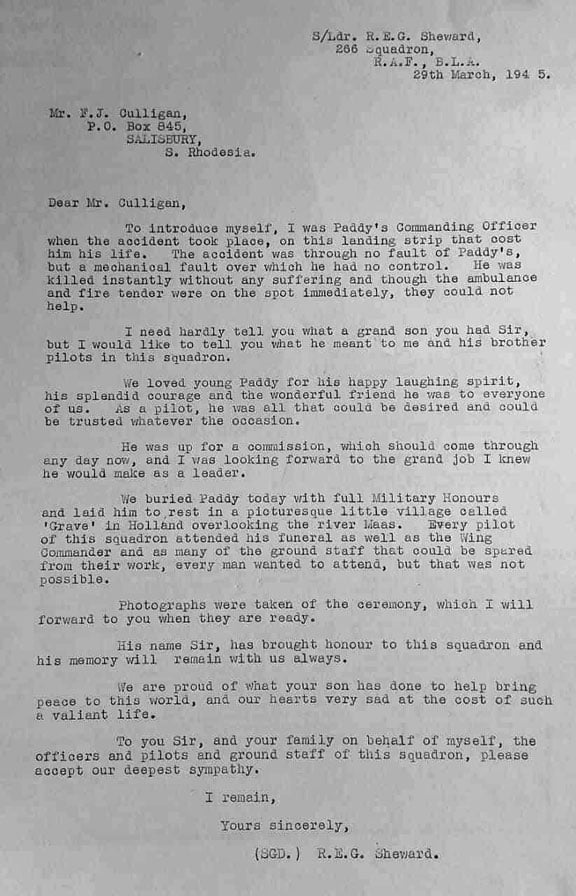
After 16 April, both Wings will move to other airports.
In april Albert Henry Collyer of 35 Wing died and is also buried in Grave and also Oliver Lee of 125 Wing is buried next to him.
War experiences Denis Patrick Culligan
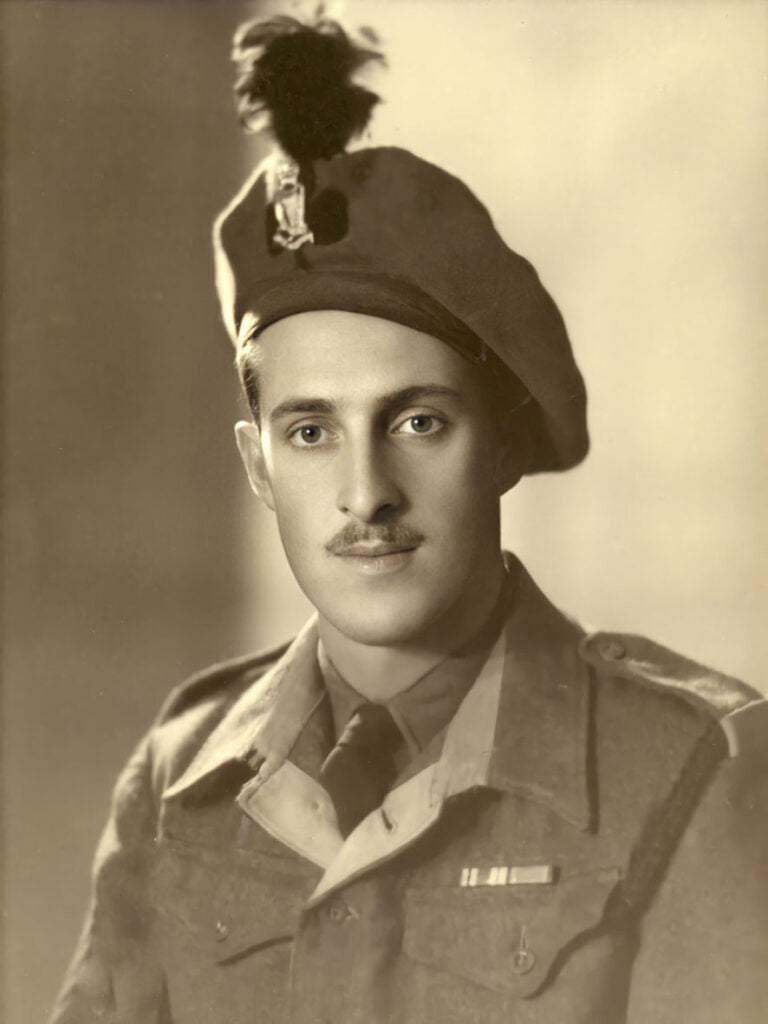
At the time of Paddy’s death, his older brother Denis was in a Prisoner of War (POW) camp in Poland. Frank and Margherita had only two sons. Denis survived the war.
About 20 years ago Denis wrote down his war experiences for a speech at the Military History Society. A short summary was written by Beverley, his daughter.
Padraig’s older brother Denis Culligan was an articled clerk in a law firm in Johannesburg, South Africa, when war was declared. At that time, South Africa was a self-governing Dominion of the British Empire.
The discovery of vast gold deposits in 1886 in the area which became Johannesburg had resulted in a ‘gold rush’. By 1939, Johannesburg was the commercial centre of South Africa and its largest city. Many of its residents had immigrated from Britain, and had huge loyalty to the Crown. So most young men signed up for the army or air force. All these men were volunteers as there was no conscription in South Africa,
Although of Irish, Italian and French descent, Denis also signed up, and joined the South African Irish Regiment. This Regiment fought in Abyssinia and North Africa. On 23rd November 1941, near Tobruk, the Germans attacked. The surviving men of the SA Irish Regiment were taken prisoner. They spent 1.5 years in a POW camp in Gravina, Italy, When the Allies landed in southern Italy the men were transported to the huge camp Stalag VIIIB near Breslau, on the then Polish border.
In February 1945 with the Russians within eyesight of the camp, they were all moved west. At Swinefurt the Germans abandoned them, and they spent 28 days walking west, scavenging for food, with the Allied Airforce overhead, strafing German tanks etc. Padraig Culligan was in the 266 (Rhodesia) Squadron based in Holland during this time and it was during this march that Padraig lost his life. Denis and others were picked up by advancing American troops, who transported them to Paris.
Padraig in RAF uniforms


School photo’s


Funeral Padraig


Lights on War Graves Christmas Eve 2025