Graham | Alexander Gay


Biography
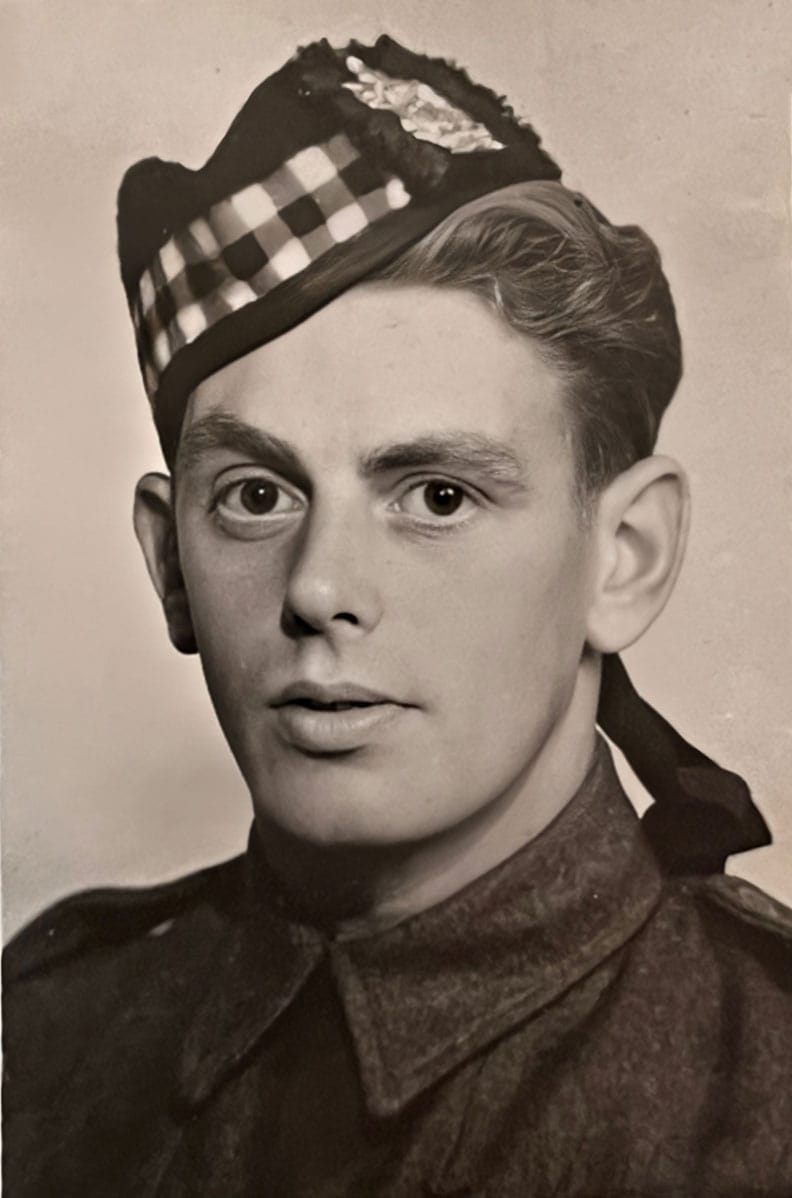
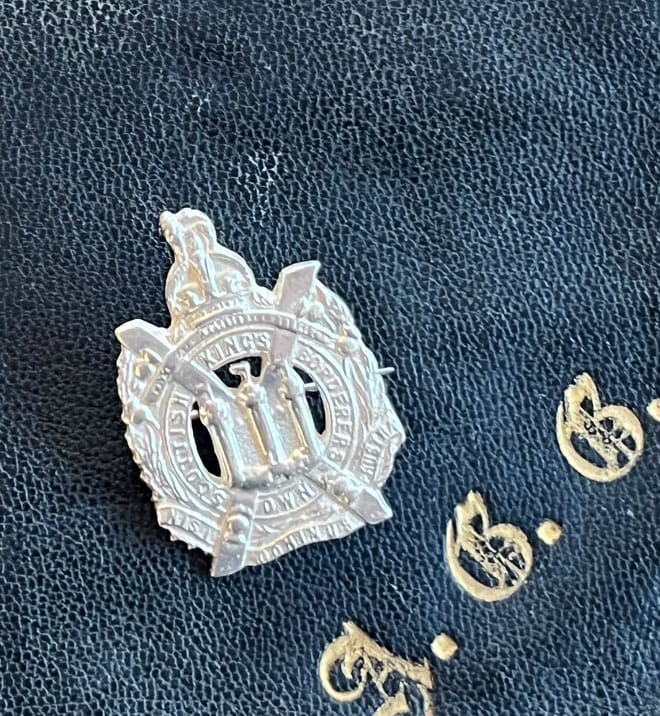
Alexander Gay Graham was killed in action on 14 October 1944. He was a Sergeant in the 1st Battalion of the King’s Own Scottish Borderers (Service No. 3193892). He was initially buried at Cemetery H.J. Hendriks, in Overloon and re-interred on 27 May 1947 in grave IV. B. 3 in the Overloon CWG Cemetery.
Family Background
Alexander Gay Graham (who was known as Alex) was the son of Robert Graham and Elizabeth Gay who had married at Henderson House, Pittenweem on 1 January 1909 after banns according to the form of the Evangelical Union Congregational Church. Henderson House was Elizabeth’s home. Robert was living at Kirk Wynd, Anstruther Easter and was a Fireman. He was born in 1883 in Markinch, Fife, and was the son of David Graham, a Ploughman, and Janet Graham (nee Law), both of whom had died by this time. Elizabeth Gay was born in 1885 in Pittenweem and was the daughter of Robert Gay who was a fisherman and Agnes Meldrum Gay (nee Watt).
Pittenweem and Anstruther are villages located on the south facing Fife coast. Markinch is further west and inland, near the post war New Town of Glenrothes.
Robert and Elizabeth Graham had children as follows: Agnes Watt 1909, David 1911, Janet Law 1912, Robert Gay 1914 (who died in 1915), Alexander Gay 17 April 1917, Thomas 1921 and twins Francis and Robert 1923 (though Robert died in 1924).
Agnes was born in Pittenweem, David in Anstruther Easter, Janet to Alexander in Methil, Thomas in Anstruther Wester and Francis and Robert in Buckhaven (probably Methil). Methil is part of Buckhaven on the Fife Coast well to the west of Pittenweem.
In 1911, Robert and Lizzie (as she was known then) were living in a 2 roomed property at Rose’s Buildings, Durie Street, Methil. Robert was now working as an Engine Fireman for the North British Railway. By the time of Janet’s birth in 1912 Robert was working as a stoker in a steam vessel.
At the time of Alex’s birth on 17 April 1917, the family were living at 102 Durie Street, Methil. His father was now described as a Railway Engine Driver.
By June 1921, Robert and Elizabeth were at 44 High Street, Anstruther Wester. With them were their first five surviving children, including Alex. Robert was working as an Engine Driver for the North British Railway. The family of seven were still living in a 2 roomed house.
Alex’s brother, David, married Letitia Ross in Scoonie, Fife in 1931. His sister, Janet Law Graham, married Peter Lawson in 1939 in Methil. His brother, Thomas, married Christina Chapman from South Shields in Newbourne, Suffolk, in 1942. He was an RAF Radio Operator during WW2.
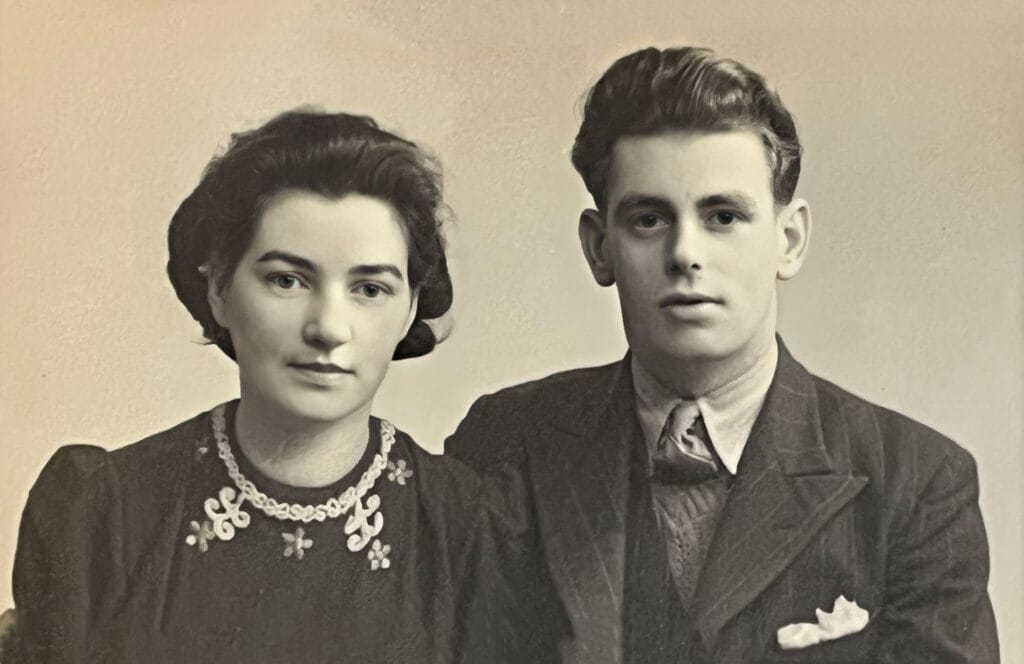
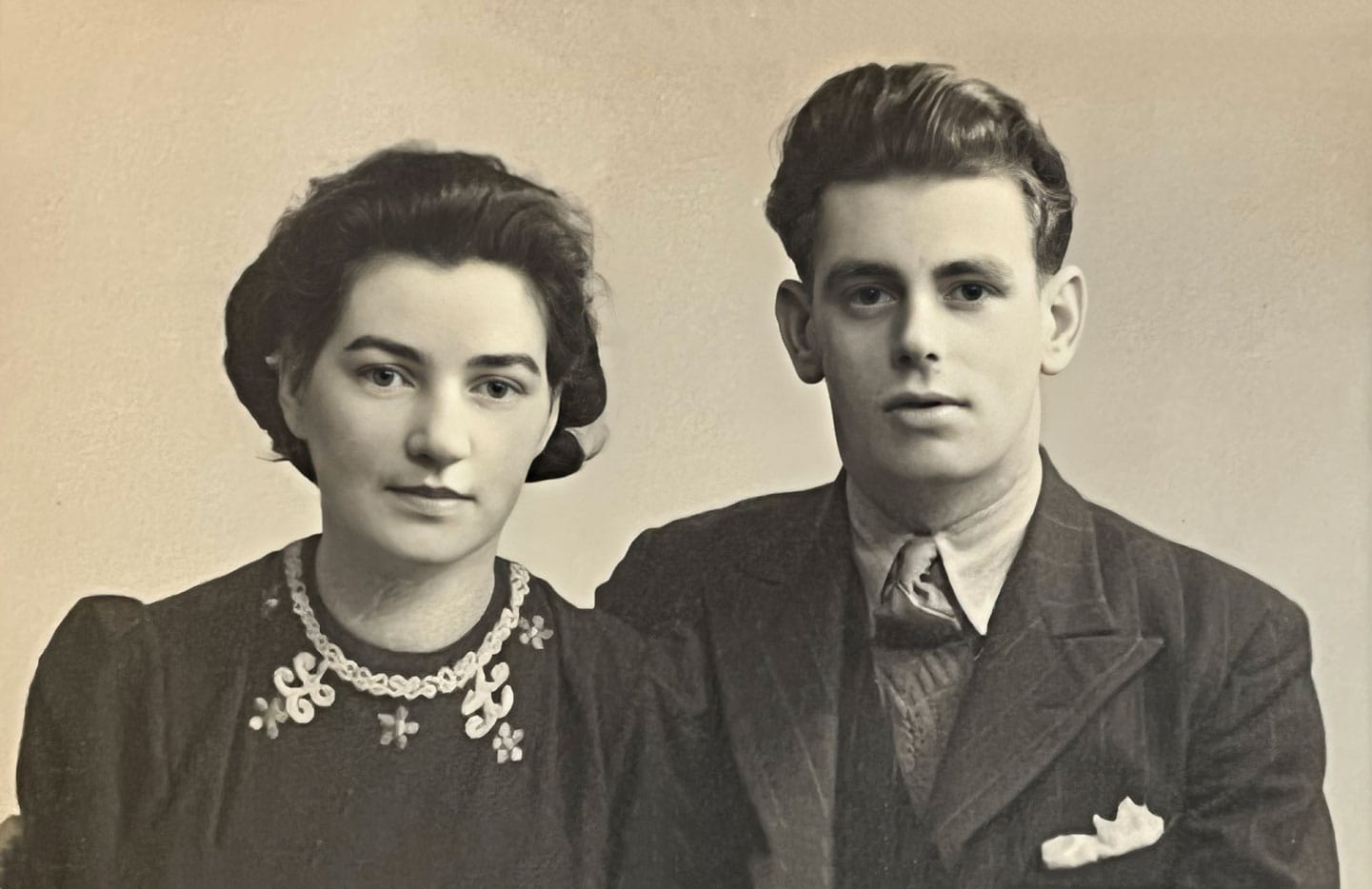
Alex married Catherine Frances Stokes on 24 October 1942 at the Catholic Church in Littleham, Devon. It may be that Alex was posted to this area. Kate had been born on 5 April 1919 in Youghal Road, Dungarvan, Waterford, Ireland. In September 1939 she was living at 20 Holmes Road, Twickenham, London. She was working as a parlour maid in the household of 58 year old widower Frederick W Chambers who was a company director. In the same household were Mary E Hall (later Marsh) born 17 September 1906 – working as a Chauffeuse/House Keeper and Eileen Jeffrey (later French) born 24 May 1921 working as a Cook.
Alex and Kate had a child, Rona C Graham, born in the spring of 1944 in Devon.
Military Career
Alex had enlisted in the King’s Own Scottish Borderers at Berwick on Tweed on 15 March 1940. He stated that he was born on 17 April 1917 in Methil, Fife. He gave his address as 44 Lomond Gardens in Methil. He initially named his mother, Mrs E.G. Graham of the same address, as his next of kin. He was 5ft 7in tall, weighted 129lbs, had brown hair and eyes and was a Presbyterian. He was declared Grade 1 medically fit.
His trade on enlisting was given as a Branch Stores Manager. He said the nature of this work was as a salesman for groceries and provisions. His employer was Hay’s Grocery Stores of 20 Bernard Street, Leith. Their business was in wholesale and retail groceries, provisions and fruit.
He was initially posted as a Private to the KOSB Infantry Training Centre. He was posted to the 1st Battalion KOSB on 9 June 1940. He joined them just after the Battalion had to be evacuated from Dunkirk. From this time, they were performing defensive roles in Sussex.
Alex was appointed as an Unpaid Lance Corporal on 30 May 1941. This was converted to a Paid role on 19 January 1942.
As has been seen, he married Catherine Frances Stokes in Devon on 24 October 1942. He later changed his next of kin to Catherine at 2 Cleveland Place, Exmouth, Devon.
On 20 February 1943, he was appointed firstly as an Unpaid Acting Corporal and then in a Paid capacity on the same day. Shortly afterwards, on 6 March 1943, the Battalion was sent to Acharacle on the Ardnamurchan Peninsula in western Scotland, having just been issued with extra clothing. They began training here on 8 March and the War Diary indicates that the purpose of the training was to harden the troops “and from the looks of the hills there isn’t much doubt that it will.”
However, between 23 and 26 March the Battalion transferred again to Stobs Camp at Hawick in the Scottish Borders where they remained until mid October 1943. Here their time was again spent training for what was to come. Alex became a War Substantive Corporal on 21 May 1943.
While based here, they sometimes had spells in other locations. In particular, from 19 to 27 April nearly the whole Battalion spent time on Combined Operations Training at Inverary on Loch Fyne. Here they practiced landing exercises for what was to become D-Day. However, they were glad when they got back to Hawick as it had rained every day in Inverary. A major focus was training on firing ranges as they were required to be first class shots by 31 July. They also spent time on marches, sometimes of around 12 miles which they seemed to enjoy. In early July most of the men were able to have around a week’s leave.
From 22 July to 9 August they were again at Inverary for more training on landings. The Battalion suffered the death of a Corporal Clark during a field firing exercise as he was hit by a 3in piece of mortar shrapnel. This time they started with 4 glorious days of weather before it started raining again, so they were again glad to be back at Hawick.
Various exercises in September were held jointly with the 2nd Battalion Lincolnshire Regiment and the 2nd Battalion Royal Ulster Rifles with whom they would fight in Europe.
In early September one company was undertaking farming work, being distributed far afield such as to Yetholm near the English border, though it was said that the men seemed to enjoy it. They were officially thanked for helping to get the harvest in. On 1 October the War Diary reported that “The famers have returned to the fold.”
Another exercise away from Hawick took place from 5 to 13 October at Tighnabruaich. It was described as a tented camp in a sea of mud where many came down with ‘flu.
On 17 October the Battalion left Stobs Camp for Selkirk as they switched location with the 2nd Lincolnshires. Training continued here as usual. Alex attended the 62nd Command Physical Training Course at the Command Physical Training School at Redford Barracks, Edinburgh from 18 October to 6 November and passed with an “A” grade.
In early January 1944 the Battalion was again at a different location for around a week. This time it was at the Muir of Ord in North East Scotland in a tented camp where they were practicing landing and moving off a beach. Many men seemed able to take some leave in February 1944. Alex was appointed as an Unpaid and then Paid Acting Lance Sergeant on 13 March 1944. He undertook rifle shooting training (Class 1 and 2) and in April 1944 he was also instructed in how to defuse German Teller mines and Schuh mines.
Towards the end of April, the War Diary gets less explicit about locations. There was a briefing on 25 April for an operation, then on 29 April, a move was made to “different locations” in readiness for embarkation.
Alex’ daughter has kept two letters which her father wrote to her mother. The first is dated 6 May 1944, just a month before the D-Day landings. Small parts were lost, but it reads as follows:
“My Darling,
This is only a few lines meant until I can find a little more time to write you a decent letter. I thought I might have had a letter waiting for me ……… return today but no such …….. hope there is one tomorrow.
There is a …. that the 24 hour passes will be ….. again and if so I will get home at the weekend. Of course don’t bank too much on that but I’ll try my best. Dick who has been trying for several weeks to get leave to get married has been granted 7 days leave for same. He has been extremely lucky as leave has all been cancelled but this special concession is apparently general throughout. He goes tomorrow and is quite excited.
I hope you are both enjoying the lovely weather and are taking full advantage of it. By the way when are you having Rona christened or have you already done so. Another thing will you send on her birth certificate. Hurry up and write dear, All my love, Ever Yours, Alex.”
During May, the Battalion seems to have been based in the south of England as there are references to the South Downs and Waterlooville. On 26 May, the camp was sealed and preparations began for Operation Overlord on 27 May. They moved to the marshalling area on 31 May and commenced embarkation on 4 to 5 June, but the operation was postponed for 24 hours.
Alex will have landed with the Battalion at Queen Beach on D-Day, 6 June 1944. They reached St Aubin D’Arquenay that night then moved to Periers sur le Dan the following day for an attack on Cazelle. However, this was cancelled as it was reported clear of enemy. They then moved to the vicinity of Le Mensil which is just south of Mathieu and north of Caen. During their time there they assisted the South Lancashires in an attack on Cambes en Plaine on 9 June and patrols were sent to attack towards La Bijude on 12 and 15 June. While in this position near Le Mensil they frequently incurred casualties either while on patrol or as a result of enemy shelling. During this period, on 14 June, he was appointed as an Unpaid and then Paid Acting Sergeant.
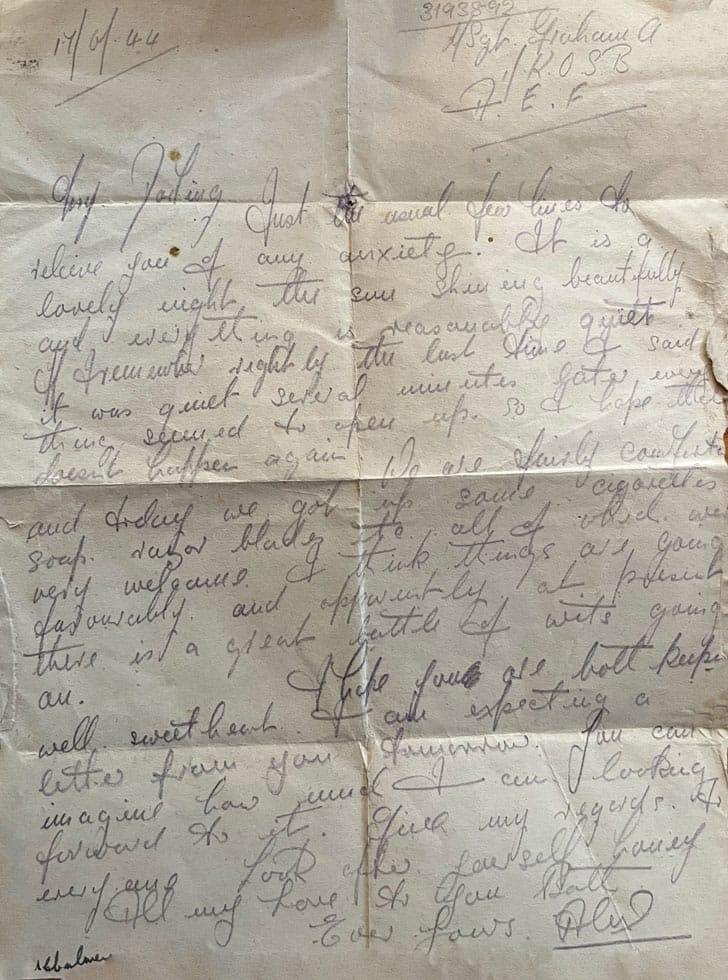
It was also while here on 17 June that Alex wrote again to Kate at 2 Cleveland Place, Exmouth, South Devon:
“My Darling,
Just the usual few lines to relieve you of any anxiety. It is a lovely night the sun shining beautifully and everything is reasonably quiet. If I remember right by the last time I said it was quiet several minutes later everything seemed to open up so I hope this will not happen again.
We are fairly comfortable and today we got up some cigarettes, soap, razor blades etc. all of which were very welcome. I think things are going favourably and apparently at present there is a great battle of wits going on.
I hope you are both keeping well sweetheart. I am expecting a letter from you tomorrow. You can imagine how much I am looking forward to it.
Give my regards to everyone. Look after yourself. All my love to you both. Ever yours, Alex.
Addendum on envelope:
I have not had a letter from mother. Have you been writing to her or her to you?”
Life was perhaps not quite as quiet as he suggested as on the previous evening two soldiers had been wounded by a burst from a Spandau which fired near the Battalion HQ. On the morning of the day he wrote the letter three heavy explosions had been heard and the village church was shelled by enemy at around 05:40. However, the Allies’ own Medium Artillery knocked out an enemy mortar position in La Bijude after a heavy barrage.
The 1 KSOB fought around Caen until the town capitulated, and then advanced north through Belgium.
The Battalion entered the Netherlands from Belgium on 21 September at Budel, where the troops were given a great welcome by the inhabitants. They moved on to Liessel on 24 September where they undertook patrols of the area east of the Deurne Canal. On 28 September the Battalion took up positions further north covering a cross roads at Milheeze, then on 1 October they moved further north again to St Hubert where they were again very well received by the inhabitants. They remained here for a time carrying out patrols but also undergoing training and having time to relax a little. After what was described as a pleasant stay of 10 days at St Hubert, the whole Battalion moved to an assembly area just west of St Anthonis on 12 October. On that day, the 1st Battalion of the Suffolks succeeded in capturing Overloon and took up a position just south of the village.
At 1320 on 13 October, the Battalion began its attack on the western part of a wood south west of Overloon, south and west of the property known as Helderse duinen today. They started from a position just north of the east/west Overloon to Oploo road. One squadron of Churchill Tanks (4th Grenadier Guards), one squadron of Flail tanks and one squadron of Flamethrowers led the way. By 1700 hours the leading troops had succeeded in reaching a point about 200 yds from the southern edge of the wood and this is when the Battalion consolidated for the night. No enemy were encountered until the forward companies got into position, and then isolated machine guns opened up occasionally and continued to do so till an hour after nightfall. From the time that the whole Battalion was in the wood, the enemy put down fairly heavy artillery, mortar, and Nebelwerfer fire on the wood.
On 14 October, the Royal Ulster Rifles attacked the woods to the east of the Battalion and then consolidated their position. The Lincolns then passed through the RUR and put in an attack on a wood a bit further south of them. They were attacked by machine guns and suffered casualties, causing them to have to withdraw to the RUR positions. For the rest of the day, the enemy put down a large amount of fire on the Brigade area, quite a large proportion of which was from Nebelwerfers. In the afternoon, the Lincolns with two companies of RUR with heavy supporting artillery and machine gun fire succeeded in reaching their objective of a wood further to the south.
During this day, the 1st KOSBs explored further to the south and west corners of the wood where they were based, destroying two machine gun posts and killing six of the enemy and wounding others. Recce patrols also ascertained that there were enemy in a wood to the south and that a stream would present an obstacle to tanks. It was on this day that the Battalion had three men killed and twelve wounded from shelling and mortaring. One of the three killed was Sgt. Alexander Gay Graham and another was Pte. Robert Wright. They were initially buried near the junction of Peelkampweg and Vredepeelweg, south west of Overloon. The third man killed was Private William Joseph Simmons who was initially buried a little further to the south in the wood. Alexander Gay Graham and Robert Wright were later re-interred alongside each other at the Overloon War Cemetery while William Joseph Simmons was later re-interred at Mook War Cemetery.
Alex had served for a total of 4 years and 214 days of which 134 days were in N.W. Europe. He was awarded medals as follows: 1939/45 Star, France & Germany Star, Defence Medal and the War Medal 1939/45. His wife was awarded a pension of £1/15s a week from 29 January 1945 with an allowance of 11s for their child.
Aftermath
Alex’s wife was initially informed of Alex’s death in a very impersonal letter written to her by the Infantry Record Office at Perth on 23 October 1944.
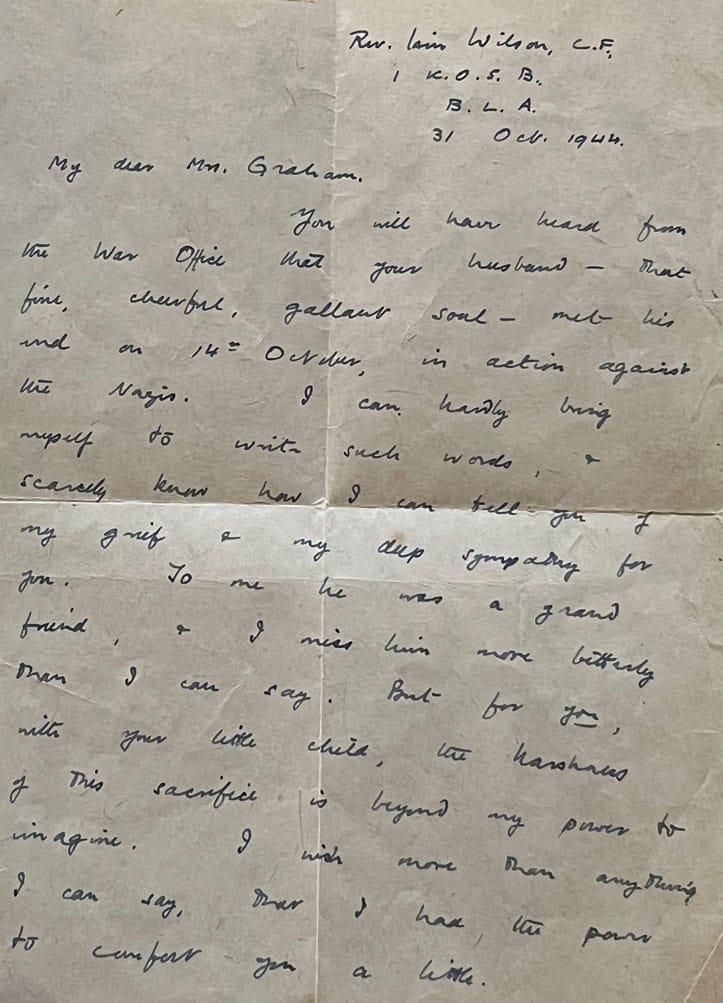
She then received a more personal letter written on 31 October 1944 by the Rev. Iain Wilson of the 1 KOSB. It said the following, though it is incomplete:
“My dear Mrs Graham,
You will have heard from the War Office that your husband – that fine, cheerful, gallant soul – met his end on 14th October, in action against the Nazis. I can hardly bring myself to write such words & scarcely know how I can tell you of my grief & my deep sympathy for you. To me he was a grand friend, & I miss him more bitterly than I can say. But for you, with your little child, the harshness of this sacrifice is beyond my power to imagine. I wish more than anything I can say, that I have the power to comfort you a little.
I hope it may be some small help when I tell you that he met his end quite painlessly, & instantly. He definitely would not know for a second what had happened. He was spared any injuring pain or knowledge of his passing.
He was advancing against the enemy, when he ran into fierce machine gun fire. Wounded to the head, he passed away immediately. Later I found him and laid him to rest with some of his comrades. He looked absolutely peaceful, & with hardly a mark. I secured such of his possessions as I could, & all available personal effects should reach you in due course.
My dear soul, I cannot tell you with what grief I preformed this duty. It is as if a piece of…”
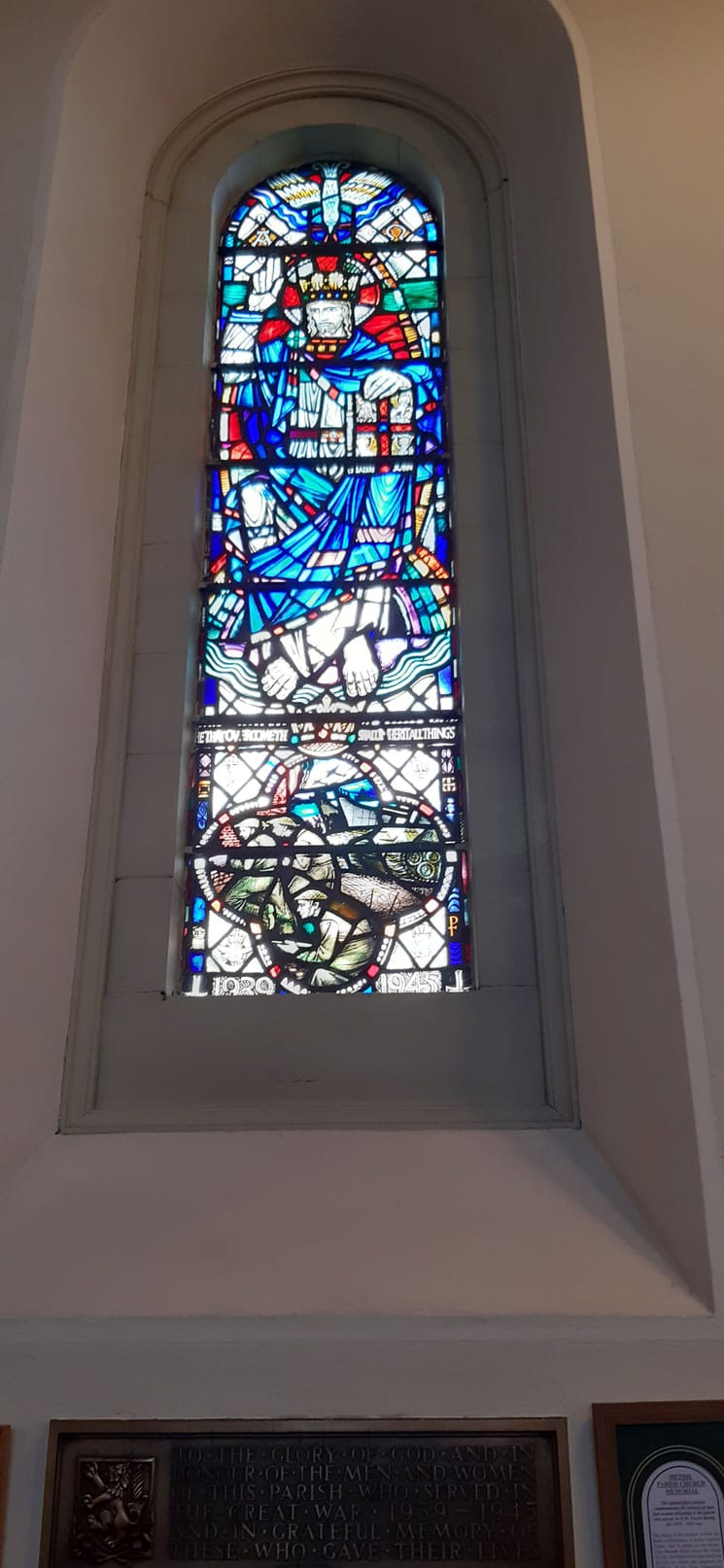
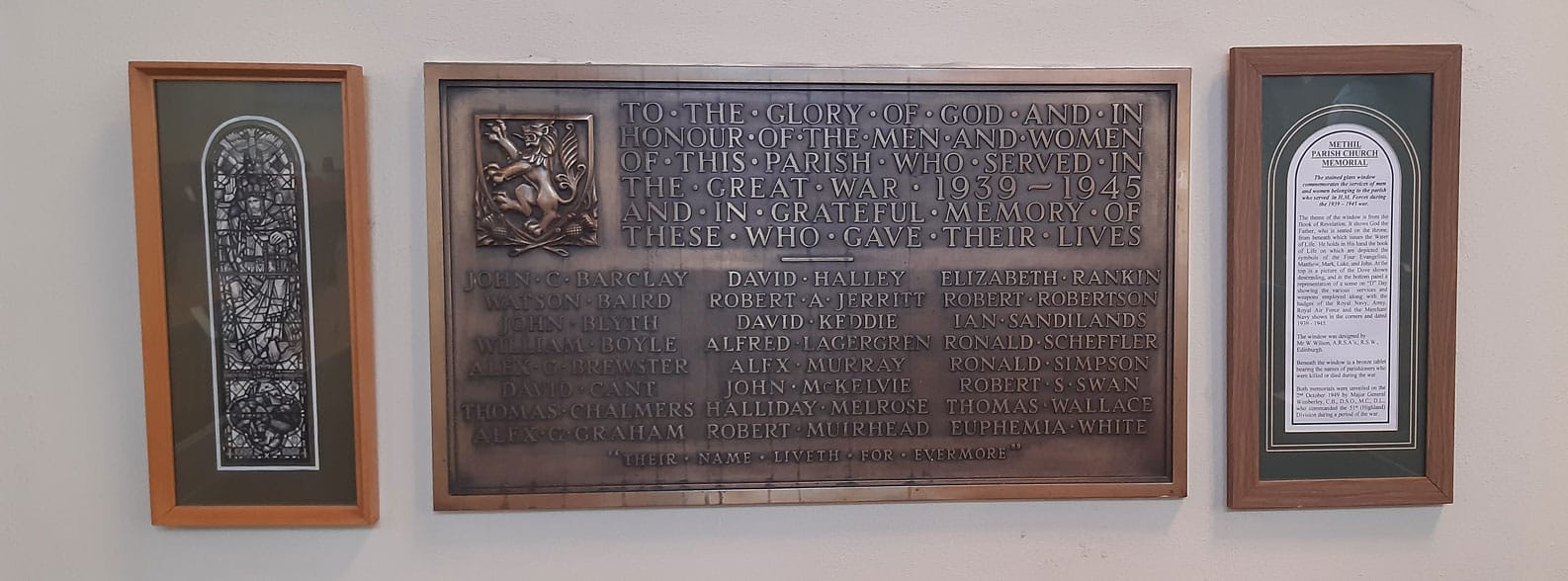
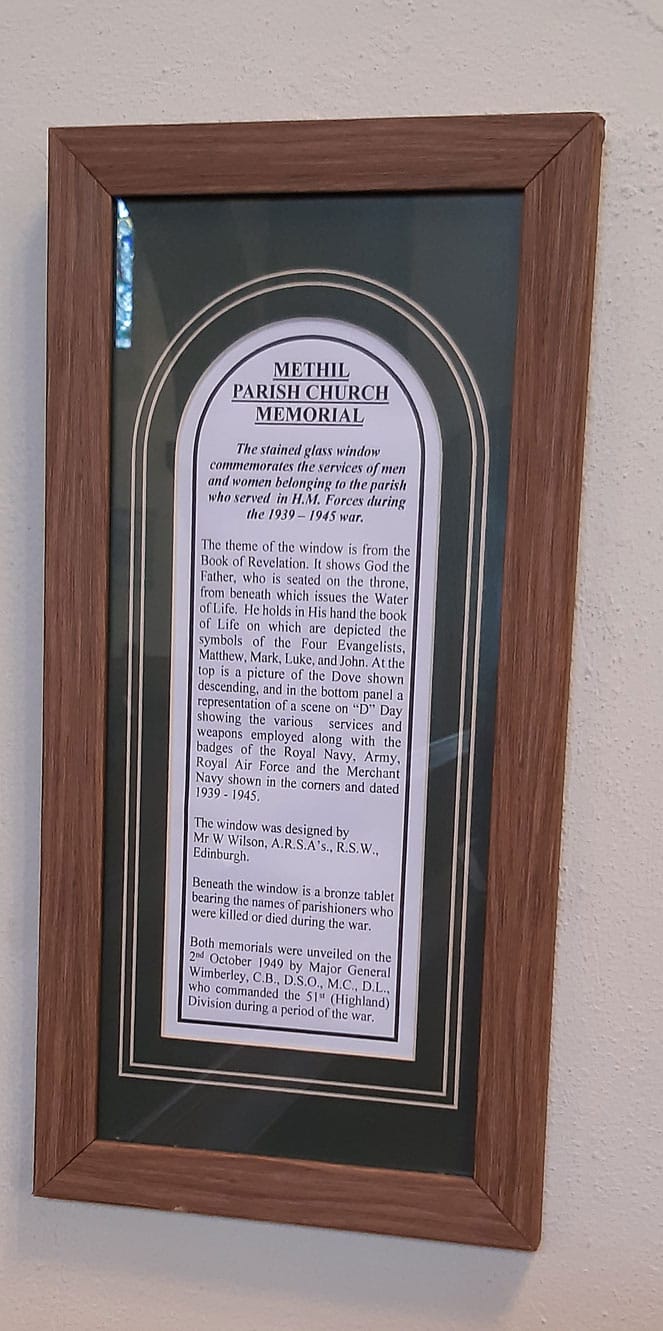
Alexander Gay Graham is commemorated on the WW2 memorial plaque in Methil Parish Church.
It seems that Catherine changed address a couple of times shortly after Alex died. In early November letters were addressed to her at 44 Lomond Gardens in Methil, which was his parent’s address. Around 12 December she gave the Army the following address: c/o Wayside Nursing Home, Cookham Road, Maidenhead, Berkshire. However, on 16 January she advised them that her permanent address was now 116 Wash Lane, South Yardley, Birmingham 25.
It was to this address that his Personal Effects were to be sent. These consisted of: 2 Wallets, 2 Cigarette Cases, 4 Post Cards, 15 Photos, 1 Ring, 1 Chain, 3 Letters, 1 Gospel of St John, 3, 2 Stamps, 3 ½ Stamps, 2 Medallions.
Kate had a large Irish family, some of whom came to England after the war. They helped her look after Rona.
At some point after Alex’s death Kate was living at 25 St. Luke’s Road, Maidenhead, Berkshire. In 1950, she married Charles W F Clarke in Maidenhead and they went on to have a daughter there, Una Clarke, in 1953.
Alex’s father only survived him by three years, dying in 1947 in Methil. His mother died in 1966, again in Methil.
His brother, Thomas, emigrated to New South Wales in Australia in 1949 and his youngest brother, Francis, married Hannah Frazer McLaughlin McClean in 1952.
His sister, Janet Law Lawson, died in 1954 in Edinburgh. His brother, David, died in 1976 and his sister, Agnes, who never married, in 1991. Both died in the Methil area. His brother, Thomas, died in 2004 in New South Wales and finally Francis died in 2016 in Methil.
Several of them left children, some of whom remain in the Methil area.
Alexander’s daughter, Rona C Graham, married Ronald J Jenkins in 1969 in Windsor, Berkshire.