Irvine | John

Biography
John Irvine died on 15 October 1944 in the vicinity of Overloon. He was aged 19 at the time. He was a Rifleman in the 2nd Battalion of the Royal Ulster Rifles (Service No. 14688534). He was initially buried at Cemetery Helderse Bossen, Overloon and re-interred on 29 May 1947 in grave IV. D. 12. in the Overloon CWG Cemetery. The inscription on his grave reads: “In memory of dear John. Always loved always remembered by Mum, Dad and family.”
No photo of John Irvine has yet been found. Should anyone reading this have a photo of him or further information regarding him – or if they are aware of any errors in his biography below can they please contact the Foundation?
Military Career
The 2nd Battalion of the Royal Ulster Rifles was part of the 9th Infantry Brigade, 3rd Infantry Division serving with the British Expeditionary Force (BEF) in France from 1939–1940. It took part in the Battle of Dunkirk and was evacuated from there with the rest of the BEF. The battalion returned to Europe for the D-Day landings in June 1944 and fought in the Battle of Normandy, specifically in Operation Charnwood where they were the first British troops to enter the city of Caen, which had previously seen bitter fighting in the British attempt to capture it.
From mid July until mid September they remained in France, alternating between spells of fighting and spells of rest and training.
On 16 September they made the long journey from their last base in France at Hacqueville to Naast near Soignes in Belgium. The War Diary states that “from Albert to Mons people lined the streets of the towns giving us a very warm welcome and presented us with fruit. In some places the crowds which congregated made it rather difficult for the convoy to get through”. They moved on a further 112 miles the following day to Kolis near Lille St Hubert. Again “cheering crowds welcomed us in every town and village, presenting us with coffee and more fruit.”
On 18 and 19 September the Battalion was involved in extending and solidifying the bridgehead over the Escaut Canal which had already been made by 50 Division.
On 21 September, they crossed from Belgium into the Netherlands at Maarheeze, where they rested until the 24th before moving on to Deurne on the 15th, Bakel on the 29th, Beers on 1 October and then Cuijk on 2 October. They remained in the vicinity of Cuijk until 11 October, experiencing some shelling but also undertaking training and relaxation. The War Diary reports that “The Battalion football team played a local Eleven at Beers, our team gaining an easy victory by 5 goals to 1. The game was watched by a large number of spectators & the Band was loudly applauded when they played during the interval & after the game.” During this period there was much mention of rain and wind.
Read a detailed account of 8 October 1944, the day of this match, told after the war by the son of Sergeant Reginald Hammersley, who played in the match and survived the war.
On 12 October, the Battalion moved about 10 miles south of Cuijk to near St Anthonis. It was decided that the 3rd British Infantry Division, of which the Battalion was a part, would clear the area of woody country as far as Venray and possibly further. The role of the Battalion was to lead the Brigade with the intention of capturing & clearing the large wood to the south west of Overloon. The following day they therefore marched from St Anthonis southwards and the initiative started at 0900 hrs. They had a few casualties crossing the open ground but had more cover once in the wood. However, the wood presented its own problems as it varied in thickness, tracks through it were soft and sandy and the tracks and woods on the map bore little relation to tracks and woods on the ground. Most of the enemy had, however, left the wood and they reached their intended position by 1800 hrs. Tanks had been unable to help as they could not follow the infantry through the wood. Indeed, no vehicles could reach the forward companies because tracks had not been cleared of mines so food, water, blankets & greatcoats had to be manhandled up to the company positions by relays of working parties. They also had to dig in – so little sleep was had that night. Casualties during the day had not been heavy and these few were caused principally by mortar fire.
Although some records state that Rifleman John Irvine was killed in action on 15 October 1944 another account says that he was taken to the Regimental Aid Post on 13/14 October and died of his wounds on 15 October.
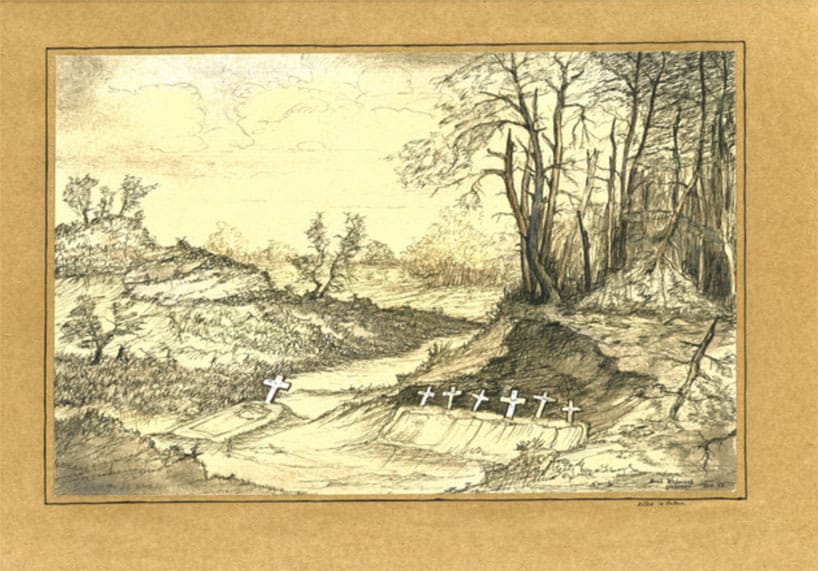
Together with six of his comrades, he was temporarily buried in the Helderse Bossen and reburied at Overloon War Cemetery on 29 May 1947.
The other comrades were: Albert Victor Bushell, Kenneth Erskine, Melvern Roy Guy, William Henry Lewis, Richard Scott, Anthony Tuohy and Wil van der Burgt.
Family Background
John was the son of David and Agnes Irvine of Paddington, London. Military records indicate that John was born in Belfast in Northern Ireland.
Only one couple named David and Agnes Irvine were found living in Paddington in September 1939. It is thought that these were David Irvine and Agnes Magee who had married in 1912 in the Pottinger district of Belfast. This district lay to the east of the River Lagan, near Belfast city centre.
In September 1939, they were living at St Stephen’s Gardens, Notting Hill, Kensington and Chelsea, Paddington. This lies between Paddington Station and Notting Hill. David was shown as born on 8 May 1891 and was working as a Builder’s Labourer. Agnes was born on 4 December 1891 and was working in a hotel. With them was a son, David J Irvine born 29 January 1913 who was unemployed. There was a closed record suggesting the presence of another child, thought to be John Irvine. Also present was Thomas Magee born 9 December 1900 who was also a Builder’s Labourer – shown as married but no wife present.
David Irvine had served in WW1. He enlisted on 1 December 1914 as a Private in the 15th or 16th Battalion of the Cheshire Regiment and joined them at Birkenhead the following day. His Service Number while in that regiment was 16/20943. On enlistment he gave his age as 24. His address was 12 Frankfort St, Belfast and he was a Labourer. It was noted that he had married Agnes Magee on 8 July 1912 at St Anne’s Belfast. She was given as his next of kin at 12 Frankfort Street. It was also noted that he had a son, David John Irvine, born on 29 January 1913 at Killinghy, County Down and baptised on 5 March 1913 in Belfast and a daughter, Mary Anne Irvine, born 20 June 1914 and baptised in Belfast on 22 January 1915. Other records show that David John Irvine was born at 35 Bread Street East, Belfast.
However, it was also noted in his service records that David Irvine’s daughter, Mary Anne Irvine, died of bronchitis on 15 March 1915 at Kingswood Street, Belfast aged just 8 months. The death was reported by Ellen Magee of 39 Skipton Street who was present at the death.
During his time in the Army, Agnes’ address was first changed to 5 Kingswood Street and then to 50 Trillick Street, Belfast. Kingswood Street and Trillick Street are close to each other in the same area of Belfast as David and Agnes had married.
David embarked for France on 30 January 1916 and served with the British Expeditionary Force until 31 January 1919. During this time, he was transferred first to 189 Labour Company in the Labour Corps on 14 May 1917 and then to 45 Labour Company on 7 April 1918. His Service Number was changed to 113035 when he joined the Labour Corps. He left France and was demobbed at Oswestry on 31 January 1919. He had 28 days leave on 3 February 1919. He was transferred to the Reserves on 3 March 1919 and the address given was 29 Douglas Street Belfast. He was awarded the WW1 British War Medal and Victory Medal which were sent to 29 Douglas Street, Belfast and acknowledged by him on 12 January 1921. This street was again in the Pottinger District.
David and Agnes had two more children, this time at 29 Douglas Street. They were Agnes born on 28 November 1919 and William born on 24 November 1920. Sadly, Agnes died when she was just 7 hours old and William when he was 5 weeks old on 31 December 1920. Ellen Magee of 9 Douglas Street was present at William’s death.
On 1 February 1923 David and Agnes had another child at 29 Douglas Street whom they again called William. It is thought that they then also had John Irvine, born 1925 in Belfast, though that birth record has not yet been seen.
David Irvine was still shown as living at 29 Douglas Street, Belfast in 1932 but by 1939 it was occupied by William Magee.
It seems that sometime between 1932 and 1939 David and Agnes moved to London. It seems likely that William did not come with them as only David and probably John appear to be with them in London in September 1939. William would only be 16 in 1939, so was most probably staying with relatives in Belfast. David John Irvine died in Paddington late in 1939 aged 26. It is not thought that he ever married.
Sadly, John Irvine died near Overloon on 15 October 1944, meaning that William was the only child left of the six which had been born to David and Agnes Irvine.
It seems that William was also serving in the Royal Ulster Rifles. It was reported in the Belfast Telegraph of 21/6/1944 that Rifleman William James Irvine of the Royal Ulster Rifles, husband of Mrs A Irvine, 10 Bangor Street, Belfast had been wounded.
It was then reported in the Belfast Telegraph of 11 November 1944 that Rifleman “Jack” Irvine RUR, younger brother of Rifleman W. Irvine of 10 Bangor Street, Belfast had been killed. It was stated that his parents resided in London.
John and William’s mother, Agnes Irvine died in the Kensington district in 1955 and David Irvine in the same district in 1959. Thomas Magee (born 9/12/1900) died in Aylesbury, Buckinghamshire in 1971.
John’s Brother William Irvine
William Irvine had married Annie Thompson at McQuiston Memorial Presbyterian Church in Knockbreda, Belfast on 3 November 1943. He was already in the Army and his father’s name was given as David Irvine. Annie Thompson was living at 10 Bangor Street at the time and it was noted that her father, William Thomson, was deceased. Annie was the daughter of William Thompson and Sarah McMonagle who had married on 1 September 1920 in Belfast. William and Sarah seem to have had at least four children, all in Belfast: William born on 4 February 1921, Annie (or Anna) born 1 April 1922, David born 28 February 1924 and Maureen (birth year unknown). However, Wiliam died on 18 March 1921 when he was just 6 weeks old.
From at least 1939 to 1947, it was a Mrs Fanny McMonagle who was the householder at 10 Bangor Street. It seems that William and Annie lived with her. She was Annie’s widowed grandmother. She died on 24 January 1947, aged 76 and is buried in Dundonald Cemetery. She was buried alongside what are thought to be two of her own children: Robert McMonagle who had died aged 14 on 8 November 1920 and John McMonagle aged 45 who had died on 23 May 1942 – and also her grandson William Thompson who had died on 18 March 1921. After her death, it was Sarah Thompson who was shown as the householder living at 10 Bangor Street. It is likely that several generations of this family were living together, including William Irvine. Sarah Thompson, still of 10 Bangor Street, died on 2 March 1966. She was buried alongside her mother. At the time of her mother’s death, Annie Irvine was now living at 26 Clandeboye Street, Belfast. William Irvine may have died by then. It seems they had at least 5 children as follows: David, William, Iris, Martha and Kathleen.
John’s Parents’ Background
Agnes Magee was the daughter of William and Ellen Magee. In 1901 they were living at 28 Dufferin Street, Pottinger, Down. William was born in 1872 and Ellen in 1874, both in Antrim. With them were children as follows: Agnes b 1892, Georgina b 1895, William b 1896, Maggie b 1897 and Thomas b 1901. All the children were born at Ballymacarret in Belfast City. Ballymacarret is part of the Pottinger District of Belfast. The family were not found in later censuses, but a William Magee, born in Ballymacarret in 1896 was found in 1921. He was a Private in the 4th Battalion of the Worcestershire Regiment. He was serving in Germany with the Army of the Rhine. It has been seen that Thomas Magee was living with his sister in Paddington in 1939. Agnes’ father, William Magee, died on 30 November 1940, aged 68, and is buried in the Dundonald Cemetery, Belfast. Her mother, Ellen Magee, died on 11 October 1943, aged 74 and is buried in the same cemetery.
David Irvine was the son of David John and Annie Irvine. In 1901 they were living in Pottinger, Down. Both were born in Down in 1857/9. With them in 1901 were children as follows: Agnes b 1884, Mary b 1884, Elizabeth b 1886, Hugh b 1888, Sarah b 1890, David b 1891, Maggie b 1897, Ellen b 1899. All the children were born in Down. They were living in Portallo Street, Down in 1911 which was again in the Pottinger district. The same children (excluding Agnes, Hugh and Sarah) were still present and also Martha b 1902 and Harriet b 1904 – both born in Down. There too was Sarah Stewart aged 22 who was a Boarder. Young David was working as a Milk Vendor. His religion was given as Congregationalist.