Laggett | Ronald


Biography
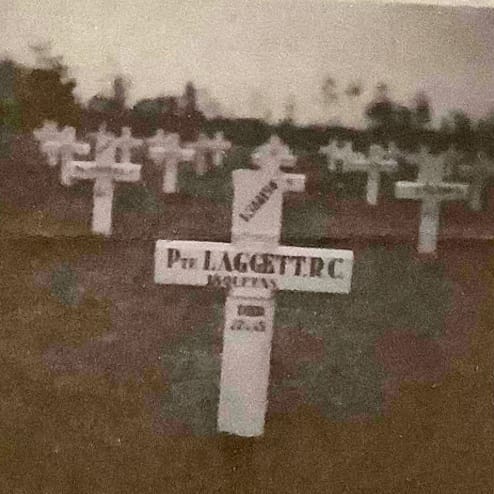
Ronald Laggett (service number 14388156) died on April 27, 1945, as a result of a heart rhythm disorder. He was 20 years old and was a soldier in the Queen’s Royal Regiment (West Surrey), 1/6th Battalion. He was initially buried at Margraten Cemetery in the Netherlands and reburied on May 1, 1947, in grave IV.A.7 at Overloon War Cemetery. The inscription on his grave reads: “Rest eternal grant them, shed on them the radiance of the heavenly light”.
Family background
Ronald Charles Laggett was born on June 3, 1924, in Westhampnett, Sussex, England.
His parents were Charles Morris Laggett (1879–1962) and Edith Warren (1889–1975).
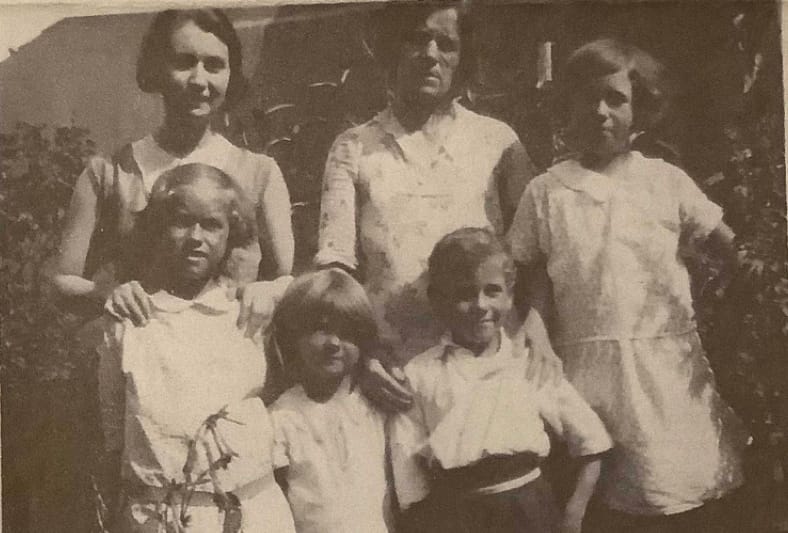
He had at least four sisters: Nellie Laura (1910–1976), Edith May Laggett (1918–1994), Vera Gertrude Laggett (1921–1999), and Irene Joan Laggett (1926– ).
They lived at 4 Scott Street in Bognor Regis, West Sussex in southern England. Charles, his father, was a gardener. Ronald was a milk roundsman when he enlisted.
Bognor Regis
Bognor Regis is a town and seaside resort in West Sussex on the south coast of England. Bognor used to be a fishing (and smuggling) village with a harbor, until it was transformed into a seaside resort. It was a place located in a frontline province at war; of a people who endured the dangers and hardships of wartime, prepared to face the invader, opened their doors to displaced persons and housed military personnel, and contributed in numerous ways to the broader war effort.
On the beach between Bognor Regis and Aldwick lies the wreck of a floating pontoon that was once part of the Mulberry floating harbors used by the Allies to invade the French coast on D-Day, June 6, 1944. It broke loose during a storm on June 4, the day before it was due to cross the English Channel to Arromanches, and was left behind. Shortly after D-Day, it washed up on the beach.
They were designed in 1942 and then built in less than a year in the utmost secrecy. Within hours of the Allies creating bridgeheads after D-Day, sections of the two prefabricated harbors were towed across the English Channel from southern England and placed off the coast of Omaha Beach (Mulberry “A”) and Gold Beach (Mulberry “B”), along with old ships that would be used as breakwaters.
The Mulberry B harbor at Gold Beach was used for ten months after D-Day, supplying more than two million men, four million tons of supplies, and half a million vehicles before it was completely decommissioned. The partially completed Mulberry A harbor at Omaha Beach was damaged by a severe storm on June 19. After three days, the storm finally subsided and the damage was found to be so severe that the harbor was abandoned and the Americans resorted to landing troops and equipment on the open beaches.
Military background
Ronald Charles Laggett began his military career on December 17, 1942, with the Queen’s Royal Regiment. After completing his basic training, he was transferred to the 2nd Battalion of the East Surrey Regiment in Great Britain on April 27, 1943. While the active battalions of this regiment were fighting in North Africa and Italy, Ronald and his battalion focused on defending the homeland and preparing for the invasion of Europe.
On April 16, 1944, he returned to the 1/6 Battalion of the Queen’s Royal Regiment. Training during this period was extensive and intense. While the troops practiced cooperation with the RAF, war was already looming: during their exercises in England, the troops were regularly fired upon by enemy German machine guns from the air.
On April 28, a Reinforcement Unit of this battalion was established, to which Ronald was assigned, under the command of Captain G.A.R.N. Warren, awaiting deployment.
In May 1944, the battalion was fully prepared for Normandy. Vehicles were waterproofed and the troops were prepared with tactical training, lectures, and inspections. While the vehicles traveled by road to the coast, the troops traveled by train to the assembly camps. The men received their mess tin rations and French francs to get through the first week in France. In early June, they embarked at the Royal Albert Dock and Tilbury Docks, after which their convoy anchored at Southend, waiting for the go-ahead.
The Landing and the Battle of the Bocage
While the first waves of soldiers stormed the beaches on June 6, Ronald was briefed on the progress in the camps. Between June 7 and 9, his convoy sailed through the Strait of Dover under cover of a smoke screen. On June 10, 1944, the arrival at Gold Beach was complete and the entire battalion gathered at Sommervieu, near Bayeux.
For Ronald, the battle in France had now officially begun.
As part of the 131st Brigade of the famous 7th Armored Division (the “Desert Rats”), Ronald marched through the treacherous Normandy countryside. It was a war of attrition in the “Bocage”: an area full of dense hedges where a German ambush could lie behind every bush. The advance took them past places such as Briquessard, Grentheville, and Fontenay-le-Marmion.
August 3, 1944: The Day of the Disappearance
At the beginning of August, the battalion was near Aunay-sur-Odon / Jurques, a little south of Caen, during Operation Bluecoat. The day of August 3 began hopeful with a successful ambush on a German column, but in the afternoon disaster struck.
At 2:50 p.m., the enemy launched a massive counterattack with infantry and tanks under cover of a smoke screen. The fighting was unprecedentedly fierce; although German tanks were destroyed, the British anti-tank guns were put out of action and the positions were overrun. Around 4:00 p.m., D Company and parts of B Company were completely overrun by the advancing German armour.
In the chaos of this surprise attack, the toll was assessed: the battalion suffered heavy losses with 161 casualties, including 23 dead, 45 wounded, and 93 missing. This was the day Ronald Laggett was reported missing. He was one of the men who fell into enemy hands during the fierce fighting.
Prisoner of War: Stalag IV-B and IV-D
After the chaotic fighting on August 3, 1944, Ronald Laggett’s fate remained unclear for some time. While his unit attempted to restore the lines, he was officially registered as missing. Only later did confirmation arrive that he had been taken prisoner during the surprise attack on his company. From the battlefield in the Normandy “Bocage,” an uncertain journey deep into the German Reich began for him. He was registered as prisoner of war number 71010 and transferred to Stalag IV-B.
Stalag IV-B was one of Nazi Germany’s largest and most multinational prisoner-of-war camps. The camp was located about 8 kilometers northeast of the town of Mühlberg, in what is now the state of Brandenburg. Upon his arrival, Ronald found a huge, fenced-in city of barracks, where tens of thousands of men from all corners of the world were imprisoned.
The camp was a melting pot of nationalities: in addition to British soldiers like Ronald, the Germans also held Polish, French, Australian, Soviet, Yugoslavian, South African, and Italian prisoners of war. Despite the harsh conditions, the scarcity of food, and the constant threat from the guards, a close-knit community developed among the Allied prisoners in Stalag IV-B.
For Ronald, this meant the end of his active participation in the war, but the beginning of a new, exhausting ordeal: surviving behind barbed wire, far from the front, awaiting eventual liberation.
Life in the camp was a daily struggle against the elements. Stalag IV-B was extremely overcrowded, especially in early 1945 when no fewer than 30,000 prisoners – including 7,250 British – were crammed together. Hygiene was poor, food rations were minimal, and diseases such as tuberculosis and typhus claimed the lives of some 3,000 prisoners.
From this main camp, many prisoners were sent as forced laborers to various Arbeitskommandos in the region. In early 1945, an evacuation order was suddenly issued. In the chaos of the approaching front, the prisoners of war were hastily loaded onto transport trucks before the lines shifted again.
It is not known whether Ronald was still in Stalag IV-B because, according to his Service Record, he was transferred at an unknown date to Stalag IV-D in Torgau, a town on the Elbe that would later become world famous as the place where the American and Soviet armies first met. Stalag IV-D was not a traditional barracks camp, but consisted of requisitioned buildings in the city itself, including a former printing plant and a non-commissioned officers’ school.
Although Torgau served as the administrative center for tens of thousands of forced laborers in the surrounding mines and factories, in the final phase of the war, the main camp also served as a “Heilag”: a gathering place for sick and wounded prisoners who were eligible for repatriation or exchange. There were hopes of a return home, but these exchanges never took place because the British army command feared that exchanged German prisoners would immediately be deployed back to the front.
Liberation and the Tragic End
The long-awaited freedom came at the end of April 1945. While the Red Army liberated Stalag IV-B on April 23, Allied troops reached Torgau on April 25. Ronald was finally liberated in Bennewitz, near Leipzig.
However, after months of undermining, poor nutrition, and the enormous physical and mental pressure of camp life, his body was exhausted. He was transferred to an American evacuation hospital in Naumburg for medical care. The hope of a safe return home was now within reach, but it was not to be. Just a few days after his liberation, his heart gave out; Ronald Laggett died in the hospital from the effects of a heart rhythm disorder (complete heart block).
Ronald survived the hell of the Bocage, the ambush of his company, and the hardships of the German camps, only to succumb in the early days of peace.
A year of hope and fear
While the world celebrated victory in Europe in May 1945, Ronald’s parents, Mr. and Mrs. Laggett from Bognor Regis, entered a grueling period of uncertainty. They knew that their son had been captured in Normandy in August 1944, but after that, there had been virtually no news. During the entire period that Ronald was away from home, they had received only one letter from him.
Month after month, there was no news of his release or repatriation. While other soldiers returned home, the door at 4 Scott Street remained closed.
The shock was therefore immense when, on May 20, 1946— more than a year after the actual liberation of the camps — an official message from the War Office finally arrived. It was not the announcement of his return, but the news of his death. Only then did his parents learn that their son had died thirteen months earlier, shortly after his liberation by the Americans in Bennewitz.
The bitter timing of the news was particularly painful: Ronald would have celebrated his 22nd birthday the following Monday.
Shortly after the official notification, an article appeared in the local newspaper of Bognor Regis under the headline: “Bad news for parents in Bognor: Son died shortly after liberation.” The newspaper described the tragic turn of events and expressed its condolences on behalf of the entire community of Bognor Regis. The article summarized the young soldier’s sacrifice: called up in 1943, captured during the Battle of Normandy, and dying just when freedom was within reach.
The letter from the War Office concluded with words of deep sympathy for the parents, who after a year of uncertainty saw their hopes turn definitively to mourning. Ronald Charles Laggett died for freedom, but the scars of his struggle were long borne by those who waited for him in Bognor Regis.
Ronald was initially buried by the Americans in Margraten in the Netherlands, but in 1947 he found his final resting place at the British Overloon War Cemetery also in the Netherlands in Grave IV. A.7. He rests there as one of the many who lived to see liberation, but did not live to experience freedom itself.
Ronald had served for 1 year and 175 days in the UK and 322 days in North West Europe. He was awarded the 1939-45 Star, the France & Germany Star, and the War Medal 1939/45.
He is commemorated on the War Memorial in Bognor Regis.