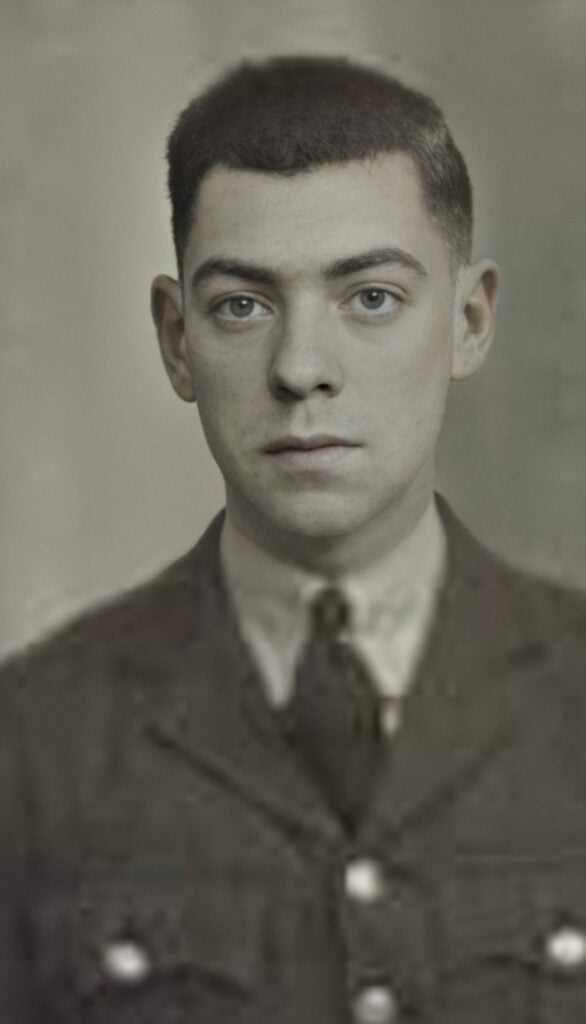
Murray | Hugh


Biography
Hugh Murray, Sergeant, flight engineer, was a member of the crew of the Stirling III BK718 which was shot down on 4th July 1943, either by Flak88 or Hayo Hermann (luftwaffepilot). They took off at 23.26 on 3rd July 1943 from West Wickham and crashed at Mehlem on the west bank of the Rhine, 10 km SSE of Bonn.
The crew is buried at Overloon War Cemetery, except Sgt I.H. Norris, who managed to leave the plane and was a Prisoner of War (POW).
The other crew members who died were:
Official information via findagrave.com:
Plane data: Short Stirling III
Serialnr. BK718
Call Sign: WP-M
Unit: 90 Sqdn.
Take off: 11:26 PM West Wickham airfield.
Target: Köln.
Operation: Bombing.
Shot down by FLAK.
Crashed at Bonn-Mehlem, Germany.
Buried Plot EEE-12-282 Allied cemetery Margraten, Netherlands.
Reburied 01/05/1947 Overloon War Cemetery.
The inscription on Hugh’s grave reads “Till the day dawns and the shadows flee away”.
Details of how Hugh came to be with this crew can be found in the extended side-story about the fate of the crew of the Stirling BK718.
Hugh Murray was born on 1st February, 1918, at 38a Hunter Street, Lochgelly, Fife, Scotland. He was the son of Hugh Murray who was a coal miner and Alison Nicol Erskine Murray (nee Wood) though Alison was always known as Alice. Hugh (Snr) was born in 1882 and Alice in 1890. They had married on 1st June 1907 at nearby Ballingry.
Hugh and Alice had four children as follows: William born 1907, Johanna born 1910, George born 1912, Hugh born 1918. Hugh and Alice also brought up a 5th child. She was Janet Leitch (born 1923) and was the daughter of Hugh Murray (Snr’s) niece – born out of wedlock – but was brought up by Hugh and Alice as their own child. She was a few years younger than Hugh (Jnr). The family were living in Lochgelly in 1911 and 1921.
Before the war, Hugh worked as a mechanic in Messrs. Alexander & Sons’ bus garage in Lochgelly.
As a child it was understood that Hugh was a haemophiliac. His nephew, also Hugh Murray, recalls his grandmother telling him that when Hugh came home with a nose bleed she knew she needed a bucket! Both he and his sister Audrey recall being told that Hugh attended hospital for a major operation probably when he was around 20, so around 1937/8. It seems that he did not suffer from haemophilia after all, but a similar illness which was cured by the removal of the spleen. It seems that, at the time, this was a very new procedure to cure this illness and he was treated as a case study for it. It seems, however, that neither Hugh nor his family were ever told that it wasn’t actually haemophilia. Hugh did appear to be cured, though Audrey says he was left with a large scar running round his waist from front to back on one side.
Audrey recalls that Hugh tried to join the RAF while in Scotland but was rejected as soon as they asked what had caused his scar and he said he’d had haemophilia. Someone advised him to go to England and apply there but that, if they asked about the scar, he was to say he didn’t know why it was there. He did this and he was accepted. He signed up in January 1939, 9 months before the start of the war.
Some time after his death, his mother was contacted by a doctor wishing to get in touch with Hugh to follow up his progress after the surgery for a medical paper – not knowing he had died in the war. A paper was published in September 1949 by H N Robson MB MRCPE, Lecturer, Dept of Medicine University of Edinburgh, in the Edinburgh Medical Journal in which it was noted that 16 out of 19 cases treated in this was between 1932 and 1949 had been successful. No doubt, had he lived, Hugh would have been included in this study.
Had he actually been a haemophiliac and not had the operation, he may not have been able to join the RAF and his life may have been saved.
Hugh’s father died in 1940 in Lochgelly, aged 58.
Hugh Murray married Frances McMillan Mitchell on 13th September 1941 in Lochee which is part of Dundee.

Frances McMillan Mitchell was born in 1915/16 in Forgan which is across the Tay from Dundee and near St Andrews. Her mother’s maiden name was Rae. Her father, James Mitchell, was born in 1873. Her mother, Jane Rae, was born in 1889. They probably married in Blythswood in Glasgow in 1905. They appear to have had children as follows:
David C born 1906, John R born 1908, Margaret S M C born 1910, Rachel C Mc born 1911, Frances Mc 1916
Hugh’s mother, Alice, lost both her parents in 1943, her father in the same month (July) as her son and her mother 5 months later. Both were in their 80s. It must have been quite devastating for her to lose her husband, son and parents in the space of only 3 years.
Hugh was reported missing in July 1943. It was recorded in the Fife Free Press of 17th July as follows:
“Reported missing – Sergeant Hugh Murray, Flight Engineer, RAF, youngest son of the late Mr Hugh Murray and of Mrs Murray 110 South Street, Lochgelly, is officially reported missing as a result of air operations. Hugh is 25 years of age and joined the RAF in January 1939, nine months before the outbreak of war. Before that he worked as a mechanic at the Lochgelly garage of Messrs Alexander & son Ltd.”
According to Alice’s grandson and granddaughter she never really accepted the fact that Hugh was dead. She had received Hugh’s log book and been told he was missing, presumed dead. She believed that perhaps he had lost his memory following the crash and would return home one day. This belief was also fuelled by a mistake when an ID tag for the wrong man was delivered to her – she thought perhaps there was a case of mistaken identity with the man who had died.
Sometime after the war, Ivor Norris visited Hugh’s mother as well as the relatives of the other crew members who had died. Her granddaughter, who was only young at the time, can remember seeing a man in uniform visit her grandmother. She rushed to tell her father that Uncle Hugh was back because he was in uniform. Instead, it was Ivor.
Perhaps to try to convince Alice that her son was dead, Ivor told her he had been driven past the crash site when initially taken prisoner. He said that only the tail was sticking out of the ground – the rest was so badly destroyed that no-one could have survived. However, it is clear from letters sent to his family from his PoW camp soon after the crash that he did not know the fate of his fellow crew members at that time.
The family lost touch with Hugh’s wife, Frances, who was probably with her own family in the Dundee area whilst Hugh was serving in England. They had been married only 20 months.
In August 1947 she was living care of the Mitchell family at 20 Caird Avenue, Dundee. She was in touch with Mr Harrie van Daal regarding his adoption of her husband’s grave at Overloon.
She wrote to him as follows on 19th August 1947:
“My dear Sir, some time ago I wrote to you inquiring about the adoption of my husband who was buried in Margareten American Cemetery, and as I fully realise the extent of work your kind task imposed on you have not worried about the lapse of time.
However, our Air Ministry have informed us that the body has been removed to the British Military Cemetery at Overloon. I shall repeat you information you requested. 632757 Sergeant Hugh Murray RAF Plot 3 Row A Grave Number I British Military Cemetery Overloon. Our religion is Church of Scotland, but that need be no object, as I should bless anyone kind enough to occasionally lay a flower on the grave of my loved one, no matter what their religious belief.
May I assure you that your country’s trial at this time is being followed with deep sympathy and interest by many like myself. Our prayers go out to Holland at this time and we pray that you may know no more sorrow but that peace will reign on the kindly people who find time to care for the graves of foreigners.
God be with your land and people now
Yours most faithfully,
Mrs Francis Murray.”
Mr. van Daal was the founder of the Overloon War Museum. He started a few weeks after the war was over, so he was way ahead in thinking and taking action. He was working as a clerk at the local municipality and he kept on asking and lobbying with the mayor of that time to make a museum. He did that because he was in Ypres, Belgium before WWII and saw all the destruction there because of the Great War. That’s why he was inspired to found a museum in Overloon. He adopted Hugh’s grave.
Frances went on to marry for a second time in 1949. Her husband was Thomas Henry G Kisby. The marriage took place in the St Clement area of Dundee.
A Dorothy Kisby was born in 1950 in Huntly, but it isn’t known if she was their daughter. Another person called Jean Ellen Mitchell Kisby married Bruce Sydney Paterson in 1975 in Dundee. The following comment was left by a Jean Paterson on 8th January 2020 alongside an online memorial to Hugh: “You always picked one of your mother’s roses to give to my mother for her buttonhole, much to your mother’s annoyance. Hope you’re picking her roses in heaven. You could have been my father but for the war. May you rest in peace.” Hugh’s nephew confirmed that his grandmother was indeed very proud of the roses she grew in her front garden but was unaware of a child by either of Frances’ marriages.
Alison Nicol Erskine Murray died in 1962 at Lochore aged 72. Lochore is just north of Lochgelly.
Frances McMillan Kisby died in 1984 aged 68 in Dundee.
Hugh’s birth family never knew where he was buried until 1993/4 when Audrey and her husband were at an event to commemorate war dead in their village of Metheringham in Lincolnshire which is the location of an old RAF base. They found themselves talking to Dick Breedijk from the Netherlands who has written books on RAF men who crashed in the eastern Netherlands. He found out a lot of information for them including the burial and re-interment.
Hugh’s nephew, who is the oldest surviving male of his line, has Hugh’s log book and in 2014, following the belated introduction of the Bomber Command Clasp (bar for the 1939-45 Star), applied for and received his medals.
His Uncle William was in the Navy for 20 years but his wife died of TB at age 25 and they had no children. Neither did his sister Johanna.
Janet Leitch (effectively Hugh’s little sister by 5 years) married John McArthur in 1945 and went on to have three children; Alison, William and Ian.
The family still have links with the RAF. The husband of Hugh’s niece, Audrey Graham, served in the RAF for 22 years; her son was in the RAF for 24 years and her grandson has served 10 years in the RAF – currently working in Belgium for NATO.