Perks | James


Biography
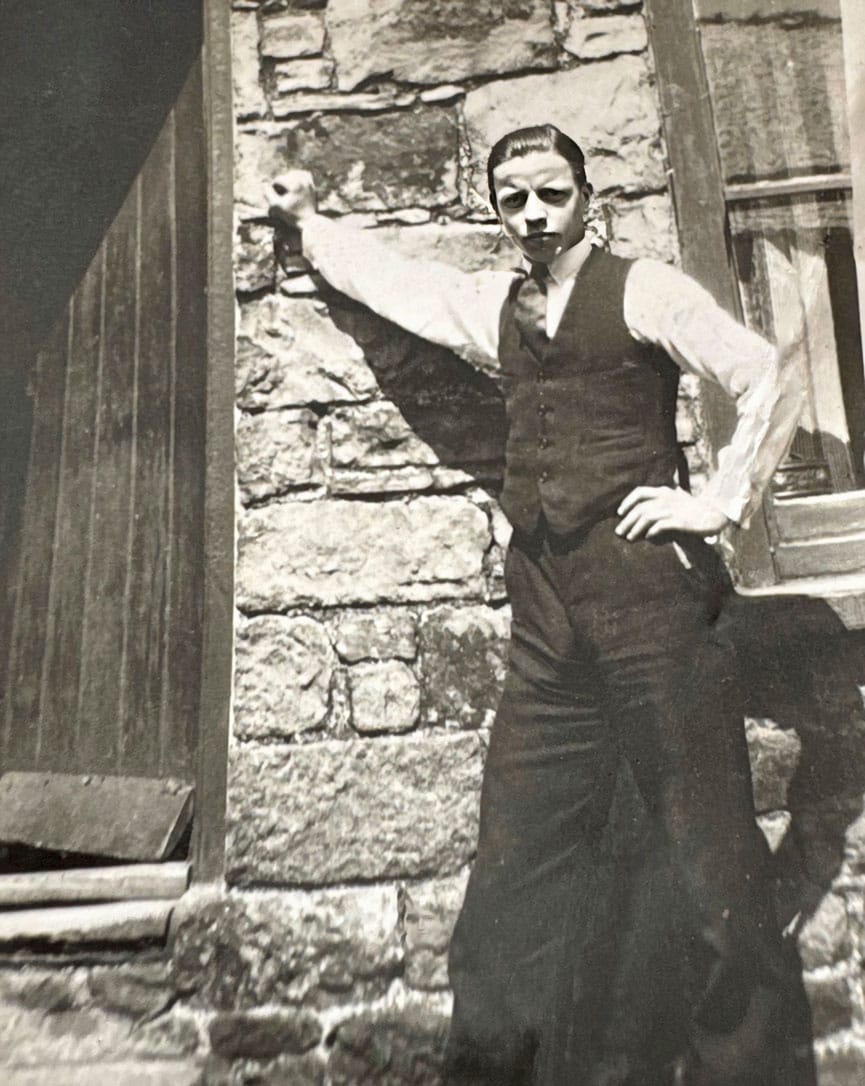
James Perks (Service No. 5120722) was killed in action on 14 October, 1944. He was a Lance Corporal in the 2ndBattalion of the Royal Warwickshire Regiment. He was initially buried at the Maria Regina Monastery at Stevensbeek and subsequently re-interred on 22 May 1947 in grave III. D. 11 at the Overloon Commonwealth War Graves Cemetery. The inscription on his grave reads “Gone from us but not forgotten never shall his memory fade.”
Family Background
James Perks was the son of James Perks and Mary Thomas (who was known as Polly) who had married in 1906 in Leominster, Herefordshire. James was born on 4/10/1911 at 5 George Street, Blaenavon and baptised on 25/10/1911 at the Parish Church in Blaenavon.
James Perks (Snr) had been born in Leominster in Herefordshire in 1872 to George and Elizabeth Perks. He was the eldest of seven children all of whom were born in Leominster. By 1901, James was living as a boarder at Three Elms Cottages, Huntington, Hereford in the household of George and Eliza Thomas. James was working as a Builder’s Labourer. George Thomas had been born in 1849 in Preston on Wye in Herefordshire and was a General Workman on a Farm. Eliza had been born in 1851 in Mansel Gamage, Herefordshire and was a Laundress.
Polly Thomas had been born in 1883 in Weobley, Herefordshire and was the daughter of Alice Thomas. Polly was one of six children, all born in Herefordshire. One of Polly’s uncles was the George Thomas with whom James Perks was boarding in 1901, which is probably how he and Polly met.
The locations named in Herefordshire are all northwest of Hereford and between it and the Welsh border.
Not only did James Perks marry Polly Thomas in 1906 in Leominster, his brother, Ernest Perks, who was born in 1879, married Polly’s sister Priscilla, who was born in 1888. This marriage took place in 1911 in the Abergavenny district of Monmouthshire in Wales which includes Blaenavon. This is in the Welsh valleys, known historically as a major centre for coal mining.
In 1911 James and Polly Perks were living at 5 George Street, Blaenavon. Ernest and Priscilla Perks were living with them. Also present was Polly’s youngest brother, George Thomas, who was born in 1890. James and Ernest were both working as Bricklayer’s Labourers while George was working as a Collier Filler. Priscilla was working as a domestic cook. Two girls who were described as James’ nieces were also living with them. These were Alice Maud Thomas born in 1907 in Treorchy, Glamorganshire and Dorthy Thomas, born in 1910 in Blaenavon. It isn’t certain whose children these were. However, on 12/2/1912, Alice Maud Perks, who had been born on 7/7/1907, was baptised with the father’s name given as James and mother as Mary. James was described as a Plasterer. It seems that James and Polly had taken Alice as their own. Similarly, by 1921, Dorothy was shown as the eldest child of Ernest and Priscilla.
As has been seen, James Perks (Jnr) was born to James and Polly on 4/10/1911 in Blaenavon. His sister, Lizzie, was born on 14/4/1914, also in Blaenavon.
James Perks (Jnr) attended the Boys’ Endowed School in Blaenavon. His School Report from March 1921 shows that he scored highly in his final terminal examination that year for Reading, Writing, English Composition, Arithmetic and Drawing. His conduct and punctuality were regarded as excellent. It was stated that he was fit for promotion to Standard 3 when the school reassembled on 4/4/1921.
In June 1921, James and Polly were still living at 5 George Street with Alice, James and Lizzie. James (Snr) was working as a Grave Digger for Blaenavon Urban District Council. Also living with them were two male lodgers aged 42 and 58. Meanwhile, Ernest and Priscilla were living at 27, Llanover Road, Blaenavon with Dorothy and had four more children.
However, James Perks (Snr) died in 1932 in the Abergavenny district.
James and Polly’s daughter, Alice Maud Perks, had married Thomas Wathen in Abergavenny district in 1928. He had been born on 25/11/1904. They had two girls there in 1929 and 1933. Their other daughter, Lizzie Perks, married John Henry Jones in the same district in 1934. John was born on 17/3/1909. They had one daughter there in 1934 and later had three more between 1938 and 1948 in Coventry.
Polly, James (Jnr) and at least one of her married daughters and family all left Wales for Coventry in the mid 1930’s. This was the time of the Great Depression when many moved elsewhere to find work. Polly remarried in Coventry in early 1936. Her husband was William Ernest Perks who was born on 26/11/1901. He was the son of her first husband’s brother.
James Perks married Frances Doreen Jones a few months later in 1936 in Coventry. She had been born on 26/3/1915 in Blaenavon to Thomas Jones and Elizabeth Ruth Jenkins who had married there in 1906. Her parents had both been born in Blaenavon, Thomas in 1880 and Elizabeth in 1882. She had two brothers, Idris born in 1907 and John in 1909. The family were living in Blaenavon in both 1911 and 1921. Thomas was a Stationary Engine Driver, but in 1921 was out of work, as were many men at that time. He had been working for the Blaenavon Iron and Steel Company. It is possible that it might have been Frances’ brother John who had married James’ sister Lizzie in 1934.
James and Frances had a child, Ruth H Perks, early in 1939. In September that year, the three of them were living at 117 Station Avenue, Coventry. James was working as a Mechanic but it is not clear in which industry.
They were one of three related households all living at that same address. James’ mother, Polly, was living there with her second husband and her married daughter, Alice Wathen. Polly’s husband was working as a Packer at a Motor Works while Alice was working as a daily help at the King’s Head Hotel. Alice’s husband, Thomas Wathen, was still living in Blaenavon at the Ivor Castle Inn, Ivor Street with his parents William and Sarah Wathen and his two daughters. It is understood that Alice’s presence in Coventry was temporary as she and her family lived in Wales for most of their lives. The third household living at 117 Station Avenue was that of John Henry Jones and his wife Betty. Betty was Polly’s other married daughter. They had their two eldest children with them. John was working at an Aluminium Foundry Furnace. Polly therefore had her three children Alice, James and Betty all living close to her at this time in 1939.
Military career
James Perks enlisted with the 2nd Battalion of the Royal Warwickshire Regiment on 26/6/1940. James would not therefore have been involved in the Battle of France or the evacuation from Dunkirk in June 1940.
After Dunkirk, the battalion moved to Somerset to counter a potential German invasion but in early December it was transferred to London and was not, unlike most of the rest of the Army, committed to beach defence duties. In September 1942, it was transferred to 185 Infantry Brigade which was then incorporated in the 3rd Infantry Division.
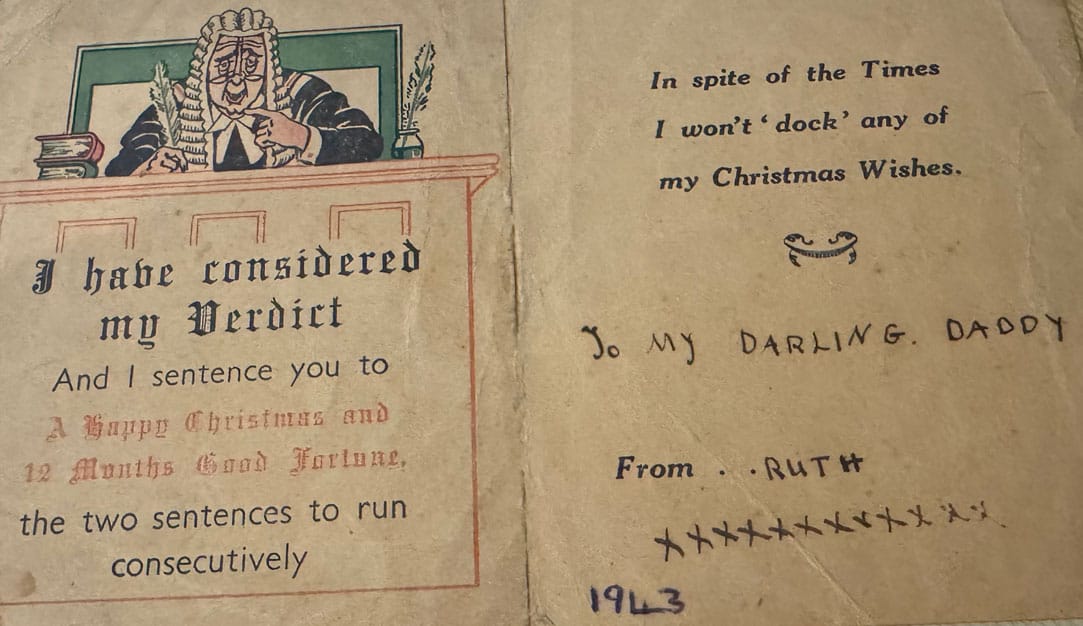
James received his last Christmas Card from Ruth at Christmas 1943, which she still keeps.
The 3rd Infantry Division landed on D-Day on 6 June 1944 with the first assault on the Normandy beaches.
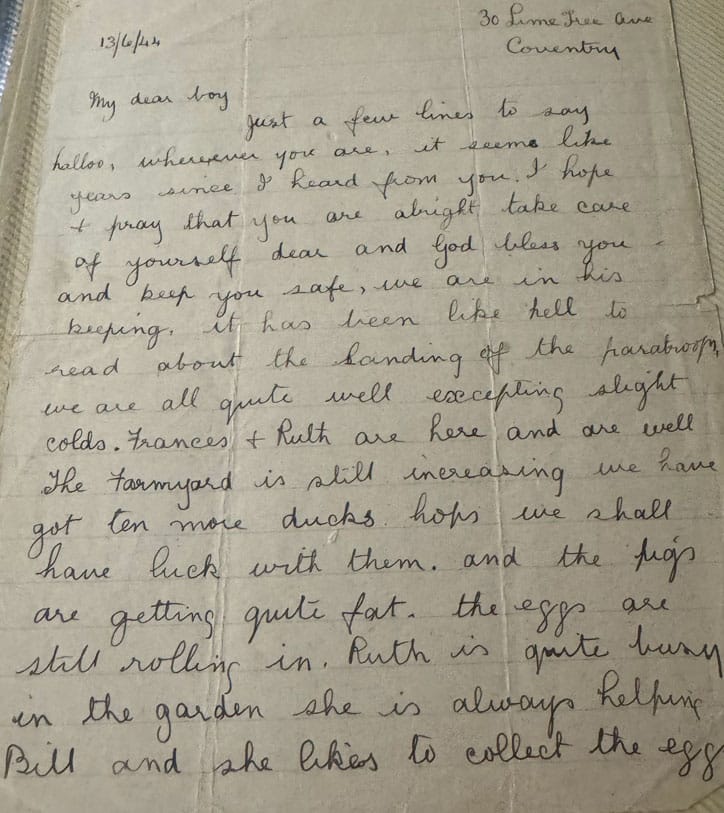
His mother, clearly concerned at hearing that the assault had started, wrote the following to him on 13/6/1944 from 30 Lime Tree Avenue, Coventry:
“My dear boy,
Just a few lines to say hello wherever you are, it seems like years since I heard from you. I hope and pray that you are alright take care of yourself dear and God bless you and keep you safe, we are in his keeping. It has been like hell to read about the landings of the paratroops. We are all quite well excepting slight colds. Frances and Ruth are here and are well. The farmyard is still increasing. We have got 10 more ducks hope we shall have luck with them. And the pigs are getting quite fat. The eggs are still rolling in. Ruth is quite busy in the garden, she is always helping Bill. And she likes to collect the eggs.”
The Battalion fought through the Battle for Caen and the break out from Normandy then pushed on through Belgium, entering the Netherlands at Asten on 22 September, 1944. This is to the east of Eindhoven.
Following the failure to take the bridge at Arnhem in Operation Market Garden in late September 1944, the Allied Forces were left in a very precarious narrow salient through the Netherlands.
On 1 October, in drenching rain, the Battalion moved north east to Malden which is between Nijmegen and the River Maas. It was now the aim of Operation Aintree to widen the salient by heading south from Nijmegen to take Overloon and then Venray before finally eliminating a German bridgehead on the River Maas near Venlo. Initially, the US 7thArmoured Division was to undertake this task while British forces, including the 3rd Division, would move eastward, across the German frontier, and capture the forest area known as the Reichswald, from which the Germans had been launching counter attacks.
However, by 9 October, the plan changed. An attempt by the US 7th Armoured Division to take Overloon and Venray had lost many men and tanks without making much headway. Field Marshal Montgomery decided that he must postpone the Reichswald attack. He needed to clear the Scheldt estuary to open the badly needed port facilities of Antwerp and the lesser, but also essential, task of eliminating the German forces west of the Maas. The latter objective was entrusted to 8 Corps, including the 3rd Division. The 3rd Division was to attack south east to Venray, in the hope of drawing off enemy forces while three other divisions prepared to advance eastward to Venlo.
The Battalion therefore turned southwards and by 12 October they had moved to near Wanroy, a village south of the Maas and just north of Overloon. They took over from 8 Infantry Brigade which succeeded in capturing Overloon that day but were unable to make progress through the woods south of it.
Sgt. George W A Davis later gave a vivid description of the conditions which were to come:
“The last good, long, sleep we had was about the 10th or 11th of October. Our clothes were filthy, we were near exhaustion, due to lack of food and sleep. It was very cold and rain and sleet all the time, so we were all wet. There were shells, mortar bombs, machine gunning, Moaning Minnies, rockets and German snipers all over the place.”
The following day the Battalion moved to a position just 500 yds north west of Overloon with the aim, along with the 2ndBattalion of the King’s Shropshire Light Infantry, of clearing these woods and then allowing the 1 Norfolk Battalion to pass through and advance on Venray. The Battalion achieved its objective, but they had come under heavy fire from enemy mortars, artillery and small arms fire as well as two tanks when they reached the open ground south of the wood and it had taken longer than expected to clear the woods. By the time the objective was reached it was so late that it was decided not to put the 1 Norfolk Battalion through until the next day. The Warwickshires dug in on the southern edge of the woods.
On 14 October, the 1 Norfolks continued the advance at first light, moving through the Warwickshire battalion astride the main road, while 9 Infantry Brigade attacked the woods to the west. They met very heavy opposition during the day and had to cope with swampy ground but by 1800 hours the 1 Norfolks had secured the high ground north of the Molenbeek which was a wide ditch and a major obstacle between Overloon and Venray. 9 Infantry were established in the north part of the woods. The 2 Warwickshires were then ordered to advance and secure the ground between the 1 Norfolks and 9 Brigade. B and D Companies performed this task and by dark were dug in to the right of the Norfolks overlooking the Molenbeek while A and C companies and battalion headquarters remained in their original positions. Even this limited move cost the Battalion 20 casualties with 15 men wounded and 5 killed, one of whom was Lance Corporal James Perks. The others were Privates NH Almey, J Hopson and RA Peen and Lance Corporal C Bailey who are also buried nearby at Overloon.
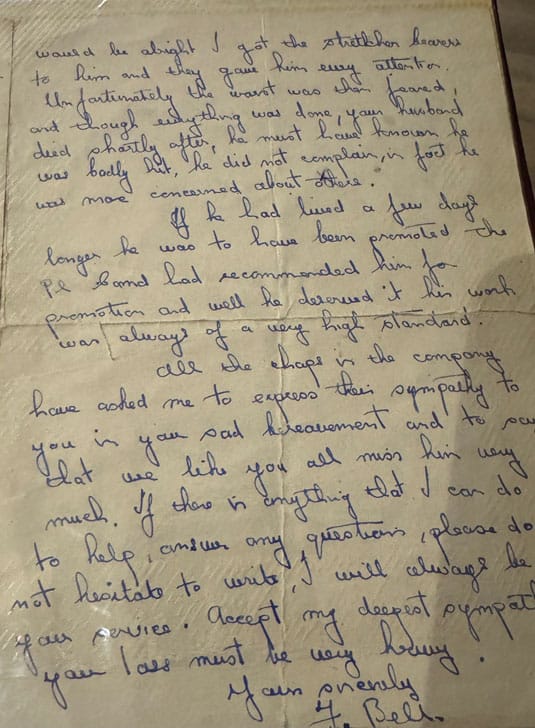
James had been in D Company. Major F. Bell who was in charge of D Company later wrote the following to James’ wife:
“Dear Mrs Perks,
I commanded this company in which your husband served. I thought that you would like to know how your husband met his death. That is in a little more detail than the War Office give. It grieves me to have to write a letter of this kind to you, I would far rather it could have been for some happy event instead of this. Your husband was an exceedingly good company man and very well liked. In this Pl he was quite a character and all men swore by he was very brave.
In the action in which he fell, we were advancing when the Germans started to shell heavily it was during this that your husband got hit with shrapnel. I was near at the time, but did not actually see it happen. I spoke to him asked him how he was and quite cheerfully he said he had been hit, but not to worry as he would be alright. I got the stretcher bearer to him and they gave him every attention. Unfortunately the worst was then feared, and though everything was done, your husband died shortly after, he must have known he was badly hit, he did not complain, in fact he was more concerned about others.
If he had lived a few days longer he was to have been promoted the Pl Comd. had recommended him for promotion, and well he deserved it his work was always of a very high standard.
All the chaps in the company have asked me to express their sympathy to you in your sad bereavement and to say that we like you all miss him very much. If there is anything I can do to help, answer any questions, please do not hesitate to write, I will always be at your service. Accept my deepest sympathy. Your loss must be very heavy.
Yours sincerely,
F. Bell.”
From D-Day until the end of the war the 2nd Battalion of the Royal Warwickshire Regiment lost 286 officers and men killed in action, with nearly another 1,000 all ranks wounded, missing or suffering from exhaustion.
Aftermath
After James’ death, Frances and Ruth moved back to Blaenavon to live with Frances’ family. This family support enabled Frances to work in a munitions factory for a time after the war.
Frances and Ruth moved back to Coventry around 1951. Again, Frances had to work, helped by James’ family in the area. However, in 1953 she married John James Credland in Coventry (known as Jim). They had no children of their own.
In 1955, the Royal British Legion organised a trip to Overloon for the children of the men buried there. KLM provided the flights for free. Ruth, who was then aged 16, stayed with a Dutch family in Nijmegen and visited the grave. Ruth was presented with a book featuring photographs of war cemeteries which included a message from Queen Elizabeth II before this trip.
Ruth married Ronald Kilford in Coventry in 1961.
James’ mother, Polly’s, second husband, William Ernest Perks of 30 Lime Tree Avenue, Coventry, died on 1/12/1966. She herself died in Coventry in 1969.
James’ wife, Frances, had a stroke in the 1960s and was not expected to live for more than 6 months. Both she and her husband moved in with Ruth in 1967. Sadly, Jim Credland died in 1970, aged just 58. Thankfully, Frances’ prognosis was wrong. She lived for many more years than expected, dying in Coventry in 2004. It is believed that she had been affected more than was generally realised by James’ death and was greatly helped by the support of her daughter. Both Frances and Ruth, who took on the responsibility of caring for her mother, were therefore also casualties of the war.
Ruth and Ronald had a daughter, Lorraine, in 1973 in Coventry. Ruth’s husband, Ronald, died in 1994.
Ruth continues to display a collection of memorabilia about her father at her Church on every Remembrance Day.
James is also commemorated on the Blaenavon Clock Tower Memorial.
Family photo’s and documents