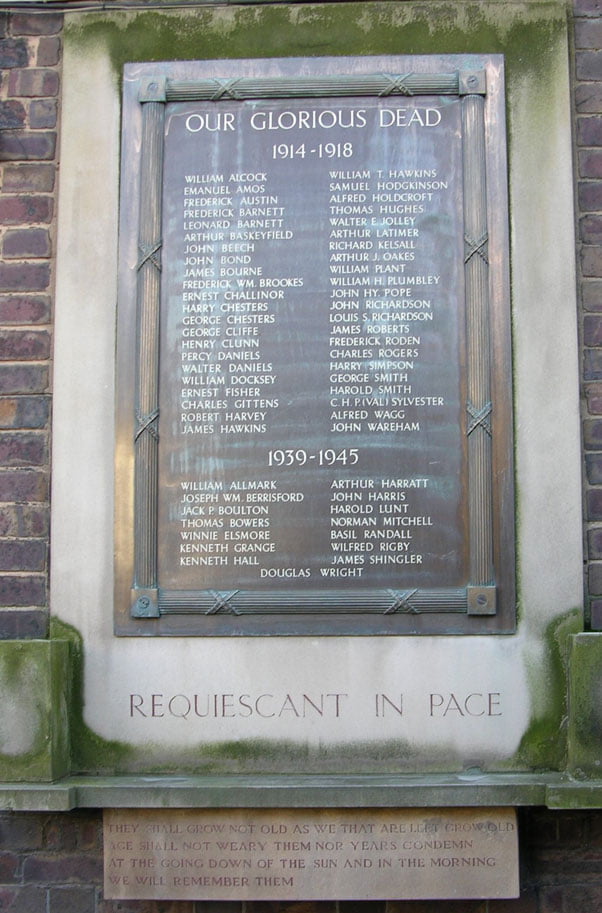
Rigby | Wilfred


Biography
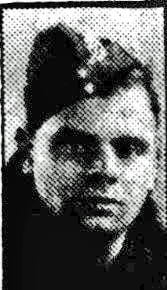
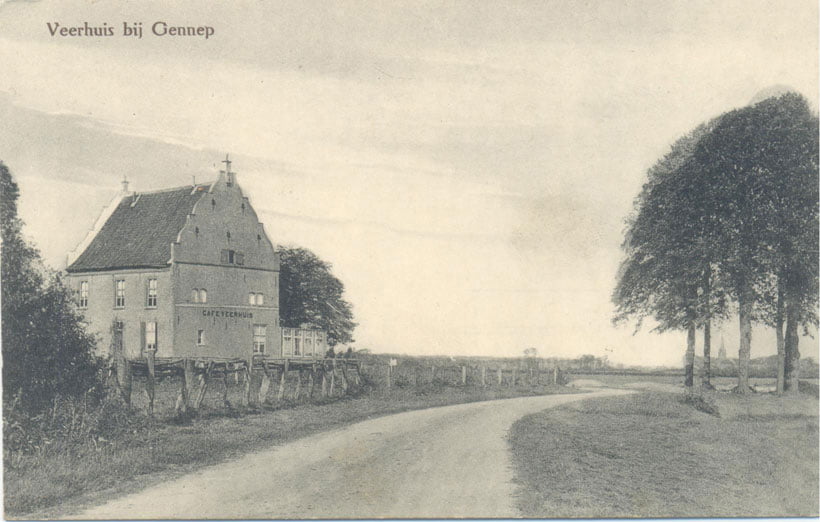
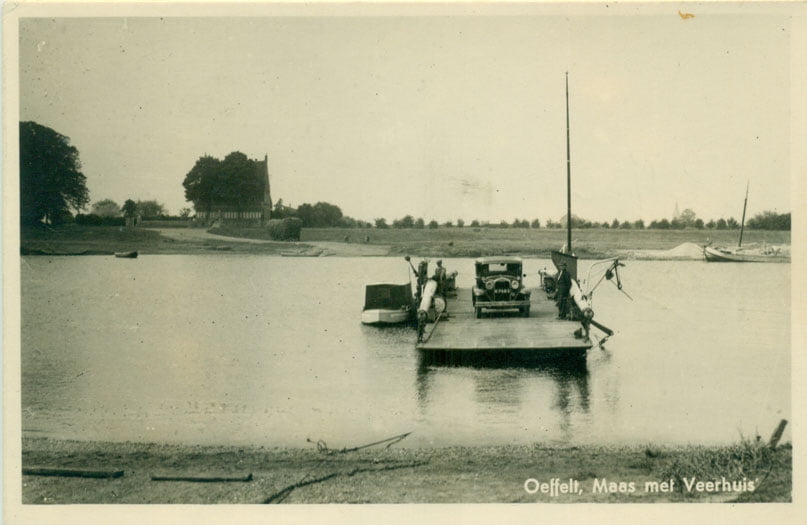
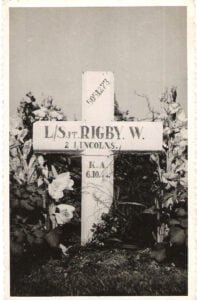
Wilfred Rigby was killed in action on 6 October 1944 in the vicinity of the ferry house (Het Veerhuis) in Oeffelt. He was aged 26 at the time. He was a Lance Serjeant in the 7th North Staffordhsire Regiment and the 2nd Battalion of the Lincolnshire Regiment (Service No. 5051273). He was initially buried at the village square in Haps and re-interred on 18 July 1946 in grave I. D. 4 in the Overloon CWGC Cemetery. The inscription on his grave reads “Greater love hath no man than like this “.
Family background
Wilfred was the son of Noah and Elizabeth Rigby, husband of Hilda Rigby and father of son Geoffrey, who was born in November 1944.
He had two brothers, Kenneth and Douglas.
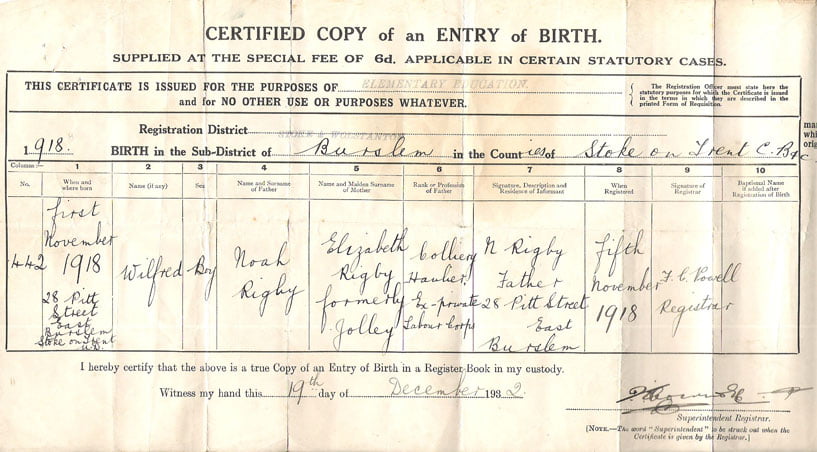
Wilfred is born at 28 Pitt Street East, Burslem, in Stoke on Trent. The family moved to 28 Collinson Road, Goldenhill, Stoke on Trent before 1928, and then to 39 Wharf Street, Middleport, Burslem, Stoke on Trent .
Wilf attended Middleport Senior school until 1932.
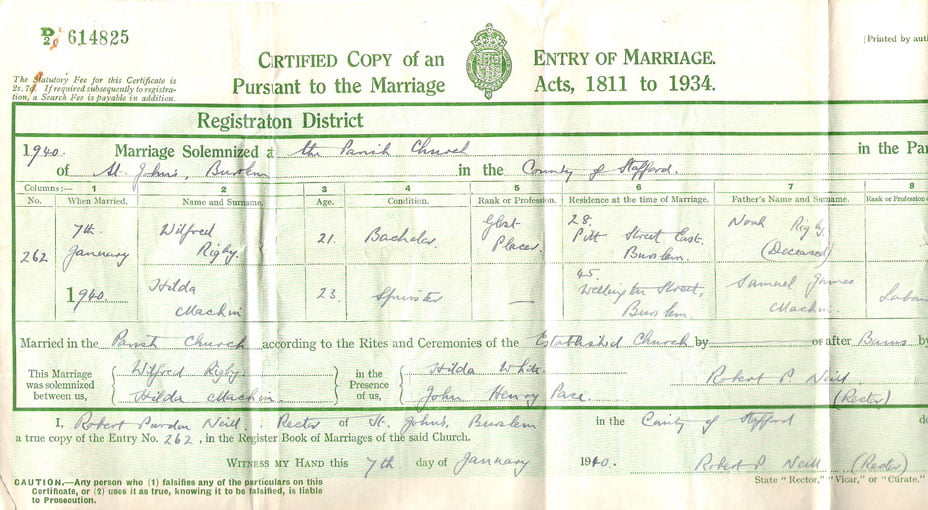
He worked at the famous Henry Doulton Pottery Manufactory in Stoke on Trent, working as a Glost Placer until 1939. This work involved carrying and placing ware into the kilns that were used to fire the famous pottery.
On 20th October 1939 he entered the North Staffordshire Regiment as an Infantryman. Wilf married Hilda Machin on 7th January 1940. Wilf’s only son Geoffrey was born 29th November 1944.
Memories by his son Geoffrey
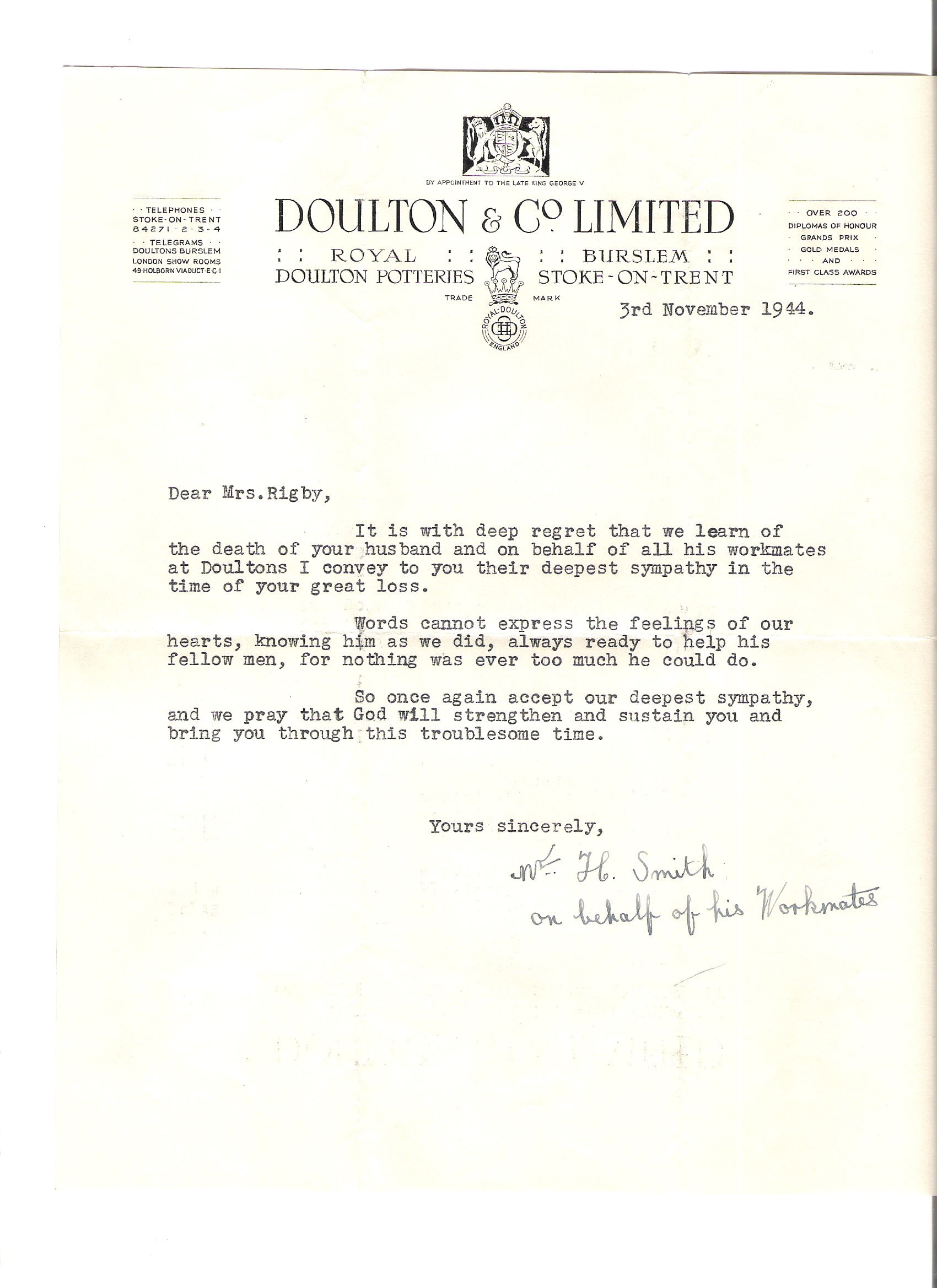
Geoffs father, Wilfred Rigby, was a Lance Sergeant in the British Army and was only 26 when he died. Wilfred’s wife, Geoffrey’s mother, received £35 8s 0d war gratuity in 1946 along with many telegrams and letters of condolence, including one from Doulton. Geoff was born a month after Wilfred died and knows little of his father’s military history. He recently brought down a box from the attic which was full of photographs, love letters and birthday cards Wilfred sent to his wife. There were also letters and documents relating to Wilfred’s death that have helped to build up a hazy picture of events at that time.
He had worked at the Doulton factory as a ‘placer’ before being conscripted to the North Staffs Regiment. His army number was 5051273 and was buried at Overloon, Holland.
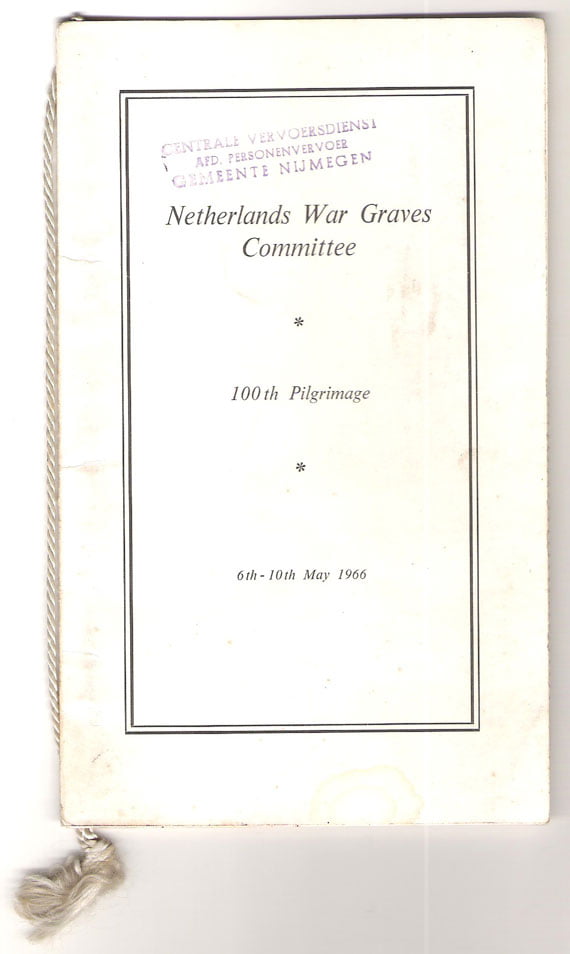
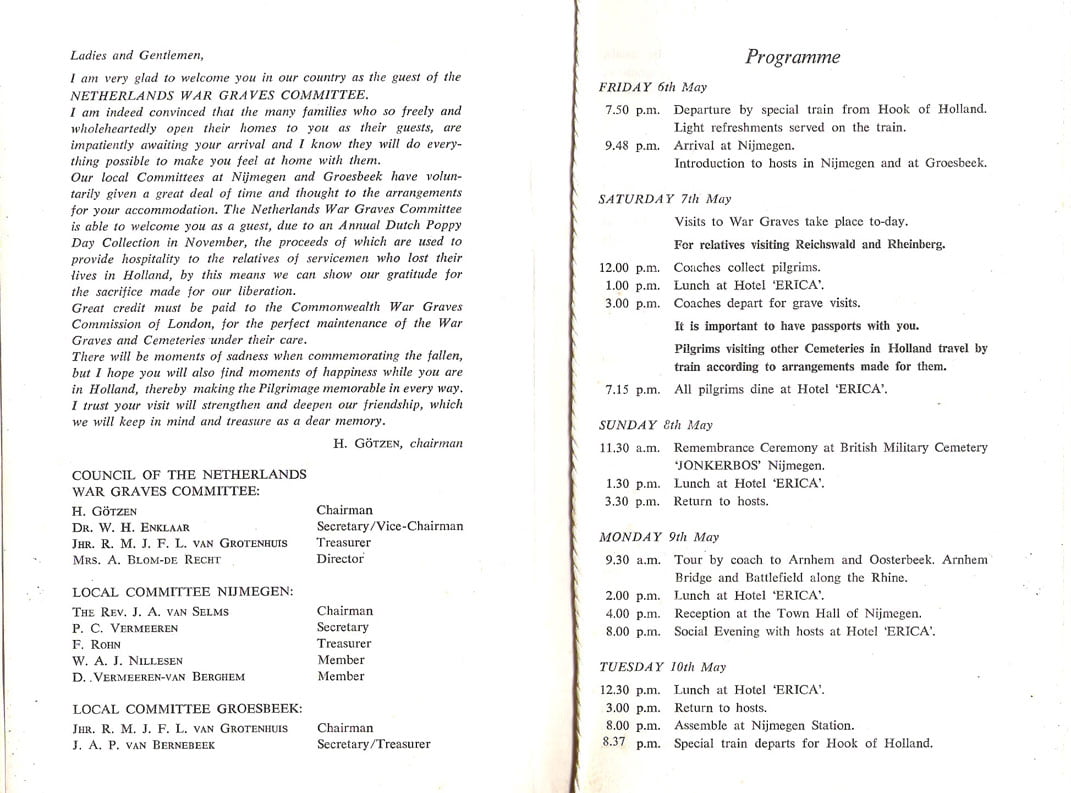
In 1966, twenty years later, Geoff’s mother came across an article in the Sentinel advertising a trip organised by the British Royal Legion to Holland to visit the war graves. It was the 100th pilgrimage organised by the Netherlands War Graves Committee. Geoff and his mother went on a four day visit to Holland and stayed with Mrs Harmsen and her family in Nijmegen at de Groenestraat 344. Geoff was able to visit his father’s final resting place and take part in a service of rememberance.
He has not been back to Overloon since, but has hopes to return in the future. Geoffrey has 2 sons and 3 grand children.
Geoff Rigby


Military background
In 1939 Wilfred Rigby was enlisted to the North Staffordshire Regiment 6th Bn. The North Staffordshire Regiment at that time consisted of two Regular and two Territorial battalions – the 1st and 2nd Regular and the 6th and 7th Territorials.
The two Territorial battalions formed part of 176th Infantry Brigade (which included both the 6th and 7th North Staffords and the 7th South Staffords) of 59th (Staffordshire) Infantry Division. The division trained in the United Kingdom for many years until it landed in Normandy in June 1944 as part of Operation Overlord where they fought in the Battle for Caen and gained an excellent reputation during Operation Charnwood and the Second Battle of the Odon.
However, only the 6th Battalion landed in France as the 7th Battalion had been transferred elsewhere in 1942, being replaced in the 176th Brigade by the 7th Royal Norfolks. The 6th Battalion had been in France for less than two months when, in August 1944, along with other infantry units of 59th Division, it was broken up to supply replacements to other British units, due to a severe shortage of infantry replacements throughout the Army at the time. It is likely that because of that Wilfred was assigned to the Lincolnshire Regiment 2nd bn.
This Battalion also took part in the D-Day landings in June 1944 and was then engaged throughout the Normandy Campaign, taking part in Operation Charnwood and Operation Goodwood.
They remained in Normandy until 15 September. They then took part in the push up through Belgium and the Netherlands with the aim of supporting the airborne troops engaged in Operation Market Garden which ultimately did not fully succeed following the failure to take the bridge at Arnhem in late September.
On 16 and 17 September the Battalion moved into Belgium near Mons. They found that the civil population were very enthusiastic, particularly in the area of the Belgian frontier. They then joined in the effort to cross the Escaut Canal where all the bridges had been blown by the enemy. They succeeded with other regiments in this difficult task in the face of opposition and a bridge was complete by 19 September. The Battalion moved on to Achel on 20 September where all ranks were able to get a night’s sleep under cover and then Hamont the following day where they remained until 25 September while the 11 Armoured Division took Deurne in the Netherlands. The Battalion moved to Deurne that day and took over from the 11 Armoured Division with the 2nd Battalion Royal Ulster Rifles. They remained in this area, sometimes engaging with the enemy who were on the east side of a canal. On 29 September they moved north to Milheeze and then Haps on 1 October.
The base of the 2nd Lincolnshire Regiment stayed in Haps from the 1st till the 12th of October. From there, attempts were made to clear the west side of the Meuse between Cuijk and Oeffelt. This was done together with 2nd Bn Royal Ulster Rifles, the 1st Bn King’s Own Scottish Borderers and 3rd Reconnaisance Regiment (9th Brigade 3rd Infantry Division).
On the east side of the Meuse, resistance remained strong, particularly in Middelaar, Milsbeek, and Gennep. The stone factory in Milsbeek served as the main center of opposition, as its tall chimney functioned as an observation post from which German artillery coordinated the defense. On the east side of the river, the enemy was also attacked from Plasmolen.
Between 1 and 7 October, the Ferry House in Oeffelt — Het Veerhuis — was repeatedly occupied by the enemy and then retaken by British forces. Patrols of the 2nd Lincolnshire Regiment discovered that the Ferry House had once again fallen into German hands. Despite heavy British artillery bombardments, German troops continued to appear around the stone factory in Milsbeek.
On 4 and 5 October, the chimney of the Milsbeek factory was finally brought down, and the church in Middelaar was reduced to rubble. On 6 October, the 2nd Lincolnshire Regiment launched another attack on the Ferry House — this time successfully. After intense shell fire, the first scouts found only an empty ruin. Despite the destruction, the remains of the building still stood firm.
It was on this day that sadly, Lance Serjeant Wilfred Rigby was killed in action.
He was buried in the village square in Haps. Three other British soldiers were also buried there in October 1944. They were comrades Francis Charles Cannings, and Warren James Harris, both from the 2nd Bn Lincolnshire Regiment and Jack Arthur Maddock Longhurst from the 7th Hampshire Regiment. The graves of these soldiers were lovingly tended by the inhabitants of the village of Haps and flowers were regularly laid there.
All four were buried side by side at Overloon War Cemetery on 18 July 1946.