
Cannings | Francis Charles


Biography
Francis Charles Cannings was killed in action on 5 October 1944 in the vicinity of Overloon. He was aged 20 at the time. He was a Private in the 2nd Battalion of the Lincolnshire Regiment (Service No. 5193748). He was initially buried at Dorpsplein, Haps and re-interred on 18 July 1946 in grave I. D. 2 in the Overloon CWGC Cemetery. The inscription on his grave reads “You live always in our memory, beloved son and brother.”
Francis’ Family Background
Francis (or Frank as he was generally known) was the son of Edward Charles and Ethel Mary Cannings of Axminster, Devon.
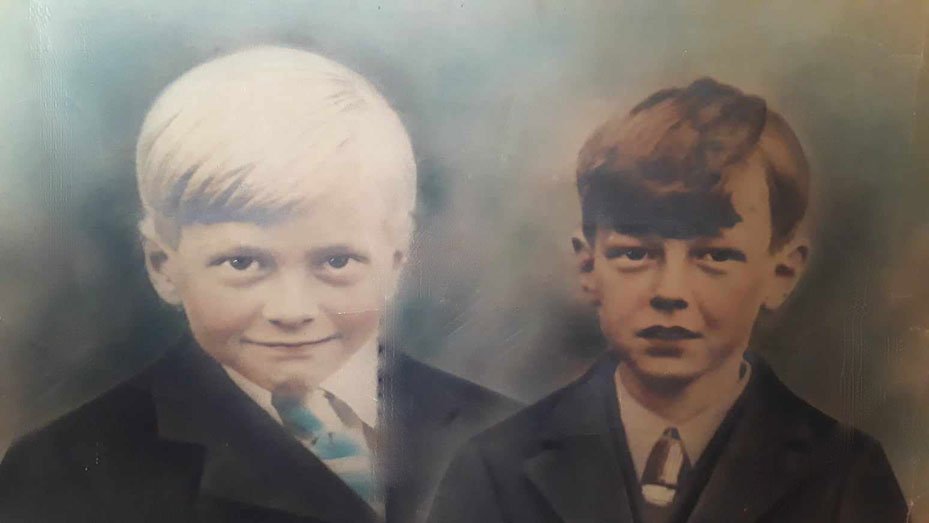
Edward Charles Cannings (known as Charles) had married Ethel Mary Critchell in Axminster in 1922. They went on to have two children: Francis Charles on 20 October 1923 and Michael E on 20 June 1926.
In September 1939 Charles and Ethel were living at 115 Whitstone Road, Shepton Mallet, Somerset. Charles was a Railway Permanent Way Inspector. Their son Michael was there but not Frank. Ethel’s 7 year old nephew, James Lawrie (born 13 October 1931) was also present. At this time, Frank was living with his uncle and his wife, Herbert (known as Jack) and Nora Cannings, at 35 Third Avenue, Denville, Havant, Hampshire. Jack was a Butcher Manager & Slaughterman and Frank was working as a Butcher’s Apprentice.
Curiously, in 1939, Frank’s birth date was given as 20 October 1922 rather than 1923. This may have been a simple mistake – but it could also relate to a family story which says that Frank tried to join up while under age but was recognised and sent home. A Francis Charles Cannings with Service No. 1827728 did indeed try to join the Royal Artillery in 1941 but there is a reference to this being cancelled on 12 August 1941. He finally enlisted on 9 February 1942. Most of the family worked for the railways so were in reserved occupations. As a butcher’s apprentice he was not protected, however, he was very determined to serve, whatever his father felt or said.
Sadly, he was killed in action on 5 October 1944.
The Shepton Mallet Journal of 27 October 1944 announced his death as follows, giving more details of his life before the war though with a few inaccuracies such as the country where he died:
“Roll of Honour – The many friends of Mr and Mrs E.C. Cannings have learned with deep regret of the loss they have sustained by the death in France on October 5th, 1944, of their son Frank, at the age of 20 years, and much sympathy has been extended to them. Mr and Mrs Cannings lived at 115, Whitstone Road, Shepton Mallet for many years. Mr Cannings having been the Permanent Way Inspector on the S. and D. Railway in this district for some 11 years. Recently he was transferred to Tavistock to take up a similar post. His son Frank was well known in the Town, starting his education here and then going on to Wells Blue School. Later he went to Portsmouth in business with his uncle, and afterwards to Frome, from which town he volunteered in the Army, and went to France with the Lincolnshire Regiment.”
Francis’ brother, Michael E Cannings married Joan Selway in Bristol in 1950. They had two children, Paula J Cannings in 1955 and Heather M Cannings in 1958, both born in Bristol.
Charles Cannings died in 1979 in Axminster and Ethel in 1983 near Bristol.
Michael E Cannings died in 1981 in Bristol.
Military Career
Frank Charles Cannings initially attested for the Army on 9 February 1942 at Bath. He gave his age as 18 and stated that he was born on 20 October 1923 at Axminster in Devon. He was described as 5ft 8 ¾ in tall and weighed 154 lbs. He had a fresh complexion, brown eyes and brown hair. He had been working as a Butcher’s Assistant. He gave his religion as Church of England. He had educational grade C and was declared grade 1 fit. He gave his address as 115 Whitstone Road, Shepton Mallet, Somerset. He named his father, Edward Charles Cannings, of that same address as his next of kin, though this later changed to 8 The Nook, Brooklands, Tavistock, Devon.
Frank was posted as a Private to No. 15 Infantry Training Centre of the 70th Battalion of the Gloucestershire Regiment at the Barracks in Gloucester on 9 February 1942 but he was immediately assigned to the reserves, only being embodied into his unit a few weeks later on 26 February 1942.
He was transferred to the 70th Battalion of the Northamptonshire Regiment on 12 August 1942. On 16 November 1942 he was given the rank of unpaid acting Lance Corporal. On 31 December 1942 he was permanently attached to No 1 Infantry Training Centre and employed on the permanent staff of 51 Primary Training Wing as instructor. On 28 January 1943 he was granted the position of Paid Lance Corporal. However, on 22 March 1943, he ceased to be employed on the permanent staff of 51 PTW and reverted to the rank of Private.
On 12 April 1943 he was posted to the 4th Battalion of the Northamptonshires. On 20 September 1943 he was confined to barracks for 14 days. He had been found smoking during the hours of darkness while on training and it seems he reacted badly as he was also accused of using obscene language to an NCO and refusing to obey an order given by an NCO.
He was assigned to 42 Reinforcement Holding Unit on 14 July 1944 and arrived in North West Europe on 18 July 1944. He was then assigned to 33 RHU on 20 July 1944 and then transferred to the 2nd Battalion of the Lincolnshire Regiment on 23 July 1944.
This Battalion had taken part in the D-Day landings in June 1944 and was then engaged in Operation Charnwood and Operation Goodwood which were part of the Battle for Caen. The Battalion had suffered heavy casualties. After Operation Goodwood, they were relieved by the South Lancashires on 22 July and it was on the day after this that Frank joined them. They were back on patrols by 25 July and continued to be involved in the Normandy Campaign. By mid August they were able to concentrate on training for the next stage of the war and have a period of rest and relaxation.
They remained in Normandy until 15 September. They then took part in the push up through Belgium and the Netherlands with the aim of supporting the airborne troops engaged in Operation Market Garden which ultimately did not fully succeed following the failure to take the bridge at Arnhem in late September.
On 16 and 17 September the Battalion moved into Belgium near Mons. They found that the civil population were very enthusiastic, particularly in the area of the Belgian frontier. They then joined in the effort to cross the Escaut Canal where all the bridges had been blown by the enemy. They succeeded with other regiments in this difficult task in the face of opposition and a bridge was complete by 19 September. The Battalion moved on to Achel on 20 September where all ranks were able to get a night’s sleep under cover and then Hamont the following day where they remained until 25 September while the 11 Armoured Division took Deurne in the Netherlands. The Battalion moved to Deurne that day and took over from the 11 Armoured Division with the 2nd Battalion Royal Ulster Rifles. They remained in this area, sometimes engaging with the enemy who were on the east side of a canal. On 29 September they moved north to Milheeze and then Haps on 1 October. One Company moved east to Oeffelt the next day with the aim of clearing the area west of the Meuse of small parties of the enemy. The Battalion was now within 6 miles of the German frontier. Other Companies took turns in Oeffelt in the next few days. On the night of 4/5 October, patrols from the forward Companies heard motor transport movements east of river. “A” Company patrol came into contact with the enemy who had crossed the river. The enemy were engaged and two believed hit. However, the patrol suffered two casualties – 1 Ordinary Rank killed and 1 wounded. The man who was killed was presumably Francis Charles Cannings.
He had served for a total of 2 years and 240 days. He was awarded medals as follows: Medals 1939/45 Star, France & Germany Star, War Medal 1939/45.
His personal effects were sent to his mother, Mrs EM Cannings, on 5 March 1945 at 8 The Nook, Brooklands, Tavistock, Devon. They consisted of letters, a pen, a pair of spectacles, a cigarette case, his Identity disc, cap badge and some photos.
He was buried in the village square in Haps. Three other British soldiers were also buried there in October 1944. They were comrades Wilfred Rigby and Warren James Harris, both from the 2nd Bn Lincolnshire Regiment and Jack Arthur Maddock Longhurst from the 7th Hampshire Regiment. The graves of these soldiers were lovingly tended by the inhabitants of the village of Haps and flowers were regularly laid there.
All four were reburied side by side at Overloon War Cemetery on 18 July 1946.
Francis’ Father’s Family
Edward Charles Cannings was the son of Emanuel Edward Cannings and Anna Martin who had married in the Shaftsbury district of Dorset in 1893. Emanuel had been born on 19 October 1865 in Gillingham, near Shaftsbury in Dorset while Anna had been born on 11 July 1869 in Stour Provost in Dorset which is just to the south of Gillingham. They had eleven children as follows: Margaret Alice 1894, Gertrude Anna 1895, (Edward) Charles 21 January 1897, Elsie May 1898, George Henry 1900, Frank 1902, Reginald 1903, Dorothy Ellen 1905 (known as Nell), Herbert John 1907 (known as Jack), Florence Mary 1910 (known as Gwen) and (Frederick) William 1911. Several preferred to be called by their middle names as shown.
In 1901 Anna Cannings was living at Shaftesbury Road, King’s Court Lane, Gillingham, though Emanuel wasn’t present. With her were her first five children who were all born there and also her widowed father in law, George Cannings, aged 68. George continued to live with them until 1921 at least. Their next four children were born in Misterton which is between Yeovil and Axminster in Somerset between 1902 and 1907, suggesting they were living there at the time. By 1911, Emanuel and Anna were living at 10 Hillhead Terrace, Axminster where they remained.
Emanuel was a Railway Inspector, shown in 1921 more specifically as a Permanent Way Inspector for London & South West Railways and retired by 1939. Their first two children (Margaret Alice and Gertrude Anna) appear to have left home by 1911, and both married in 1919. However, the remaining children were still with their parents until at least 1921. Edward Charles was working as a Messenger in 1911, but by 1921 he was a Labourer for the L&SW Railway. In 1921 Elsie was working as a General Domestic Servant (but out of work); Frank was described as a Soldier on Furlough; Reginald was a Porter on the L&SW Railway and John was a Book Stall Lad for Messrs W H Smith & Son at Axminster station.
By 1939, only Nell Cannings was still living at Hillhead Terrace with her parents. Living with them was Frederick Ellis, born 4 July 1907 and working as a Carpet Factory Creeler – managing the racks that hold the spools of yarn. He married Nell later that year and they lived there for the rest of their lives.
Anna Cannings died in 1948 and Emanuel E Cannings in 1953, both in Axminster.
Francis’ Mother’s Family
Ethel Mary Critchell was the daughter of Benjamin Richard Critchell and Agnes Laura Robbins who had married in Dorchester, Dorset in 1893. Benjamin had been born in 1871 in Dorchester and Agnes in 1873 in Colyton which is near Axmouth in Devon. They had two children: Edward Thomas on 29 April 1894 in Bridport, Dorset and Ethel Mary on 3 August 1896 in Fordington, Dorset. However, a prison register shows that a warrant was issued for Benjamin Richard Critchell on 16 August 1901 for neglecting his wife and children. In that year Agnes was living with her two children at 26, Alington Road, Dorchester. It was stated that her husband was an engine driver but was absent.
By 1911, Agnes was living at Willhayes Cottages, Axminster, Devon. She was shown as a widow. A third child was present, Lavinia Irene Hyacinth Critchell, born 1909 in Axminster who was known to the family as Irene. Agnes had also taken in a widower as a lodger: George William Clarke, a 44 year old cowman born in Seaton in Devon. Agnes’ son, Edward, was working as a labourer. At the time of Irene’s birth Agnes was working as a dressmaker.
Agnes married for a second time in 1917 in Axminster. Her husband was William Barrell, born 24 December 1862. By 1939 they may have been living at 71 Cadogan House, Chelsea, London. William was working as a Commercial Clerk. She died in 1948 in Wokingham, Berkshire.
In 1921 Ethel was living at West Street, Axminster. She was a servant in the household of William Edwin Goldsmith Potter and his wife Kathleen. He was a House Furnisher and Kathleen and their 21 year old daughter Dorothy Banks were assistants in the business of Sulby Potter, House Furnisher.
Edward Thomas Critchell served in the Army in WW1 from 1914 to 1920. He seems to have initially served as a Private in the Welsh Regiment (No. 38859), then a Private in the Labour Corps (No. 361735), then a Corporal in the Welsh Regiment Territorial Force (No. 3947695). However, an article in the Somerset County Herald and Taunton Courier of 08 June 1946 reported that Edward Thomas Critchell (52), a temporary postman of 17 Chandos Street, Bridgewater was fined £10 for stealing postal packets. It was stated that only his previous good character and army record had saved him from going to prison. His defence pointed out that he had served in both World Wars and was discharged in 1942 as unfit, his papers reading “very good”. He had had great domestic trouble, had been hard up and was waiting to go into hospital to undergo a severe operation. There were no previous convictions. He had lost his job and was not qualified for any trade. Edward went on to marry a widow, Hilda I Stockham, in Bridgewater in 1949. He died in 1974 in Taunton.
Irene Critchell married John Elder Lawrie and had a son, James John Henry Lawrie on 13 October 1931 while living at 33 Queen Street Devonport. John Elder Lawrie was a Petty Officer Steward in the Royal Navy on board HMS Charybdis. He was born on 5 January 1904 in Leith in Scotland but died on war service on 23 October 1943. Irene Lawrie died on 30 June 1993 in Plymouth. Her address at the time was 182 Wolseley Road, North Prospect, Plymouth, Devon.

