
Rowntree | John


Biography
John Rowntree was born on 1st December, 1909 in Cleckheaton to John Robert Rowntree and his wife Elizabeth (nee Sanderson). Cleckheaton is just south of Bradford. The family were living at 6 St John’s Row, Cleckheaton at the time and he was baptised as St John’s Church there. John was shown on his birth record as John, but he tended to be known as Jack or Jackey in his childhood.
His father, John Robert Rowntree, had been born in Middlesbrough and had married Elizabeth Sanderson there in 1905, though she was from a long established family in Thorne near Doncaster. John Robert Rowntree’s widowed mother was living with another son in Little Horton Lane in Bradford by 1911 and Elizabeth was working as a housemaid for a Vicar and his family at Great Horton Road, Bradford from 1901, so this might be how they met.
However, they started married life in Stockton on Tees and seem to have moved first to Cleckheaton around 1908 and then to Bradford between 1911 and 1914. They had seven children in all. It is thought that Elizabeth died in 1922. This left John Robert Rowntree with a young family to bring up, including young John aged just 13. John Robert Rowntree went on to marry Annie Corcoran in 1928. She was about 16 years younger than him. It is thought they had more children. In his early years John Robert Rowntree was a Groom and at John’s birth in 1909 he was described as a “Teamer” who drove a team of horses, but by 1921 he was a Store Keeper for Bradford Town Council.
In 1933 John Rowntree married Nellie Marson in Bradford.
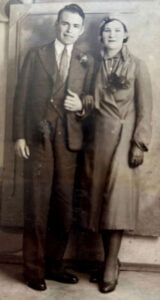
Nellie was born on 29th June 1910 in the village of Kinsley in the district of Hemsworth. Kinsley is between Fitzwilliam and Hemsworth – all being between Wakefield and Doncaster. Her parents were Walter and Ellen Marson (nee Attwood). Walter was born in Ackworth (between Pontefract and Hemsworth) while Ellen was born in Staffordshire. They had a total of eleven children. Walter was a coal miner at Hemsworth Colliery.
In September 1939 John and Nellie Rowntree were living at 98 Butler Street, Bradford. John was described as a Monumental Works Labourer – i.e. a Stone Mason. By this time, they had two children: Patricia Elizabeth born on 5th April, 1934 and John Neal Brian born on 3rd February 1937 and went on to have another, Norman, in 1941. It is thought that his father never saw Norman. All were born in Bradford.


Military carreer
Information obtained from the Royal Pioneer Corps Association indicates that John enlisted at Bradford and joined for training on 1 April 1940. He was a Private in what was then called the Auxilliary Military Pioneer Corps (service number 13015608).
In September 1939, a number of infantry and cavalry reservists had been formed into Works Labour Companies, which soon became the Auxiliary Military Pioneer Corps (AMPC). Pioneer units were combatant troops used for light engineering tasks. They performed a wide variety of tasks in all theatres of war, including full infantry, mine clearance, guarding bases, laying prefabricated track on beaches, and effecting various logistical operations. Almost as soon as his war service started, John Rowntree was captured on 25th May 1940 in the vicinity of Boulogne in France and sent to Stalag XXIB Schubin (PoW number: 2490).
Battle of France
The exact circumstances of his capture aren’t known – but the following gives as indication of what the AMPC was doing at that time. During the Battle of France in May 1940, No. 5 Group AMPC commanded by Lieutenant Colonel Donald Dean VC, were engaged in labouring tasks in the Doullens area, near Amiens, when the group were threatened by the advancing Germans. After requisitioning a train, and following a fire-fight with the leading German units, the Group were able to reach Boulogne-sur-Mer. Here Dean was ordered to help establish a defensive perimeter around the town. On 23 May, the Germans attacked in earnest; in fierce fighting at their barricades, the pioneers destroyed one tank by igniting petrol underneath it. The pioneers were the last to fall back from the perimeter and most were evacuated from the harbour.
Further to the south, on 18 May, an infantry brigade was improvised from several AMPC Companies under the command of Lieutenant-Colonel J. B. H. Diggle. Known as “Digforce”, the brigade became part of Beauman Division and fought in defence of the Andelle and Béthune rivers on 8 June 1940 against the 5th and 7th Panzer Divisions. Digforce brigade and thousands of other BEF Pioneers were evacuated to England in Operation Aerial. An unknown number of AMPC troops were killed when the HMT Lancastria was sunk off St Nazaire on 17 June. On 22 November 1940, the name AMPC was changed to Pioneer Corps. On 28 November 1946, in recognition of their performance during the Second World War, King George VI decreed that the Pioneer Corps should have the distinction “Royal” added to its title.
Prisoner of War Camp
Stalag XXIB Szubin was a German prisoner-of-war camp for officers and enlisted men, located at Szubin a few miles southwest of Bydgoszcz, Poland, which at that time was occupied by Nazi Germany. It was a former Polish boys’ school to which barracks were added. It seems to have been used initially for Polish civilians and soldiers in 1939. On December 1, 1939, the Germans formally established two new permanent POW camps. They were each a Stalag—by definition, for enlisted men, petty officers, and privates: Stalag XXI B1 Schokken (modern-day Antoniewo, approx. 70 km from Szubin) and Stalag XXI B2 Schubin (located in Szubin proper). Between March and May 1940, the Germans relocated the majority of the Polish POWs deep into the Reich. Over the next few weeks, the Wehrmacht interned the first POWs captured during the French campaign here – these men were primarily British soldiers. It was presumably in this period that John Rowntree arrived at Szubin.
A re-organisation of the camps in this area to accommodate RAF personnel resulted in the existing prisoners relocating to nearby Tur in December 1940 with the camp now known as Stalag XXI B/H Thure. This existed for less than a year. Most of the remaining prisoners in Tur were relocated in autumn 1941 to Stalag XXI D Posen. This consisted of three separate camps established in some of Poznan’s eighteenth century forts along with forced labour camps in the surrounding countryside which could be up to 200km distant from Poznan. This is likely to have been where John remained until the PoWs were moved out before the advancing Red Army eventually took the town at the Battle of Poznań in February 1945.
Death of John
John Rowntree died on 18th April 1945. Family recall that he died of tuberculosis while a prisoner of war. He was initially buried in a cemetery at Margraten which is between Maastricht in the Netherlands and Aachen in Germany before being re-interred further north at Overloon. It isn’t clear how he found himself anywhere near the Dutch border in 1945, though there are stories from survivors at other camps of long forced marches to move PoWs back into Germany as the war drew to a conclusion. Some other men buried initially at Margraten then at Overloon were also prisoners of war, some of whom were liberated, then offered to continue to fight.
John’s address given at the time of his death was 5 Heap Lane Bradford.
Nellie went on to marry Ernest Allen in 1953 in Bradford. They had at least one son.
John’s father, John Robert Rowntree, was still alive when his son died. He himself lived until the age of 77 and died in 1959.
John’s children, Patricia, John and Norman, went on to lead their own lives with families of their own.

