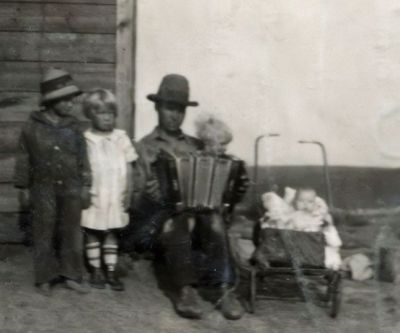
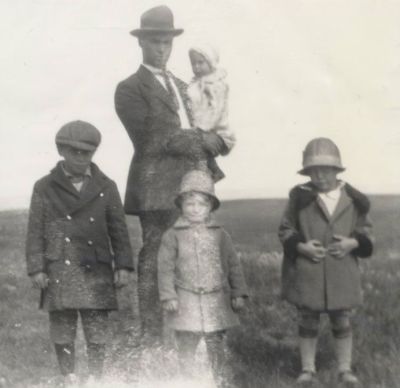
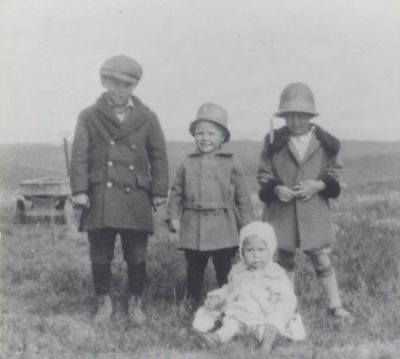
Taerum| Lorne Clifford


Research into the LANCASTER PD221
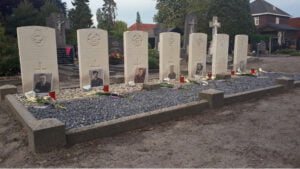
A resident of Westerbeek, Hans Ooms set out to find out the circumstances of the Lancaster PD221 that crashed near Westerbeek, killing the entire crew which is buried in the Westerbeek cemetery.
On Saturday 3 February 1945, Lancaster PD221 took off from North Killingholme airbase in England for a mission to the German town of Bottrop. There lay (and still lies) the Prosper industry which was dedicated to the production of fuel articles. In that context, it was a target of strategic importance.
On board the bomber, which belonged to the 550 squadron of the Royal Air Force, was a seven-man crew consisting of:
- Flying officer Robert George NYE, pilot, aged 23
- Sergeant Jack HOLDING, navigator, aged 22
- Sergeant James Frederick MOYLE, bomb aimer, 22 years
- Sergeant Charles STUART, flight engineer, 30 years
- Warrant officer William Johnson HOWSON, radio operator, 25 years
- Flight sergeant William Henry COOK, back turret gunner, 20 years
- Flight sergeant Lorne Clifford TAERUM, tail gunner, 18 years
William Cook and Lorne Taerum were from Canada, the others were British.
At 18, Lorne was not only the benjamin of this crew but also one of the youngest at RAF Bomber Command.
On that particular Saturday afternoon at exactly 16.31 hours, the boys took off as part of an attack force of 192 bombers and 18 Mosquitos to set course for the Ruhr area in Germany. The attack on Bottrop took place in waves between 7.30pm and 7.45pm from an altitude of 16,000 to 20,000 feet. Despite numerous search lights, night fighter activity and some cloud cover, the ‘aiming point photo’ showed that the attack had been very effective.
On the way home, disaster struck. As mentioned, German night fighters were active. The PD221 and its crew presumably became prey to pilot Hauptmann Heinz Rökker and his ‘Bordfunker’ Feldwebel Carlos Nugent who belonged to 2./NJG 2, a night fighter unit stationed in Twente at the time.
The Lancaster broke into parts and came down scattered in the immediate vicinity of the core of the village of Westerbeek. The largest part crashed behind the Lange family’s farm on the Koehardstraat. The entire crew lost their lives in the process and found their final resting place at the cemetery in Westerbeek. A son of the Lange family could still clearly remember the events surrounding the crash. Emotionally, he said it had not left him untouched throughout his life.
On 4 and 5 May 2005, I organised a commemoration to pay attention to this dramatic historical event, then 60 years ago. Family members of Jack Holding, Lorne Taerum and William Howson attended. In addition, wing-commander Jack Harris and his wife also gave an appearance. Jack was a veteran of 550 squadron and had also taken part in the attack on Prosper as a young pilot. Fortunately, he was able to tell the story.
I had planned a second commemoration in May 2020 to mark the 75th year since the crash. However, Corona threw a spanner in the works.
Every year during Remembrance Day, resident Freddie Toonen and his sons place a candle, flower and memorial stone at the graves. A very nice gesture!
Hans Ooms
Family pictures