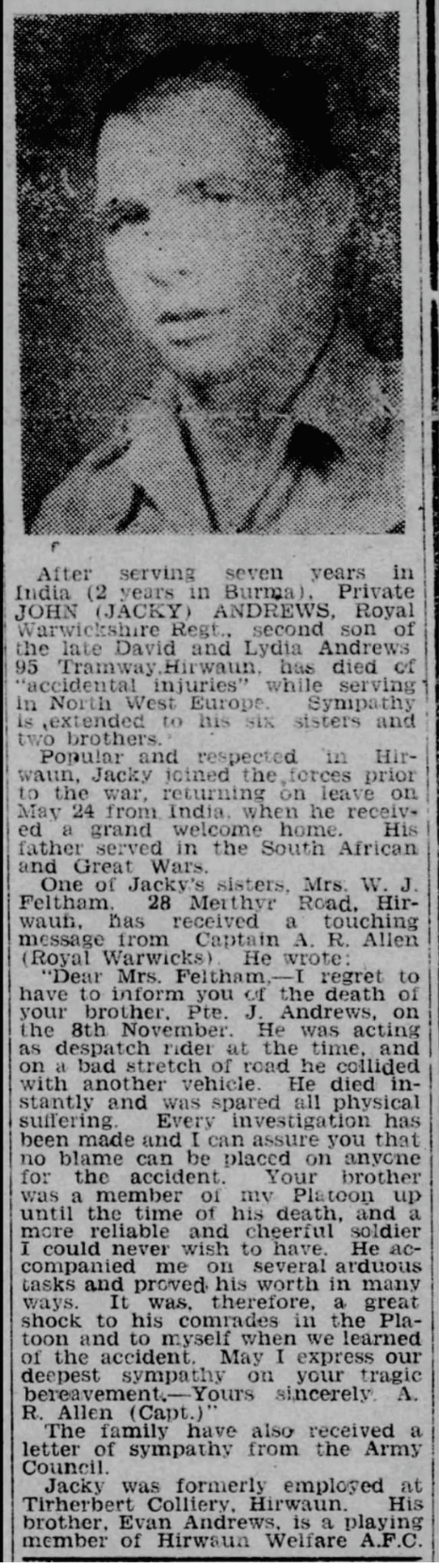
Andrews | John


Biography
John Andrews died in a tragic motorcycle accident on 8 November 1944 in Stevensbeek. He was 24 years old. He was a Private in the Royal Warwickshire Regiment, 2nd Battalion (service number 3959646). He was initially buried at the Maria Regina Convent in Stevensbeek and reburied on 27 May 1947 in grave III.D.10 at the CWGC Cemetery in Overloon. The inscription on his grave reads: “Deep in our hearts, your memory we keep. Longed for always. Brothers and sisters.”
FAMILY BACKGROUND
John Andrews (known to his family as Jacky) was born on 4 January 1920 at 10 p.m. at 98 Tramway, Hirwaun, Aberdare, the son of David Andrews and his wife Lydia, née Drew. He was the eldest of twins and the seventh of ten children. His siblings were:
- Margaret, born on 12 December 1908 in Mardy
- Elizabeth Jane, born on 6 June 1910 in Mardy, died on 28 April 1988 in the district of Merthyr Tydfil
- Harriet, born on 1 June 1912 in Glyneath
- William David, born on 7 January 1914 also in Glyneath, died on 5 August 1972
- Martha Maud, born on 25 March 1915 in Hirwaun, died in 1996 in the district of Pontypridd
- Eva Mary, born on 12 September 1917 in Hirwaun
- Evan (John’s twin brother), born on 4 April 1920 at 10.10 p.m., died on 8 April 1920 at 98 Tramway, Hirwaun
- Catherine C., born in 1921 in Hirwaun
- Evan R., born in 1923 in Hirwan, died in 1994 in the Pontypridd district
David Andrews was born in Aberystwyth, Cardiganshire, in 1871, but moved to the Hirwaun area, where he met Lydia Drew and married her on 12 March 1908 in the district of Merthyr Tydfil. Lydia’s family came from Calne, Wiltshire.
John’s mother, Lydia, was the eldest of five children of William Drew (born in Hirwaun in 1861 and died in Hirwaun in 1916) and Mary E. Thomas, also known as Margaret (born in 1863 in Cwmaman and died before 1901 in Hirwaun).
In the 1911 census, the family lived in Glyneath, where David was an underground freight carrier in a local coal mine.
During the First World War, John’s father David served in the Army Service Corps (regiment/number 106780).
By the time John and his twin brother Evan were born, the family had returned to Hirwaun and lived at Tramway 98 in Hirwaun, a small village north of Aberdare. Part of Tramway still exists, although many of the old houses have been replaced by modern homes. In the 1939 census, John’s father, who had become a widower after Lydia’s death in 1931, lived at Tramway 95 with John’s younger brother Evan. Sadly, John’s father died in 1940. Many members of the Drew family lived nearby.
Military career
John enlisted in the army before the war and served seven years in India, including two years in Burma. In May 1944, he returned from India on leave and was given a grand welcome in his hometown, where he was very popular and respected.
With the Royal Warwickshire Regiment 2nd Bn., he was transferred to the 3rd Infantry Division, with which the regiment landed on D-Day, 6 June 1944, as part of the opening attack on the beaches of Normandy. The battalion fought throughout the Battle of Caen and the breakthrough from Normandy, through northern France to Belgium and the Netherlands.
After failing to capture the bridge at Arnhem in Operation Market Garden at the end of September 1944, the Allies were left behind in a very precarious narrow salient through the Netherlands.
The battalion had entered the Netherlands at Asten on 22 September 1944. This is east of Eindhoven. On 1 October, they marched northeast in a rainstorm to Malden, which lies between Nijmegen and the Meuse. The aim of Operation Aintree was to widen the salient by moving south from Nijmegen to capture Overloon and then Venray, and finally to eliminate a German bridgehead on the Meuse near Venlo.
Initially, the American 7th Armoured Division was to take on this task, while British forces, including the 3rd Division, would move eastward across the German border and capture the forest area known as the Reichswald, from where the Germans had launched counterattacks.
However, on 9 October, the plan changed. An attempt by the American 7th Armoured Division to capture Overloon and Venray had lost many men and tanks without making much progress. Field Marshal Montgomery decided that he needed to postpone the attack on Reichswald. He needed to clear the Scheldt estuary to open up the much-needed port facilities at Antwerp and the smaller but equally essential task of eliminating German forces west of the Meuse. This latter objective was entrusted to 8 Corps, including the 3rd Division. The 3rd Division needed to attack southeast towards Venray, hoping to distract enemy troops while three other divisions prepared to advance eastwards towards Venlo.
Sgt. George W A Davis later gave a vivid description of the conditions that were to come: “The last good, long sleep we had was around 10 or 11 October. Our clothes were filthy, we were almost exhausted from lack of food and sleep. It was very cold and it rained and snowed all the time, so we were all wet. There were grenades, mortar bombs, machine gun fire, Moaning Minnies, rockets and German snipers everywhere.”
Overloon was taken by other battalions on 12 October. From 13 to 18 October, the battalion, together with other regiments, was involved in clearing the forests around Overloon of the enemy and then in the capture of Venray. This required crossing the Molenbeek, which was a major obstacle for both tanks and infantry. The battalion successfully achieved its objectives but suffered heavy losses with 14 killed, 90 wounded and 3 missing.
On 19 October, the battalion was relieved and returned to Overloon, where they remained for a rest period until 25 October. Life there was not very comfortable because the village had been badly damaged during the battle for liberation. One writer described it as ‘pitifully battered… roof tiles lay scattered on the roofs of the houses; ragged shell holes in the walls of the houses revealed a view of a crucifix, a plush armchair or perhaps a portrait of Queen Wilhelmina.’
A special order of the day was issued on 21 October by the 8th Corps Command, which read as follows: “I would like to congratulate you all on the excellent performance you have given during the recent operations against Venray. You have all played your part in this success, but I need to congratulate 185 Inf BDE in particular on the magnificent achievement of bridging the stream north of Venray with all elements against them. In these battles, you have shown determination and perseverance and have gained the conviction that you are better than the enemy. This is probably the first action for many of you, and I feel that you have made a great start and have therefore gained my complete confidence.”
On 26 October, the battalion took over from the South Lancashires in Venray. An important task in the coming days was to evacuate the large number of civilians still in the town. The Germans still controlled the road east of Venray to Oostrum, so shelling continued. The battalion remained in Venray for the first half of November and held this line. Accommodation was good and almost all ranks were able to live in cellars. At this time, there was practically no contact with the enemy at the battalion front, allowing for a certain degree of relaxation. Visits to cinemas and theatres continued regularly, as did the allocations for various clubs and leave to Brussels. This seemingly peaceful and safe existence was nevertheless disrupted by German mortar and grenade fire, which increased every day and was very heavy in some places towards the end of the period.
It was during this period that John Andrews was killed in a motorbike accident on 8 November 1944. He was working as a despatch rider that day and collided with another vehicle on a bad stretch of road. He was killed instantly and spared physical suffering.
His commander, A.R. Allen, wrote to his family:
‘He was a member of my platoon until his death, and I could not have wished for a more reliable and cheerful soldier. He accompanied me on several difficult missions and proved his worth in many ways. It was therefore a great shock to his platoon comrades and to myself when we heard of the accident.’
He was buried in a field grave near the Maria Regina Convent in Stevensbeek and on 27 May 1947, reburied in grave III.D.10. at the CWGC Cemetery in Overloon.