
Bellamy | Michael Hardy Child


Biography
Lt. Michael Hardy Child Bellamy (Service No. 293708) was killed in action on 13/10/1944 aged just 20. He was in the 2nd Battalion, King’s Shropshire Light Infantry. He was initially buried at Cemetery P. Borghs, Vierlingsbeekseweg, Overloon and subsequently re-interred on 13 May 1947 in grave II. C. 2 at the Overloon Commonwealth War Graves Cemetery in Overloon. The inscription on his grave reads: “I have fought a good fight, I have finished my course I have kept the faith.”
He was born on 31st December, 1923 to Ernest Charles Bellamy and Ethel Mary Bellamy (nee Child), of Gorleston, Norfolk.
Michael’s Father’s Family
His father, Ernest Charles Bellamy, was born in Gorleston on 18 February, 1880 to David W Bellamy and Lucy Jane Bellamy. David Bellamy was a butcher employing one man and two boys in 1881. His wife, Lucy, had been born in St Clair, Michigan in the USA. She was the daughter of Charles George Kitton, a Captain in the Merchant Service so may have been English but born in the USA. They were living in Baker Street in Gorleston in 1881 and 1891. Ernest was only son in a family of 6 children: Lucy M (1879), Ernest C (1880), Alice G (1881), Margaret S (1884), Dorothy A A (1888), Jessie E (1890). Sadly, his mother, Lucy, died on 19 July 1899 aged just 51. She is buried in Great Yarmouth New Cemetery with the inscription “Loving Memory of Lucy Wife of D.W. Bellamy who died June 19 1899 aged 51 years.” By 1901 the family were living at 136, King Street, Great Yarmouth. All the children were still at home with four of the older children working: Ernest as a butcher; Lucy and Margaret as Butcher’s Clerks and Alice as a Miliner. The family employed two servants, one of whom, Elizabeth Davey, was with them from at least 1881 to after 1901. By 1911 David Bellamy had become a farmer at Wheatcroft Farm, Bradwell and he was still there in 1939, just a year before he died in 1940. His daughter Margaret was living with him as his housekeeper and was 56 when her father died. His son, Ernest Charles Bellamy, administered his estate.
Michael’s Mother’s Family
Michael’s mother, Ethel Mary Child, was born in Great Yarmouth on 14 August, 1884 to Benjamin Charles Child and Harriet A Child. They had just two children, Ethel Mary in 1884, then Alice Eleanor much later, in 1903. At the time of the 1901 Census, Ethel was visiting her uncle, William Chapman, in Willesden, Middlesex. In 1891 the family lived in Nelson Terrace, Great Yarmouth but by 1901 they had moved to Trafalgar Road, Great Yarmouth and in 1911 and 1921 they were in Nelson Road, Great Yarmouth. By 1921 Benjamin was shown as retired having worked as a Rate Collector for Great Yarmouth Town Council and Great Yarmouth Board of Guardians.
Michael’s parents
Ernest Charles Bellamy married Ethel Mary Child in 1909 in the Yarmouth district. They had five children as follows: Margaret Lucy Elizabeth (1910) – known as Betty, David Winter Child (1911), Ernest Peter (1915) – known as Peter, John Roger (1918) and Michael Hardy Child (1923). Ernest was shown in 1911 as a Master Butcher. In both 1911 and 1921 Ernest and Ethel were living at 136 King St, Great Yarmouth, the same location as Ernest’s father was living in 1901. Elizabeth Davey was still working for them in 1911 as a cook. In 1917, the partnership between Ernest and his father in the butcher’s business known as D.W. Bellamy & Son was dissolved, with Ernest going on to run the business. At that time, they had premises at 136 King Street and 61 King Street, Great Yarmouth and also at 48 High Street and 22 Baker Street, Gorleston on Sea.
His granddaughter, Margaret, says that Ernest worked tirelessly at the business but was also very active in town life. He founded the Great Yarmouth Operatic and Dramatic Society, appearing in plays and Gilbert and Sullivan Operas and passed on his love of drama and music to his daughter, Margaret’s mother. She believes that his talents have passed down the generations to current members of the family including a great grand-daughter who is a professional flautist and great great grand-daughter who is studying Musical Theatre. He was very conscientious in ensuring that his sisters were financially secure and was kind and generous to all. The family was very important to him.
It seems that from around 1929 they retained the King Street premises presumably as part of their business, but lived at Bradwell House, Burgh Road, Bradwell which is just on the outskirts of Gorleston. This is where they were residing at the time the 1939 Register was taken in September that year. Ernest was shown as a Master Butcher and Meat Contractor. Living with them were Ethel’s widowed father, Benjamin Child, and her sister, Alice Eleanor Child (known as Eleanor), who was 36 and working as a school teacher. All of Ernest and Ethel’s children had left home. Michael’s sister, Margaret Lucy Elizabeth (Betty) Bellamy, had married Edward Rudolf (Rudy) Wood in 1937 and had moved to Hereford. They had a daughter, Margaret, in 1939 and another, Caroline, in 1942. David Winter Child Bellamy had joined the army as possibly had his brother, John Roger Bellamy, by that time.
Peter Bellamy seemed to be the naughty one of the family, or at least got blamed for any mischief. He was a slow or inattentive learner at Duncan House School in Great Yarmouth but did much better at King Edward 7th School in Kings Lynn where he joined his elder brother David as a boarder. He passed his School Certificate in 1932 and moved to London to work at Smithfield Market as a porter. There was no place for him in the family business during the difficult years of the depression. By 1935 he had joined the Metropolitan Police and was excused the Civil Service educational exam to allow for promotion because of his school qualifications. By 1939 he was working in CID for the Metropolitan Police and living in Ealing. Ethel’s mother had died in 1937 and her father died in 1941.

Michael’s Military Career
Michael was educated at Duncan House School and Framlingham College. In 1940 he joined the staff at Lloyd’s Bank in Ludlow. He didn’t wait to be called up but volunteered in 1942. He passed out of Sandhurst as a tank officer and had really wanted to join a tank brigade but on redistribution was sent to the King’s Shropshire Light Infantry Regiment. By January 1944 he was a 2nd Lieutenant and an Acting Lieutenant by D-Day on 6 July, 1944. He had spent some time training in Scotland prior to D-Day.
The 2nd Battalion began the war in Jamaica, with a company detached to the Bermuda Garrison. The battalion would eventually join the 185th Infantry Brigade, which included the 2nd Battalion, Royal Warwickshire Regiment and the 1st Battalion, Royal Norfolk Regiment. The brigade was originally assigned to the 79th Armoured Division but was then transferred to the 3rd British Infantry Division in April 1943, when the division was preparing to invade Sicily, until it was replaced by the 1st Canadian Infantry Division. The battalion took part in the D-Day landings (Operation Overlord), where they failed to capture the D-Day objective of Caen due to the presence of the 21st Panzer Division.
Michael was present at D-Day and was reported as wounded the following day, 7 July 1944. Thirty eight years later, his sister, Betty Wood, wrote down the story of what had happened to him. The full story can be read in a side-story. He was not among the very first to land at Arromanches, but he landed quite early on D-Day. He nearly drowned when he first jumped off the amphibious truck into the deep water. A wire cable had been run ashore to enable disembarking but there was a heavy swell running. As the undertow ran back, the cable caught in the top of his pack and dragged him under the water where he struggled to free himself. Thankfully, when the next swell came in it lifted the cable and he surfaced and reached the beach. As they were marching that day, he had to witness the result of one of his companions receiving a direct hit by a mortar bomb. There was nothing left of him.
Michael was then asked to carry out a reconnaissance and bring back a report of enemy presence and activity. As he was trying to cross a stream, he was shot through the leg just below the knee. The bullet went clean through the leg and bone, doing no damage to joints but causing him to bleed freely. He took cover and, when he thought the way was clear, he started to hobble back to his unit. He had to cross a field which had been entirely peaceful on his way out. However, it was now raked with fire from both sides. Somehow, he managed to get to the other side, but not before he had been hit through the elbow – a remarkable wound in that the bullet went in below the joint and came out just above it but, rather miraculously, did no bone damage. Although it wasn’t straightforward, he managed to get bandaged up and finally get back to his unit. He was then taken back to the beach and finally put aboard a ship and was back in Ronkswood Hospital at Worcester sometime during the night.
By the following week he was limping but not in much pain. He stayed with his sister for a few days in Hereford after his release from hospital to convalesce for a little longer. It may have been at this time that his niece, Margaret, then just 5 years old, remembers him as a curly haired lad who played a silly game with her. After this stay, he left to return to his parents at Bradwell. He travelled into Hereford by bus with his sister and her children, but he left it in order to take a short cut to the station. They waved goodbye and that was the last they ever saw of him. He also met his brother John when he was recovering from his injury.
Michael rejoined his regiment in August 1944.
His brother David was the last family member to see him alive. They were able to meet a couple of times in August 1944 as both were serving in the Seine valley in France. David regretted afterwards that he hadn’t initially been more open and affectionate with Michael. They had both been through terrible experiences and David must have felt he shouldn’t let the side down by being too emotional. A second meeting felt more normal and David saw that Michael was obviously well liked by his platoon and by officers. Their last words to each other were: David: “Well, I must be off. May not see you for bit. Look after yourself.” Michael: “OK. Mind how you go. Good luck.”
The 2nd Battalion proceeded through Belgium and the Netherlands but the only partly successful Operation Market Garden, which reached as far as Nijmegen but failed to take Arnhem, left the Allied forces in a rather precarious narrow salient.
Between 2 and 8 October 1944 the 2nd Battalion found itself in Mook which is on the east bank of the River Maas, south of Nijmegen and north of Overloon. The aim had been to attack the enemy to the east in the Reichwald Forest, but priorities changed to widening the salient by heading south to take Overloon, Venray and cross the Maas at Venlo. The Battalion therefore moved down to Oeffelt then reached Rijkevoort on 12 October.
At first light on 13 October, the Commanding Officer and Company Commanders carried out a reconnaissance of the woods south of Overloon through which the Battalion was to pass while the Battalion reached its assembly position about 1,000 yds north of Overloon prior to the attack itself which began at 12 noon.
The battalion had the support of one squadron of Churchill tanks from the Coldstream Guards and an artillery barrage. The plan was for W and Z companies to be the two forward companies on the left and right respectively. Y company were to advance on the eastern edge of the woods and give protection to the attack from that flank. X Company were to be in reserve. The attack proved difficult as the Churchill tanks were bogged down or delayed by minefields and radio communication in the thick woods was abysmal. The two forward companies managed to reach approximately the intended positions, but Y company found that the edge of the woods on the map was far from clear on the ground. They managed to reach their area after much wandering about the woods.
Capt. R.R. Rylands, ‘W’ Company, 2 KSLI wrote: “The woods were so vast that no copybook wood clearing drill was possible, especially as the map did not ‘fit’. The job was done – with considerable casualties particularly on the forward edge of the wood facing Brabander and Venraij. Lt. Mike Bellamy who had rejoined after being wounded on D-Day, was killed by a concealed Machine Gun.” Another source commented that this was “a very great loss as he was always cheerful and had more experience than the average subaltern.”
The Impact on his Family
Michael’s brothers, David and Peter visited his original grave in Overloon on Sunday 7th October 1945. They wrote to their parents describing their pilgrimage. Ethel then wrote a letter to her daughter, Betty, dated 11 October, a year after Michael had last written to his parents – just two days before he was killed. She enclosed an extract from David’s letter:
“Sunday was a beautiful day after the rain and clouds of the preceding week. We left Nijmegen about nine and travelled first to Grave and then by the road following the line of the Maas river until we turned inland to near Overloon. It is a forlorn corner of Holland and little recovered. Tanks and knocked out vehicles still lie about the fields and the village and the woods and thickets about it are more completely shattered I think than any other such hamlet I have seen outside Normandy. We had been told to turn left at the church, which was identifiable only by a heap of rubble with fragments of arches and ecclesiastical-looking coping stones and slabs of material to show what it was. Then at the site of the war cemetery now being formed on a slope in a small wood we met an English-speaking Dutchman. I think he was something to do with the war museum and memorial which the Dutch government in co-operation with the 3rd Division are constructing next the official cemetery. He took us round to the museum, a fine, long building under construction at the corner of a pine wood which is to remain as it is with its debris of war, rather on the lines of the Canadian memorial trenches at Vimy Ridge after the last war. After that he took us round the isolated graves or little temporary cemeteries in the surrounding area but it was not till afternoon, when we had almost given up, that we came upon Michael’s. As Rylands said, he had been buried in a garden; it was on the road leading East from Overloon to the Maas. There were three others there who had been killed the same day. I cannot pretend to you that it was anything but a sad and dreary spot in a little patch of garden of two poor cottages, now overcrowded with people who have returned to this village and have all they can do to feed themselves and exist among the ruins. But the graves have been cared for and are free from weeds and at the foot of each has been planted a flower that was blossoming orange, the national colour of Holland. The official cemetery is ready now and re-interment will probably take place in the next month or so, but I was glad to have seen the place as it was and to be able to visualise what the nature of the fighting must have been. When you get this letter it will be just a year since Michael’s death; I hope this account will not add to the renewed sorrow you are bound to feel at this time, but you will feel glad that someone of his was able to go along”.
Ethel was so grateful to think that the graves were well-tended and says at the end of her letter that “It is very good and kind of the people.” It is thought that Michael’s parents were eventually in touch with the Borgh family who owned the cottage garden where Michael was temporally buried and Peter visited the official cemetery later as did his son, Michael, who was named after his uncle.
It is likely that the man that his brother met who showed them his grave was Harry van Daal who was instrumental in founding the War museum in Overloon.
Peter visited Overloon again in 1960 en route to see daughter Susan who was staying with a German family in Remscheid. But this time it was to the proper cemetery, not a garden with orange flowers on the grave as in 1945.
A generation later came the strange experience of Michael Charles Bellamy (born 20/02/1945) and named after the uncle he never knew. At Easter in the early 1980s he was in the Netherlands with his young family, staying in a bungalow park for a few days. They had bicycles and spent hours exploring the local area. They got to the Overloon war cemetery. His wife Pat and the children went in to look at the graves but Michael sat outside as he wanted to finish a book. That done he got up to see where the family had got to and, as he caught sight of them, he turned and found himself looking at his own name on a gravestone. He’d found Michael’s grave quite by chance and felt the experience uncanny and still does so.
His mother, Ethel, was a loving mother and grandmother, but had a reputation within the family of being a bit intimidating. She kept Michael’s uniform in a wardrobe which her grand-daughter Margaret opened not long after Michael’s death. Ethel explained what it was and rather surprised her grand-daughter by saying with a sob “Poor Uncle Michael.” Margaret was shocked by her tears but a moment later she was back to her stoical self.
His death was a shattering blow to the whole family. However, they bore their loss bravely and just carried on as did so many others.
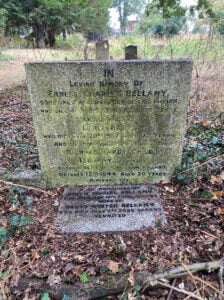
Michael is commemorated at Bradwell St Nicholas on the grave of his parents and brother David.
Michael’s Brothers During WW2
All three of Michael’s brothers also served in WW2 and survived.
His eldest brother, David Winter Child Bellamy (Service No. 1471332) had a distinguished war record and was active from the war’s beginning to its end. He may have joined the 74 Field Regiment Royal Artillery as early as 1938. He served in the Middle East (Egypt / Libya) and by September 1942 he was a Battery Quarter Master Sergeant and Acting Warrant Officer Class II (Regimental Quarter Master Sergeant). It was announced in the London Gazette of 24 September 1942 that he had been awarded the Military Medal for Gallant and Distinguished Service. The recommendation for this medal reads as follows:
“On 28 June 1942 South East of Mersa Matruh, a motor transport column started at nightfall to break through the German position which encircled the area. Shortly after the start, when the officer in charge failed to return from a reconnaissance, RQMS Bellamy assumed command and his personal courage and resourcefulness succeeded in bringing the bulk of the column to safety. When ordered to surrender by armed members of the Nazi Red Cross RQMS Bellamy refused to submit to them as non belligerents and led the column on its way. On more than one occasion when the column was fired on by A/tk guns and machine guns RQMS Bellamy went on alone to find a way through the enemy position refusing to allow anyone to accompany him. He eventually succeeded in getting clear of the enemy positions and led his column across the desert to our own lines. It was entirely due to his leadership and the splendid example he set by his personal gallantry and determination that his men, vehicles and stores were saved from capture.”
On 3 January 1943 he was promoted to 2nd Lieutenant. He was serving in France by August 1944 and was still serving with his regiment in Northern Germany until he was demobbed in November 1945.
According to his army paybook Peter joined the Middlesex Regiment in 1943 after a few injuries and narrow escapes on police duty during London bombing raids. He was sent on an OCTU course and moved around the country from one barracks to another. He was due to go to India with the regiment but a pre-embarkment medical showed up a serious heart murmur. This must have been caused by an attack of rheumatic fever when he was away at school and probably saved his life. Many of his friends didn’t survive the war.
John Roger Bellamy was still at Cambridge reading Mathematics when war was imminent. By 1941 he was a Lance Corporal in the Royal Corps of Signals and was based at Catterick in North Yorkshire. Later he served in Italy. His niece, Margaret, remembers him telling her in a letter that he felt guilty that he had had an easy time of it compared with his brothers.
The Family After the War
Michael’s father, Ernest Charles Bellamy, died on 6 July 1956, aged 76. He was living at 23 Addison Road Gorleston Great Yarmouth. His wife and son, David Winter Child Bellamy, administered his estate. David was shown as a butcher, continuing the family tradition. Michael’s mother, Ethel Mary Bellamy, died the following year.
Michael’s sister, Betty Wood adored her brothers, particularly David who was only a year younger. She read English at Royal Holloway College London and taught for three years at Hereford High School before marrying Rudy Wood and going on to have daughters Margaret and Caroline. They met as members of an amateur dramatic society. Betty (under her proper name of Margaret) later found success as a writer of One Act Plays, some of which are still in print and are still being performed. It took Rudy a while to be accepted by Ethel. He had a Yorkshire accent and had rather different political views! However, he won his mother-in-law round eventually. Following a happy marriage of over 50 years, Rudy died in 1988 and Betty was 91 when she herself died in 2001. Their daughter, Caroline, died in 2023.
David Winter Child Bellamy married Edith M Hall in 1945 in Suffolk and went on to have two children: David Christopher M (1948) and Timothy J (1952). As boys, he, Peter and John had all helped in the Butcher’s in King Street and it was assumed that as the eldest son he would inherit the business which he did, though he would much rather have gone to university. Eventually, in 1964 after a lifetime in the business, he sold it and took a degree in History at East Anglia University and enjoyed a career in education. Like his father, David had a very strong sense of duty and he and Edith kept an eye on at least one eccentric spinster in the family as well as Eleanor, Ethel’s unmarried sister, a sweet and placid lady. He had a quietly dry sense of humour. They were devoted parents and grandparents and were very hospitable. When Edith eventually succumbed to dementia, he cared for her at home until her death. He was a lovely man and when he was approaching the end his elder son Christopher cared for him with the same devotion. David Winter Child Bellamy died in 2008, aged 97. Sadly, Christopher himself died in 2021.
Peter Bellamy married Hilda Gibson Scott on 19 April 1941 at Seaham Harbour in County Durham. His brother, Lance Corporal John Bellamy of the Royal Corps of Signals was the best man. They had two children: Susan B (1943) in Suffolk and Michael C (1945) in Durham. In 1945 Peter was seconded to the Control Commission in Germany with the rank of Captain. He arrived in Hamburg on 11 August 1945 and was appalled at the devastation. He found the exhausting work worthwhile as it made use of his police experience. Captain Ernest Peter Bellamy of the Special Investigation Branch at Hamburg appeared in the newspapers in April 1947, giving evidence against Theodore Reid Hartwick, a Canadian born Control Commission officer, of Egham Surrey, who was imprisoned for six months and fined £1000 for using cigarettes allocated to displaced persons to buy black market fur coats, jewellery, clothes and cameras. During his posting in Hamburg Peter met his brother David several times. Peter was then posted to Berlin where he was joined by Hilda and the two children. Although Peter was released from active military service on 7 November 1947, the family remained in Berlin until June 1948. They escaped the Russian blockade of Berlin in the last convoy to get out. They then spent some time in Bünde, Nordrhein-Westfalen, before returning to England later that year. On his return, Peter rejoined the Met where he served for many years, reaching the rank of commander before transferring to what was then Birmingham City police (later West Midlands) as Assistant Chief Constable. He and Hilda spent 25 happy years living in Hackman’s Gate near Birmingham before moving to Clevedon in 1998 to be close to daughter Susan. He and Hilda died within 3 months of each other in a nursing home in Clevedon in 2003. Their ashes lie in St Andrew’s churchyard, just above Poet’s Walk, with a wonderful view cross the Bristol Channel to Wales.
John Roger Bellamy met a lovely Canadian widow called Zoe whom he married. He realised that life in Canada would offer better opportunities and an altogether more attractive standard of living, so they emigrated and lived there for the rest of their lives, having three children, David, Douglas and Katherine. His Mother was not pleased by this, but John and Zoe visited several times and contact was never lost. He was a good correspondent, displaying an entertaining and sardonic sense of humour.


