Cleary James

Cleary | James

  • First names

    James

  • Age

    31

  • Date of birth

    03-01-1913

  • Date of death

    16-10-1944

  • Service number

    1830152

  • Rank

    Private

  • Regiment

    Royal Norfolk Regiment, 1st Bn.

  • Grave number

    III. B. 13.

  • James Cleary

    James Cleary

    James Cleary

  • Grave James Cleary

    Grave James Cleary

    Grave James Cleary

Biography

James Cleary was killed in action on 16 October 1944, aged 31. He was a private in the 1st Battalion of the Royal Norfolk Regiment (Service No. 1830152). He was initially buried at Huijsmans Cemetery in Rieterdreef in Overloon and re-interred on 14 April 1947 in grave III. B. 13. in the Commonwealth War Grave Cemetery in Overloon.

Family background

James Cleary was the son of John Cleary and Catherine Moss who married in 1897 in the West Derby area of Liverpool. John was born in 1877 and Catherine in 1878, both in Liverpool.
 
John and Catherine had eleven children as follows in Kirkdale in West Derby: Susan 12 January 1898, Mary Ellen 1900, John 1903, Sarah 1905, Catherine 1908, William 1911, James 3 January 1913, Margaret 1915, Joseph 1918, Edward 1920 and Gerard 1922. Sadly, it seems that Mary died in 1902, William in 1912, John in 1918 and Edward in 1921 – all before they reached adulthood.
 
In 1901 John and Catherine were living at 56, Rockingham Street, Kirkdale, West Derby with their first two children. John was working as a General Carter. Also present were a married couple and two children who were boarders and also John’s brother in law. By 1911 they were living at 234 Arlington Street, Kirkdale. With them were their first four surviving children. By 1921 they were living at 199, Arlington Street. John was working as a general carter at Cramsber Cartage Co. but was out of work at the time. With them were all seven of their  surviving children who were born by then, including James.  Susan was working as a Tin Smith for British American Tobacco Co. Ltd. and Sarah as a Baker’s Assistant for Miss Taylor and Son Ltd., 27 Heriot Street.
 
John Cleary, died in 1927 in West Derby and Catherine in 1937 in Liverpool North.
 
James’ sister Sarah had married Robert Prior in 1926 in Liverpool and his sister Margaret had married Enoch Atherton in 1934.
 
In September 1939, James Cleary was living on his own at 3 Burrell Street, Liverpool. He lived in one of four rooms at this address. He was working as a “General Labourer” probably in the plumbing trade.  His sister Susan Cleary was living at 12 Iris Street, Liverpool in the household of John and Esther Swift. Her occupation was Tin Soldering. His sister Sarah Prior was living at 109a Stanley Road, Liverpool with her husband and seven children. His sister Catherine Cleary was probably living at 124 Goodison Road, Liverpool in the household of John G and Barbara Swift and their son. Catherine was working as a Tobacco Packer. It may be that the Clearys were related to the Swifts as both Catherine and Susan were living with families of that name. His sister Margaret Atherton was living with her husband at 15 Jubilee Grove, Wallasey, Cheshire. There too was her brother, Gerard who was working as a General Labourer. His brother, Joseph, had moved away from Liverpool to Rochester in Kent and was working as an Aircraft Fitter (Detail and Assembly). He was living at 27 Star Hill, Rochester in a house with two other young men working in the Aircraft industry.
 
James married Margaret Sullivan in Liverpool on 15 June 1940.  
 
Margaret was the daughter of Joseph and Elizabeth Sullivan. She was born on 13 October 1919 in West Derby. She was the eldest of ten children born between 1919 and 1939. In 1921 she had been living with her parents at 6, Wilkin Street, Kirkdale. Her father was born on 5 March 1896 and her mother on 23 September 1898, both in Liverpool. Her father was working as a Ship’s Boiler Scaler for C P O S Ltd. By September 1939 they had moved to 42 Harcourt Street, Liverpool.Margaret and their two  youngest sons were with them. Their other children  were not present. It seems that five of them at least were living in Telford, Shropshire with two different families. Perhaps they had been sent there to avoid the coming war. Margaret was working as a Kitchen Maid.

Death of his Brother, Joseph Cleary

James’ brother, Joseph Cleary, died on 22 April 1941 while serving as an Air Mechanic 2nd Class (Service No. FAA/FX 79350). He was in 761 Naval Air Squadron which was a Fleet Air Arm naval air squadron of the Royal Navy. It had been formed at HMS Heron, Royal Navy Air Station at Yeovilton in Somerset as the Advanced Training Squadron of the Fleet Fighter School in 1941. He is buried in Plot M Grave 4 in a Commonwealth War Grave at Yeovilton (St. Bartholomew) Churchyard.

James Cleary’s Military Career

James himself enlisted just two months later on 26 June 1941. He stated that he was born on 3 January 1913 at Kirkdale in Liverpool. He gave his address as 14 Leaton Street, Liverpool 4. He named his wife, Margaret Cleary, at 14 Linton Street as his next of kin. He was described as being 5ft 7 ½ in tall and weighed 152 lbs. He had hazel eyes and dark brown hair. He was declared A1 medically fit. He gave his occupation as Warehouseman in Cold Stores and gave his religion as Roman Catholic.

On enlisting he was posted as a Gunner in the Royal Artillery to 278/ 212 Light Anti Aircraft Training Regiment. On 23 July 1941 he was posted to 278 Battery of the 68th LAA Regiment in the Royal Artillery.

The 68th Light Anti Aircraft Regiment had been formed in December 1940 at Cark in Cumbria with three batteries, one of which was 278 Battery. It seems to have been based in North East England until August 1942 when it was transferred to the South Coast. It served in Anti-Aircraft Command until April 1943. It then became the divisional LAA Regiment of 59th(Staffordshire) Infantry Division. From April 1943 it was based in Kent. The Division remained in the UK until 1944, assigned to anti-invasion and guard duties, while training for combat overseas.

James seems to have trained in using an Anti Aircraft Light Machine Gun and qualified as a Motor Cyclist.

He seems to have had some medical issues during his army career. On 17 August 1942 he was sent to a Military Opthalmologist at Brighton as he had been wearing his own spectacles until then. He appears to have been supplied with different spectacles.

He then seems to have suffered from an attack of scabies which required hospital treatment at the Connaught hospital, Knaphill  near Woking in Surrey from 10 to 18 November 1942. It was described as a complicated case but seemed to be responding to treatment.

On 12 August 1943 the Military Hospital at Colchester was requested to examine him as he had been complaining of a pain at the back of his eyes for 6 months which was aggravated by close work and his role in spotting aeroplanes. He had been supplied with glasses a year before. He had been taken off driving duties but not spotting. On 4 November 1943 the hospital at Chartham near Canterbury was requested to repair his spectacles, which was done.

The 59th division was assigned to the Second Army and transferred to France to take part in the Battle for Normandy. On 7 July, the division saw action in Operation Charnwood, which resulted in the capture of the German-occupied city of Caen. A week later, the division fought in Operation Pomegranate. The territorial goal of this operation was to capture the town of Noyers, which was not accomplished due to determined German resistance. The fighting played an important role in distracting German forces from the major British offensive, Operation Goodwood, which was launched soon after.

James himself embarked for overseas on 18 July 1944. By late July, the German frontline was crumbling, and a general offensive was launched. The division advanced and captured a bridgehead over the River Orne, fending off several counter-attacks to maintain its hold. The division’s final combat was a protracted battle to capture the town of Thury-Harcourt. During these battles it suffered several thousand casualties. By August 1944, the Army was badly short of manpower in many of its units. As the division was the most recently established formation serving within the Second Army in France, it was chosen to be disbanded and its men transferred to other units to bring them up to strength. The division was broken up on 26 August and officially disbanded on 19 October 1944.

In line with this, on 30 August, James was placed on X(iv) list for 21 Army Group (49 RHU) which means that he was being considered for transfer as a reinforcement for another unit. On 4 September 1944 he was posted as a Private to the 1st Battalion of the Royal Norfolk Regiment.

The 1st Battalion of the Royal Norfolk Regiment had landed in Normandy at Sword Beach on D-Day (6 June 1944). It played its part in the 1st and 2nd Battles for Caen which succeeded on 9 July after which the Battalion had its first rest period since D-Day. It continued the fight in Normandy through mid July and early August and was involved with Operation Goodwood and then in the preparation for the break out from Normandy which succeeded in late August.

From 17 August until 3 September the Battalion had a rest period which also allowed them to take on reinforcements to replace the substantial number of men they had lost. It then moved to Villers en Vexin until 17 September. It was while there that James will have joined the Battalion.

By this time, the Allied troops were making a fast advance through France and Belgium to the Escaut canal south of Eindhoven in readiness for Operation Market Garden. On 17 September, airborne troops landed in a corridor from the Belgian/Dutch border via Eindhoven and Nijmegen to Arnhem to secure bridges and allow ground forces to move forward with speed – then to reinforce and strike east into Germany.

The role of the Battalion along with others was to protect the main line of communications northwards along this corridor. It moved on from Villers en Vexin on 18 September and reached Peer on 19 September then Asten on 23 September. They entered Helmond, just east of Eindhoven, on 25 September. It had just been taken by another Battalion and they received an uproarious welcome from the Dutch people.

On 29 September, it moved out of Helmond and on over the River Maas at Grave through Heumen and on to Maldens Vlak. Here they spent time patrolling the area facing the Reichswald Forest in Germany not far to the east.

However, problems with supply lines had resulted in the failure of the Allies to hold the bridge at Arnhem, so plans changed. The Allies found themselves in a narrow salient through the Netherlands and so it was decided to clear the enemy to the south in Overloon, Venray and Venlo while also securing Antwerp to help with supply issues. American Troops initially attempted to take Overloon, but did not succeed so the British Army took on the task.

On 9 October the Battalion retraced its steps to Grave, then south to dominate a stretch of the River Maas in the Cuijk area. On 11 October, the Battalion moved on foot from Cuijk, through Haps and St Hubert and on again the next day to Wanroij, St Anthonis and Oploo, arriving north of Overloon on 13 October.  At this time, other British Troops were engaged in capturing Overloon, using an artillery barrage which caused heavy damage to the village.

The Battalion spent the night of 13 October in the woods around Overloon. The ground forward of the woods was flat and featureless and a stream called the Molen Beek ran across the route between Overloon and Venray. From its far bank the enemy had a clear view over a distance of 1000 yards of the British Troops leaving the shelter of the woods.

At 0700 hrs on the morning of 14 October, two companies led the attack to the south with support from two troops of Churchill tanks. The advance was a difficult one, as once through the thick woods there was very little cover. Some tanks were hit and others retreated back into the woods, leaving the Infantry without support. The Battalion succeeded in reaching a point about 400 yds short of the Beek that day, though were left in a very exposed position. They had to remain there the following day while other units reached their positions in order to carry out a co-ordinated attack on the Beek the following day.

The Molen Beek was between 10 and 15 feet wide and had slopping banks about 5 feet high creating an effective gap of about 30 feet. The approaches were difficult with cratered tracks and waterlogged ground. The area was extensively mined. The success of the operation depended on crossing the beek silently by night. Any attempt by day would be suicidal as the road bridge was blown. It was therefore planned that the infantry would cross using floating pontoon bridges while a bridging tank would use a girder bridge for vehicles, including tanks.

The Royal Engineers successfully built the two pontoon bridges overnight – one on each side of the road. At 0500 hrs on 16 October B and D Companies crossed without incident – though it was later discovered that D Company had walked through a minefield of Schumines. Later A Coy did the same with no casualties. By 0600 hrs the leading Companies were keen to press on as they were lying in the open in full view of the enemy and suffering casualties. However, other units hadn’t fared as well and so the Norfolks weren’t allowed to push on. The bridging tank failed to lay the bridge under intense fire. On the second attempt a flail tank was half way across when the whole lot toppled into the Beek. The Battalion’s Churchill tanks had all been knocked out – but thankfully the enemy tanks had withdrawn. By 0700 hrs the leading companies were allowed to progress. Casualties mounted up. By the afternoon, A and C Companies were able to push on to about 1000 yds south of the Beek. The Battalion had succeeded in securing the crossing and forcing the enemy to withdraw. This was the day on which James Cleary and 16 other men of the Battalion were killed.

By 18 October Venray had been taken. Between 13 and 18 October, the Battalion incurred 43 fatal casualties and about 200 wounded.

James had served for a total of 3 years and 113 days of which 91 were served in North West Europe. He was awarded medals as follows: 1939-45 Star, France & Germany star, Defence Medal,  and the War Medal 1939/45.

Aftermath

Late in 1944 Margaret Cleary gave birth in Liverpool to their only child, Susan Cleary. His wife was awarded a pension of £1/12/6 from 18 Jan 1945 with an allowance of 11s for their child.

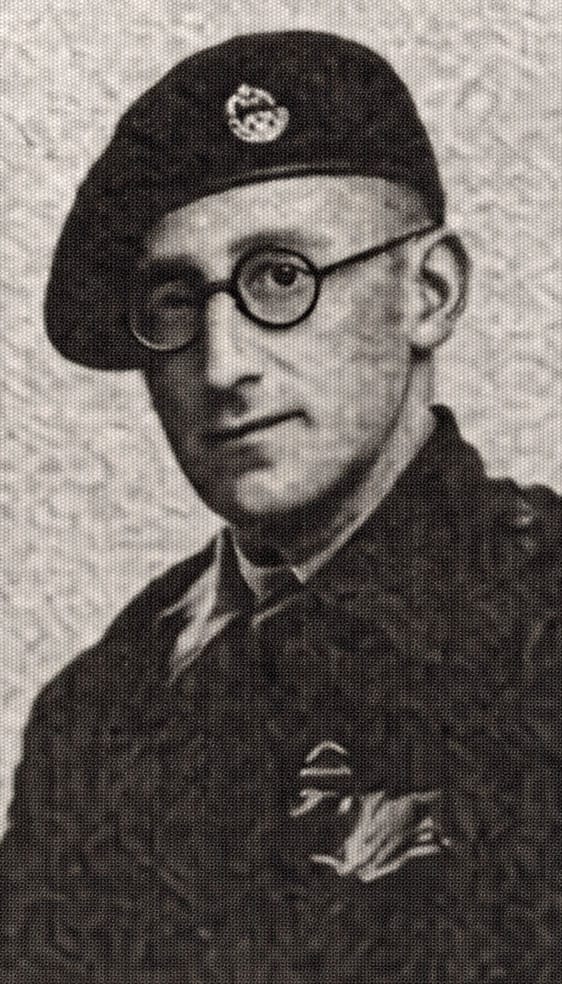
The Liverpool Echo of 2 February 1945 reported on his death with his photo as follows:
“Mrs Margaret Cleary of 14, Linton Street, Liverpool 4 has been informed that her husband, Private James Cleary, who went to France with an infantry regiment shortly after D-Day, has been killed in action in North West Europe. Aged 31, he was for 3 ½ years in a Royal Artillery AA Battery before being transferred, and his former colleagues are asked to communicate with his wife. He was an old boy of St Alphonsus School, and was formerly employed by a Liverpool cold storage firm. He leaves a three month old baby girl whom he never saw.”

His wife went on to marry Martin J Cox in Liverpool in 1952. They had two more children.

His daughter, Susan Cleary, married in 1966 and had two children.

James’ wife, Margaret Cox, died on 22 May 2003.

Bronnen en credits

From FindMyPast website: Civil and Parish Birth, Marriage and Death Records; England Census and 1939 Register Records; Electoral Rolls; Military Records
Wikipedia 761 Naval Squadron
Service Record for James Cleary from the National Archives ref no. WO 423/717887
Royal Artillery 1939-45 Website
Information from “Thank God and the Infantry – from D-Day to VE-Day with the 1st Battalion, the Royal Norfolk Regiment” by John Lincoln
History of the 1st Battalion The Royal Norfolk Regiment
Wikipedia 59 Infantry Division
Wikipedia Royal Norfolk Regiment
Liverpool Echo 2 Feb 1945
Assistance from Iwan van Dijk and Sue McGuire of “Liverpool History Society” in sourcing the photograoh
Assistance from Alistair Steed, nephew in law of Margaret Sullivan

Research Elaine Gathercole
  

Continue reading

Crouch Herbert

Crouch | Herbert

  • First names

    Herbert William

  • Age

    38

  • Date of birth

    10-06-1907

  • Date of death

    07-10-1944

  • Service number

    7930069

  • Rank

    Lance Serjeant

  • Regiment

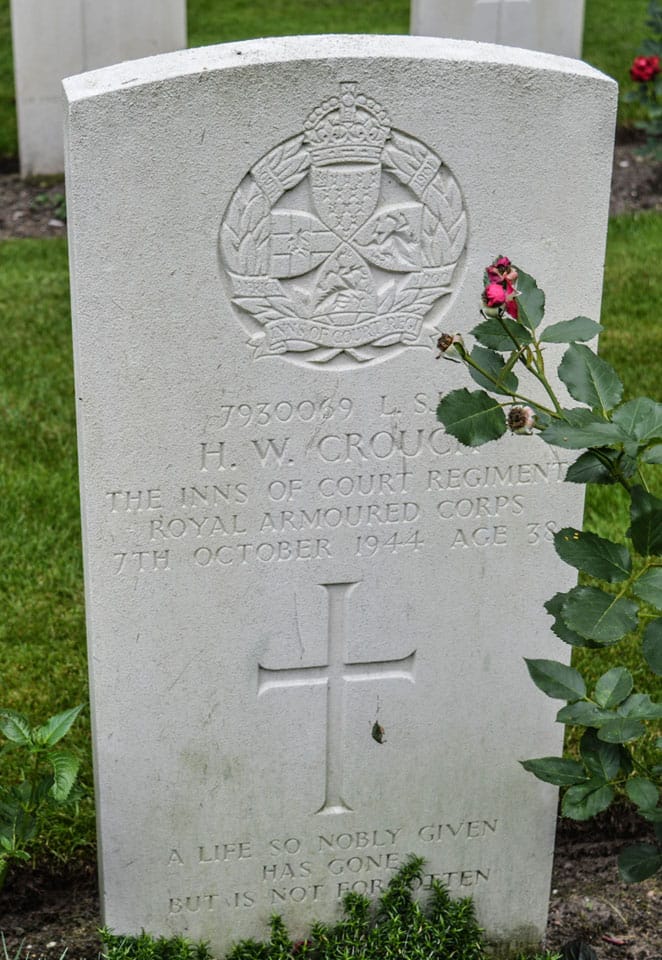
    Royal Armoured Corps, Inns of Court Regiment

  • Grave number

    II. D. 12.

  • Herbert William Crouch

    Herbert William Crouch

    Herbert William Crouch

  • Grave Herbert Crouch

    Grave Herbert Crouch

    Grave Herbert Crouch

Biography

  
Herbert William Crouch was killed in action on 7 October 1944 in the vicinity of St Anthonis. He was aged 38 at the time. He was a Lance Sergeant in the Royal Armoured Corps, Inns of Court Regiment (Service No. 7930069). He was initially buried just east of St Anthonis at the premises of M. Jansen at Boxmeerseweg A 62 St Anthonis, Oploo and re-interred on 21 May 1947 in grave II. D. 12. in the Overloon CWG Cemetery. The inscription on his grave reads: “A life so nobly given has gone but is not forgotten.”

Family background

Herbert William Crouch (who was known to family and friends as Bob), was the son of Herbert Crouch and Emily White who had married in Brentford district, Middlesex in 1906. Herbert had been born on 25 June 1878 in Hanwell and Emily on 29 May 1876 in Southall Green. They had seven children, all in Hanwell as follows: Mabel Emily 1906, Herbert William 10 June 1907, Mary Louisa Minnie 1909, Sidney James 1910, Ethel M 1912, Percy O 1914 and Leonard A 7 July 1917.  However, Ethel died in 1913.
 
In 1911 Herbert and Emily were living at 59 St Dunstan’s Road, Hanwell with their first four children which included Bob. Herbert was a labourer who was building horses’ stables. Also present was Herbert’s widowed mother, Mary Elizabeth Crouch, who had been born in Oxford in 1842.
 
In 1921, the family were at the same address with their six surviving children. Herbert was now working as a temporary hand for the Superintendent of Central London District Schools. Their eldest daughter, Mabel, was working as a General Domestic Servant. Also present was Mary Pratt, a 73 year old boarder.
 
Bob married Mabel Florence Bloomfield in October 1931 in Hanwell Union Church. The West Middlesex Gazette described their wedding as follows:
“Crouch – Bloomfield
In Hanwell Union Church on Saturday the Rev JT Stevens officiated at the wedding of Mr Herbert William Crouch, eldest son of Mr and Mrs Crouch, of 59 St Dunstan’s Road, Hanwell and Miss Mabel Florence Bloomfield, eldest daughter of Mr and Mrs Bloomfield, of 25 Lawn Gardens, Hanwell. Mr Southcombe played appropriate organ pieces for the ceremony.
 
The bride in white crepe de chine with lace coatee and necklet of pearls held a shower bouquet of red roses. She was given away by her father, Mr Sidney Crouch brother of the bridegroom performing the duties of best man.
 
Miss Gwen Bloomfield (sister) and Miss Ivy Hickey acting as bridesmaids, wore green crepe de chine and lace, and crystal necklets, the gifts of the bridegroom, holding bouquets of cream roses. Blue silk, with hat to match and navy crepe de chine, trimmed with beige, with a navy hat, were worn by the bridegroom’s and the bride’s mothers respectively.
 
A reception was held in Hanwell Library, and a happy couple left to spend the honeymoon at West Malling, Kent, after which they will live at 106 Beresford Avenue, Hanwell”.
 
Mabel was the daughter of William Chapman Bloomfield and Charlotte Florence Birkin who had married in 1905 in the Lewisham district of London. William was born on 9 December 1880 in Lee in Kent while Charlotte was born on 22 June 1879 in Kensington, London. They had three children as follows, all in Hanwell: Ernest Walter 1 February 1906, Mabel Florence 1 March 1907 and Gwendoline Emma 1908.
 
In 1911 William and Charlotte were living at 25 Lawn Gardens, Hanwell with Mabel and Gwendoline. William was working at a Licenced Conductor for a tram company. Their son, Ernest, was living with his grandparents, Chapman James and Emma Mary Bloomfield at 134 Fernbrook Road, Lewisham and his aunt, Carrie Emma Bloomfield. Chapman was a Greengrocer born in 1849 in Lee, Kent, Emma was born in 1851 in London and Carrie was born in 1879 in Lee and was an assistant in a fancy shop. In 1921, William and Charlotte were still living at 25 Lawn Gardens with all three of their children. William was still working as Tram Conductor for London United Tramways Co.
 
On 20 April 1938 Mabel’s sister Gwen, still of 25 Lawn Gardens, aged 30 and working as a nurse travelled from Liverpool to St John’s Newfoundland, Canada
 
In September 1939, Bob and Mabel were living at 65 Daryngton Drive, Ealing. Bob was working as a Printer. They seem to have been living with Lewis G and Moira E Ashby who had both been born in 1906. Lewis was a Storekeeper. There too were Mary E Ashby aged 7 and David F Ashby aged 3. Another unnamed child was present – but it is not thought that Mabel and Bob had any children.
 
At this time, Bob’s parents were still living in St Dunstan’s Road, but only their son Leonard was with them. Herbert was retired but available for work while Leonard was working as a Joiner Woodworker.
 
Mabel’s parents were living on their own, still at 25 Lawn Gardens and William was now working as a Trolley Bus Conductor.
 
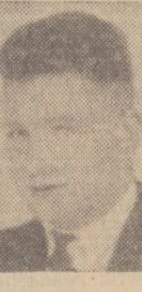
An article in the Middlesex County Times of 28 October 1944 after Bob’s death gives more information about his life before the war:
“Lived to Help Others
Official notification has been received by Mrs H.W. Crouch of 17 Briarbank Road, Ealing, of the death of her husband – killed in action in Holland.
 
Sergt. Herbert W. Crouch was 38 years of age and the eldest son of Mrs Crouch and the late Mr H. Crouch, of 59 St Dunstan’s Road, Hanwell. ‘Bob’ Crouch, for as such he was known to all his friends, was educated at St. Mark’s School, Hanwell. At 12 years of age he became a member of the 16th Thames Valley Company Boys’ Brigade, which was attached to Union Church, Hanwell. This proved to be the beginning of a life lived chiefly for helping others, for he served the ‘16th’ for 10 years, with a keenness and loyalty that has seldom been equalled in the history of the company, and when, having held every non-commissioned rank, he finally accepted a commission, he filled his new position with dignity and great usefulness for several years.
 
At the time of his ‘call up’ for military service, nearly four years ago, he was showing great promise as outdoor representative from Messrs. Farmer and Sons Ltd of 295 Edgware Road, W2, a firm of printers and stationers with whom he had been apprenticed upon leaving school.
 
Ever a firm advocate of physical fitness, he was himself a first class athlete, and gained special prowess at gymnastics, football, high jump, etc. He was a ‘good sportsman’ in the truest sense.
 
He interested himself in associations of mutual benefit and was for several years a delegate to the London and Provincial Yearly Dividing Friendly Society, West London District, Jersey Lodge 42
 
Previous to the outbreak of war, he was a keen supporter of the movement for ‘worldwide moral re-armament’. He was for 20 years a member of the Union Church, Hanwell and held during that period several responsible positions i.e. assistant Sunday School Superintendent, Bible Class Leader, steward. Football Club secretary etc.
 
‘Sincerity’ was the keyword of all his service and his gay and buoyant spirit provided him with a capacity for helping and encouraging all those whose lives he touched.
 
Mrs Crouch wishes to express her very deep appreciation of the many tokens of sympathy she has received.
 
A memorial service will be held at the Union. Church at 6:30 PM tomorrow.”

Military career

It seems that Bob had enlisted in the autumn of 1940.
 
Between the wars, the Inns of Court Regiment consisted of one squadron of cavalry and two companies of infantry. The two infantry companies were converted to light tank cavalry squadrons in 1937 and two years later formed the Royal Armoured Corps Wing, Sandhurst. In 1939, the mounted squadron joined a cavalry training regiment in Edinburgh, but this was disbanded in 1940. From 23 January 1941 until 15 January 1943, the regiment was part of the 9th Armoured Division in Great Britain. From 1943, it was under the direct command of I Corps, the assault formation of 21 Army Group and later led the advance of 11th Armoured Division.
 
During the campaign in Northwest Europe of 1944–45, the Inns of Court, organised as an armoured car regiment, was the reconnaissance asset of I Corps. It was organised in four squadrons. Of these, C Squadron
landed on Juno Beach with the 3rd Canadian Infantry Division with the aim of advancing inland at speed to destroy the main crossings from Thury-Harcourt to a point five kilometres south of Caen and preparing four crossings on the Odon River for demolition. The other three squadrons did not arrive at Juno Beach until 30 June.
 
The Regiment played its part in the Battle for Normandy, involved in reconnaissance and other activities. On 28 August they crossed the Seine and ended the month around Amiens. Then began the advance up through northern France, Belgium and the Netherlands. The individual squadrons had different roles. Given what each was doing at the time of Herbert’s death, it is likely that he was in B Squadron.
 
Generally, the action in the first week of September was a push towards Antwerp. They then moved eastward, carrying out recces on various parts of the Albert Canal and patrolling it to prevent enemy movement to the south of it. By 19 September, D Squadron had moved into the Netherlands with the others following in the next few days. The move northwards continued between Eindhoven and Asten and Someren and then on to Helmond.
 
By the last few days of the month, the regiment had moved over to the west bank of the River Maas between Cuijk and Vierlingsbeek. Here they carried out patrols, often encountering enemy. However, by early October A and C Squadrons were back further south, taking it in turns to patrol between Deurne, Meijel and Liessel or to be in reserve. B Squadron continued to patrol the west bank of the Maas between Beugen, Boxmeer and Sambeek and D Squadron were in this same area but were in reserve on 7 October when Herbert was killed. It is therefore most likely that Herbert was in B Squadron.
 
By day Armoured Car patrols were maintained in each village with observation posts in church towers, windmills and convents. By night these patrols were withdrawn behind the railway line about 1,000 yards back from the river and the villages became “No Man’s Land” in which both sides patrolled, the Germans coming over the river by boat to steal food or, as stated in the War Diary, “ to renew amorous connections”.  Spasmodic shelling of the villages was carried out by the Germans, but the Regiment retaliated using their superiority in artillery.  These were the circumstances on the day Herbert was killed, probably somewhere near Boxmeer. This fits with where he was buried, slightly further back towards St Anthonis.

Aftermath

It seems that Bob’s father was spared hearing of his son’s death as he himself died on 30 July 1944, as announced in the Middlesex County Times of 5 August 1944:
“Crouch – On July 30, 1944, at 59, St Dunstan’s Road, Hanwell, W.7., Herbert, beloved husband of Emily Crouch, passed peacefully away in his 66th year.”
 
A major obituary to Bob immediately following his death has already been shown. However, a significant number of family members paid tributes to him in the Middlesex County Times of 6 October 1945 as follows:
 
Crouch – In everlasting memory of ‘Bob,’ H.W. Crouch (Sergt. R.A.C.) Who was killed in action on October 7, 1944, liberating the people of Antwerp.
He is one of many who have given their all, that we may have another chance to build a new world. O valiant heart.
His loving wife, Mabel.
 
Crouch – In proud and loving memory of my dear son and brother, Sergt. H.W. (Bob) Crouch, killed in action in Holland, October 7, 1944.
His smiling face and loving ways
Are pleasant to recall.
He always had a cheerful smile
And died beloved by all
From mum, brothers and sisters and Auntie Min.
 
Crouch – In loving memory of our dear brother, Sergt. Herbert (Bob) Crouch, killed in action in Holland, October 7, 1944.
Beautiful memories are all we have left.
We loved him too dearly e’er to forget
From Sid, Win and Janet.
 
Crouch – In loving memory of our dear brother, Sergt.  H.W. (Bob) Crouch, killed in action in Holland, October 7, 1944.
A loving brother, true and kind
He was to all in heart and mind
From Louie and Bill.
 
Crouch – In proud and loving memory of Bob, killed in action, Holland, October 7th, 1944.
All the joy you found in life, in such great measure you shared with those around you. Where you went was love, happiness, friendly speech and the laughter of little children.
Mum and Dad Bloomfield and Gwen.”
 
Bob’s mother, Emily Crouch, died in 1964 in Ealing and his wife, Mabel F Crouch, died in 1996 in Watford.

Sources and credits

From FindMyPast website: Civil and Parish Birth, Marriage and Death Records; England Census and 1939 Register Records; Electoral Rolls; Military Records; British Newspaper Archive
Wikipedia – Inns of Court Regiment
War Diary for Inns of Court Regiment from Traces of War
West Middlesex Gazette 3 October 1931
Middlesex County Times 5 August 1944
Middlesex County Times 28 October 1944
Middlesex County Times 6 October 1945

Research Elaine Gathercole, Tracey van Oeffelen


Continue reading

Riches Charles

Riches | Charles Ernest

  • First names

    Charles Ernest

  • Age

    20

  • Date of birth

    13-01-1924

  • Date of death

    14-10-1944

  • Service number

    5892153

  • Rank

    Private

  • Regiment

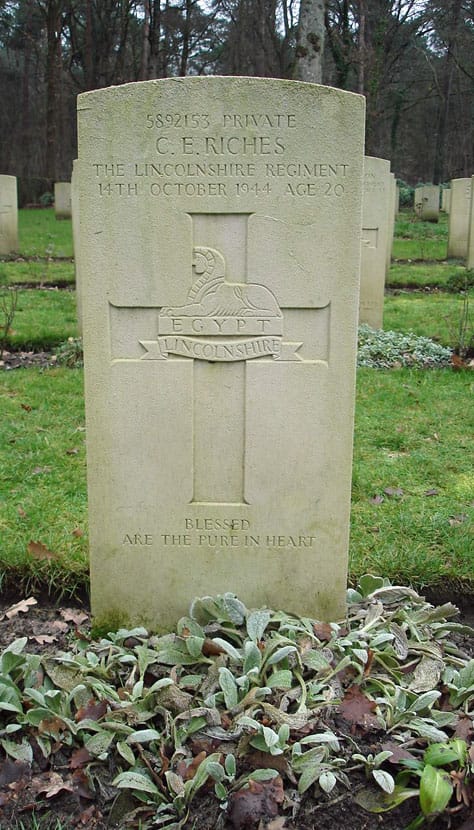
    Lincolnshire Regiment, 2nd Bn.

  • Grave number

    I. B. 9.

  • Charles Ernest Riches

    Charles Ernest Riches

    Charles Ernest Riches

  • Grave Charles Riches

    Grave Charles Riches

    Grave Charles Riches

Biography

Charles Ernest Riches was killed on 14 October 1944 at Overloon. He was aged 20 and a Private in the 2nd Battalion of the Lincolnshire Regiment (Service No. 5892153). He was initially buried at the Vogelsangs Farm near Overloon and re-interred in grave number I. B. 9. at the Commonwealth War Grave Commission Cemetery at Overloon on 15 July 1946.

Family background

Charles Ernest Riches was the son of Pymer James Riches and Catherine McPherson Riches (nee Studdy).
 
Pymer James Riches had been born in the Medway district of Kent on 16 June 1869. He was the son of James Riches and Ann P Riches (nee Pymer). James had been born in 1829/30  and Ann in 1830/1, both in Wareham, Norfolk.
 
In 1871, James and Ann were living at Dale End, Chatham, Medway, Kent. James was working as a Telephone Line Man. With them were three children: Ann Lavinia born 1865 in St Giles, Cambridgeshire, William Foster born 1868 in Histon, Cambridgeshire and Pymer James himself who had been born in Chatham in 1869. This suggests that the family moved from Histon to Chatham between 1868 and 1869.
 
By 1881, the family had moved to 3, Warwick Place, Daventry, Northamptonshire. James was working as a Telegraph Clerk and so was in the Civil Service. The same three children were present plus a fourth, Arthur, who was born in Daventry in 1875. At this time Annie was working as a Boot Fitter while William was a Boot Rivetter.
 
In 1891 they were living at 40, Warwick Street, Daventry. James was now described as a Telegraph Pensioner. With them were children William and Arthur, working respectively as a Shoe Rivetter and Shoe Clicker, and a granddaughter, Emma Riches born in 1885 in Daventry. Annie and Pymer James were no longer at home. It isn’t known where Pymer James Riches was at this time.
 
Catherine McPherson Studdy had been born on 13 December 1877. She was the daughter of William Studdy and Elizabeth (or Isabella) Studdy (nee Guthrie). William had been born in 1837 in Walker (or Long Benton), Northumberland (now a part of Newcastle). Elizabeth had been born in 1836/7 in Belford, Northumberland. They had married in1861 in Newcastle.
 
In 1871 William and Isabella (as she was referred to then) were living at Campbell Street, Westgate, Newcastle upon Tyne. William was an Ale Porter Agent and Isabella was described as an Ale Porter Agent’s wife. With them were four children as follows: James William b 1863, Peter Robert b 1865, Mary Elizabeth b 1867 and Hugh McPherson born 1871. The first three were born in the Elswick area of Newcastle while Hugh was born in the St John’s area of Newcastle. Also present was a servant, Elizabeth Ann Chantler born 1853 in the St John’s area.
 
In 1881, William and Elizabeth were living at 8, Tindal Street, Westgate, Newcastle upon Tyne. William was now a Draper’s Assistant but was unemployed at the time. James, Peter, Mary and Hugh were still with them. However, two more children were present: Margaret A (Meggie) b 1874 and Catherine herself born in 1877  – both born in Newcastle. James was working as a Butcher and Peter as a Warehouseman Draper.
 
William Studdy died in Gateshead, County Durham in 1889.
 
By 1891, Elizabeth was therefore widowed and living at 105, Marian Street, Gateshead, Co. Durham. With her were her four younger children: Mary, Hugh, Margaret and Catherine. Hugh was working as a Provisions Warehouseman.
 
In 1895, Pymer James Riches married Catherine McPherson Studdy in the Chester le Street district of County Durham.
 
In 1901 Catherine Riches was living at 40, Saltwell Road, Gateshead, Co. Durham in the household of her widowed mother Elizabeth Studdy. Elizabeth’s son, Hugh McPherson Studdy, and a granddaughter Catherine McPherson Studdy born in Newcastle in 1893. Hugh was working as a General Cartman and was still single. With Catherine were her first two children: James William b 1897 and Mary Elizabeth b 1899, both in Newcastle (though Mary may actually have been born in Gateshead). Again, it isn’t known where Pymer was at this time.
 
By 1911, Pymer (now known as James) and Catherine were living at Redheugh Hall, Rose Street, Gateshead, Co. Durham. Pymer was working as a Horse Keeper to Colliery Bank. Their children, James  and Mary, were still with them as were four more children as follows: Sarah Allison b 1902, Meggie Ann b 1905, Catherine McPherson b 1907 and Elizabeth Fraser b 1909 – all born in Gateshead. James William was working as a Token  Lad (above ground).
 
Redheugh Hall had been part of the Redheugh estate which had existed since the 13th Century. The Hall was a late 17thCentury House. The setting of the house was ruined when the Newcastle and Carlisle Railway was built between the house and River Tyne. In 1835 the house was leased to a glass manufacturer from Newcastle. The railway was moved in 1839 but the estate was put up for sale in 1850 as building plots for villas. It was only sold after 1871 when the Redheugh Bridge opened, increasing access to the site from Newcastle. Much of the land was built on, but the Hall stood empty. In 1912 it was a storehouse, with hay held in the eighteenth century drawing room. Then it was sold to the Redheugh Colliery Company. It would be in this latter period when the Riches family lived in part of it.
 
Between 1917 and 1919 Pymer and Catherine had moved to Daventry in Northamptonshire. In June 1921 they were living at Drayton Grange. Pymer was now working as a Gardener for AW Priestly. With them were Sarah, Catherine and Elizabeth plus four more children: Edith Louise b 1911, Hilda Margaret b 1913, Dorothy b 1917 and Peter Robert b 1919. Peter was born in Daventry and the others in Gateshead. Their two eldest children and Meggie Ann were no longer at home. Another child, Ralph Allison Riches, had been born in Gateshead in 1915. In June 1921, he was a patient in the General Hospital, Billing Road, Northampton.
 
Charles Ernest Riches was born in Daventry on 13 January 1924. He was therefore the youngest of Pymer and Catherine’s twelve children
 
In September 1939, Pymer and Catherine were living at 10 Williams Terrace, Daventry. Pymer was now working as a retired Baker/Confectioner and Catherine was a Laundress. With them was Charles and an undisclosed record suggesting the presence of another child. This was likely to have been Hugh McPherson Bishop (known as “Mac”) who was the son of Pymer and Catherine’s daughter, Mary Elizabeth Riches. She had married Victor Bishop in 1916 and had two children, one of whom was Mac who was born in 1920. It seems her husband had abandoned her and she died in 1927, leaving her mother to bring up Mac. Charles was working as a Baker and Confectioner.

Military Career

The 2nd Battalion of the Lincolnshire Regiment served with the British Expeditionary Force (BEF) and returned from Dunkirk after the battles of France and Belgium in 1940. Charles will have been too young to have been in the Army at that stage. The Battalion then spent the next four years training in various parts of the United Kingdom before taking part in the D-Day landings in June 1944.
 
It is thought that Charles joined up in the Army around May 1943.
 
The Battalion landed in France on 6 June where they spent the night just south of Lion sur Mer. They engaged the enemy in areas north of Caen during June and early July.
 
It is known from a Casualty Record that Charles was wounded while in Normandy, but the exact date is not recorded. A total of 36 men from the same Battalion were similarly recorded as wounded on the same list. Those from other regiments on those lists were shown as wounded between 25 June and 13 July.
 
The Battalion was involved in Operation Charnwood on 8 to 9 July. This was intended to capture Caen. While it was a tactical success for the Allies, they lost 3,817 troops during the operation. It is likely that it was in this battle that Charles was wounded. The Battalion War Diary records that 113 Other Ranks were wounded and 23 killed on 8 July.
 
The Battalion moved on to fight in Operation Goodwood where a further 211 Other Ranks were wounded and 18 killed on 20 July. This is another possibility for when Charles was wounded. It is not known how severe his injury was or when he was able to rejoin his unit. The Battalion continued to fight in Normandy during August and early September before moving rapidly on into Belgium on 16 September and then Deurne in the Netherlands on 25 September. This was part of the Allied push towards Arnhem in Operation Market Garden which ultimately failed to take the bridge at Arnhem.
 
On 9 October 1944 the Battalion found itself in Haps, just south of Nijmegen and North of Overloon. It was to take part in Operation Aintree in the coming days with the aim of taking Overloon to the south and then Venray before finally eliminating a German bridgehead on the River Maas near Venlo. They were ordered to move south to St Anthonis on the 11th, but this was postponed to the 12th due to bad weather. The move was completed on the 12th and they then moved slightly further west on the 13th, though with one man killed and 3 wounded.
 
On the 14th, the plan was for B Company to be guided through a wood held by the Royal Ulster Rifles to its front edge from where they would carry out a recce to check if a stream was passable and if the north eastern corner of a wood to the south was held by the enemy. However, the guides were late and the move through the wood was slower than expected, so the recce did not take place. At 7.30am the Company began to advance south out of the wood under a 10 minute concentration of artillery fire. However, before the Company had advanced 100yds the enemy opened fire from a track about another 100 yds ahead. The advance continued and the track cleared of the enemy. This yielded about 10 prisoners and a few dead. As soon as the prisoners were clear, enemy defensive fire came down on the Company and four or five machine guns opened up from the left flank. 12 Platoon were ordered to advance under covering fire from 10 Platoon but in so doing lost about half their number. The Company Commander issued an order to retreat back to the Royal Ulster Rifles’ position. By this point one Lieutenant and 34 other ranks had been killed or wounded. It was decided to launch an attack at 1530 hours with D and A companies in the lead. The enemy had been seen moving in the area of the stream in front of the wood. It was thought that the enemy holding the Battalion objective were probably a Company strong. Immediately the attacking force came into the open they were subjected to intense artillery and mortar fire but they pressed steadily on to reach their objective. During this action the Battalion again suffered very heavy casualties. This was the day on which Charles Ernest Riches was killed in action.

Aftermath

His death was reported in the Newcastle Evening News of 3 November 1944. He was described as Private Charles E Riches, 2nd Lincolnshire Regiment, youngest son of Mr and Prs P J Riches, of 10 William Terrace, Daventry (late of Redheugh Hall, Gateshead).

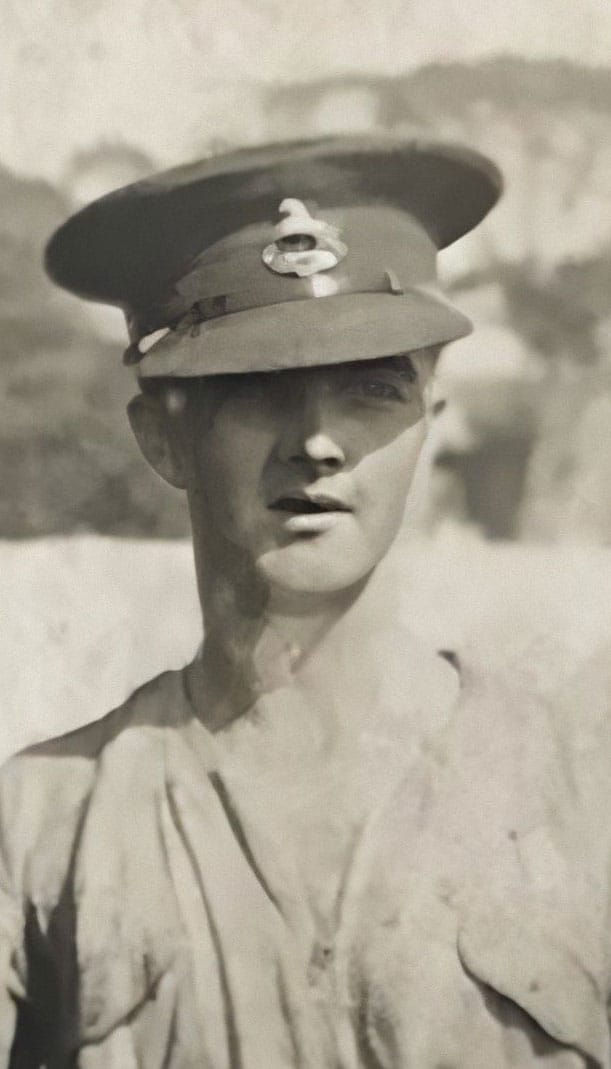
It was also reported with his photograph in the Northampton Mercury  of 3 November 1944. It is thought to read as follows: “Official information has been received that Pte Charles Ernest Riches youngest son of Mr and Mrs Riches of William Terrace, Daventry has been killed in action in North West Europe. Pte.  Riches who was 20 joined the army over a year and a half ago before which he was a ?? in the Daventry Civil Defence Service. He attended Daventry Abbey School after which he was employed in Daventry Coal Supply. A boxer, Pte. Riches was a member of Daventry Boys’ Club. A brother L.A.C Peter Robert Riches is serving in the RAF.”

As seen in this article, Charles’ brother also served in WW2. So too did their sister Dorothy’s husband. He served in the Northampton Yeomanry alongside Charles and Peter’s nephew Mac who had been brought up with them almost as a brother as they were of similar ages.

Pymer J Riches died in Daventry in early 1945, just a few months after his son.

Catherine M Riches may have died in 1951 in Meriden Warwickshire.

Sources and credits

From FindMyPast website: Civil and Parish Birth, Marriage and Death Records; England Census and 1939 Register Records; Electoral Rolls; Military Records
Lincolnshire Regiment War Diaries via Traces of War Website and the Normandy War Guide Website
Wikipedia – information on the Lincolnshire Regiment and Operation Charnwood.
Newcastle Evening Chronicle of 3 Nov 1944
Photo and information from the Northampton Mercury 3 Nov 1944
Assistance from Beverley Whittaker, Charles’ niece.

Research Elaine Gathercole
  

Continue reading

Moore George

Moore | George

  • First names

    George

  • Age

    29

  • Date of birth

    09-05-1915

  • Date of death

    18-10-1944

  • Service number

    3769934

  • Rank

    Lance Corporal

  • Regiment

    South Lancashire Regiment, 1st Bn.

  • Grave number

    II. A. 8.

  • George Moore

    George Moore

    George Moore

  • Graf George Moore

    Graf George Moore

    Grave George Moore

Biography

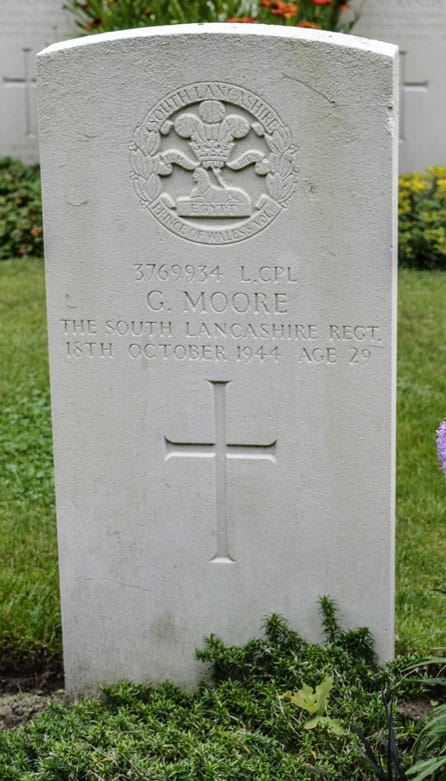
George Moore (Service Number 3769934) died of his wounds on October 18, 1944. He served with the 1st Battalion, South Lancashire Regiment. He was initially buried at Deurneseweg in Oploo and was reinterred on January 28, 1946, in grave II.A.8 at the Overloon War Cemetery.

FAMILY BACKGROUND

George Moore was born on May 9, 1915, in West Derby, Lancashire, England. His parents were George Moore (1890–1953) and Sarah Alice Moore (née Bateman) (1894–1979). His father was a baker, and his mother was a homemaker. In 1918, during the First World War, his father served with the Royal Army Medical Corps.

George had the following siblings: Alice (1913), Albert Leonard (1918), Esther (1921), Lilian (1924), William Harold (1927), Jennie (1931), and half sister, Jean (1936).

The family lived at 56 Uxbridge Street, Edge Hill, Liverpool, and later moved to 19 Marmaduke Street in Liverpool.

MILITARY CAREER OF GEORGE MOORE

Early Years and the Territorial Army (1934–1937)

On April 17, 1934, the 18-year-old George Moore enlisted in the Territorial Army. He was posted to the 5th Battalion of the King’s Regiment (Liverpool). In 1934, 1935, and 1936, he faithfully attended the mandatory 15-day annual training camps. At the time, he lived at 19 Marmaduke Street and worked as a railway porter.

On October 20, 1936, he was honorably discharged from this battalion, only to be declared officially fit for active service with The King’s Regiment the following day in Seaforth. He listed his father, George Moore of 22 Mozart Street, Lodge Lane, Liverpool, as his next of kin. During his training, George proved to be a dedicated student, obtaining his 3rd Class Education Certificate in 1936 and his 2nd Class Certificate in 1939 while stationed in Peshawar, British India.

A Global Stage of War

During the Second World War, the King’s Regiment was spread across various fronts:

  • British India (now Pakistan/India): The 1st and 13th Battalions guarded the borders. They later formed the core of the famous “Chindits”, fighting the Japanese deep in the Burmese jungle.
  • England and Europe: The 5th and 8th Battalions defended the home front until participating in the Normandy landings in 1944.
  • Mediterranean: The 2nd Battalion fought in North Africa and took part in the invasions of Italy and Greece.

Although the regiment was ceremonially based in Liverpool, its men fought all over the world: from the beaches of France to the mountains of Pakistan and the jungles of Burma.

Service in British India: The Transport Section

On November 10, 1937, George was assigned as a Private to the 1st Battalion and sent to Peshawar, near the Afghan border. He was placed in the transport section. Because of the rugged, mountainous terrain of the Khyber Pass, trucks were unusable; the unit relied entirely on mules for transporting ammunition and supplies.

Caring for these animals was a demanding daily task. George was described by his superiors as a quiet, respectful, and cheerful worker with excellent prospects. In September 1938, he was officially rated as a skilled rider with “good knowledge of animal management.”

Incidents with Mules

Despite his skill, George seemed to be a magnet for accidents involving these headstrong pack animals:

February 1939: During an exercise, another soldier’s mule bolted, causing a panic. George was thrown from his mule and kicked while on the ground.

July 1939: While riding to the “Grass Farm,” a passing mule reared and kicked George’s right ankle. He had to return to the barracks on his own despite great pain.

August 1941: While walking behind his animal to put away a currycomb, the mule kicked out unexpectedly, striking his right knee and resulting in two days of hospitalization.

Discipline and Promotion

His Service Record also showed the human side of the young soldier. During his early service in Devonport, he once stayed away for four days without leave, which earned him a reprimand. In India, discipline became stricter; minor offences, such as an incomplete uniform or briefly leaving his post, were punished with ‘C.B.’ (Confined to Barracks). Nevertheless, he remained ambitious. His educational certificates led to his promotion to Lance Corporal on 11 March 1943.

From 2 August 1943 to 28 January 1944, he served in India with the 13th Battalion of the King’s Regiment. The 13th King’s provided the bulk of the British contingent for the “Chindits” (Burmese word for Lion). The Chindits, officially known as Long Range Penetration Groups, were special operations units of the British and Indian armies that saw action in 1943-1944 during the Burma campaign of the Second World War. Their operations consisted of long marches through extremely difficult terrain, carried out by malnourished troops who were often weakened by diseases such as malaria and dysentery. Controversy remains about the extremely high number of casualties and the questionable military value of the Chindits’ achievements. George may have been involved in these operations.

THE ROAD TO THE EUROPEAN FRONT

On 28 January 1944, George left the port of Bombay and returned to England. After passing through various training centres, he underwent a medical examination in June 1944 and was found fit for active service in North-West Europe.

In the summer of 1944, administrative changes followed in quick succession:
In July, he was placed on the S.O.S. list (Struck Off Strength) in preparation for a new assignment.
On 11 August, he was added to an S.O.S. Reinforcement Draft group.
On 21 August 1944, he was officially assigned as T.O.S. (Taken On Strength) to the 1st Battalion, South Lancashire Regiment. For this, he gave up his stripes and became a Private again. That same day, he left for France.

Normandy and the Falaise Pocket

George joined a battalion that had already been through heavy fighting. The 1st Battalion had landed on Sword Beach at Colleville-sur-Mer on D-Day. The landing and advance cost the lives of more than 100 Lancashires, including their commander. After fierce fighting at Pegasus Bridge, the bloody battle for Caen and the capture of Chateau de La Londe, the battalion took part in the offensive at the Falaise Pocket.

When George joined his unit on 21 August, the encirclement of German troops had just been completed and the Battle of Normandy was coming to an end. After a short period of rest and training in northern France, the regiment marched through Belgium towards the Dutch border.

Operation Market Garden and the Battle of Overloon

Operation Market Garden commenced on 17 September 1944. The Allies’ plan was to advance rapidly through the Netherlands by dropping airborne troops at the bridges over the Meuse, Waal and Rhine rivers. The aim was to capture and secure these bridges, in combination with a simultaneous armoured attack on a narrow front from Belgium. Both the East Lancashires and the South Lancashires took part in this operation on the flanks of the main axis; the South Lancashires were on the right flank.

To this end, on 18 September, the South Lancashires, together with the Suffolks and Yorkshires, first formed a bridgehead to Sint-Huibrechts-Lille. This was followed by patrols towards Kaulille, where the temporary headquarters were established the following day. In the two days that followed, the Meuse-Scheldt Canal was crossed and on 20 September, the battalion entered Hamont. The plan was to advance to Weert the following day, but that first joint attack failed due to fierce German resistance.

After several days of reconnaissance, George and his battalion arrived in Bakel via Maarheeze, Leende, Heeze, Geldrop and Helmond. This route took them through an area that had already been liberated by the 11th British Armoured Division. They were then deployed on 3 October in Mook, just south of Nijmegen. This was part of the offensive in Operation Market Garden, which ultimately failed because the bridge at Arnhem could not be captured. As a result, the Allies ended up in a narrow corridor through the Netherlands. On 30 September, the American 7th Armoured Division had already attempted to widen this corridor by attacking from their position at Sint Anthonis Overloon, but this attack also failed.

The battalion remained in Mook until 8 October and then moved south towards Wanroij. On 9 October George was promoted again to Lance Corporal. It had been decided that the Americans would withdraw and that the British would take on the task of widening the corridor via Overloon, Venray and Venlo. Initially, the attack on Overloon was to begin on 11 October, but due to the very wet weather and poor soil conditions, it was postponed until 12 October.
On 12 October, the attack began at 12 noon with a very heavy artillery bombardment. The 2 East Yorks led the attack on the area described as “Dog Wood”, west of Overloon, while the 1 Suffolks focused on Overloon itself. Both units reached their objective at 3 p.m., after which mopping-up operations followed. The 1 South Lancs had previously been held in reserve, but at 5 p.m., the A and D companies were ordered to advance to clear a remaining area. Each front company was supported by a troop from the 3 Grenadier Guards. They encountered little resistance and by evening they had taken up their position on the edge of a clearing west of Overloon.

The Attack on Overloon and Venray

The next day, they advanced a little further south. On 14 October, however, they were ordered to go to the road between Rouw and Halfweg (northeast of Overloon) to secure control of a junction leading to Schaartven. Meanwhile, the 1st Suffolks and 2nd East Yorks were struggling to cross the Molenbeek and attack Brabander and Venray. On 17 October, George’s battalion followed the 2nd East Yorks to the north-western edge of Venray, where they were ordered to take the southern part of the town. Although Venray had been almost completely cleared, heavy artillery fire continued and minefields were discovered. On this day, Venray was officially liberated.

However, the planned advance to Venlo had to be abruptly halted a day later, on the orders of Supreme Commander Eisenhower. The liberation of the Scheldt estuary was given priority. The strategy for the advance south was reconsidered and attention shifted to patrols east of Venray. As a result, Venray remained a front-line town for months; despite its liberation, artillery fire continued to be a daily occurrence.

It was on this day, 18 October 1944, that George Moore was wounded and died of his injuries that same day.
He had served for 7 years and 363 days.

He was buried together with a number of comrades on Deurneseweg in Oploo and reburied on 28 January 1946 at Overloon War Cemetery.

George Moore was posthumously awarded the following medals for his service: 1939-43 Star, France & German Star, Defence Medal, and the War Medal.

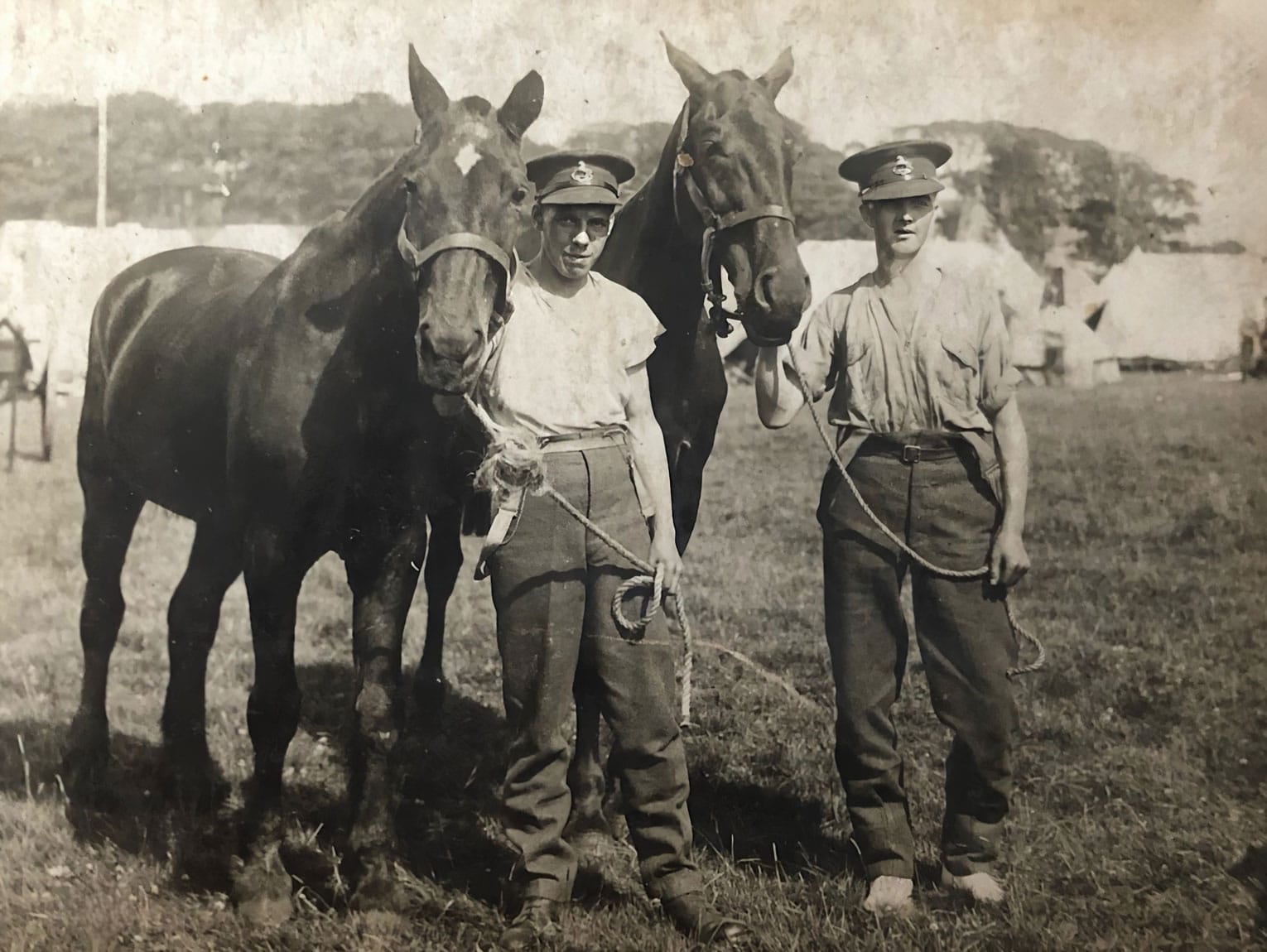
  • George Moore (right) and comrade with regimental horses

    George Moore (right) and comrade with regimental horses

    George Moore (right) and comrade with regimental horses

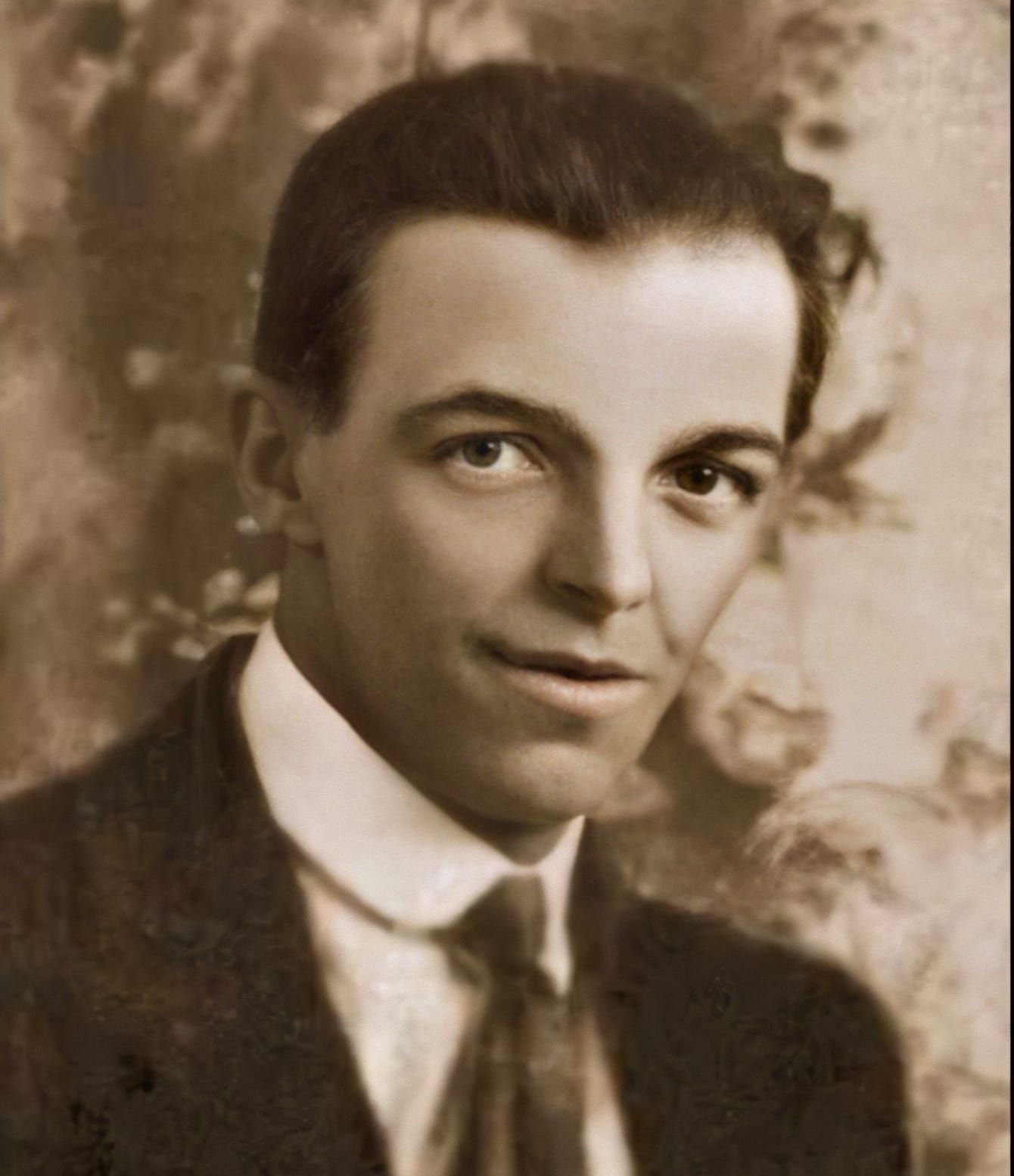
  • Vader George Moore

    Vader George Moore

    Vader George Moore

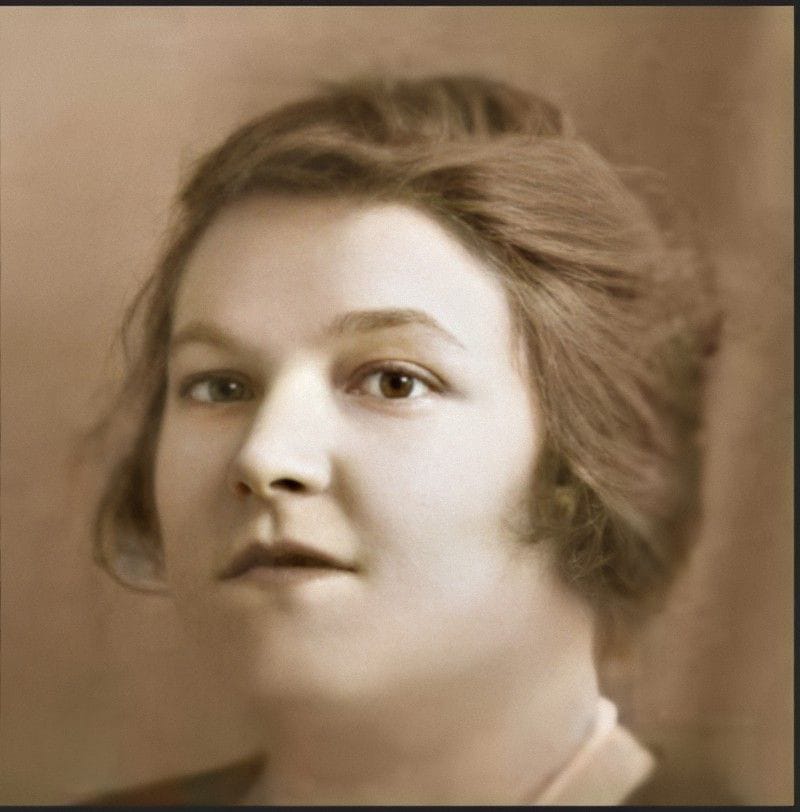
  • Moeder Sarah Alice Bateman Moore

    Moeder Sarah Alice Bateman Moore

    Moeder Sarah Alice Bateman Moore

Sources and credits

Ancestry Civil and parish birth, marriage, and death records; English census and records from 1911, 1921, and 1939; electoral rolls; military records and family trees.
Ancestry family tree Eric Bateman
Wikipedia for 1st South Lancashire Regiment, King’s Regiment (Liverpool), 13th King’s Regiment
War Diaries 1st South Lancashire Regiment
Service Record WO 423/362060 of George Moore from the National Archives
Kevin Moore and Leo Janssen for the photo of George
Eric Bateman for the photos of George’s parents

Research Anny Huberts

Continue reading

Gray | John Henry

Gray | John Henry

  • First names

    John Henry

  • Age

    42

  • Date of birth

    29-01-1903

  • Date of death

    11-05-1945

  • Service number

    883381

  • Rank

    Bombardier

  • Regiment

    Royal Artillery

  • Grave number

    IV. A. 1.

  • John Henry Gray

    John Henry Gray

    John Henry Gray

  • Grave John Henry Gray

    Grave John Henry Gray

    Grave John Henry Gray

Biography

John Henry Gray died on 11 May 1945 from injuries sustained in a traffic accident. He was 42 years old and was a Bombardier (service number 883381) with the Royal Artillery. He was buried at the American Military Cemetery in Margraten in the Netherlands and reburied on 1 May 1947 at Overloon War Cemetery in grave IV.A.1.

Family Background

John Henry Gray was born on 29 January 1903 in Old Kilpatrick, Dunbartonshire, Scotland. His parents were John Gray (1863–1927) and Annie McKeever (1878–1956).

His siblings were: Helen Gray (1898–1898), Margaret Gray (1900–1985), Patrick Gray (1901–), Mary Gray (1904–), Anne Gray (1906–1997), Bella Gray (1907–1992), Sissy Gray (1908–1911), Winnifred Gray (1911–), Thomas Gray (1915–1955) and William Gray (1916–1977).

He married Agnes Doyle in Paisley on 27 July 1923 and they went to live at 13 Underwood Lane. Later they lived at 96 Seedhill Road, also in Paisley.
They had six children, all born in Paisley: John 22 October 1924, Margareth Doyle 25 September 1926, William Henry 31 August 1928, Thomas 6 June 1930, Agnes 16 January 1933 and Terence 21 August 1936.

John worked as a motor driver.

Military career

John enlisted in the Royal Regiment of Artillery on 12 May 1938, at the recruiting office of the 156th Infantry Brigade.
On 29 September 1939, he was mobilised into the British Army, shortly after the outbreak of the Second World War. His mobilisation took place in Stranraer, Scotland, after which he was deployed for service within the United Kingdom.

His first posting was with the 5th Battalion of The King’s Regiment, an infantry unit of the Territorial Army. In this early period, their duties consisted mainly of home defence, including guarding vital infrastructure, ports and communication lines, as well as military training and readiness services. The battalion was mainly stationed in north-west England and southern Scotland, areas of strategic importance in the early years of the war.

In 1940, as German air raids on Britain intensified, he was transferred from the infantry to the Royal Artillery. After retraining at a Basic Artillery Training Centre, he was assigned to the 225th Heavy Anti-Aircraft Battery, becoming part of the British air defence during the Battle of Britain and the subsequent Blitz.

In addition to his duties as an artilleryman, he was formally appointed as a Vehicle Mechanic and was required to maintain recognised technical proficiency. His work included the maintenance and repair of military vehicles, tractors for anti-aircraft guns and associated equipment, which were essential for the deployability of Heavy Anti-Aircraft units. On 12 January 1944, he was officially classified as a Vehicle Mechanic, Group A, Class III, recognising him as a skilled executive mechanic.

His Service Record shows that he served in various units of the Royal Artillery between 1941 and 1944. In the early years of the war, he served with the 58 Anti-Tank Regiment, the 223 Anti-Tank Regiment, the 3rd Reserve Regiment, and in June 1943, he joined the 97 Anti-Tank Regiment.

During this period, he steadily rose through the ranks. He was promoted from Gunner to Lance Bombardier, then to Bombardier, and subsequently held positions as Acting Bombardier and War Substantive Bombardier. He remained in England during these years and would later fight on the North-Western Front.

France

On 17 June 1944, he arrived in France as part of the 21st Army Group. The 21st Army Group was commanded by General (later Field Marshal) Bernard Montgomery.
During the fighting in Normandy, this Army Group was involved in the Battle of Caen and the fighting for the Falaise Pocket, among other things.
After Operation Dragoon, the 21st Army Group formed the left flank of the Allied advance in north-western Europe. It was responsible for capturing the ports and eliminating the V-1 and V-2 launch bases along the coasts of France and Belgium. On 4 September 1944, the Belgian port city of Antwerp was captured.

Belgium

On 20 December 1944, John was assigned to the 31 Reinforcement Holding Unit, which was part of the 101 Reinforcement Group. This unit had already been in the area for a few months and consisted mainly of Royal Artillery officers and other ranks, who had been supplied from various regiments. There was a great deal of training, from map reading to shooting exercises, rifle exercises, weapons training and vehicle training. But there was also personal training to stay strong, and football was played regularly.

The unit was stationed in Bourg Leopold, Belgium, 70 km southeast of Antwerp.

Leopoldsburg (Bourg-Léopold) was an important strategic military location during the Second World War, with the Camp of Beverloo. During the First and Second World Wars, the camp was occupied by German troops. Part of the camp was also used by the Germans as a prisoner-of-war camp. After the Battle of France, 10,000 members of the Hitler Youth, who formed the 12th SS Panzer Division Hitler Youth, were trained at the camp. During the war, it was also used as a transit camp for the Holocaust. In May 1944, the camp was bombed by the Allies and fierce fighting ensued, resulting in many casualties.

The months of January and February 1945 in Bourgh Leopold were relatively quiet, with occasional attacks by enemy aircraft, but normal support activities continued.

Holland

In April, the unit left in three groups by train for Gennep at the river de Maas in North Limburg in the Netherlands.

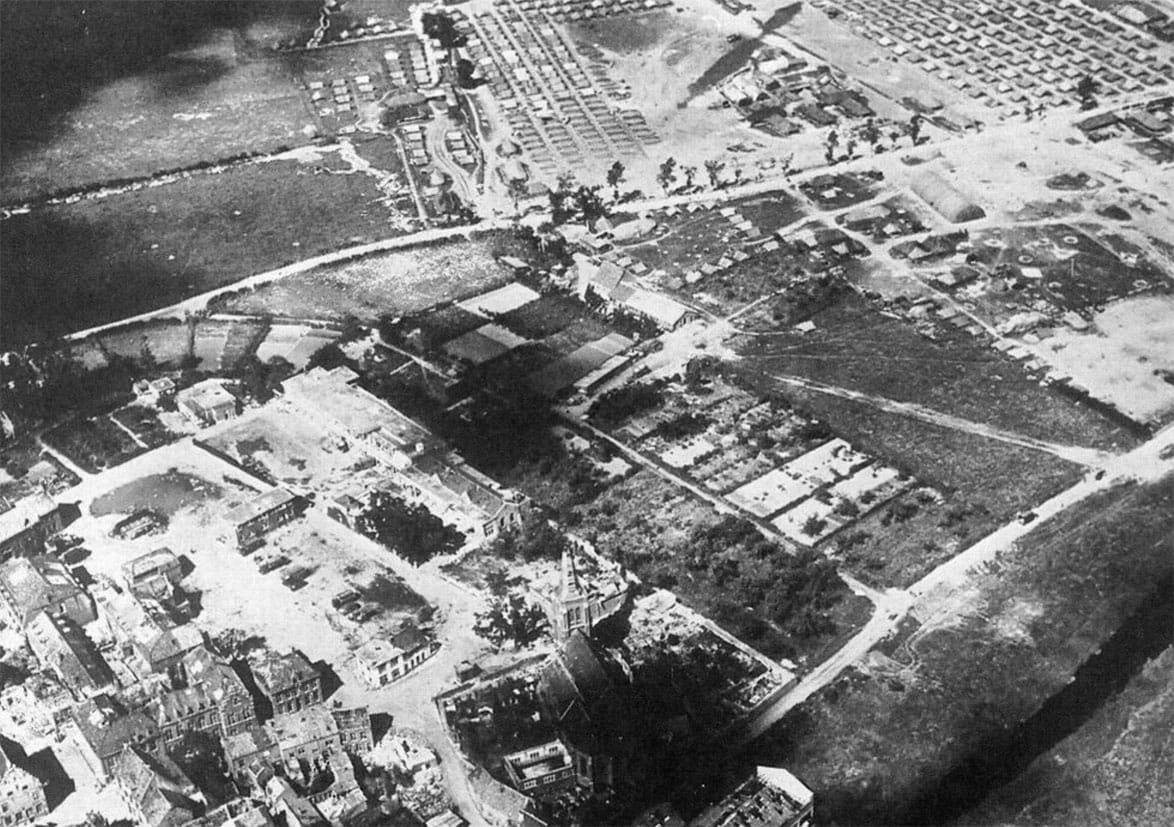
Following the construction of two crucial Meuse bridges by the British Engineers, an impressive tent camp was established on the outskirts of Gennep at the Maaskemp in April 1945. This large-scale transit camp, which resembled a small village in both size and structure, played a key role in the logistics of the Allied advance. Various British regiments utilized this facility to recuperate during their journey to or from the front lines in Germany, with the flow of troops streamlined via the “German line” railway connection.

As the Maaskemp served as a transit hub, Gennep saw a constant stream of rotating regiments, ranging from troops arriving fresh from England to units returning from heavy combat in France or Germany for leave or regrouping. Additionally, especially during the lead-up to the liberation, large groups of British artillerymen were stationed in the immediate vicinity to support the further push into the Reichswald.

The first group of the Unit from John arrived on 18 April, the second on 19 April and the third on 20 April. They stayed in tents or houses. Some of the houses were watertight, but all were in “filthy” condition, as described in the War Diary. Their tasks consisted of normal support duties, and they were also assigned to escort three groups of prisoners of war, consisting of three officers and 100 other ranks, to Germany every day.

These transports of prisoners of war took place from 1 to 7 May. The accommodation in Gennep was used to its full capacity, as each train carried between 800 and 1,000 soldiers every day. It was an emergency situation, but it meant that the unit could deploy 1,250 reinforcements every day where they were most needed. As hostilities decreased, this number dropped to 500 to 600, and the future role of the Reinforcement Holding Unit was reviewed.
On 11 May 1945, John Gray was sadly killed in a very tragic traffic accident. The information his wife Agnes received was that he was transporting German POW’s, and a bridge that he drove over was mined and it blew up killing him. His Service Record shows that there was insufficient evidence to identify a guilty party. His death was marked as Killed in Action.
He was buried at the American military cemetery in Margraten in South Limburg in grave CCC-2-33. On 1 May 1947, he was reburied at Overloon War Cemetery in grave IV.A.1.

John received the following medals for his military actions:
1939-1945 Star
France & Germany Star
Defence Medal
War Medal 1939-1945

  • German POW with British soldiers February 1945. Source IWM and Stichting Erfgoed Gennep

    German POW with British soldiers February 1945. Source IWM and Stichting Erfgoed Gennep

    German POW with British soldiers February 1945. Source IWM and Stichting Erfgoed Gennep

  • German POW with British soldiers February 1945. Source Stichting Erfgoed Gennep

    German POW with British soldiers February 1945. Source Stichting Erfgoed Gennep

    German POW with British soldiers February 1945. Source Stichting Erfgoed Gennep

  • Street in Gennep Februari 1945 Source Stichting Erfgoed Gennep

    Street in Gennep Februari 1945 Source Stichting Erfgoed Gennep

    Street in Gennep Februari 1945 Source Stichting Erfgoed Gennep

  • Transitcamp in Gennep 1945

    Transitcamp in Gennep 1945

    Transitcamp in Gennep 1945

  • City Centre Gennep 1945

    City Centre Gennep 1945

    City Centre Gennep 1945

Sources and credits

Ancestry Civil and parish birth, marriage, and death records; English census and records from 1911, 1921, and 1939; electoral rolls; passenger lists, military records, and family trees.
Wikipedia
War Diaries 31 Reinforcement Holding unit WO 171-3692 and WO 171-8205
Robert Clark of researchingww2.co.uk for the above War Diaries
Service Record WO 423/202335 of John Henry Gray from the National Archives
Stichting Erfgoed Gennep for the photo’s
Liberationroute

Research Anny Huberts

Continue reading

Hawksby | John Victor

Hawksby | John Victor

  • First names

    John Victor

  • Age

    23

  • Date of birth

    06-12-1920

  • Date of death

    14-10-1944

  • Service number

    1445252

  • Rank

    Private

  • Regiment

    Lincolnshire Regiment, 2nd Bn.

  • Grave number

    I. D. 1.

  • John Victor Hawksby

    John Victor Hawksby

    John Victor Hawksby

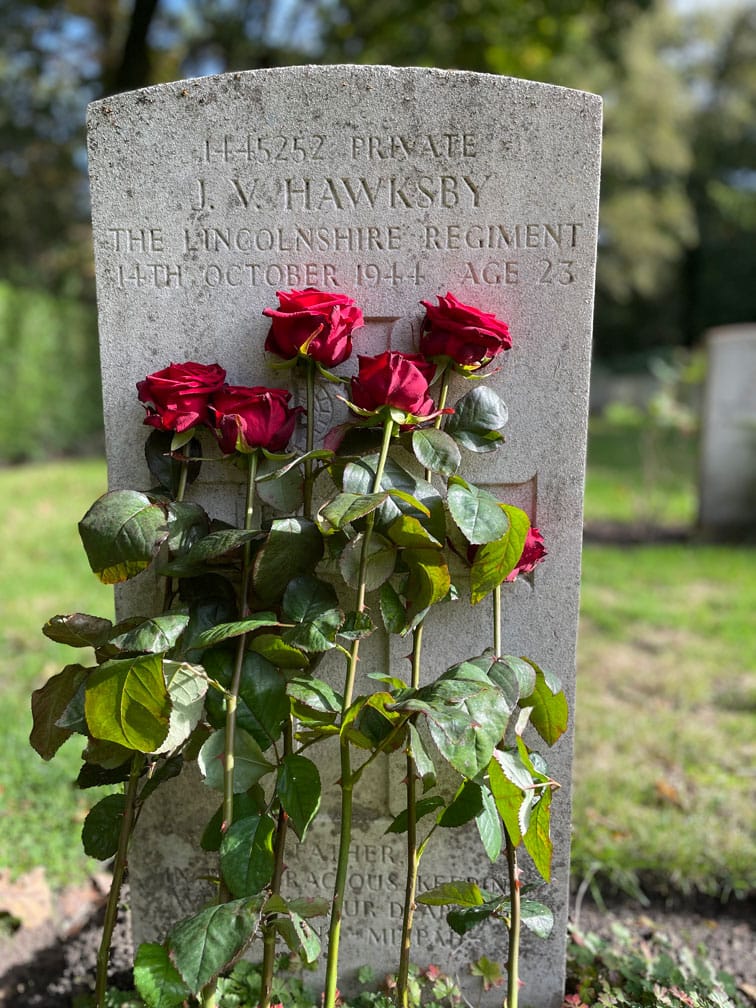
  • Grave John Victor Hawksby

    Grave John Victor Hawksby

    Grave John Victor Hawksby

Biography

John Victor Hawksby died of his injuries on 14 October 1944 in Overloon, aged 23. He was a soldier in the Lincolnshire Regiment, 2nd Battalion (service number 1445252). John was initially buried at the farm of Vogelsangs in Overloon and reburied on 15 July 1946 at the Overloon war cemetery in grave I. D.1. The inscription on his grave reads: ‘Father, In Thy gracious keeping We leave our dear one Sleeping. -Mizpah-

Family background

John Victor was born in 1920 and was the son of John Edward Hawksby (1892–1958) and Elizabeth Thompson Evers (1898–1984). He was the brother of Eric Hawksby (1926–1976).
They lived in West Hartlepool, Durham, England.

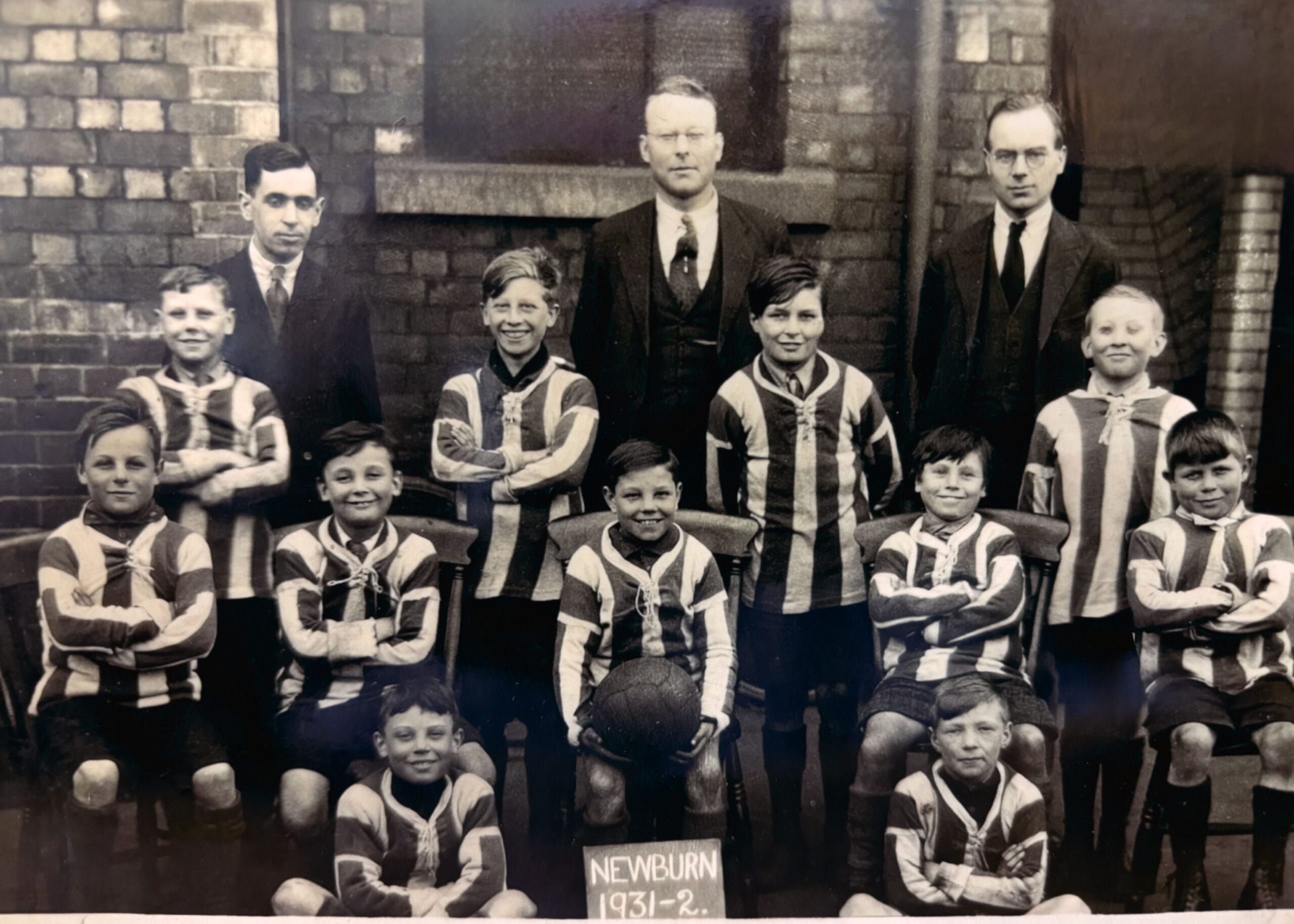
John (named Vic by his family) attended Newburn School in West Hartlepool and then worked in the construction industry. He was a member of the St John Ambulance Brigade and the Durham Heavy Brigade T.A. (Territorial Army) in Hartlepool, through which he was called up for service at the outbreak of war. He was subsequently transferred to the infantry, the North Staffordshire Regiment, most probably the 6th battallion which was the only Staffordshire battalion which landed in Normandy.
With this battalion he landed in Normandy in June 1944 and was wounded in August 1944. 

The 6th Battalion had been in France for less than two months when, in August 1944, along with other infantry units of 59th Division, it was broken up to supply replacements to other British units, due to a severe shortage of infantry replacements throughout the Army at the time. It is likely that because of that John Victor was assigned to the Lincolnshire Regiment 2nd Bn after he recovered from his wounds.

Lincolnshire Regiment 2nd bn

The 2nd Bn Lincolnshires took part in the D-Day landings in June 1944 and was then engaged throughout the Normandy Campaign, taking part in Operation Charnwood and Operation Goodwood.
They remained in Normandy until 15 September. They then took part in the push up through Belgium and the Netherlands with the aim of supporting the airborne troops engaged in Operation Market Garden which ultimately did not fully succeed following the failure to take the bridge at Arnhem in late September. 
Following the failure to take the bridge at Arnhem in Operation Market Garden in late September 1944, the Allied Forces were left in a very precarious narrow salient through the Netherlands. It was the aim of Operation Aintree to widen this salient by heading south from Nijmegen to take Overloon and then Venray before finally eliminating a German bridgehead on the River Maas near Venlo.
 
On 16 and 17 September the Battalion moved into Belgium near Mons. They found that the civil population were very enthusiastic, particularly in the area of the Belgian frontier. They then joined in the effort to cross the Escaut Canal where all the bridges had been blown by the enemy. They succeeded with other regiments in this difficult task in the face of opposition and a bridge was complete by 19 September. The Battalion moved on to Achel on 20 September where all ranks were able to get a night’s sleep under cover and then Hamont the following day where they remained until 25 September while the 11 Armoured Division took Deurne in the Netherlands. The Battalion moved to Deurne that day and took over from the 11 Armoured Division with the 2nd Battalion Royal Ulster Rifles. They remained in this area, sometimes engaging with the enemy who were on the east side of a canal. On 29 September they moved north to Milheeze and then Haps on 1 October.

The base of the 2nd Lincolnshire Regiment stayed in Haps from the 1st till the 12th of October. From there, attempts were made to clear the west side of the Meuse between Cuijk and Oeffelt. This was done together with 2nd Bn Royal Ulster Rifles, the 1st Bn King’s Own Scottish Borderers and 3rd Reconnaisance Regiment (9th Brigade 3rd Infantry Division).  
On the east side of the Meuse, resistance remained strong, particularly in Middelaar, Milsbeek, and Gennep. The stone factory in Milsbeek served as the main center of opposition, as its tall chimney functioned as an observation post from which German artillery coordinated the defense. On the east side of the river, the enemy was also attacked from Plasmolen.

Between 1 and 7 October, the Ferry House in Oeffelt — Het Veerhuis — was repeatedly occupied by the enemy and then retaken by British forces. Patrols of the 2nd Lincolnshire Regiment discovered that the Ferry House had once again fallen into German hands. Despite heavy British artillery bombardments, German troops continued to appear around the stone factory in Milsbeek.

On 4 and 5 October, the chimney of the Milsbeek factory was finally brought down, and the church in Middelaar was reduced to rubble. On 6 October, the 2nd Lincolnshire Regiment launched another attack on the Ferry House — this time successfully. This first week of October the Batallion lost three comrades, who were temporarily buried at the village square in Haps and later in 1946 reburied at Overloon War Cemetery.

On 9 October 1944 the Battalion were ordered to move south to St Anthonis on 11 October, but this was postponed to the following day due to bad weather. The move was completed on 12 October.
They were kept in reserve for the battle that was being fought around Overloon. The 8th Infantry Brigade was tasked with capturing Overloon and advancing to Venray. Shortly before nightfall, they heard that Overloon had fallen and that the battalions of the 8th Division were struggling to hold their ground.

On Friday, 13 October the aim was for the Royal Ulster Rifles, followed by the King’s Own Scottish Borderers and then the Lincolnshires to clear wooded areas just west and south of Overloon in which the Germans had entrenched themselves, then cross a stream called the Molenbeek between Overloon and Venray. They would be supported by Churchill Tanks of the 4th Tank Grenadier Guards. The Lincolnshires therefore moved down to a position just north west of Overloon that day.
In addition to the difficult terrain, two other factors played a crucial role – the Germans had dotted the entire area with their dreaded “Shuhminen.” These wooden mines were difficult to detect. They didn’t tend to kill but inflicted severe injury to the victim’s legs. In addition, the German troops had a strategic observation point from Venray’s church tower. Any Allied troop movement would be watched and relayed to their artillery which would result in a barrage of shells.

The Royal Ulster Rifles and the King’s Own Scottish Borderers began the attack on the forests. However, it soon became apparent that they were barely making any progress, leaving the Lincolnshires out of the battle all day. Nevertheless, the Lincolnshires suffered one man killed and 3 wounded.

On the 14 October, the plan was for B Company to be guided through a wood held by the Royal Ulster Rifles to its front edge from where they would carry out a recce (reconnaissance)  to check if a stream was passable and if the north eastern corner of a wood to the south was held by the enemy. However, the guides were late and the move through the wood was slower than expected, so the recce did not take place. At 7.30 am the Company began to advance south out of the wood. Before the Company had advanced 100 yds the enemy opened fire from a track about another 100 yds ahead. The advance continued but came under such heavy fire with so many casualties that the Company Commander, Anthony Frith Smith, issued an order to retreat back to the Royal Ulster Rifles’ position. By this point one Lieutenant and 34 other ranks had been killed or wounded.

Following a reconnaisance by the Company Commanders, it was decided to launch a full battalion attack at 15.30 hours with the support of the whole of the Divisional Artillery and an additional tank division on the right flank. The enemy had been seen moving in the area of the stream in front of the wood. It was thought that the enemy holding the Battalion objective were probably a Company strong. Immediately the attacking force came into the open they were subjected to intense artillery and mortar fire which was just as bad as in the early morning but this time they pressed steadily on to reach their objective. During this action the Battalion suffered very heavy casualties including four officers killed and another four wounded.

It was on this day that sadly, John was wounded and died of his wounds.

The fallen soldiers were buried the following day at noon on the Vogelsangs family farm on Helderseweg in Overloon. They were later reburied at the British cemetery “De Kleffen”, on the site where the War Museum is now located.

On 15 July 1946, a total of 27 men from the 2nd Battalion of the Lincolnshire Regiment who had died on 14 October 1944 were reburied side by side at the Overloon war cemetery. John is buried in grave I. D. 1.

Letters from Vic to home

  • Letter August 2nd 1944

    France August 2nd 1944

    Dear mum,

    I am answering your letter written last week, the 27th and as today is Wednesday 2nd and I got yours on Monday. You can see it’s not taking long for them to get here now, but I still haven’t got the papers (newspapers) so that’s two lost by now. I think I’ve seen all I’m going to of them. 
    I’m glad the bairns (children) got the cards, I’ve sent one to Gran, one to Aunt Mary and one to Aunt Nell as well, they and the writing paper I found in the same Bosch kit in a village we took a fortnight ago last Sunday.

    I’ve been busy but I’ve managed to pull through ok as yet. 
    The only thing I don’t like is this mortars. By the way, you remember my saying about the Major, well sorry to say he’s not with us anymore, mortar shrapnel got him so I’ve lost at least one good friend. 

    You people at home seem to be busy. Lately seeing relations. I have been away from the family for donkey’s ages (a long time), still I suppose everybody likes a visit West (West Hartlepool) now and then. 
    I bet Bills Nell will be cut up a lot over Bill but she will have to keep her chin up the same as the rest of us and hope for the best, anyway if she is in West she may cheer up a little. 

    I wish I was at home now. I would certainly change with anyone as doesn’t like the idea of buzz bomb repairs (John Victor was a bricklayer before the war), anything would do instead of this, I could certainly do with a rest. I’ve not had my boots or my slacks (trousers) off since I joined the battalion. 

    I’m making up for the time I spent in England with the RA (Royal Artillery). I’ve seen enough Jerrys lately to last me a lifetime, a lot of them are only 15 or 16 years old so that’s one thing that the papers are telling you that I can definitely vouch for as I’ve seen their paybooks and dates of birth. This calling up at such an age has been going on for a while. I saw a pay book the other day, a lad only 18 now who’s date of enlistment was may 1942. They are from the Hitler Youth movements and regular fanatics. 

    The weather here is much the same as at home, you know, one day boiling hot and next dull and foggy so we can’t really grumble. 
    Well folks I shall close down once more with love to all at home, remember me to all and thank them for remembering me,

    Your loving son
    Vic

  • France 10th September 1944

    France 10th September 1944

    Dear Mum, Dad and Eric,

    I am well settled in now and have no grumbles except your cigs haven’t reached me yet but other lads say it usually takes a month for theirs so I am still hoping, my other crib (demand) is for writing arterial. I am now using some I’ve scrounged (found/borrowed) and we can’t get anymore. So if you can?

    I hear the Pools (Hartlepool Utd. FC) beat the Quakers (Darlington FC) 4-2 but it wasn’t your shouting that let me know. 

    We heard the wireless, a civvy (civilian) set where we are now, the electricity came on yesterday and the householders who own the barn we are in treat us like their own family we have had a bit of a change just lately. She gives us all sorts of things such as apples and pears and peaches of course food as well but we refuse it as they don’t get so much themselves so I’m happy enough with this war as it stands. 

    The news is good lately and I don’t think it’ll be long before I’m giving my settee and the wireless at home a good bashing. 
    I am at present with the others of course doing bags of peace time soldiering in preparation for the victory march through the Unter den Linden or at least that is what I surmise it is for. 

    So you had best tell Jake to hang on a while and I shall be back for his wedding, not that I want to do Eric out of a job but I should like to be there all the same. While you are about it you can tell Gran to hurry up with her flags or else she will be too late and that would never do I suppose. 

    I hope dad is feeling fit for work now he’s had a good spell off now and I hope he feels the difference, it’s just what he wanted isn’t it. 
    I’m still looking forward to that drink with him even if he’s found a list of jobs for me as big as Sydenham Road ( John Victor’s home address) I suppose he’s been looking around taking notice of what needs doing while he’s been home, still I shall be only too glad to do them. 

    Well folks I’ve no more news so as usual I’ll sign off with love to Cheeky Charlie, gran, uncle Gus in fact all the family by and large

    Your loving son
    Vic

Aftermath

Ouders van John met kinderen Vloet op Overloon War Cemetery in 1948
Parents of John with children Vloet at Overloon War Cemetery

After the war, Toon and Dora Vloet from Overloon took care of John Victor Hawksby’s grave and welcomed John’s parents in 1948. Family members also visited Overloon in 1958, and their son Jan Vloet, who was born in 1945, visited John’s brother Eric Hawksby in England in the late 1960s. In 1975, Jan, his wife and children travelled to visit the family in England.
Eric’s widow, Muriel, and her children also visited Jan Vloet’s family and met Toon and Dora in Overloon.

Since then, contact has been maintained and John’s grave is still adopted by the Willems-Vloet family.

80th anniversary of the liberation of Overloon 2024

During this weekend, John Hawksby’s family and friends visited Overloon to take part in all the commemorative ceremonies. They also joined a battlefield tour that took them through the area where John fought and where he was buried until he finally found his final resting place at Overloon War Cemetery in 1946.

  • School football team Newburn

    School football team Newburn with John Hawksby sitting left in front row

    School football team Newburn with John Hawksby sitting left in front row

  • John Edward Hawksby, father of John and Eric in WWI uniform

    John Edward Hawksby, father of John and Eric in WWI uniform

    John Edward Hawksby, father of John and Eric in WWI uniform

  • John Victor Hawksby

    John Victor Hawksby

    John Victor Hawksby

  • John Victor Hawksby

    John Victor Hawksby

    John Victor Hawksby

  • Hartlepool Daily Mail 16-11-1944

    Hartlepool Daily Mail 16-11-1944

    Hartlepool Daily Mail 16-11-1944

  • Ian Hawksby at the grave of John Hawksby

    Ian Hawksby at the grave of John Hawksby

    Ian Hawksby at the grave of John Hawksby

  • Clint Dougherty Ro Dougherty Jeanne Willems-Vloet  Julie Hawksby Ian Hawksby Tiny Willems

    Clint Dougherty Ro Dougherty Jeanne Willems-Vloet Julie Hawksby Ian Hawksby Tiny Willems

    Clint Dougherty Ro Dougherty Jeanne Willems-Vloet Julie Hawksby Ian Hawksby Tiny Willems

  • Roses at John's grave

    Roses at John’s grave

    Roses at John’s grave

  • Roses at the grave at the 80th liberation of Overloon

    Roses at the grave at the 80th liberation of Overloon

    Roses at the grave at the 80th liberation of Overloon

  • 80 years remembrance at Overloon War Cemetery

    80 years remembrance at Overloon War Cemetery

    80 years remembrance at Overloon War Cemetery

  • Battlefield tour 14-10-2024

    Battlefield tour 14-10-2024

    Battlefield tour 14-10-2024

  • Battlefield tour 14-10-2024

    Battlefield tour 14-10-2024

    Battlefield tour 14-10-2024

  • Ian and Julie Hawksby at the farm yard Vogelsangs Helderseweg Overloon

    Ian and Julie Hawksby at the farm yard Vogelsangs Helderseweg Overloon

    Ian and Julie Hawksby at the farm yard Vogelsangs Helderseweg Overloon

  • Temporary grave location of John Hawksby

    Temporary grave location of John Hawksby

    Temporary grave location of John Hawksby

John Victor and his love for music

John loved music and had a beautiful singing voice himself. One day, he went with his brother Eric to a record shop in Hartlepool, where there was a recording booth. He loved the song “The Stars Will Remember” and decided to record it there. After the brothers had chatted for a while, John began to sing.

The recording was found many years after the war, when his brother Eric had passed away. Eric’s son Ian and his friend Clint Dougherty did their utmost to edit the recording and remove all unnecessary noise.
The song was written by Don Pelosi and Leo Towers and the lyrics are very poignant.

Don Pelosi was an Italian-born British songwriter who wrote many hits in the 1940s and 1950s. During the war, songs such as ‘The Stars Will Remember’, ‘Good Morning Sergeant Major’ and ‘When the Poppies Bloom Again’ were very popular and were covered by artists such as Vera Lynn and Frank Sinatra.

THE STARS WILL REMEMBER, SO WILL I

The stars will remember the night we said goodbye
The stars will remember, so will I
A rose as a token, a kiss that brought a sigh
The stars will remember, so will I
And now the stars and I, we share the lonely lane
But in my solitude, it seems I hear you call my name
The world may forget you as time goes passing by
But stars will remember, so will I
And now the stars and I, we share the lonely lane
But in my solitude, it seems I hear you call my name
The world may forget you as time goes passing by
But stars will remember, so will I.

Listen here to the recording

BATTLEFIELD TOUR TO HELDERSEWEG OVERLOON

During the commemorative weekend marking the 80th anniversary of the liberation of Overloon, on 14 October 2024, exactly eighty years after his death, his voice could be heard again during a battlefield tour. John’s song was played on Helderseweg in Overloon, at the place where he and many of his comrades were temporarily buried at the time. It was an impressive and moving moment, shared by all those present — including the other families of the soldiers who lost their lives in Overloon.

Watch the video of this beautiful moment on Helderseweg.

Sheet music The Stars Will Remember (So Will I)

  • Sheet music The Stars will  remember and so will I

    Sheet music The Stars will remember and so will I

    Sheet music The Stars will remember and so will I

  • Sheet music The Stars will  remember and so will I

    Sheet music The Stars will remember and so will I

    Sheet music The Stars will remember and so will I

Christmas Eve 2025 Lights on War Graves Overloon

On Christmas Eve 2025, the story of John Hawksby’s life was told in a trilogy by Overloon War Chronicles and Jeanne Willems-Vloet, who adopted his grave. The unique audio recording of the song sung by John and recorded on tape before he went to war was also played.

It was an impressive ceremony attended by hundreds of interested parties, veterans, adopters and residents of Overloon.

The 281 candles placed at the graves on this occasion created an extra beautiful and emotional atmosphere, while Fanfare Vriendenkring played the song “The Stars Will Remember”, which they had rehearsed especially for this occasion.

For an extensive photo report, see our foundation’s Facebook post.

A number of recordings and compilations of the ceremony were made by local photographers and Omroep Land van Cuijk.

Photo reportage by Albert Hendriks of Overloon Nieuws 

Reportage by Omroep Land van Cuijk

Compilation of Lights on War Graves by Geert Arts

A quote from the Christmas Eve speech by the foundation’s chairman, Hennie de Hoog:

‘The story of John Victor Hawksby shows who these men in the cemetery were before they became soldiers. Ordinary people with dreams and families, just like you and me. The photographs at the graves give them back their faces. The candles on Christmas Eve show that the connection between Overloon and these 281 men is still very much alive, even more than eighty years later.’

  • John's grave at Christmas Eve 2025

    John’s grave at Christmas Eve 2025

    John’s grave at Christmas Eve 2025

  • Bag pipers during Trilogy

    Bag pipers during Trilogy

    Bag pipers during Trilogy

  • John's grave and the candles

    John’s grave and the candles

    John’s grave and the candles

  • Lights on war Graves Overloon War Cemetery Christmas Eve 2025

    Lights on war Graves Overloon War Cemetery Christmas Eve 2025

    Lights on war Graves Overloon War Cemetery Christmas Eve 2025

Sources and credits

Wikipedia
Ancestry birth and death records
War Diaries Lincolnshire Regiment 2nd Bn
Toon and Dora Vloet
Jan and Truus Vloet
Tiny and Jeanne Willems-Vloet
Ian and Julie Hawksby

Clint Dougherty for editing the music recording
Terence Birnie for the sheet music

This biography has been compiled by our foundation based on our own research and stories from other soldiers who served in the same regiment or participated in the same battle on that day. Part of this work was carried out collectively within the foundation.

Research Anny Huberts

Continue reading

Follow us

e-mail: overloonwarchronicles@gmail.com
address:
Holthesedijk 2 a, 5825JG Overloon

Chamber of Commerce: 83346422
Bank: NL04 RBRB 8835 3869 69
Stichting Overloon War Chronicles
BIC / SWIFT code RBRBNL21

©2021 Overloon War Chronicles