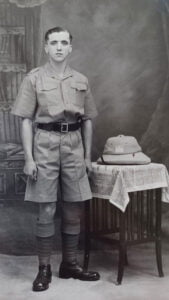
Sharp Thomas Albert

Sharp | Thomas Albert

  • First names

    Thomas Albert

  • Age

    22

  • Date of birth

    1922

  • Date of death

    26-11-1944

  • Service number

    5961628

  • Rank

    Private

  • Regiment

    East Yorkshire Regiment, 2nd Bn.

  • Grave number

    I. D. 11.

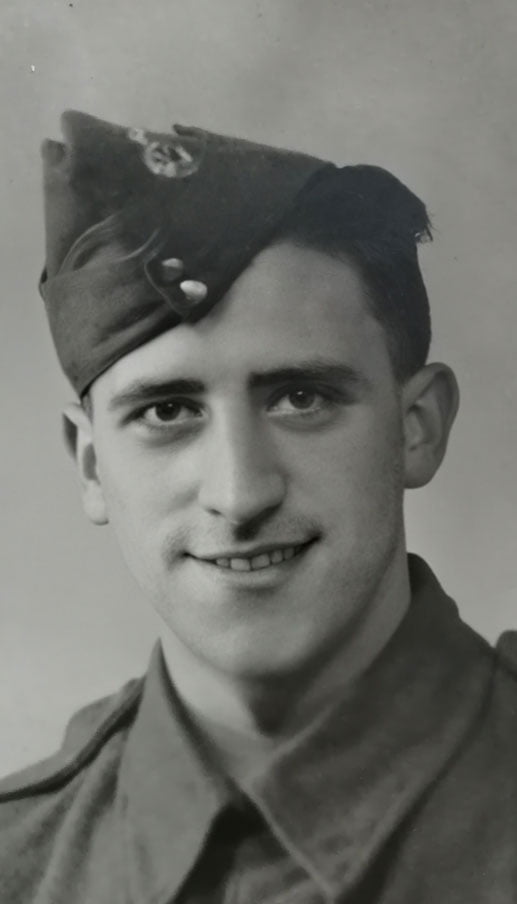
  • Thomas Sharp

    Thomas Sharp

    Thomas Sharp

  • Grave Thomas Sharp

    Grave Thomas Sharp
    Grave Thomas Sharp

Biography

Thomas Albert Sharp (Service No. 5961628) was killed accidentally on 26 November, 1944 while serving in the Netherlands in WW2. He was aged 22 and a Private in the 2nd Battalion of the East Yorkshire Regiment. He was initially buried at the Cemetery A. vd Wijst in Overloon and re-interred on 13 May 1947 in Grave No. I.D.11 at the Overloon War Graves Cemetery. The inscription on his grave reads: “For ever with the Lord! Amen; So let it be”.

Military career

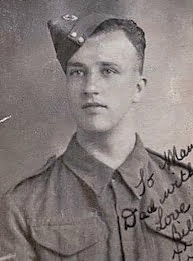
It isn’t known when Thomas Albert Sharp joined up. However, a photo indicates that he was initially in the 2nd Battalion of the Hertfordshire Regiment. This Battalion spent the first years of the war on anti-invasion duties. In July 1943 it changed its role to become the infantry element of a ‘Beach Group’. The task of these new units was to provide local defence and communications on the landing beaches during the invasion of Europe. Alongside the infantry, they comprised a number of specialist sections drawn from the technical branches, as well as balloon and anti-aircraft artillery detachments, the total force amounting to around 5,000 men. The 2nd Hertfordshires joined 9 Beach Group, and the commanding officer, Lieutenant Colonel J.R. Harper, was appointed overall commander. On D-Day, 6 June 1944, it was assigned to Gold Beach where they landed in the fourth wave and were involved in fighting throughout the day. In the following days, the battalion assisted the Royal Engineers in clearing land mines and moving supplies off the beach. Despite Harper’s hope that it would be redeployed as infantry upon the completion of this task, it was disbanded on 17 August and the soldiers dispatched in replacement drafts to other units. It was probably at this point that Thomas was transferred to the 2nd Battalion of the East Yorkshire Regiment.
 
The 2nd Battalion of the East Yorkshire Regiment had taken part in the D-Day landings and lost many men as a consequence. A substantial number of reinforcements joined the Battalion in late July when it had returned across the Orne to Beuville, near Caen in France. It played a part in action to secure a road junction at Vire in mid August but played no further part in the Battle of Normandy. In September they were in Belgium and successfully crossed the Escaut canal as part of the ill-fated Market Garden operation, arriving in Gemert in Holland on 26 September where they received a tremendous welcome.
 
October saw the 2nd Battalion involved in some of the heaviest fighting since the end of June, amid continual rain and mud. The battalion played its part in capturing Overloon and Venray between 12 and 17 October, with a substantial number of casualties. On 19 October the battalion moved to the St Servatius area of Venray, relieving the 2nd Warwickshire Regiment. They played their part in evacuating patients and refugees from the St Servatius mental institution while in close proximity to the enemy. For the remainder of October they occupied a gap between units of the 11th Armoured Brigade during a German threat at Meijel. Major General GPB Roberts DSO MC spelled out his gratitude to the 2nd Battalion in a letter: “They occupied an unpleasant area for rather a long time with never a grumble. They did some excellent patrols under most unpleasant conditions”.
 
On 1 November, the battalion moved to relieve the 1st Hereford Regiment at Griendtsveen and remained there for a week, enduring bad weather and enforcing a system of standing patrols by day and roving patrols by night in an area of peat-bogs, marshes and flooded fields. On the 10th, the battalion went into reserve at Overloon and rejoined the 3rd Division. On 22 November, the battalion moved into Smakt, which proved to be a heavily mined area, and discovered the bridge was rigged with a 500 kilogramme bomb. `D’ Company sent out a patrol to see if the village of Maashees had been evacuated and when it was found to be free of Germans, the rest of the Company followed. On 25 November the 1st Suffolks attacked nearby Geijsteren castle without success. The castle lay just to the south of Maashees. On 26 November Typhoons attacked the castle. It was on 26 November that Thomas Sharp was killed by accident. The nature of the accident is not currently known. Further attacks on the castle in the next two days fully destroyed it.

His Birth Family

Military records indicate that Tom was the son of William George and Melita Sharp of Harpurhey, Manchester. He was born in 1922 in Manchester.          
 
William George Sharp was born on 12 April 1892 in Dukinfield, Lancashire. Melita Williams was born on 21 February 1895 in Manchester. They married on 27 September, 1916 at St Catherine’s Church, Manchester (Prestwich District). He was aged 24 and described as a soldier. Melita was aged 21. They were both shown as living at 19 Sand Street. William’s father was Thomas Sharp, a Labourer. Another document held by the family state that his mother was called Margaret. Melita’s father was William Williams and had been a porter but was deceased at the time of her marriage. William and Melita had children as follows, all in the Manchester area: William G 1920 (known as Bill), Thomas A 6/7/1922 (known as Tom) , Melita 21/6/1926 (known as Leta), Margaret 28/5/1928 and Arthur C 1933.
 
By 1921, William and Melita were living at 24, Bronze Street, Manchester. William was a Wagon Sheet Repairer and Store Keeper for the Stores Dept. of the Lancs and Yorks Railway. Their first child, Bill, was present.
 
By September 1939 they were living at the School House Alfred Street, Harpurhey, Manchester. William was now a Municipal School Caretaker and Melita was an Assistant School Caretaker. William was also an ARP Warden. Tom was the only child present. He was working as an Aviation Accounts Clerk.
 
At this time, their daughter, Leta, is shown as living in the household of James and Annie Eyre at 127 Hermitage Street, Rishton, a small town to the east of Blackburn in Lancashire. James was born 08 Mar 1905 and was a Calendarman in a Paper Mill while Annie was born on 02 Apr 1906. There seem to have been five children in the household whose names are not disclosed. Two appeared after Leta’s name. It is possible that these were her younger sister Margaret aged 11 and younger brother Arthur aged 6. Leta herself was only 13 and at school. Margaret’s son remembers his mother saying they were evacuated for a very short time due to the war, maybe just a few days or a week or two, but were called back home by their mother, saying something like “if we’re going to go, we’ll all go together”.
 
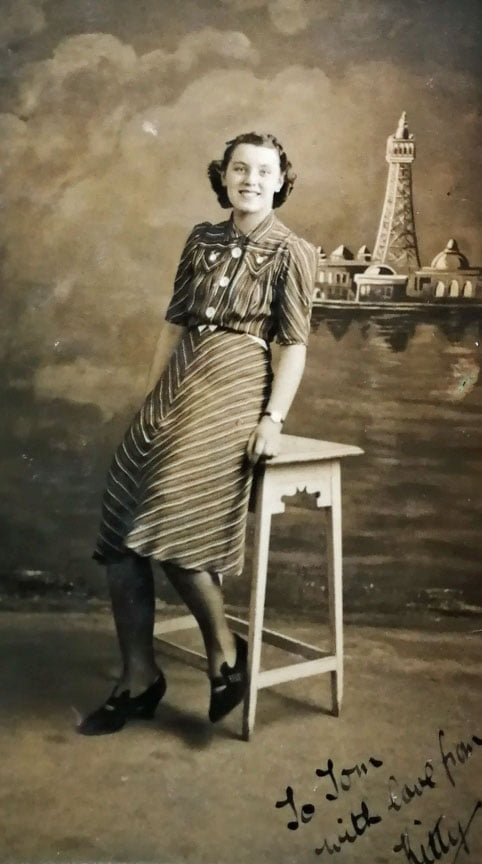
It isn’t known when Tom joined the army. He very nearly survived it but, as has been seen, sadly died on 26 November 1944. He left behind a girl friend, Kitty, as well as his parents and brothers and sisters.
 
His brother Bill was also in the army during WW2 and served at Arnhem. His family understand that Bill was trying to get Tom transferred to his own regiment. He went to Overloon but was too late as he had already been killed. Bill wrote in the visitors’ book at the cemetery “Sorry our kid.  Arrived too late”. This was probably when he visited with his eldest son and his family after the war.
 
Tom Sharp is remembered on his Mum and Dad’s grave stone at Blackley Cemetery in Manchester.
 
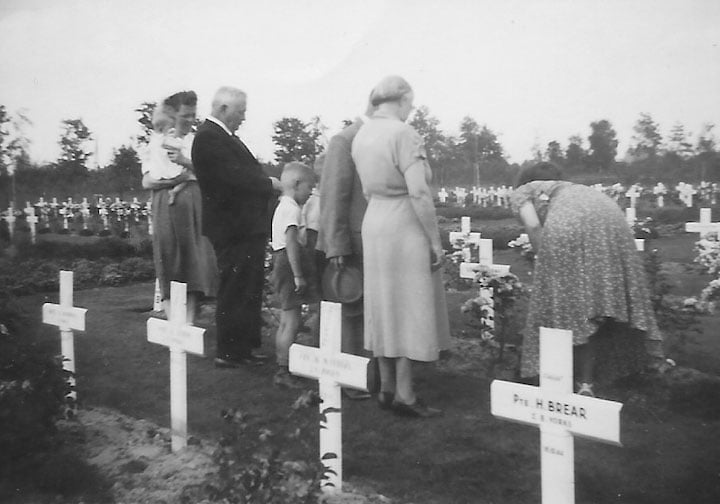
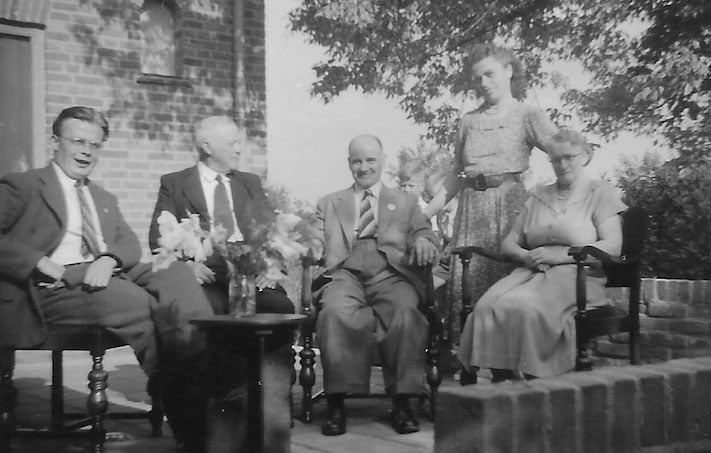
William and Melita visited Tom’s grave shortly after the war ended and met Police Sergeant Wim Weijmans who had adopted his grave. Not only was he a policeman, but he had been very active in the resistance during the war. Other family members have visited Tom’s grave on several occasions in more recent times.
 
William George Sharp died in 1956 and Melita Sharp in 1977 – both in Manchester.
 
Tom’s siblings went on to marry and all but Arthur had children of their own. Some of their descendants have settled in Canada and Australia.

His Father’s Birth family

While it isn’t certain, it is thought that William George Sharp was the son of Thomas and Margaret Sharp who were born in Liverpool in 1857 and around 1860 respectively. Thomas was a Bricklayer’s Labourer. They appear to have had children as follows: Margaret 1879, Thomas A 1882, Emma 1888, Mary G 1891, William 1893, Jane 1899. William was born in Dukinfield and Jane in Manchester while the others were born in Liverpool. However, William’s birth record in Dukinfield has not been found and, rather oddly, Margaret’s husband is shown as Thomas in 1891 but Albert in 1901. This may simply be a mistake by the person taking the census.
 
In 1891 they were living at Court 3, 3, Prince Edwin Lane, Everton but by 1901 they were at 15, Silver Street, Manchester. By 1911, Margaret was still shown as married, but Thomas was not present. She was living at 2 Bronze Street, Collyhurst, Manchester. In 1911 there was also a Boarder, Joseph Sims born 1869 in Manchester, who was working as a Traveller. Bronze Street is the same street as William and Melita were living in 1921, and, as will be seen, where Melita lived before her marriage – so that is probably how they met.
 
In 1901 Thomas (Jnr) was working as a hawker. In 1911 Emma and Mary were working as cap machinists and William was a Sheet Repairer, the same occupation as he later had in 1921, though he was a soldier at the time of his marriage in 1916. Emma Sharp was a witness at William and Melita’s wedding.

His Mother’s Birth Family

Thomas’ mother, Melita Williams, was born in Manchester in 1895. In 1901 she was living with her widowed father, William Williams, at 26, Bronze Street, Manchester, the same street as where her husband-to-be was living in 1911 and where they were later living in 1921, after their marriage. Thus, Melita’s mother had died before she was 6. Her father was just 39 and a market porter born in 1862 in Norbury which is near Bishop’s Castle in Shropshire.
 
William could not have been married for long as, in 1891, he was still single and living with his parents, Edward T and Emily Williams at 2, Brydonville Street, Manchester. His family originated from the Worcestershire/Birmingham area but by 1891 the family had moved to Manchester. He had six siblings.
 
In 1901 there were also two visitors in William’s house – Caroline Ward a 43 year old widow who was a tailoress born in Gloucestershire and Ernest Ward, born in 1886 in Manchester.
 
In 1891, ten years before she was seen as a visitor in William’s household, Caroline Ward was living already living in Bronze Street – at number 34. She was the head of her own household. At that time, she was shown as born in 1855 in Gloucestershire, already widowed and working as a Finisher. With her at that time was her son Ernest and another son, Edward Simon, born 1876 in Birmingham who was working as an errand boy. There too were three boarders. These were Melita Scanlan, born 1858 in Newcastle Upon Tyne and working as a Slipper Binder; Isabella Scanlan born 1884 in Manchester and Annie Hewitt, born in 1890 in Manchester.
 
By 1911 Melita Williams and her father were living at 4 Bronze Street, Collyhurst, Manchester. It was now Caroline Ward who was shown as the head of the household and still working as a tailoress. Her son, Ernest, was still present and working as a mechanic. William and Melita Williams were described as boarders. Melita was a Machinist. This fits with the family’s understanding that a lady called Carrie helped to bring Leta up after her mother died. They understand that she wasn’t a relative but was a neighbour. Melita’s granddaughter could recall that her grandmother called Carrie her “mother” and said she was kind and loving which is thought to have contrasted with her earliest experiences.
 
By 1916 Melita’s father had also died.
 
It was difficult to identify Melita’s mother as her father could only have married after 1891, his wife had died by 1901 and her maiden name wasn’t known. However, it is thought that her mother was Melita Scanlan who was living with Caroline Ward in Bronze Street in 1891. No marriage was found, but both names give scope for mis-recording which could result in a marriage being missed. A Melita Williams died in Manchester in 1896, just a year after Tom’s mother, Melita, was born.
 
Melita Scanlan’s family had originated from Newcastle Upon Tyne. She was the daughter of William Scanlan and Elizabeth Scanlan (nee Topping). She had three older brothers. It is thought that her parents had died by 1881. However, by 1881 her eldest brother William had married and had moved to Manchester. They had ten children. Tom’s mother handed down a photo album to her daughter which belonged to Melita Scanlan’s niece, Amelia Scanlan, who married Alphonse Hertzog in Salford in 1910. This seems to very firmly link Melita Scanlan to Willaim Williams. The album also contains a photo of Samuel Scanlan, Melita Scanlan’s nephew. He joined the South Lancashire Regiment on 19 April 1915 and was killed in action in WW1 on 18 November in the same year.
 
It is thought that Isabella Scanlan, who was also living as a boarder in Caroline Ward’s house in Bronze Street in 1891, was possibly Melita Scanlan’s daughter and so was Melita’s half sister. She married Thomas Stanyer on 16 September 1911 in Manchester. Thomas Stanyer was a witness at William Sharp and Melita Williams’ marriage in 1916. Isabella died in 1925 in Salford.

  • D-Squad E-Coy 2nd Hertfordshires

    D-Squad E-Coy 2nd Hertfordshires

    D-Squad E-Coy 2nd Hertfordshires

  • his girl friend Kitty

    his girl friend Kitty

    his girl friend Kitty

  • Tom Sharp

    Tom Sharp

    Tom Sharp

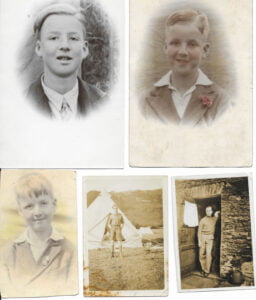
  • Bill Sharp

    Bill Sharp

    Bill Sharp

  • William Sharp at Toms' grave

    William Sharp at Toms’ grave

    William Sharp at Toms’ grave

  • Leta Sharp and Wim Weijmans

    Leta Sharp and Wim Weijmans

    Leta Sharp and Wim Weijmans

  • William and Leta Sharp in Overloon

    William and Leta Sharp in Overloon

    William and Leta Sharp in Overloon
Sources and credits

From FindMyPast website: Civil and Parish Birth, Marriage and Death Records; England Census and 1939 Register Records; Electoral Rolls; Military Records
Probate Regsistry
Information on the East Yorkshire Regiment from a thesis written by Tracey Cragg for her PhD with the Department of History, University of Sheffield 2007 “An `Unspectacular’ War? Reconstructing the history of the 2nd Battalion East Yorkshire Regiment during the Second World War
War Diaries from Traces of War Website
Wikipedia – Hertfordshire Regiment Information
Photos and Information from Thomas A. Sharp’s niece, Linda Jones, his nephew, John Leach and other family members.

Research Elaine Gathercole


Continue reading

Taylor John

Taylor | John

  • First names

    John

  • Age

    28

  • Date of birth

    1915

  • Date of death

    16-10-1944

  • Service number

    834770

  • Rank

    Serjeant

  • Regiment

    Royal Artillery, 75 Anti-Tank Regt.

  • Grave number

    IV. E. 12.

Grave John Taylor

Grave John Taylor

Grave John Taylor

Author Arno van Dijk

Biography

The Commonwealth War Graves Commission cemetery in Overloon, popularly known as the English cemetery, contains 281 graves. Each with its own story. In this report series, the Overloon War Chronicles Foundation highlights such a special story every time. This time grave number 12, section IV, row E.

John Taylor (1915 – 1944)

The Battle of Caen and the deadly Loobeek
 
“We were going towards the elite German Panzer units. It was the hardest battle-you got bullets mortars bombs shells and everything falling down like rain and I do mean rain. There were blokes with heads blown off and burnt- there were rows and rows of them. There was a big château right at the bottom of Hill 112. We were deployed there with the 16 pounders. We dug in a slit trench. The château was being used as a field medical theatre, there was a large tent and outside the tent on each side were rows and rows of dead bodies covered in coats.”
(Source: James Hawkesworth/Jim Constable/bbc.co.uk/history/ww2peopleswar/stories)

John Taylor is born on Sunday 12 December 1915 in Everton, a district in the city of Liverpool. He is the son of William Taylor (born December 1888) and Sarah Alice Taylor, maiden name Cowley (born 9 August 1890 in Liverpool).
William works for a long time as an oil mill labourer at the company J. Bibby Sons Limited Cattle Food Oil Refiners Soap in Liverpool where, among other things, seeds are processed into cattle feed via millstones.
William and Sarah get married on 3 August 1913 at St Mary’s in Kirkdale, a district in north Liverpool, they move to 104 Buckingham Street in Everton and start a family.    
In addition to William, Sarah and John, the following sons are born: William (born July 1914), Edward Thomas (December 1918), George (October 1920), Joseph (1923) and Ernest (14 September 1926). In 1923 also Cornelius is born, but he dies that same year.
John is officially baptized on 2 January 1916 at Christ Church in Everton by W. Hill Melling.

John works as a porter before he enlists in the British army, in the Territorial Army in Liverpoolm on 14 February 1934. He becomes a gunner in the 235th Battery of the 59 (4 West Lancashire) Medium Brigade. This is a part time unit. He enlists initially for four years.
 
You can read how it continues in the full version of “Faces from the Past” below. 

John-Taylor-biography

Sources and credits

See the full version.

Continue reading

Tallon George

Tallon | George

  • First names

    George

  • Age

    21

  • Date of birth

    16-03-1923

  • Date of death

    01-11-1944

  • Service number

    3607626

  • Rank

    Corporal

  • Regiment

    King’s Own Scottish Borderers, 1st Bn.

  • Grave number

    II. B. 5.

  • George Tallon

    George Tallon

    George Tallon

  • Grave George Tallon

    Grave George Tallon

    Grave George Tallon

Biography

Son of Richard Harrison Tallon and Daisy Tallon of Burneside, Westmorland.

George Tallon was born on 16 March 1923 in Burneside, a village south of the Lake District in Cumbria. Apart from their parents, the family consisted of three children; George, Dick (Richard) and Betty (Elizabeth) Tallon.
After leaving school, George went to work at the local paper mill, Paper Mill James Cropper, until World War II broke out in 1940. 

Jeugdfoto's van George Tallon
Young George Tallon

George is keen to join the army, but after 82 days of training as a private in the infantry of the 6th Battalion of The Border Regiment in Edinburgh, he is immediately discharged due to “incorrect statement regarding age at enlistment”. He was only 16 years old at the time and was asked to return when he was “the right age for it”.

On 29 January 1942, he re-enrols in the army in Carlisle and undergoes his basic training as a soldier. The 1st battalion of The King’s Own Scottish Borderers, to which George belongs, is part of the invasion of Normandy on D-Day (6 June 1944). Via Caen, they advance through Belgium to the Netherlands.

In the letters George writes to his mother, he mentions that he is very surprised by the many canals and rivers and the seemingly endless rainy weather. It reminds him of home.

In August 1944, to his own surprise, George was promoted to corporal. “We are having a hard fight here in Holland,” he writes in one of his letters to his mother. And on 10 October 1944, he writes: “I think I saved the life of one of our men when we crossed the last canal. He was bleeding to death on the side of the road and I carried him to a dressing station. There they immediately took care of him and said he would be fine.”

Even during the Battle of Overloon, George was still writing home that he hoped to move on to Germany soon (“but then we’d have to be careful”), that there wasn’t really that much news and “keep smiling”.
He will not receive his mother’s last letter of 28 October 1944. George Tallon is killed on 1 November 1944 near Vierlingsbeek, presumably west of railway line and east of Overloon.

Corporal George Tallon is temporarily buried at the Schaartven, near A. van de Wijst in Overloon. He is reburied at Overloon War Cemetery on 13 May 1947.

  • Daisy Tallon

    Daisy Tallon

  • Burneside Church Memorial

    Burneside Church Memorial

  • St Oswald's war memorial

    St Oswald’s war memorial

  • Medals George Tallon

    Medals George Tallon

  • George Tallon's identify disk

    George Tallon’s identify disk

  • Croppers Plaquette

    Croppers Plaquette

  • Page from his service book

    Page from his service book

  • Page from his service book

    Page from his service book

  • Page from his service book

    Page from his service book

  • George's parents visiting his grave

    George’s parents visiting his grave

  • Family visit to Mr Jan Henckens

    Family visit to Mr Jan Henckens

  • Temporary graves in 1945

    Temporary graves in 1945

The letters

  • Letter 21-05-1944

    Letter 21-05-1944

  • Letter 15-08-1944

    Letter 15-08-1944

  • Letter 25-08-1944

    Letter 25-08-1944

  • Letter 07-10-1944

    Letter 07-10-1944

  • Letter 10-10-1944 1st page

    Letter 10-10-1944 1st page

  • Letter 10-10-1944 2nd page

    Letter 10-10-1944 2nd page

Sources and credits

Mr. Alan Thompson

Research Nicole van Loon  

Continue reading

Willoughby George

Willoughby | George Victor

  • First names

    George Victor

  • Age

    19

  • Date of birth

    1925

  • Date of death

    13-10-1944

  • Service number

    14713144

  • Rank

    Private

  • Regiment

    Suffolk Regiment, 1st Bn.

  • Grave number

    II. E. 5.

Grave George Willoughby

Grave George Willoughby

Grave George Willoughby

Biography

George Victor Willoughby was killed in action on 13th October 1944 in Overloon, Netherlands. He was just 19 and a private in the 1st Battalion of the Suffolk Regiment (Service No. 14713144).
 
He was the son of George Thomas Willoughby and Mavis Willoughby (nee Tillett) of Sheerness in Kent who had married in 1924 in Watford.

While George Victor Willoughby was born in Watford in 1925, his three siblings were born in Sheppey in Kent as follows: Mavis D 1927, Jean M 1937, Kenneth I 1941. This suggests that the family probably moved to live there by 1927. In 1939 Mavis was living at 33 Russell Street, Sheerness with her first three children.
 
Young George Victor Willoughby found himself involved as a witness in a court case in October 1939 in Sheerness when he was just 14. He had been sent to deliver a radio to an address but was intercepted outside by the purchaser who said he would take it as he was locked out of the house because his wife was out shopping. George noticed the key was in the lock and became suspicious so reported it to his manager. The man was sentenced to 6 months in prison for this and other offences.
 
However, it was George himself, aged 17, who was in the Police Court in Sheerness in September 1942 for shop breaking and larceny. He and another boy aged 16 had broken into a shop and stolen cigarettes and cash valued at a total of £20. George actually fainted as the hearing was nearing a conclusion and had to be carried out of the courtroom, returning a few minutes later having been revived. They were allowed out on bail with their mothers standing surety and went on to plead guilty to this and admitted 8 previous offences at East Kent Quarter Sessions in October. It was acknowledged that it was the younger boy and not George who was the ringleader. They were sentenced to Borstal for 3 years.
 
It isn’t known exactly when George signed up for the Army, but it is understood that it was possible for boys sent to Borstal to be able to choose to join the armed services instead. This may be what he chose to do.
 
After the evacuation of Dunkirk in May 1940, the 1st Battalion of the Suffolk Regiment spent the next four years training in the United Kingdom for the invasion of Normandy in 1944, otherwise known as D-Day. They landed on Sword beach on 6th June and were involved in attacking and taking the Hillman Fortress on that day. They continued to progress through France and Belgium, including severe battles which cost many lives at Chateau de la Londe and at Tinchebrai before arriving in the Netherlands, reaching Molenhoek just below Nijmegen by 1st October. From there they swung round to the south, passing through Mook and Rijkevoort to approach occupied Overloon from the north. The aim was to attack Overloon and clear the enemy salient west of the River Maas in what was known as Operation Aintree. The attack on Overloon was delayed by heavy rain and very muddy conditions until noon on the 12th October. The plan was that the 1st Suffolk Regiment would attack on the right while the 2nd Battalion of the East Yorkshire Regiment would proceed on the left. The Battalion successfully reached a position just to the south west of Overloon that day, but with one officer and 9 men killed and a further 2 officers and 55 men wounded. During the night the Battalion area was subjected to fairly heavy shell and mortar fire. On the 13th the Battalion remained in the same position, with the 185th Brigade attacking on the left of the battalion to clear the woods to the south east. The Battalion made just a slight change in position to the east later in the afternoon to sit astride the main road to Venray. Although this was a relatively uneventful day for the Battalion, nevertheless 4 Other Ranks were killed (including George Victor Willoughby) as well as 2 officers and 18 other ranks wounded.
 
Overloon was successfully liberated, but at a large cost in lives and the devastation of the village by artillery fire.
 
George’s death was remembered in the Sheerness Times Guardian in October 1945: “Willoughby – In loving memory of George Victor Willoughby, reported killed in action on October 13th 1944 near Nijmegen. Aged 19 years, ‘Although one year has passed since we heard from you, we often speak of you and in silence remember always.’ – Mum, Dad, Mavis, Jean and Ken. ‘Till we all meet again’.” A similar entry was made in October 1948.
 
George’s father, George Thomas Willoughby, died in spring 1980 in the district of Swale in Kent which includes Sheerness. His mother, Jane Mavis Willoughby, died in the same area in late 1982.

George’s Father’s Family

George Victor Willoughby’s father, George Thomas Willoughby, was born in late 1900 in Watford to Mary Ann Willoughby who was unmarried at the time. In 1901 he was living in Ballards Buildings, Watford with his 27 year old mother and 47 year old grandmother Emma Willoughby who had both been born in Amersham in Buckinghamshire. In 1911 George was still living in Ballards Buildings. However, his mother was now married to William Adams and both were described as farm labourers. However, it seems that Mary had had a further two children prior to her marriage: Lily Willoughby in 1905 and Lizzie Willoughby in 1909. They and George were described as William’s son and daughters. There too were 2 adult and 3 child lodgers.
 
Royal Navy service records for George Thomas Willoughby (Service Number J51395) shows that on 2/3/1916, during WW1, he joined the Royal Navy as “Boy 2nd Class.” These were boys aged 15-17 of adequate physical height, weight and medical fitness for the Navy and evidence of being of ‘good character’. He was posted to HMS Ganges which was a shore based Royal Navy training establishment based at Shotley in Suffolk. However, prior to this, his occupation was described as “T.S. Arethusa”. This was Training Ship Arethusa which was based on the River Thames at Greenhithe in Kent. This was run by a charity known as “Shaftesbury Homes and Arethusa”. They provided refuge and taught maritime skills to destitute young boys who had been sleeping rough on the streets of London and trained them for a career in the Royal Navy or Merchant Navy. The circumstances in which George was sent to Arethusa are not known.
 
George was upgraded to “Boy 1st class” in August 1916 and assigned to HMS Marlborough. On his 18th birthday on 23rdNovember 1918 he was promoted to Ordinary Seaman and signed on for 12 years and on 25/8/1920 was promoted to Able Bodied Seaman – a rank which he continued to hold until the end of his service. He remained on HMS Marlborough until 19/3/1919. From then until 1943 he spent periods of time at HMS Pembroke which was the Royal Navy Shore Barracks at Chatham in Kent interspersed with postings to ships at sea including HMS Hawkins from July 1919 to April 1921, HMS Royal Oak from November 1921 to June 1922, HMS Repulse from August to November 1922, HMS York from August 1930 to April 1932, HMS Cumberland from February 1933 to March 1935 and HMS Kent from July 1938 to January 1941, now taking part in WW2. He also served periods, especially from 1923 to 1930 and at the end of his career, at other shore stations, including HMS Columbine at Port Edgar on the Firth of Forth in Scotland, HMS Egmont in Malta and HMS Eaglet in Liverpool. He was generally well behaved, though he was given 90 days detention in 1921 for striking the Regulating Petty Officer who was in charge of discipline and 10 days punishment while in Scotland for creating a disturbance on shore. It isn’t totally clear, but it is thought that he was finally released from the Navy on 26/9/1943.
 
Meanwhile, he had married Mavis Tillet in late 1924 in Watford, while in the Navy.

Prior to his marriage George Thomas Willoughby is recorded in 1922 and 1923 at 47 Liverpool Road, Watford in a list of Absent Voters for electoral purposes but it shows he was actually based at HMS Pembroke – i.e. Chatham. In 1925, after he married Mavis in 1924, he was still shown in the same way, but by 1926 both George and Mavis were shown as living at 42 Belgrave Avenue, Watford in the same household as Mavis’ mother, Isabella Tillett.

George’s Mother’s Family

Mavis was actually named Jane Mavis Tillett, born 1905 in Halifax, Nova Scotia, Canada. She, too, came from a military family. In 1911, she was living with her mother, Isabella Tillett, and four siblings at the Malplaquet Barracks in Farnborough (described as “Detention Barracks Commandant’s House Warder’s Quarters”). Her husband was presumably a soldier there. They had married in 1902. Isabella had been born in Cape Town, South Africa on 19/8/1884. By 1921 she was living at 42, Belgrave Avenue, Watford with now six children. They were born as follows: Jane Mavis 1905, William Henry 1907, Alfred John 1908, Harry Edward 1909, Arthur Roderick 1911 and Lillian Rosebella 1920. Other than Mavis, they were all born in various places in South Africa except the last child who was born in Watford. Isabella and all her children were British Citizens by virtue of their parentage. It isn’t known who Isabella’s husband was or where he was in 1921. Isabella was still living at the same address in 1939 and described as married vs widowed. There too was her youngest child and what appears to be three male lodgers. Isabella Tillett died in 1972 in Watford.

Sources and credits

From FindMyPast website: Civil and Parish Birth, Marriage and Death Records; England Census and 1939 Register Records; Military Records, Electoral Rolls
Forces War Records
National Archives Document ADM/363/164/131 GT Willoughby Service Record
Suffolk regiment War Diary
Wikipedia and Friends of the Suffolk Regiment websites for information on the regiment
Wikipedia for information on Boy Seamen, HMS Arethusa and other naval ships
Assistance from the Historical Research Group of Sittingbourne and Tony Pointing of Sheppey Family History Society
Sheerness Times Guardian (dates 6/10/1939, 11/9/1942, 1/10/1945, 22/10/1948)
Kentish Express 9/10/1942

Research Iwan van Dijk, Leo Janssen, Elaine Gathercole  

Continue reading

Hopson Joseph

Hopson | Joseph

  • First names

    Joseph

  • Age

    26

  • Date of birth

    22-12-1917

  • Date of death

    14-10-1944

  • Service number

    5113550

  • Rank

    Private

  • Regiment

    Royal Warwickshire Regiment, 2nd Bn.

  • Grave number

    III. D. 9.

  • Joseph Hopson

    Joseph Hopson

    Joseph Hopson

  • Grave Joseph Hopson

    Grave Joseph Hopson

    Grave Joseph Hopson

Biography

Joseph Hopson was killed on 14th October 1944 at Overloon. He was aged 26 and a Private in the 2nd Battalion of the Royal Warwickshire Regiment (Service No. 5113550). He was initially buried at the Maria Regina Monastery in Stevenbeek and transferred to the current Overloon War Graves Commission Cemetery on 22nd May 1947.
 
The 2nd Battalion, Royal Warwickshire Regiment was part of the British Expeditionary Force at the beginning of the war and took part in the Battle of France, with survivors being evacuated from Dunkirk in June 1940. After Dunkirk, the battalion moved to Somerset to counter a potential German invasion but in early December it was transferred to London and was not, unlike most of the rest of the Army, committed to beach defence duties. In September 1942, it was transferred to the 185th Infantry Brigade which was then incorporated in the 3rd Infantry Division which landed on D-Day on 6th June 1944 with the first assault on the Normandy beaches. It fought from the Battle for Caen and the break out from Normandy to the Rhine crossing. From D-Day until the end of the war, the 2nd Battalion, Royal Warwickshire Regiment lost 286 officers and men killed in action, with nearly another 1,000 all ranks wounded, missing or suffering from exhaustion.
 
The Battalion entered the Netherlands at Asten on 22nd September, 1944. This is to the east of Eindhoven. On 1stOctober, in drenching rain, they moved north east from there to Malden which is between Nijmegen and the River Meuse. The plan at that stage was for the US 7th Armoured Division to move south east through Overloon and Venraij to the west bank of the Meuse opposite Venlo while British forces, including the 3rd Division, would move eastward, across the German frontier, and capture the forest area known as the Reichswald, from which the Germans had been launching counter attacks.
 
However, by 9th October, the plan changed. An attempt by the US 7th Armoured Division to take Overloon and Venraij had lost many men and tanks without making much headway. Field Marshal Montgomery decided that he must postpone the Reichswald attack. He needed to clear the Scheldt estuary to open the badly needed port facilities of Antwerp and the lesser, but also essential, task of eliminating the German forces west of the Meuse. The latter objective was entrusted to 8 Corps, including the 3rd Division. The 3rd Division was to attack south east to Venraij, in the hope of drawing off enemy forces while three other divisions prepared to advance eastward to Venlo.
 
The Battalion was therefore diverted southwards and by 12th October they had moved to near Wanroy, a village south of the Meuse and just north of Overloon. They took over from the 8th Infantry Brigade which succeeded in capturing Overloon that day but were unable to make progress through the woods south of it.
 
Sgt. George W A Davis later gave a vivid description of the conditions which were to come: “The last good, long, sleep we had was about the 10th or 11th of October. Our clothes were filthy, we were near exhaustion, due to lack of food and sleep. It was very cold and rain and sleet all the time, so we were all wet. There were shells, mortar bombs, machine gunning, Moaning Minnies, rockets and German snipers all over the place.”
 
The following day the Battalion moved to a position just 500 yds north west of Overloon with the aim, along with the 2ndBattalion of the King’s Shropshire Light Infantry, of clearing these woods and then allowing the 1st Norfolk Battalion to pass through and advance on Venray. The Battalion achieved its objective, but they had come under heavy fire from enemy mortars, artillery and small arms fire as well as two tanks when they reached the open ground south of the wood and it had taken longer than expected to clear the woods. By the time the objective was reached it was so late that it was decided not to put the 1st Norfolk Battalion through until the next day. The Warwickshires dug in on the southern edge of the woods.
 
The following day was the 14th October, the day on which Joseph was killed. The 1st Norfolks continued the advance at first light, moving through the Warwickshire battalion astride the main road, while the 9th Infantry Brigade attacked the woods to the west. They met very heavy opposition during the day and had to cope with swampy ground but by 1800 hours the 1st Norfolks had secured the high ground north of the Molenbeek and the 9th Infantry were established in the north part of the woods. The 2nd Battalion of the Warwickshires was then ordered to advance and secure the ground between the 1st Norfolks and the 9th Brigade. B and D Companies performed this task and by dark were dug in to the right of the Norfolks overlooking the Molenbeek while A and C companies and battalion headquarters remained in their original positions. On this day five Other Ranks of the 2nd Battalion Warwickshires were killed (including Joseph) while Major GFJ Jerram and fourteen Other Ranks were wounded.

Family history

Joseph’s parents were Joseph and Eliza Hopson (nee Burrows). Eliza Burrows was born on 1st April, 1897 while Joseph Hopson (Snr) was born a few months later on 14th June, 1897, both in the Dudley area. They married in that area in 1917 and had four children as follows: Joseph 22/12/1917, Lawson 29/8/1919, Mary 2/2/1922 and William 22/7/1923.
 
The Dudley area was already known for its nail making and chain making industries as well as a glass industry in the 17th and 18th centuries. The iron industry boomed in the 19th century and the glass industry also continued to prosper. A brick making industry also emerged at this time, making use of local clay and a ready supply of coal slack from nearby collieries. During the 20th century, the traditional industries in Dudley declined in importance but industry became more diverse. While the metalworking and glass industries continued in the area new industries included plastics, electronics, and chemicals.
 
In 1921 Joseph and Eliza were living with Eliza’s 61 year old widowed mother, Maria Burrows, at 5, Shropshire Row, Kingswinford. There too were young Joseph and his brother Lawson as well as Maria’s 18 year old daughter Ethel. Joseph (Snr) was working as a Clay Miner / Hewer at Mr J Waterfield & Sons Fire Brick Works. Eliza and Ethel were both working as Fire Brickmakers for Mr G Chance at the Himley Fire Brick Works.
 
Although the address is given as Kingswinford, 5 Shropshire Row was an area to the west of Dudley and Gornalwood, just south of Himley and North of Kingswinford, all now in the West Midlands. It is probably where Joseph’s mother Eliza and all her children including Joseph were born. It is thought that his father Joseph (Snr) was born in nearby Lower Gornal or Gornalwood as were Eliza’s parents.
 
This was a heavily industrialised area. In the immediate vicinity of Shropshire Row were several brickworks and collieries. Waterfield’s Brick Works was situated on Jew’s Lane in Lower Gornal which was a few miles north east of where they were living. It was sold off and then closed in the early 1930s. Mr G Chance’s brick works was located at Shutt End near Pensnett, Kingswinford, just to the south of Shropshire Row. It had been founded in 1847 to supply refactories to the owner’s Smethwick Glass Works.
 
By 1939 Joseph and Eliza were in their own home at 2 Redhall Road in Gornalwood. Joseph (Snr) was working as a Brick Worker at a Marl Quarry. Eliza was now a housewife rather that doing paid work. All their children were working: Joseph (Jnr) was working as a Cutting Machine Brick Worker shaping refractory goods. Lawson was working as a Hand Brick Moulder for a Fire Clay Goods Manufacturer, Mary was a Machinist (Tailoress) and William was working as a Grinding Mill Brick Worker.
 
Joseph’s brother, Lawson, married Annie Friend in 1942 and Joseph married Annie’s sister, Violet E Friend in 1943.
 
Annie and Violet’s parents, William and Edith Friend (nee Westwood), had married in 1914. They had 8 children as follows: Mary E 1915, Bert Edward 2/8/1916, Violet E 29/11/1917, Annie 7/9/1919, Ernest John 9/3/1921, George H H 5/3/1923, Edith M 1927, and Gloria D 1931. However, Mary died in 1916 and Edith in 1927, both just 1 year old.
 
In 1921 William and Edith Friend (aged 34 and 30 respectively) were living at 9, Prospect Road, Gornalwood, with their children Bert, Violet, Annie and Ernest. The head of the household was Edith’s 63 year old widowed father, Edward Westwood, and there too were his 21 year old son Samuel James Westwood and 18 year old daughter Annie Westwood. It is likely that William, Edith and all their children as well as Edward and his other children were born in this same area. William was working as a miner at the Baggeridge Colliery Co. – but was out of work at the time. This colliery was founded in 1902 by the Earl of Dudley and was located adjacent to Gospel End Village and well to the north west of Gornalwood. Edward Westwood was a Platelayer working for the Earl of Dudley, but he, too, was out of work.
 
By 1939 Edith was living at 60 Brookdale in Gornalwood with children Bert, Violet, Annie and George. It isn’t known where William was or what happened to him. Bert was working as a Colliery Maintenance Engineer, both Violet and Annie were Brickyard Workers (described as heavy work) while George was working as a Turner on Air Ministry work. Ernest was still living at 9 Prospect Road, though his aunt, Annie Westwood, was now the head of the household. He  was working as a Rope Man – a surface worker at a Coal & Fireclay Mine.
 
Annie Friend then went on to marry Lawson Hopson in 1942 and Joseph married Violet Friend in 1943.
 
Joseph and Violet Hopson had a child, Brian G Hopson in early 1944 in this same area.
 
Lawson and Annie Hopson had two children: William J Hopson in 1943 and Lawson D Hopson in 1951.
 
It isn’t known when Joseph Hopson joined the army but sadly, he died on 14th October 1944, not long after the birth of his son. His name is recorded on the Lower Gornal War Memorial originally erected in 1929 with WW2 names added much later. It is positioned in front of the Memorial Hall built in 1925.
 
Violet Hopson went on to marry Eli Whitehouse in 1948 and they had one child called John M Whitehouse in 1949.
 
Joseph’s son, Brian, married Patricia M Williams in Dudley in 1969. Their daughter, Sharon Hopson was born in 1970 and married Mark J Richards in 1996 in Dudley. They have two children, Joseph’s great grandchildren, born in 1997 and 2001 who are now making their way in the world.
 
Violet E Whitehouse died aged 84 in 2002 in Dudley.

Memory Hall gebouw
Lower Gornal War Memorial

Memory Hall
Lower Gornal War Memorial

Memorial Hall
Lower Gornal War Memorial

Sources and credits

From FindMyPast website: Civil and Parish Birth, Marriage and Death Records; England Census and 1939 Register Records; Electoral Rolls; Military Records
Photos and information from Sharon Richards (Joseph’s granddaughter) and Lawson and Ian Hopson, his nephew and great nephew
Sedgley Local History Society for photos of the Lower Gornal War Memorial
Traces of War Website for Royal Warwickshire Regiment War Diaries
History of the Royal Warwickshire Regiment 1919-1955 by Marcus Cunliffe
Account of Sgt George W A Davis of the Royal Warwickshires                
Wikipedia for information on the Royal Warwickshire Regiment and Baggeridge Colliery
Lower Gornal Website for information on Waterfield Fire Brick Manufacturers 
Brocross Website for information on Himley Brick Works

National Library of Scotland for Ordnance Survey Maps
UK BMD for an understanding of West Midlands’ Enumeration Districts
 
Research Iwan van Dijk and Elaine Gathercole

Continue reading

Emmerson George

Emmerson | George Arthur

  • First names

    George Arthur

  • Age

    34

  • Date of birth

    14-03-1909

  • Date of death

    14-10-1944

  • Service number

    5835491

  • Rank

    Private

  • Regiment

    Suffolk Regiment, 1st Bn.

  • Grave number

    III. C. 10.

  • George Emmerson

    George Emmerson

    George Emmerson

  • Grave George Emmerson

    Grave George Emmerson

    Grave George Emmerson

Biography

George Arthur Emmerson (Service No. 5835491) was killed in action on 14 October, 1944. He was a Private in the 1st Battalion of the Suffolk Regiment. He was initially buried at Cemetery Th. J. Janssen, Overloon and subsequently re-interred on 15 May, 1947 in grave III. C. 10 at the Overloon Commonwealth War Graves Cemetery. His inscription reads “Peace, Perfect Peace”.

Family history

George Arthur Emmerson’s parents were Harry and Maggie Mabel (or Mabel Maggie) Emmerson.

Harry was the son of Joseph and Emma Emmerson (nee Wayman) who had married in 1858 in the district of Ipswich in Suffolk. Joseph was born in 1834 and Emma in 1835. They spent their married life at Near Valley Farm, Black Bird Corner in Framsden, Bosmere, Suffolk. Joseph was an agricultural labourer. They seem to have had children as follows:  Charles (1858), William (1860), John (1863), Nathan/Matthew (1866), Reuben (1870) and Harry (1872). Emma died in 1878 aged just 44 when Harry was only 6. By 1891 only Harry was still at home with Joseph and was an agricultural labourer. Harry joined up in the Norfolk Regiment on 11 October 1891 (Service No. 2990) when he was aged 18 and 4 months. He was finally discharged on 8 October 1903. During this time, he was in India from 22 February 1894 to 4 October 1899.
 
Mabel Maggie Tilney Saunders was the daughter of John Saunders and Sarah Tilney. She was born in 1887 and was baptised at St Mary’s Benhall, Suffolk. John Saunders was born in 1843 and was an agricultural labourer while Sarah was born in 1844 – both in Benhall. They were living at Benhall Green, Benhall, Plomesgate in 1891 and 1901. They had children as follows: Ottewell G (1879), Dava F (1882), Mabel M (1887).
 
Harry Emmerson married Mabel Maggie Saunders in the Plomesgate district of Suffolk in spring 1908. George’s birth appears to have been recorded as Arthur George Emmerson in spring 1909 in the Blything district of Suffolk. They had three more children as follows: Bessie M (1910), Cyril F (1914) and Stanley (1916). The first three were born in the Blything district while Stanley was born in the Plomesgate district.
 
In 1911 Harry and Mabel were living in Knodishall, Saxmundham, Suffolk. Harry was now an engineer’s wood sawyer. His birth date was given as 1877 rather than 1872. With them were George and Bessie, both born in Knodishall.          
 
However, by 1921 the family seems to have fallen on hard times. Mabel was living as an inmate in Bulcamp Workhouse, near Halesworth. This had been built in 1764 to provide poor relief for about 400 inmates. Alterations were made in 1836 as a result of the New Poor Law and the workhouse was operated by the Blythling Poor Law Union. It established a deliberately harsh regime where husbands were separated from wives and children from parents. Well into the twentieth century, a retired District Nurse was quoted in the 1970s: “my villagers … were scared stiff at the bare mention of Bulcamp”. Because the able-bodied preferred low wages outside the workhouse to the ‘prison with a milder name’, Bulcamp increasingly tended to serve the needs of the infirm, aged, orphaned and sick. The hospital function developed almost by accident from the sick wards of the workhouse. The Board of Guardians did not disappear until the Local Government Act of 1929, when authorities were encouraged to turn workhouses into hospitals. After 1930, the workhouse was renamed Red House but Bulcamp’s high walls did not come down until after 1945.
 
It isn’t known where Harry was at this time, but the four children found themselves at Hope House in Yoxford. This had been opened by the Blythling Poor Law Union in 1913 as a children’s home. It was located in Yoxford High Street and in 1924 it could accommodate 35 children with Miss E Dowsett as Superintendent. George and Bessie are shown as having been born at Coldfair Green while Cyril was born at Snape and Stanley at Sternfield. Coldfair Green is near Knodishall and Sternfield is near Benhall while Snape is not far from either. The children ranged from George at 12 years old down to Stanley at nearly 5.
 
Harry Emmerson then died in Blything district in 1926 with his age given as 49. This would leave Mabel with four children aged 10 to 17.
 
By 1939 George (shown as born 14 March 1909) was living in the household of Percy G Horner and his wife Mary E M Horner at the Manor House High Street, Middleton which is close to Saxmundham and Yoxford. Percy was a Master Grocer born in 1895. George was working as an assistant in Retail Grocery. There too were two sons of Percy’s – John S Horner aged 25 who was a Grocer’s Apprentice and William Horner who was 6 and at school.
 
At this time, Mabel (shown as widowed and born 14 April 1887) was living at The Green, Sibton, which again is near Yoxford. She appeared to be living on her own. Three houses away from Mabel, a Reuben Emmerson was shown living on his own, though was married. He was born 26 April 1869 and was a retired farm worker. He was Harry’s brother.
 
Bessie M Emmerson was living at Hospital Farm, Dunwich, Suffolk in 1939. She was shown as born 27/9/1910 and was working as a Domestic Servant. In the same household were Edwin J and Elizabeth Clarke (aged 64) and (aged 65) and Walter J Baldock (aged 51). Edwin was an arable farmer and Walter was a Head Teacher.
 
Neither Cyril, who would be 25, nor Stanley, who would be 23, were seen in the 1939 Register. A Private C. Emmerson (Service No. 5826577) and a Private S. Emmerson (Service No. 5826798) – both of the Suffolk Regiment – were awarded the India General Service Medal 1936-1939. The Service Numbers would suggest that Cyril enlisted between August and September 1935 (aged 19) while Stanley enlisted between August and October 1936 (aged 19/20). The India General Service Medal was awarded for minor military campaigns on the North-West Frontier of India between 1936 and 1939. It was the 2nd Battalion of the Suffolk Regiment which was stationed in India from 1929, so Cyril and Stanley would have been in this Battalion. The 2nd Battalion was still in India at the outbreak of WW2, spending the early years of the war mainly deployed on internal security duties. In 1943 the battalion transferred to the 123rd Indian Infantry Brigade, part of the 5th Indian Infantry Division and served with them in the Burma Campaign. In 1944 the battalion was flown to Imphal to clear Japanese positions. Little more in known of Cyril and Stanley’s time in the Regiment – but both were still serving in 1941 when the India General Service Medal roll was compiled and, from the medal roll, Cyril appears to have been discharged on 25 February 1945 and Stanley on 28 August 1944 – rather unusually while the war was still in progress. George’s nephew, Alan, who is Cyril’s son, can confirm that his father was stationed in the North Western Frontier in India.
 
Alan was able to provide photos of men who are believed to be Cyril and/or Stanley. One shows a rather young man in a khaki drill uniform with a flat topped solar topee which includes the regimental castle patch. This was brought in for wear in 1937 but, by mid-1941, its castle patch was removed when they were training in the Tochi Valley, so the photo must have been taken before 1941. Another shows an older man in a dark blue ‘patrol’ uniform which is typical of the smart pre-war ‘walking out’ dress, often procured through the local regimental contractor. A group photo shows members of the 2nd Battalion of the Suffolk Regiment in the khaki drill uniforms which were not worn at home. They are typical of those seen between 1937-42 of men of the 2nd Suffolk serving in India. Many are shown wearing the India General Service Medal ribbon. Initially it was thought that all three brothers appeared on this photo, but it is likely that it only includes Cyril and/or Stanley.

Cyril or Stanley Emmerson

Cyril or Stanley Emmerson

Emmerson brothers in the Suffolk Regiment
Two Emmerson brothers in the Suffolk Regiment are probably on this photo. This is still being investigated.

Military career

It isn’t known at what date George joined the 1st Battalion of the Suffolk Regiment but it was clearly after September 1939. 
 
The 1st Battalion was stationed in Devonport as part of the 8th Infantry Brigade, 3rd Infantry Division and served with the British Expeditionary Force (BEF) in France from late 1939 to May 1940. The division was commanded by Major-General Bernard Montgomery. With the rest of the BEF, it was evacuated from Dunkirk in 1940. The next four years were spent training in the United Kingdom for the invasion of Normandy in 1944, otherwise known as D-Day, on 6 June. The 1st Battalion, under the command of Lieutenant Colonel Richard E. Goodwin, landed on Sword beach and was involved in attacking and taking the Hillman Fortress on D-Day itself. They continued to progress through France and Belgium, including severe battles which cost many lives at Chateau de la Londe and at Tinchebrai. There is a casualty record indicating that George was wounded sometime around 29 June to 14 July, which would have been just after the battle to take Chateau de la Londe. However, he must have recovered as he continued on into the Netherlands.
 
The Battalion reached Molenhoek just below Nijmegen by 1 October. From there they swung round to the south, passing through Mook and Rijkevoort to approach occupied Overloon from the north. The aim was to attack Overloon and clear the enemy salient west of the River Maas in what was known as Operation Aintree. The attack on Overloon was delayed by heavy rain and very muddy conditions until noon on 12 October. The plan was that the 1st Suffolk Regiment would attack on the right while the 2nd Battalion of the East Yorkshire Regiment would proceed on the left. Early that morning the Battalion moved through St Anthonis and Oploo to an assembly area to attack Overloon. An artillery barrage moved forward 100 yds every 5 minutes with the Battalion following behind. The Battalion reached their objective that day which was just to the west of Overloon but with 10 men killed and 57 wounded. During that night the Battalion was subjected to fairly heavy shell and mortar fire. The following day the Battalion moved its position slightly east, astride the main road from Overloon to Venray. This was a more secure position than the previous night as other regiments had cleared the nearby woods of enemy. Even so, four men were killed and 20 wounded that day. Although on 14 October the Battalion suffered rather less shell and mortar fire than the previous days, nevertheless 5 men were wounded and 2 were killed, one of whom was George Arthur Emmerson.
 
His address for probate purposes was given as Sibton Green near Yoxford, Suffolk. It was Percy George Horner who administered his estate.
 
The last time Cyril saw his brother George was when they ran in to each other at a station in passing as they travelled off to different postings. Cyril and Stanley both survived the war.
 
Mabel M Emmerson died in 1961, aged 74 in Ipswich district, Suffolk with an address given of Church Cottage, Sibton, Suffolk. Her son, Cyril Frederick Emmerson administered her estate. He was described as a petroleum depot hand.
 
Bessie M Emmerson married Harry Stokes in 1947 in Blyth district, Suffolk. They are not thought to have had any children.
 
Cyril F Emmerson married Winifred M Clements in Blyth district in 1947. They had children as follows all in Blyth District: Alan (1948), Ronnie (1950), Kenneth (1953). Cyril died in 1998 in Deben district of Suffolk aged 73. His birth date was given as 12/11/1914. Alan and Kenneth are known to have married and had children, still in much the same area of Suffolk as their parents had lived. It isn’t known whether Ronnie married.
 
No marriage for Stanley Emmerson has been found.

Sources and credits

From FindMyPast website: Civil and Parish Birth, Marriage and Death Records; England Census and 1939 Register Records; Military Records, Electoral Rolls

Forces War Records Website

Bulcamp House of Industry

The Workhouse in Blything

Suffolk Regiment War Diary

Wikipedia and Friends of the Suffolk Regiment websites for information on the regiment

Ww2talk.com Website

Photos and further information from George’s nephew –  Alan Emmerson, his daughter Samantha and with help in contacting him from his brother Kenneth.

Assistance in distinguishing between photos of the brothers and on their service history from Mark Forsdike, author of “Fighting Through to Hitler’s Germany – Personal Accounts of the Men of 1 Suffolk 1944–45”.

Research Elaine Gathercole


Continue reading

Follow us

e-mail: overloonwarchronicles@gmail.com
address:
Holthesedijk 2 a, 5825JG Overloon

Chamber of Commerce: 83346422
Bank: NL04 RBRB 8835 3869 69
Stichting Overloon War Chronicles
BIC / SWIFT code RBRBNL21

©2021 Overloon War Chronicles