McKenzie John
McKenzie | John
First names
John
Age
25
Date of birth
20-01-1919
Date of death
01-11-1944
Service number
2932406
Rank
Lance Corporal
Regiment
King’s Own Scottish Borderers, 1st Bn.
Grave number
II. B. 8.
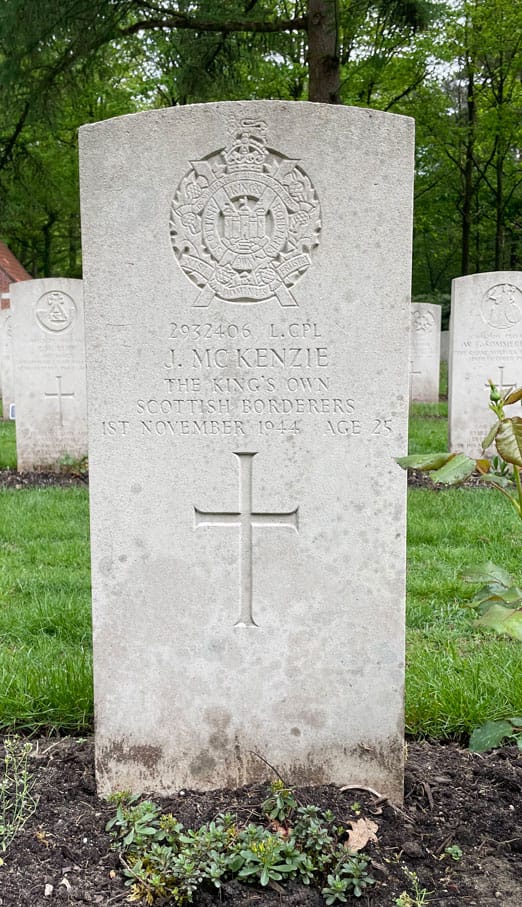
Graf John McKenzie
Grave John McKenzie
Biography
Lance Corporal John McKenzie (2932406) of the 1st Bn King’s Own Scottish Borderers was 25 when he was killed in action on 1 November 1944. He was initially buried at Cemetery A. vd Wijst, Overloon and re-interred on 13 May 1947 in grave II. B. 8 at the Overloon CWGC Cemetery.
No photo of John has yet been found. Should anyone reading this have a photo of him or further information regarding him – or if they are aware of any errors in his biography below can they please contact the Foundation.
Family background
John was born on 20 January 1919 at 22 Clark Street, Pollockshields, Glasgow to John McKenzie, a Dock Labourer, and Sarah McKenzie (nee Cardwell).
Sarah Cardwell was born on 9 July 1885 at 180 Main Street, Glasgow in the Gorbals district in Glasgow. She was the daughter of Daniel Cardwell and Jane Kirk who had married on 25 April 1884 in the Gorbals. Her father was a Steam Crane Driver at that time. Daniel was born in 1857/8 in Glasgow and Jane in 1861/2 in Lugar in Ayrshire.
Daniel and Jane Cardwell had children as follows: Sarah 1885, Hugh 1886, Agnes 1888, Francis 1890, James 1892, Daniel 1897, Mary 1899, Maggie 1902 and John 1904. The first two children were born in the Gorbals and the rest in Tradeston or Kinning Park. Only Sarah, Agnes, Mary and Maggie are thought to have survived childhood. Pollockshields, Tradeston, Kinning Park and the Gorbals are all very close to each other on the south bank of the River Clyde near the docks.
In 1891 Daniel and Jane Cardwell were living in Tradeston. Only Agnes and Francis were present, though Francis died later that year. It is thought that Sarah was living with her widowed maternal grandmother, Bridget Kirk, at 132 Commondyke, Auchinleck, Ayrshire. Bridget was aged 52 and born in Ireland. With her were two sons, Francis aged 25 and William aged 23, who were both Ironstone Miners who were born in Auchinleck.
In 1901 Daniel and Jane were living at 45B Pollok Street in Kinning Park. Agnes, Jane and Mary were present. Daniel was a Dock Labourer. Jane was a laundress. Again, Sarah was not present. She would have been 16.
It is thought that Sarah had two children named James and Hugh Docherty out of wedlock in Kinning Park in 1903 and 1904 respectively. Hugh was born on 29 November 1904 at 45 Pollock Street. This address is where Sarah’s parents were living in 1901. His father was James Docherty, a Quay Labourer, and his mother was shown as Sarah Cardwell, a Laundress. No marriage was found for Sarah Cardwell to James Docherty and it isn’t known what happened to James Docherty (Snr).
Daniel and Jane Cardwell couldn’t be found in 1911 and it is thought that Daniel died in 1913 in Govan. Jane had also died by 1913.
In 1911 Sarah Cardwell was living in the household of John McKenzie at 13 Clark Street in Pollokshields. Also present were James and Hugh Docherty who were aged 7 and 6 respectively and shown as the sons of John McKenzie. This dwelling only had one room with windows and was one of a number of dwellings at this same address. John McKenzie and Sarah Cardwell were both indicated as married, though this was probably not the case. John was 35 and a Dock Labourer from Renfrewshire, Glasgow, while Sarah was 25 and a servant from Lanarkshire, Glasgow.
John McKenzie and Sarah Cardwell had a son, shown as Alexander Cardwell, on 12 January 1912 at 13 Clark Street, Glasgow. John was shown as a Dock Labourer and Sarah as a housekeeper, but formerly a Cotton Waste Worker.
John McKenzie married Sarah Cardwell on 27 November 1913 in the Pollokshields district at Shields Road in Glasgow. They were married in the Church of Scotland. The address given for both was 13 Clark Street, Glasgow. John McKenzie was described as a bachelor and was a Dock Labourer, aged 35. His parents were Alexander McKenzie who was a Mason and Christina McKenzie (nee Russell) who was deceased. Sarah was described as a Spinster, aged 29. Her parents were named as Daniel Cardwell (a Mason) and Jane Cardwell (nee Kirk) but both were deceased by this time. David McCluskie and Margaret Campbell were witnesses. Based on the information given in 1911, John would have been nearer 37 and Sarah 27.
John and Sarah went on to have four more children as follows in Pollokshields: Margaret Campbell 1914, Jane 1916, John on 20 January 1919 and Sarah 1925. John was born at 22 Clark Street. However, Margaret died in 1915 before her first birthday.
In 1921, John and Sarah McKenzie were living at 22 Clark Street which was shown as a dwelling with 2 rooms with windows, again part of a larger property. With them were Alex and John McKenzie and also Hugh Docherty who was now described as a boarder. John (snr) was working as a Dock Labourer for Stewart Stevedores. Hugh was a Van Boy for Montgomery, Baker. It isn’t known where Jane was at this time – or Hugh’s elder brother James Docherty.
Military career
John McKenzie (Service No 2932406) enlisted in the Territorial Army on 16 October 1939 as a Private. He was 20 years of age.
His address was given as 22 Clark Street, Glasgow. He was described as 5ft 3 ¾ in and weighed 109 lbs. He had grey eyes and brown hair. He was a general labourer and was declared Grade 1 medically fit. His religion was Presbyterian. At enlistment, his next of kin was given as his sister, Miss Jane “Mackenzie”, also of 22 Clark Street, Kinning Park, Glasgow, though this was later changed to his wife after he married.
On enlistment, he was sent to an Infantry Training Centre. On 13 February 1940 he was posted to the 5th Battalion, The Queen’s Own Cameron Highlanders. John’s service record shows that he was confined to barracks for 3 days on 25 April 1940 though it doesn’t say why – the first of several misdemeanours of varying levels of seriousness.
From August 1940, the 5th Battalion formed part of the reconstituted 152nd Brigade in the 51st (Highland) Division. The 51st (Highland) Division had suffered severe losses after the failed evacuation from Saint Valery-en-Caux in June 1940 and so had to be reconstituted from the 9th (Highland) Infantry Division. From October 1940 the Battalion spent almost two years on home defence and training duties on the south coast of England and northeast coast of Scotland against a potential German invasion, which never arrived.
On 28 December 1940 John was appointed to the rank of Lance Corporal but reverted to Private at his own request on 23 August 1941.
In June 1941, the battalion had begun strenuous training for future operations overseas.
On 1 October 1941 John was deprived of 7 days’ pay because he overstayed a pass by 1 Day 22hrs 26 mins from 2359 hrs on 27 September 1941.
He was then declared a deserter on 9 December 1941 from Hayton Camp, Aberdeen. He was apprehended by civil authorities at Glasgow on 23 May 1942. He was wearing plain clothes, so not in uniform. He was tried by Court Martial on 5 June 1942. He was found guilty and sentenced to 9 months in detention and forfeited 165 days’ pay. On 11 June 1942 he was sent to the Fort Darland Detention Centre in Gillingham in Kent. This was an infantry fort built from 1870 to 1900 as part of the defensive network for Chatham Dockyard, used as a detention centre in WW2.
By June 1942, his Battalion was ordered to prepare for service overseas. They arrived in North Africa in August 1942. However, as he was in detention, John did not embark with his Battalion for the Middle East.
John’s sentence was regularly reviewed. On 2 July 1942 the Officer in Charge at the Darland Camp stated that “The conduct and industry of the above-named soldier under sentence whilst under detention at this Barrack has been to date satisfactory. On present sentence he may earn 91 days remission and subject to earning may be released 3.12.42.” He suggested a further review on 1 September 1942. At a subsequent review on 25 November 1942 his conduct was described as good while in detention. He had engaged in physical, military and weapons training. He was therefore released from detention on 3 December 1942, having earned 91 days remission. He was granted 7 days’ Privilege Leave.
He was posted to the 1st Bn Liverpool Scottish Regiment. The Liverpool Scottish had links to the Cameron Highlanders. These had been formalised in 1937 when that Battalion became the Cameron Highlander’s second territorial battalion but retained its own identity. It remained as a home forces unit throughout WW2 but suppled drafts to other units, especially Scottish ones.
However, he was again absent without leave for 1 day, 16 hrs and 41 minutes from 2359 hrs on 9 January 1943. He was confined to barracks for 10 days and forfeited 2 days’ pay RW. On 12 February 1943 he was again confined to barracks for 10 days for stating a falsehood to an NCO.
On 16 March 1943 he was transferred to the 1st Battalion of the King’s Own Scottish Borderers. It is understood that they were based in Sussex at this time.
John McKenzie married Robertina Burnside Boyd on 7 May 1943 at Kinning Park West Church, Glasgow.
Robertina, who was known as Tina, had been born in 1924 in the Plantation district which is in the same area of Glasgow as John came from. Her parents were William Boyd and Marion Burnside who had married in that district in 1918. They had children as follows: Maria McCormick Robertson Burnside Boyd, Fanny Boyd 1922, Robertina Burnside Boyd 1924, Melinda Watton Boyd 1926, Donald Gunn Boyd 1927, John Burnside Boyd 1929, Barabra Boyd 1931, Robert Smith Boyd 1932, Georgina Boyd 1933 and Muriel Denham Boyd 1936. The first four were born in the Plantation district, the next six in Pollockshields and the last in Tradeston. However, Donald and Georgina both died in childhood,
At his marriage, John described himself as a Merchant Navy Seaman – but currently engaged in War Service as a Private in the King’s Own Scottish Borderers. He said he was aged 24 (although actually only 23) and still gave an address of 22 Clark Street. His mother had died and his father was still a dock labourer. Tina was working as an electric welder and was aged 18. It would appear she had taken on work, probably in the ship building industry, normally done by the men who were at war. She was living at 535 Scotland Street which again is in Kinning Park. Her parents were William Boyd and “Maria” Boyd (Nee Burnside).
Tina was named as John’s next of kin instead of his sister after his marriage. Her address was given for that purpose initially as 535 Scotland Street, Glasgow.
John was once again declared as a deserter when he absented himself without leave at 1400 hrs at Selkirk on 7 January 1944. He was still absent when a Court of Inquiry was held at Selkirk on 29 January 1944 to investigate his absence and assess what military clothing and equipment he had taken with him. There followed a long list of items from a pair of laces costing 1 ½ pence to his Battle Dress Blouse worth 17s 9d. It amounted to a total of £4/-/1 ½. He was arrested on 20 February 1944 and put under close arrest. He was tried by Court Martial at Hawick on 11 March 1944 and charged with desertion. However, he was found not guilty of desertion but guilty of being absent without leave. He was sentenced to undergo 150 days detention and forfeited 44 days’ pay by RW. He was sent to the Military Detention Barracks at Mossbank, Glasgow on 23 March. However, when his sentence was first reviewed on 27 April 1944 it was recommended that it was suspended with effect from 27 May 1944.
John and Tina McKenzie had a child in 1944, again called John McKenzie. His date of birth is not known, but it is possible that his birth may have had something to do with John’s absence without leave that year and perhaps also the charge was reduced from desertion to absent without leave as a result.
The 1st Battalion of the King’s Own Scottish Borderers had arrived in Normandy on D-Day – 6 June. They assembled initially at Hermanville sur Mer before proceeding to St Aubin D’Arquenay to spend that night. However, John’s Service Record indicates that he only arrived in North West Europe on 8 June 1944.
The Battalion went on to play their part in Operation Goodwood in July as part of the larger battle for Caen. They saw some action at Vire on 9 August but was held in reserve during attacks at Tinchebray. From 20 August to 3 September, they had a period of training and received some reinforcements.
John was appointed as unpaid Lance Corporal on 1 September 1944.
From 5 to 16 September the Battalion was in Etrepangy where they again rested, receiving more reinforcements.
John’s sentence had been again suspended on 26 June and once more on 6 September 1944. On 8 September it was recommended that the balance of his suspended sentence be remitted. A note on a review document stated that “this man’s conduct since the suspension of his sentence has been very satisfactory. He has performed his duties exceptionally well in the field.” It seems that John had redeemed himself.
The Battalion then moved quickly past Brussels and through Leuven to support the 2nd Battalion of the Royal Ulster Rifles and 2nd Battalion of the Lincolnshire Regiment as they crossed the Meuse Escault Canal and on into Belgium and the Netherlands, reaching Milheeze on 28 September. At this point the war diary mentions that the bath unit arrived and “the whole battalion felt clean again for the first time since Etrepagny”, which was over 3 weeks previously.
On 1 October they reached St Hubert where they were very well received by the inhabitants. They remained there until 12 October. They spent their time training but also had time for relaxation. A soccer match was arranged against the Regiment’s 6th Battalion on St Hubert’s football field. They lost 4 – 1 and the Pipe Band played at half time and at the end of the match. They also had two film shows on the 10th and 11th. The diary notes that they left St Hubert on 12 October after a pleasant stay of 10 days.
On 12 October they reached an assembly area just west of St Anthonis. On that day, the 1st Suffolks succeeded in capturing Overloon and took up a position just to the south of the town. The following day, the 1st KOSB attacked the wood to the south west of Overloon and reached the south of the wood, though coming under fire as they reached it. They remained there the following day while the Royal Ulster Regiment and Lincolns attacked the wood further east.
On the 15th they moved a little further south and, on the 16th, continued south, expecting to remain there that night. Instead, they were ordered to take over from the 4th Battalion King’s Shropshire Light Infantry east of Overloon in the area near Smakt, with the companies lining up north to south on the west of the railway. They only took over the position at 1930 hours in very heavy rain with the reconnaissance parties hardly able to see their positions before dark. They remained there until 4 November, often under heavy shelling and mortaring. On the 17th the War diary states that the battalion suffered its worst shelling and mortaring so far. Their time was spent patrolling the area west of the railway and monitoring enemy positions. The enemy were both still in Smakt and across the railway to the east.
John was confirmed as a Paid Lance Corporal on 19 October 1944.
On 22 October a platoon entered Smakt to find the enemy still present. Only 3 men escaped with two more returning later. One officer and 19 Other Ranks were assumed killed or taken prisoner. During the period from the 14 to 31 October one officer was wounded but subsequently returned to duty, one was missing, 32 other Ranks were wounded, 10 were killed and 20 were missing.
The War Diary did not suggest that November 1st was a very eventful day, but it was the day on which John McKenzie was killed in action. In the early hours of the morning a platoon pinned an enemy patrol of six or seven men down in an area just north of a strip of trees with gun fire. However, the patrol succeeds in firing verey lights from the area of the railway in front of the platoon’s farm, where upon the platoon were heavily stonked by mortar fire. This may have been the incident in which John was killed, but this is not certain.
This was just 3 days before the Battalion was relieved by the Lincolnshire Regiment and moved back to St Anthonis for a rest period.
John had served in the Army for 5 years and 17 days in total of which 147 days were in North West Europe.
Aftermath
His wife wrote to the Regimental Paymaster on 14 November 1944 asking for further details of her husband’s death. She gave her address as c/o Boyd, 55 Honeybog Road, Penilee, Glasgow suggesting she was living with her family. Her letter was passed on to the Officer in Charge of Records at Perth who replied that he couldn’t tell her any more as detailed reports of death were not received in that office. He said it was usual for the Soldier’s Commanding Officer or someone on his behalf, to write to the next of kin, giving full particulars – but that this was not always possible and could take time to arrive. He expressed his sympathy at her sad loss.
On 27 April 1945, after his death, his personal effects were sent to Tina. These were as follows: Brooch, Notebook in case, Cigarette Case, Souvenir, 2 Letters, 5 Photographs, Wallet, 2 Medallions, 2 Propelling Pencils, Pen (Broken), Fountain Pen.
She was awarded a pension of £1/12/6 per week for herself and an allowance of 11s for their child. John was awarded the 1939/45 Star, France & Germany Star and Defence Medal.
Tina went on to marry again. This was to Samuel Leith in 1949 in the Tradeston District. She had three more children with Samuel.
Tina died in Glasgow in 1985 aged 60.
John and Tina’s son, John McKenzie, married and had four children. He died in 1994 in Inverkeithing, Fife, aged 49.
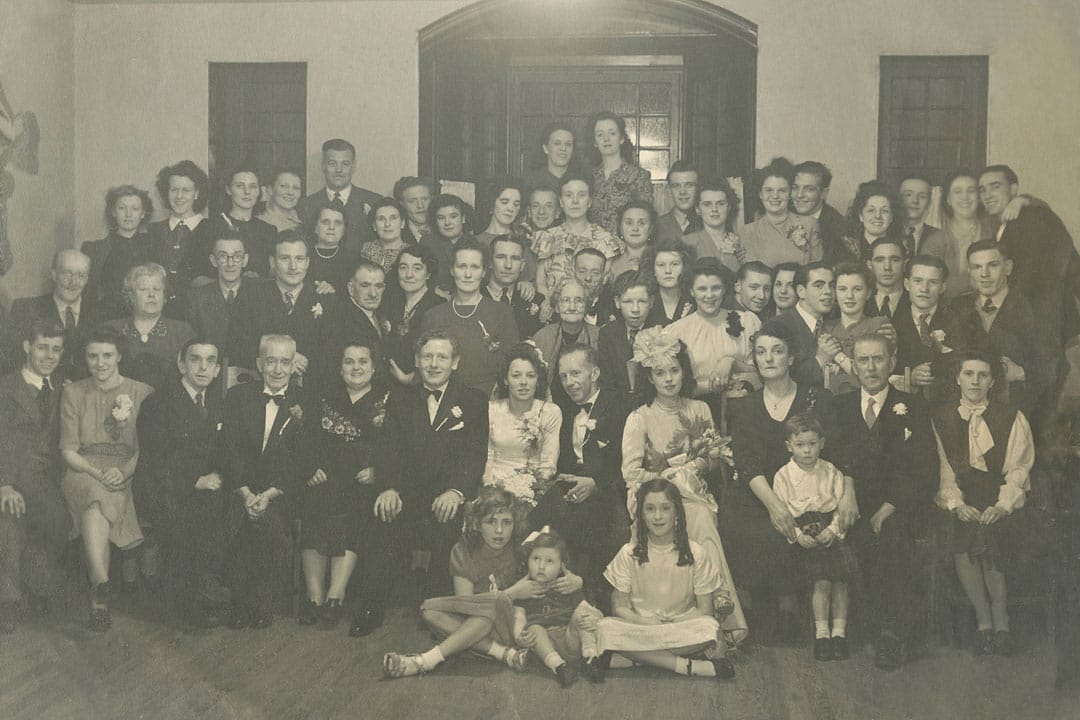
Tina McKenzie front right next to her parents with John Jr on their knee at sister Melinda’s wedding 1949
Tina McKenzie front right next to her parents with John Jr on their knee at sister Melinda’s wedding 1949
Sources and credits
From Scotland’s People website: Civil and Parish Birth, Marriage and Death Records; Scottish Census Records
From FindMyPast: Electoral Rolls; Military Records
King’s Own Scottish Borderers website
1st KOSB War Diaries (Royalscotskosbwardieries)
Service Record for John McKenzie from the National Archives ref WO 423/196929
Wikipedia: Cameron Highlanders, 51st Highland Division, Liverpool Scottish Regiment, Fort Darland
Help from Dr R Coles (Tina Leith’s nephew) and Carol-Ann McKenzie (John’s granddaughter)
Research Elaine Gathercole