Clipson | John Thomas


Biography
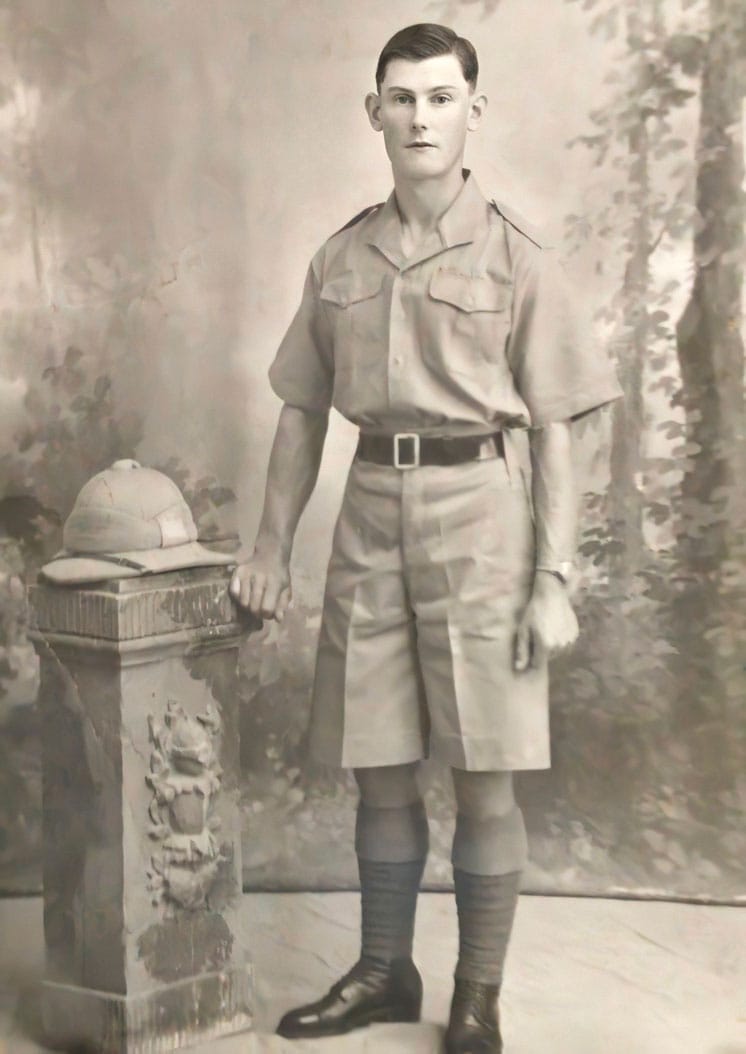
John Thomas Clipson (Service No. 5826396) was killed in action on 12 October, 1944 in the vicinity of Overloon. He was a Private in the 1st Battalion of the Suffolk Regiment. He was initially buried at Cemetery Th.J. Janssen in Overloon and re-interred on 19 May 1947 in Grave III. C. 4. at the CWGC Cemetery in Overloon. His grave is inscribed “You live with us in peaceful memory still; forget you no, we never will.”
Family Background
John Thomas Clipson was the son of William Webster Clipson and Sarah Jane White who had married in the Huntingdon district in 1906.
William Webster Clipson was born on 25 February 1877 in Gretton in Huntingdonshire which is near Uppingham. Sarah Jane White was born on 2 December 1889 in Upton near Huntingdon. By 1901, William was working as an agricultural labourer and living with his married older sister and her husband and family in Gretton. Sarah was living with her parents and siblings at College Farm, Upton, Huntingdon. Her father was an agricultural labourer.
After their marriage in 1906, William and Sarah went on to have twelve children as follows: Isaac William 20 April 1907, Frank 1909, Hilda 1911, John Thomas 17 July 1912, Sydney George 1914, Mabel Elizabeth 1916, Henry Alfred 10 October 1918, Arthur 1920, Edward K 25 January 1924, Mary Annie 18 November 1926, Frances E 1928 and Margaret Ida 2 May 1932. Isaac was born in Upton; Frank, Hilda and John in Abbots Ripton; Sydney and Mabel in Spaldwick; Henry, Arthur and possibly Edward in Godmanchester and the remainder probably in or near St Neots. It seems that the family were frequently moving for farm work, though all the places mentioned are close to Huntingdon. Isaac was known in the family as Billy, John as Jack and Henry as Alfred.
In 1911 William and Sarah were living at Abbots Ripton, Huntingdon with their first three children. William was working as a Horseman on a farm. John was born the following year in Abbots Ripton.
By 1921 they were living at Bottom Farm, Godmanchester. William was working as a Farm Labourer on Ashley Brothers’ farm. Their first eight children were with them.
A first tragedy struck the family in July 1923. John’s second eldest brother, Frank, died in an accident at Godmanchester aged just 14. He was working for a local farmer and had been leading a horse and cart down to a field. The horse was thought to have stumbled causing Frank to fall. The wheel of the cart went over his head. He had died before reaching hospital. His father said that he was a very useful lad and accustomed to horses and his employer said he was a very good boy in every way and quite capable of leading a horse. The inquest returned a result of death by accident.
John’s eldest brother, Isaac William Clipson, seems to have married in Huntingdon in 1934, but the marriage doesn’t seem to have lasted as in 1939 he was living with his parents and described as single.
John enlisted in the Army in January 1935 and gave his parents as his next of kin at 3 Bungalow, Risby, Bury St Edmunds. They had therefore moved to Suffolk by this time. It is thought that his brother, Sydney, enlisted in the Suffolk Regiment the following year.
John’s sister, Hilda, married William Robert Ashman in Risby in December 1938. He four sisters were bridesmaids.
By September William and Sarah were living at 7 Avenue Cottage, Risby, Thingoe, Suffolk. John also changed their address to this one as his next of kin not long after this. William was working as an Agricultural Stockman. With them were Isaac, Henry, Edward, Mary, Frances and Margaret. It has been seen that John and Sydney were already in the army and it is possible that Arthur may have also been called up by then. Hilda was married. Mabel may have been in service in London, though she seems to have been back in Risby by 1941.
Military Career 1935-39
As stated above, on 7 January 1935 John enlisted at Bury St Edmunds as a Private in the Regular Army with the Suffolk Regiment for a period of 7 years in the Colours and 5 in the Reserves. He stated that he was born on 17 July 1912 in Abbots Ripton. He gave his home town as Bury St Edmunds. He said he was working as a farm labourer. He was described as being 5ft 7 in tall, weighed 138 lbs. He had a fresh complexion, grey eyes and brown hair. He gave his religion as Church of England. He was declared fit.
He was initially posted to the Depot on 9 January 1935. On 26 March 1935 he received a 3rd Class Certificate of Education and then a 2nd Class Certificate on 26 July 1935. He was posted to the 1st Battalion on 18 September 1935.
On 3 February 1936 a report indicated that he was “A good young soldier. Keen, hard working & sober.” A few days later on 6 February he was posted to the 2nd Battalion and sent to India to serve in the Indian Service. On 21 September 1936 he was described as “A hard worker. Clean & smart in appearance. Honest reliable & sober.”
On 22 September 1937 it was stated in his Annual Report that he was “Hardworking. Employed in anti malarial work.” His next Annual Report on 16 September 1938 indicated that he was “Hardworking, honest sober and reliable. A good type.”
He served in the Indian Service until 31 March 1939, but this then reverted to British Service but still in India in the lead up to the war. His next Annual Report on 9 October 1939 again indicated that he had been working in anti malarial activity and was “quiet, sober and reliable.”
During these years before the war, he was employed in signals work from 15 February 1937 to April 1937 and, from 4 to 9 April 1938, he attended a refresher course in water duties at the British Military Hospital in Inhow which is in modern day Madhya Pradesh.
Military Career WW2
During the early years of the war, the 2nd Battalion of the Suffolk Regiment was mainly deployed on internal security duties.
His Annual Report on 20 August 1940 indicated that he was “A very good type of man who is on the promotion roll and should make a good NCO. He is a conscientious and intelligent worker and very keen on his job.”
On 6 January 1942 he left his unit to attend the 3rd British Driver Mechanic course at the King George VI Royal Indian Military College at Jullundhar in the Punjab. On 7 March 1942 he passed a Trade Test for Driver Motor Mechanic Class 2 (Group D Third Class). On 1 November 1942 he passed a trade test for Driver Mechanic Class II.
He arrived back in the UK from India on 9 April 1943. He therefore left India before the Battalion became involved in the Burma campaign later in 1943.
On his return, he was posted to an Infantry Training Centre. He was then posted to the 1st Battalion of the Suffolk Regiment on 27 August 1943. The following day he was absorbed into the wartime establishment of driver mechanics Group B Class II.
He embarked for France on 3 June 1944 and landed with his battalion on Sword beach on D-Day. The Battalion was involved in attacking and taking the Hillman Fortress on D-Day itself. They continued to progress through France, including severe battles which cost many lives at Chateau de la Londe and at Tinchebray.
On 20 August they arrived at Chapelle-au-Moine where they spent two weeks. Here, they had some respite from the fighting and could relax and re-train for what was to come next. They were also able to receive reinforcements to replace the men killed and wounded. On 3 September they moved 130 miles eastwards over the Seine to Farceaux where they again remained out of the action for 13 days.
The Battalion’s advance into Belgium in mid September started with the challenge of crossing the Escaut Canal. They succeeded in the face of strong opposition, reaching Hamont on 20 September. They crossed into the Netherlands on 21 September to reach Weert. On 27 September they left Weert for De Rips. On 1 October they left De Rips to take up positions behind the village of Mook, to the south of Nijmegen.
The failure of Operation Market Garden had left the allies exposed in a narrow corridor through the Netherlands. The enemy still held Overloon, Venray and Venlo to the east. Initially the Americans attempted to clear this area but the strength of the enemy was underestimated and they made little progress. The British were now charged with taking on this task. The aim was to attack Overloon from the north and clear the enemy salient west of the River Maas in what was known as Operation Aintree.
On 8 October, the Battalion moved from Mook to Rijkevoort with the aim of attacking Overloon on 11 October having passed through St Anthonis and Oploo. However, the attack was delayed by heavy rain and very muddy conditions until noon on 12 October. The attack was to begin at 1200 hours.
The plan was for the 1st Suffolk Regiment to capture the western part of Overloon and a brick factory to the south. The East Yorkshires were to advance alongside the Suffolks towards a dog shaped wood to the east of Overloon.
The attack began with a general bombardment by Typhoons and artillery followed by a creeping artillery barrage which moved forward by 100 yds every 5 minutes. The infantry followed this barrage with “A” company in the lead. They had to advance over half a mile of desolate land to reach Overloon and were immediately met with mortar fire. A sniper inside a shattered windmill succeeded in picking off Major Ellis who was “A” Company Commander, two platoon sergeants and most of the senior NCOs by identifying their rank from their badges. The attack nearly stalled at that point. However, Company Sergeant Major Leatherland took charge and led the Company to push on to clear the enemy from their machine gun positions. Communications were poor due to the weather, but a message got through to ask for air support so Typhoons emerged from the drizzle to pound the mill. Two thirds of “A” Company were killed or wounded around the windmill.
Meanwhile, B Company had steadily advanced towards the centre of Overloon which the enemy was stubbornly defending. A Panther tank looked like it might cause a problem as the anti tank platoon was unable to move forward over waterlogged ground. However, Major Martin who was leading the Company personally used a PIAT to take out the tank.
Runners from “A” Company back to Battalion HQ were so frequently wounded that no-one at Battalion knew what was happening at the front until one Runner finally got through. This was the first that Battalion HQ knew that Major Ellis had been killed. “A” Company 2nd in command, Captain John Glauert, came forward to assume command of the Company. He did so accompanied by two of his soldiers, Privates John Thomas Clipson and George Hodgson Rowlandson, in a small and lightly armed Bren carrier. They cautiously followed the route previously taken by “B” Company. Just beyond Tactical Battalion HQ, which was situated in a farmhouse on the left side of the road, they came to a halt about 200 yards from the badly damaged windmill where Captain John Glauert quickly jumped out of the Bren carrier.
As the carrier, driven by John and accompanied by George, continued on towards Overloon, they seemed completely oblivious to a burning scout car on the side of the road. They continued along the track, into the fields, in the direction of the brickworks at the “Bossenhoekweg”, where they unexpectedly hit a mine. The Bren carrier exploded and both men were instantly killed. Initially, John and George were reported as having been killed in action but that the date was unknown. This was later corrected to 12 October as the date of death.
“A” Company under Captain Glauert were then tasked with pressing on towards the brick factory which they succeeded in doing with yet more casualties. By 1730 hrs all objectives had been reached.
In Mark Forsdike’s book “Fighting Through to Hitler’s Germany” he quotes Private Claude Conybeare as follows: “Went into a terrific attack with 400 artillery guns in support; enemy strongpoint had to be taken, it was real hell let loose, and one expected to get injured at any minute. But we got through OK and captured Overloon”.
A total of one officer and 9 men of the 1st Battalion of the Suffolk Regiment were killed and a further 2 officers and 55 men were wounded.
John Thomas Clipson and George Hodgson Rowlandson were temporarily buried at Baansestraat (near Th.J. Janssen) in Overloon and are now buried alongside each other in the Overloon War Cemetery.
John had served for a total of 9 years and 279 days of which 7 years and 62 days were in India and 132 days were in North West Europe. He was awarded the India General Service Medal with Clasp 1937-39, 1939-43 Star, France & Germany Star, Defence Medal and War Medal 1939/45.
John’s family commemorated him in the Bury Free Press of 12 October 1945, a year after his death, as follows:
“In ever loving memory of a dearly loved son and brother, Pte John Thomas Clipson, who gave his life while serving in Holland on October 12th 1944.
Dearer to us than words can tell,
Was the dear son we all loved so well,
We do not forget, and never intend,
We think of you daily, and will to the end;
Wherever we are, whatever we do,
Always, dear Jack, we are thinking of you,
-From his loving Dad, Mum and Sisters.
Risby and Ely, also his Brothers still serving”
This indicates that some of his brothers had also served in WW2. His brother Isaac William Clipson, served in the RAF. His brother Sydney seems to have enlisted in the Suffolk Regiment in 1936 (Service No. 5826248). By 1945 he was a Lance Corporal in the South Lancashire Regiment. He was thought to be missing on 6 January 1945, and then discovered that he was a prisoner of war in Stalag 6F at Dorsten in the Ruhr Valley in Germany. He may also have spent time at Fallingbostel Camp. His other three surviving brothers were also of an age where they may have been called up to serve unless they were in restricted occupations. All the brothers survived the war.
They again commemorated John in the same newspaper on 11 October 1946 as follows:
“In Loving memory of a dear son and brother, 5826248 Pte John Thomas Clipson, son of Mr and Mrs Clipson, Risby, who died on October 12th 1944.
Oh, how we longed for your safe return,
But our prayers were all in vain,
We never thought as we said goodbye
We would never see you again
From his loving Father and Mother, Brothers and Sisters, Risby, Ely, Prickwillow and Scotland.”
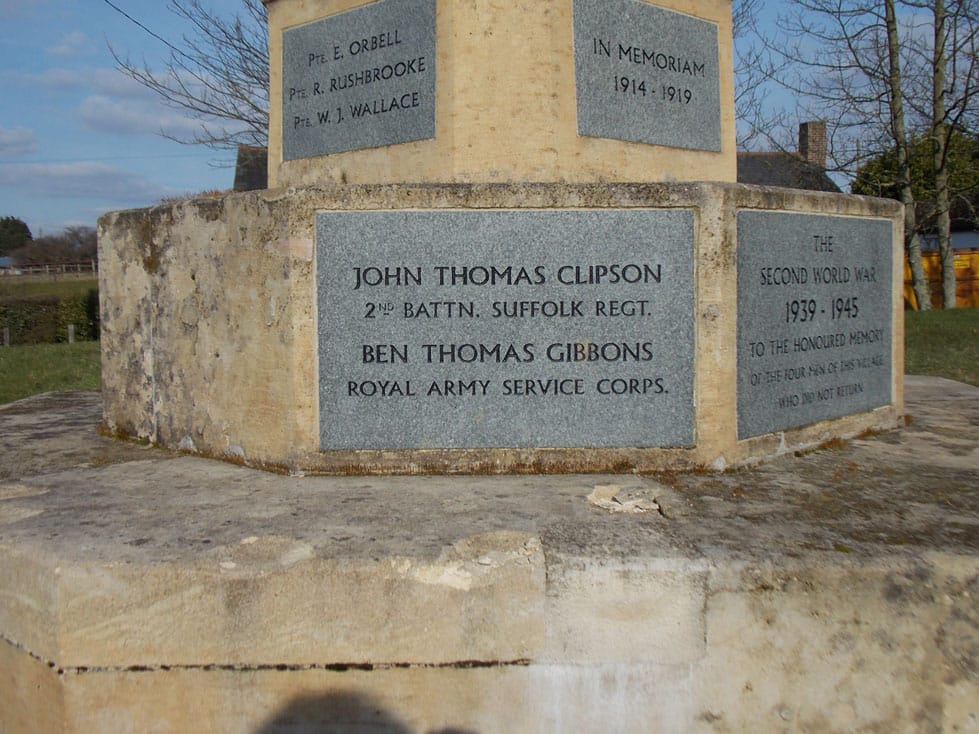
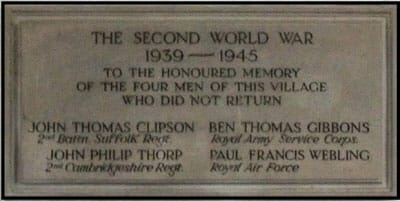
Another article in that paper on 27 February 1948 indicated that a memorial plaque had been unveiled on the south wall of the nave in Risby Church to the four men from Risby who had lost their lives in WW2. These were: John Thomas Clipson, Ben Thomas Gibbons, John Phillip Thorpe and Paul Francis Webling. During the ceremony, a bugler from the Depot, Bury St Edmunds, sounded the Last Post. They are also now commemorated on the cross on the village green which was initially erected to commemorate the men who died in WW1.
John’s sister Mabel married George Gipp in Ely in 1946 and Edward K married Lillian B Davies in Brighton that same year. In 1948 Arthur married Beatrice Hyde in the Forest of Dean in Gloucestershire. In 1949, Mary married Bertie Arbon and Margaret married William H Stone, both in the Bury St Edmunds district. Frances married Frederick G Stone in 1952 in the Bury St Edmunds district. It is not thought that Sydney or Henry married.
John’s father, William Webster Clipson, died in January 1955 aged 77 in the Bury St Edmunds district. His death was reported in the Bury Free Press of 21 January 1955 as follows:
“Land Worker of the ‘old school’ dies – Mr W Clipson
The death occurred last week of Mr William Webster Clipson, a son of the late Isaac and Mary Clipson of Gretton, Northants, who at one time worked at Risby. A farm employee all his working life, he began on a Northamptonshire farm at the age of 9. One of the ‘old school’, he was a fine type of the all round worker. He had worked at Quay’s Farm, Risby for the late Mr Murfet and for the past 20 years, Mr AS Rickwood of Chatteris. He was of a very quiet disposition and steady character and will be missed by relatives and many friends. Mr Clipson was 77. He worked seven days a week until within 10 days of his death which followed a very short illness. The funeral took place at St. Giles Church, Risby and the service was conducted by the Rector the Rev JB Mayall.”
It went on to list the mourners which included most of his surviving children.
John’s mother, Sarah Jane Clipson, died in 1966 in the Bury St Edmund’s District aged 77.
John’s eldest sister, Hilda, died in 1974 in Bury St Edmunds. On 23 March 1979, the Bury Free Press announced the death of his eldest brother, Isaac William Clipson aged 72 of 7 the Avenue, Risby on March 15. It stated that he had served in the RAF in WW2. Most of the surviving siblings attended the funeral. They themselves died between 1990 and 2009.