Cluett | William John


Biography
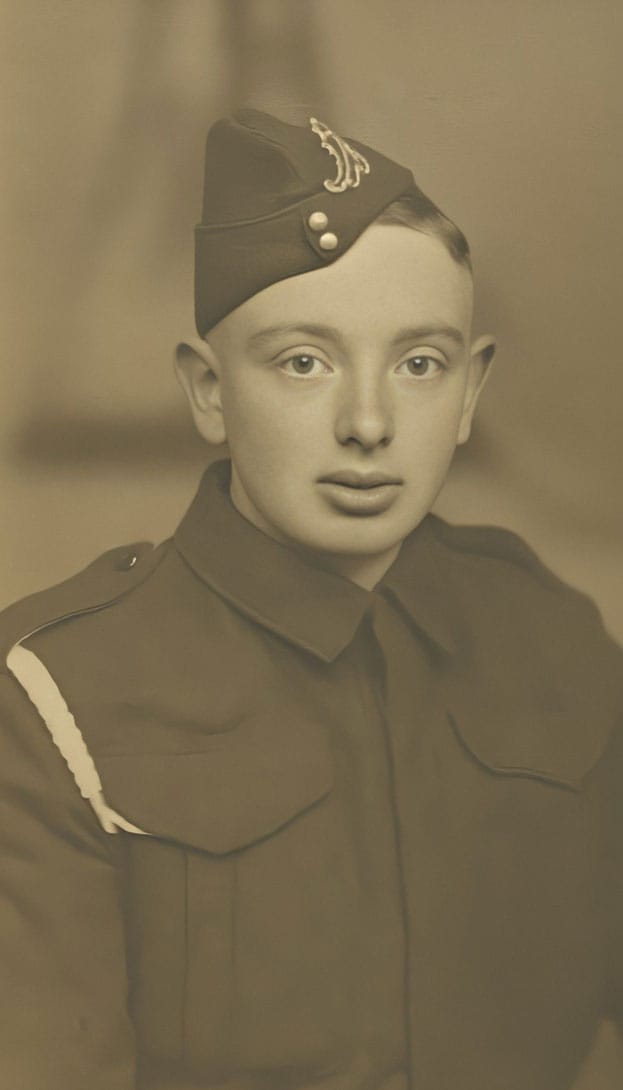
William John Cluett was killed in action on 19 October 1944 near Overloon. He was a private in the King’s Own Scottish Borderers, 1st Battalion. (Service number 1617609). He was initially buried at the A. vd Wijst Cemetery in Overloon and reburied on 13 May 1947 in grave II.B.11 at the CWG Cemetery in Overloon. The inscription on his grave reads: “At the going down of the sun and in the morning, we will remember him”.
Family background
William was born on 29 September 1914 in the town of Barnstaple, situated in the north of the English county of Devon. It needs to be noted that the England & Wales Civil Registration Birth Index, 1837–1915, states that he was born in 1913.
His parents were Kate Cluett (née Bradshaw) and John Cluett. He had one brother, Frederick Cluett (1916–1982).
Sadly, William’s father John died in 1920.
In 1921, his mother Kate, now a widow, lived with her two young sons, William and Frederick, at 40 Azes Lane in Barnstaple. She worked as a seamstress for the Collar Palton Factory, specialising in making, stitching and finishing collars.
In 1923, Kate remarried Pastor Edwin T. Austin from Barnstaple. Their marriage was described in detail in a newspaper article in the North Devon Herald. Kate’s children, Frederick and William, were also mentioned in the article. Together, they took care of William and Frederick.
William spent his childhood in Barnstaple and attended Ashleigh Road School there. He later moved to the coastal town of Torquay in South Devon, where he worked for six years as a milkman for the Manor Dairy in the Babbacombe district.
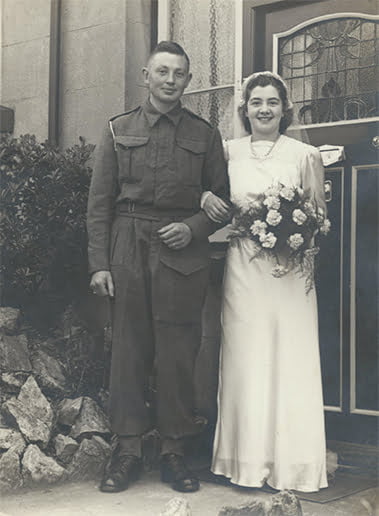
In the close-knit community of Torquay, he was a familiar sight, delivering fresh milk to households every day. William was an active member of the local community and regularly attended Upton Vale Baptist Church. In 1941, he married his wife, Katie Amelia Cluett (née Perry), at this church. Katie had a sister, Ethel Perry (1924–), a brother, Joseph Perry (1914–), and a brother, Douglas Haig Perry (Stokes) (1918–1942), who had been adopted. Douglas was a Lance Corporal in the Royal Corps of Signals and was wounded during the fighting at El Alamein; he later died as a prisoner of war on 31 October 1942.
The couple settled in a house called ‘St Lucia’ on Berea Road in the Ellacombe district of Torquay. In May 1944, their daughter, Shirley, was born.
Military Background
On 29 July 1940, 20-year-old William was called up for military service. His service number was 1617609. Here too, he gave his date of birth as 13 September 1914. At his medical examination, his physical description was recorded as 1.75 metres tall, weighing approximately 70 kg, with hazel eyes, brown hair, a chest circumference of 89 cm and a distinctive scar on his chin. His religious affiliation was noted as the Church of England and his medical classification was initially Grade II.
He was assigned to the Royal Artillery and joined the 37th Searchlight Regiment, Royal Artillery (377 S/L Training Battery, later transferred to 308 Battery of the 37th S/L Regiment and 349 Battery of the 34th Searchlight Regiment). This unit was responsible for operating powerful anti-aircraft searchlights to protect British cities, ports and strategic locations from night-time attacks by the German Luftwaffe during the Blitz and the subsequent air war.
William served for exactly four years on the British home front (Home Service, from 29 July 1940 to 27 July 1944: 3 years and 364 days). During this period, his medical classification was upgraded to A1 on 6 February 1943. William’s brother Frederick also served overseas with the British forces during the war.
RE-TRAINING FOR THE INFANTRY
By early 1944, the situation at the front had changed dramatically. With preparations for Operation Overlord (the Allied invasion of Normandy) in full swing, the British Army was facing a severe shortage of infantrymen. Many home defence and anti-aircraft units were reorganised to free up personnel for combat duties in Western Europe.
On 27 March 1944, William was officially transferred from the Royal Artillery to the Infantry and assigned to the Worcestershire Regiment (23rd Infantry Training Centre/8th Battalion). Re-ranked as a Private, he underwent intensive infantry training.
OPERATIONS IN WESTERN EUROPE AND THE K.O.S.B.
On 28 July 1944, just two months after the birth of his daughter Shirley, William embarked for overseas service in Western Europe as part of the 21st Army Group (British Liberation Army). A few days after arriving in France, with effect from 3 August 1944, he was transferred as a reinforcement to a battle-hardened unit: the 1st Battalion, King’s Own Scottish Borderers (K.O.S.B.).
This battalion formed part of the famous British 3rd Infantry Division (nicknamed the ‘Iron Division’ or ‘Pattern of Glory’), under the command of Major-General Tom Rennie. The battalion had been engaged in heavy fighting since D-Day (Queen Red Beach, Caen and the breakout through France), and William was assigned to make up for previous combat losses.
RELOCATION AND PREPARATION FOR OVERLOON
Following the heavy fighting in Normandy after D-Day and Operation Goodwood, the battalion received several groups of reinforcements in northern France to replenish its ranks.
After a period of training and rest in Étrépagny in mid-September, the battalion advanced rapidly via Brussels and Leuven. They supported the 2nd Battalion Royal Ulster Rifles and the 2nd Battalion Lincolnshire Regiment during the crossing of the Meuse-Scheldt Canal, continued through Belgium and into the Netherlands, and reached Milheeze on 28 September. On 1 October, the battalion arrived in St Hubert for a ten-day period of rest, training and reorganisation before being deployed in major combat operations.
In St Hubert, they were very warmly welcomed by the local people. They remained there until 12 October. They spent their time training, but also had time for leisure. A football match was organised against the regiment’s 6th Battalion on the St Hubert football pitch. They lost 4–1, and the Pipe Band played during half-time and after the match. On 10 and 11 October, there were also two film screenings. The diary notes that they left St Hubert on 12 October after a pleasant ten-day stay.
On 12 October, they reached an assembly point just west of Sint Anthonis. That day, the 1st Suffolks succeeded in capturing Overloon and taking up a position just south of the town. The following day, the 1st KOSB attacked the wood south-west of Overloon and reached the southern edge of the wood, although it came under fire upon arrival. They remained there the following day, whilst the Royal Ulster Regiment and the Lincolns attacked the wood further to the east.
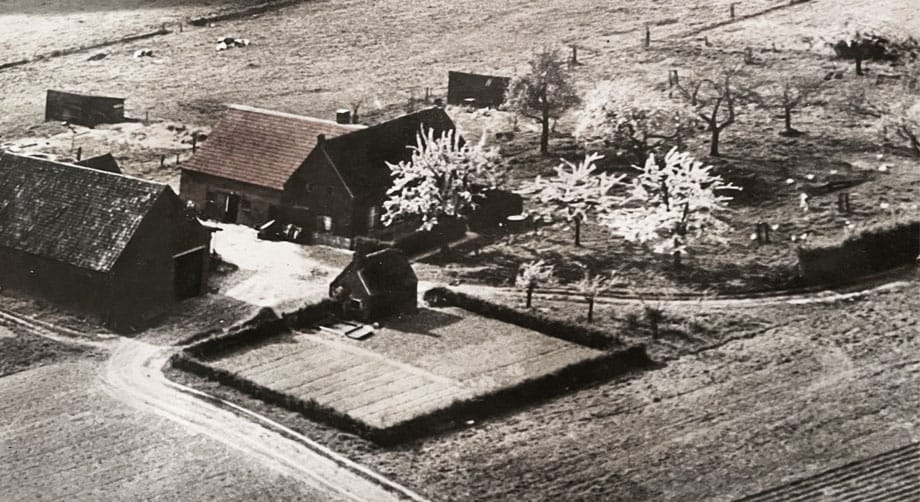
On the 15th, they moved slightly further south and on the 16th they continued their advance southwards, expecting to remain there that night. Instead, they were ordered to relieve the 4th Battalion of the King’s Shropshire Light Infantry east of Overloon in the area near Smakt, with the companies deploying in a north-south direction to the west of the railway line. They did not take over the position until 7.30 pm, in very heavy rain, which meant that the reconnaissance units could barely see their positions before dark. On 17 October, the war diary notes that the battalion endured the heaviest shelling and mortar fire it had faced to date. They spent their time patrolling the area west of the railway line and monitoring enemy positions. The heavy shelling continued on 18 and 19 October. On the 19th, the war diary notes successes in countering enemy activities through artillery fire and the establishment of an observation post in a farmstead called ‘Hoeve de Knol’. It was, however, on that day, close to that farmstead, that William Cluett was killed in action. Along with William, Edward Fenn, Percy Chambers and Thomas Wilson, comrades from the same regiment, were also killed that day.
Our foundation received a letter from the family of Edward Fenn, in which the dramatic events of that day are clearly described. They received this letter from Reuben Smith, also a comrade in the King’s Own Scottish Borderers, 1st Battalion, and a close friend of Edward Fenn. The sergeant described in the letter is very likely Thomas Wilson, and the other two are William Cluett and Percy Chambers. The graves concentration reports for these soldiers support this view.
An extract from this letter:
“We were fighting the Germans in a very large forest and managed to drive them from it out into the open country so our company stayed at that for a rest. The Germans were out into the open on a railway bank and we were in the forest. On the end of the forest facing the Germans was a farm yard and in there was the platoon which Ted (Edward Fenn) was in.
On the morning of the 19 Oct at 10 o’clock Ted was ordered to take a patrol from the farm yard to a certain spot out in the open, in which he started to do as he gets well into the open he saw a gang of Germans coming towards him, and he at once told his men to get down a keep still as he was going to wait until the Germans where near and then try and take them all prisoners, well, everything was going fine and when the Germans got near, then things became to happen, one of the men lost his nerve and jumped up and ran away, it was then that panic broke out among the men and one more man ran away leaving Ted with two men, and three men against a gang of Germans was hope-less and there fore there was only one thing to do every man for himself, and as the three heroes got up two were killed, and Ted was seen running holding his stomach.
Meanwhile the first man who ran away was running and falling over trying to get back to the farm house, and a sergeant run out to meet him and as he did, he was shot by a machine gun and killed at once. All the time this was going on our machine gun from the house was firing at the Germans, who at once aimed their gun on to the farm house, it was then Bill (another comrade), got a bullet in the left arm, and a man standing next to him got hit in the groan.
The first man to run away reached the farm house ok, at that time we who was at H.Q at the time had got the news of what had happened, and straight away a rescue party formed to try and get the dead and wounded in. We managed to get the men from the farm in but as we try’d to get the dead sergeant and Ted in (who we thought was still alive) we was fired on by the Germans, it was then the officer said it was hope-less and we would have to wait until night came. Dark-ness came and out went the rescue party we found the sergeant and brought him in as 3 hours later we made up our minds to have the 3rd attempt to get Ted in and at 10.30 that night we found him, dead.”
The next day on 20 October 1944 they were buried, after a short ceremony, in a field grave at Begraafplaats A. vd Wijst in Overloon and later, close to each other, reburied on 13 May 1947 at Overloon War Cemetery.
The full letter can be read in the biography of Edward Fenn.
For his service in the liberation of Western Europe, Private William John Cluett was posthumously awarded the following medals: the War Medal 1939–45; the 1939–45 Star; the France & Germany Star; and the Defence Medal.
On one of the forms in his Service Record, his date of birth was recorded incorrectly. William’s handwriting was such that 1914 could have been mistaken for 1919. Consequently, the year of birth 1919 was also recorded in his Service Record held at the National Archives.
The aftermath
Initially, there was some administrative uncertainty regarding his exact date of death. Early military reports and telegrams (Cas/KOSB/21 Ser. 156) state that he was killed in action on 18 October 1944. This was later officially amended to 19 October 1944 (Cas/KOSB/21 Ser. 190). His next of kin were notified on 27 October 1944, and on 28 November 1944 the Ministry of Pensions granted a weekly widow’s pension and child allowance to Katie Cluett.
The family have always believed the story that has been circulating since William’s death, namely that he was killed by a shot to the head from a German sniper after he had volunteered to collect the post. There was no one they could ask where this story came from – they can only assume that this is the information Katie was told following his death.
In Torquay, a memorial service was held one Sunday morning at Upton Vale Baptist Church, where the couple had been married three years earlier.
In April 1945, the Infantry Record Office in Perth, Scotland, returned Williams’s personal effects to his widow Katie. The official inventory listed the personal items found on his body on the battlefield:
A pocket diary, a broken pocket watch, a fountain pen, a pair of folding scissors, a lighter and lighter case, a cigarette case, a signet ring, three collections of letters, a nail file, a coin and a small lucky horseshoe (a comb in a case was crossed out as ‘not received’).
On 27 April and 26 May 1945, Katie Cluett wrote emotional, handwritten letters to the military authorities, in which she expressed her deep disappointment that her husband’s leather wallet was missing. He always carried this wallet with him; it contained precious family photographs and cash that he had saved for his family before leaving for abroad. A solid silver chain with a second charm, which he wore round his neck, was also missing. She emphasised how important the photographs were to her.
The Ministry of Defence launched an investigation through headquarters (GHQ 2nd Echelon, 21st Army Group), but on 28 June 1945, the CO of the 1st Battalion K.O.S.B. reported that no further personal belongings had been found on the battlefield and that all recovered items had already been sent on.
The letter that Reuben Smith sent to Edward’s family contained a striking paragraph about stolen belongings on the battlefield:
“Ted was brought back to our headquarters and when the officer took his pay book out of his (Ted’s) pocket that morning, it turned out that, whilst Ted was lying out in the open, the Germans had taken everything he had in his pockets. The only thing they had left him was the cross hanging round his neck.”
This could be the reason why Katie did not get back all the belongings she had been so hoping for.
POST-WAR VISIT AND COMMEMORATION IN OVERLOON
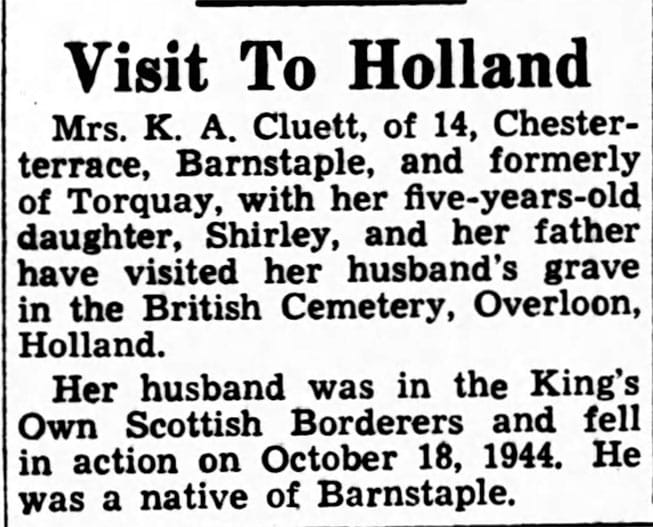
After the war, Katie Cluett travelled to the Netherlands with her young daughter Shirley and William’s stepfather, Edwin Austin, who made the journey in place of William’s mother, Kate Austin, who was too ill to travel. They visited William’s grave at Overloon War Cemetery.
The visit left a deep impression on the family. Relatives, friends and the Dutch host family gathered at the grave, where a 10-year-old Dutch boy led the group in praying the Lord’s Prayer. William’s grave was adopted by two local Dutch sisters, the Janssens, who tended it and placed fresh flowers on it every week. On her return to England, Katie Cluett expressed her sincere gratitude for the warm welcome and sympathy shown by the Dutch people, who told her that they felt “they could never repay what had been done for them.”
In 1954, Katie married Dennis M. Crane from Barnstaple. Shirley married Roberts in 1972.
Katie died in Barnstaple at the age of 93.
Her grandson Mark writes:
“I remember going to the Netherlands with my grandmother about 50 years ago, when I was still a little boy. I stayed with Nellie Van Den Boogaard’s family and visited William’s grave at the Overloon war cemetery. My grandmother and Nellie had a lifelong friendship and kept in regular contact until my grandmother passed away in December 2015 at the age of 93. Nellie and her family visited my grandmother several times over the years, and we often met up for outings in North Devon. We will always be grateful to the Boogaard family and the people of the Netherlands for looking after the war graves.”