Chambers | Percy


Biography
Percy Chambers was killed in action on 19 October 1944 near Overloon. He was a Private in the King’s Own Scottish Borderers, 1st Battalion. (Service number 5116538). He was initially buried at Cemetery A. vd Wijst in Overloon and reburied on 13 May 1947 in grave II.B.13. at the CWG Cemetery Overloon.
Family background
Percy was the son of William Arthur Chambers and Caroline S Chambers (nee Hillier). He had a twin brother called Reginald, a sister called Ethel May, a sister called Carrie, a brother called William Edward, and a brother called Leslie Norman.
The family lived in Birmingham, initially at 162 Randolph Road and, in 1921, at 19 Fordhouse Lane in Stirchley, Birmingham, Warwickshire.
In 1939 Percy was a Corporation Tram Conductor for Birmingham Corporation Tramways.
He was married to Lilian Cecilia Ruth Colbourne on 14th November 1942 in The Parish Church, Selly Hill, Birmingham. Following Percy’s tragic death, his wife Lilian remarried in 1946.
Percy was always spoken about and still is by his family.
Military career
Percy Chambers enlisted in the Territorial Army on 18 April 1940 and was assigned to the Royal Warwickshire Regiment.
At his medical examination and enlistment for military service, Percy was described as follows: approximately 173 cm tall, weighing approximately 60 kg. He had hazel-brown eyes and brown hair, and scars on both knees. He stated his religious affiliation as the Church of England. He was fully fit for active military service, Grade 1.
He named his father, William Arthur Chambers, as his next of kin. This was later amended to his wife, Lilian Cecilia Ruth Colbourne.
He was posted to the Infantry Training Centre (ITC 149) for his basic military training.
After completing his initial training, he was transferred on 22 June 1940 to the 1/7th Battalion, Royal Warwickshire Regiment. This battalion formed part of the defence of the British home front during the critical period following the Dunkirk evacuation.
During the years in which Britain was preparing for the liberation of Western Europe, Percy undertook various training courses and internal secondments.
On 18 May 1942, he was seconded to the 1st Battalion, East Yorkshire Regiment to undertake a specific training course, which he passed.
After completing his training period and secondment, he formally returned to his home unit on 19 February 1943, which is likely to have been the (1/7th) Royal Warwickshire Regiment.
His marriage
Whilst serving in the army in England, Percy married Lilian Cecilia Ruth Colbourne on 14 November 1942. The ceremony took place at Selly Hill, Birmingham, and was conducted by the Reverend H.E. Selwyn. Witnesses to the marriage included R. Chambers, Betty Colbourne, C. Colbourne and A. Chambers. The couple settled at 142 Bournbrook Road, Bournbrook, Birmingham 29.
Transfer to the King’s Own Scottish Borderers
In the run-up to the invasion of Western Europe (Operation Overlord), major reorganisation took place within the British infantry to make up for losses and bring battalions up to full combat strength.
On 30 May 1944, Percy appears to have been officially transferred on paper by the Record Office to the King’s Own Scottish Borderers (K.O.S.B.).
On 2 June 1944, his service on the British home front (Home Service) was formally concluded after 4 years and 46 days, and on 3 June 1944, Percy embarked for the crossing to North-West Europe (NWE), just before the actual landings in Normandy.
After his crossing, Percy took part in the fighting on the European mainland. Although his transfer to the K.O.S.B. was initiated on 30 May 1944 (with administrative formalities completed in the summer of 1944, as the service record notes show), he served at the front with the 1st Battalion, King’s Own Scottish Borderers.
The 1st Bn K.O.S.B. was part of the famous British 3rd Infantry Division. The battalion landed on D-Day at Sword Beach (Queen Red) and fought through the heavy fighting around Caen, the breakout from Normandy and the advance through France and Belgium towards the southern Netherlands.
In June 1944 the regiment was in northern France after the D-Day landings in Normandy. They played a role in Operation Goodwood in July, as part of the larger Battle of Caen.
The battalion saw action on 9 August at Vire, but was held in reserve during the attacks on Tinchebray. From 20 August to 3 September, they underwent a period of training. From 5 to 16 September, they were in Etrepangy, where they rested again and received another 30 men as reinforcements, in addition to the six officers and 91 men they had already received since D-Day.
They then moved quickly via Brussels and Leuven to support the 2nd Battalion of the Royal Ulster Rifles and the 2nd Battalion of the Lincolnshire Regiment in crossing the Meuse-Scheldt Canal and continuing on to Belgium and the Netherlands, where they reached Milheeze on 28 September. At this point, the war diary mentions that the bath unit arrived and ‘the entire battalion felt clean for the first time since Etrepagny,’ which was more than three weeks earlier.
St Hubert and Overloon
On 1 October, they reached St Hubert, where they were very well received by the inhabitants. They remained there until 12 October. They spent their time training, but also had time for relaxation.
A football match was organised against the 6th battalion of the regiment on the football field in St Hubert. They lost 4-1 and the Pipe Band played during half-time and after the match. On 10 and 11 October, there were also two film screenings. The diary states that on 12 October, after a pleasant stay of ten days, they left St Hubert.
On 12 October, they reached a staging area just west of Sint Anthonis. That day, the 1st Suffolks managed to capture Overloon and take up a position just south of the town. The next day, the 1st KOSB attacked the forest southwest of Overloon and reached the southern edge of the forest, although it came under fire when it arrived there. They remained there the next day, while the Royal Ulster Regiment and the Lincolns attacked the forest further to the east.
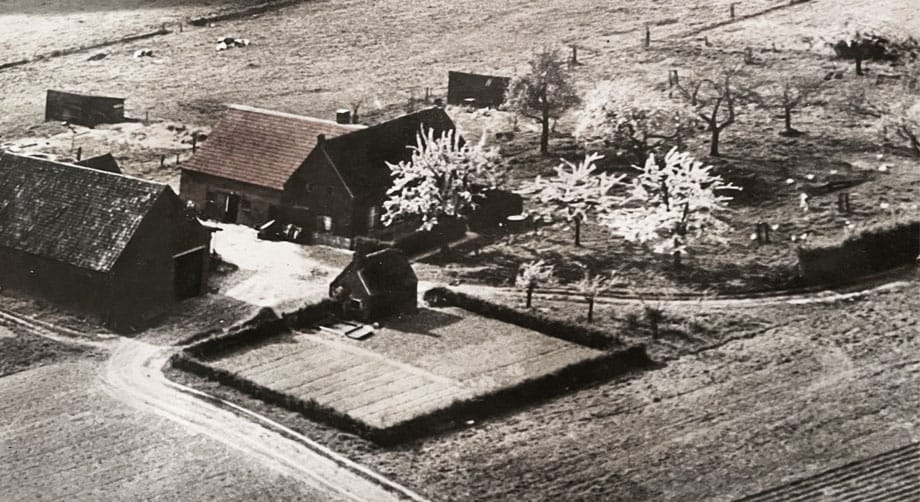
On the 15th, they moved slightly further south and on the 16th they continued their advance south, expecting to remain there that night. Instead, they were ordered to relieve the 4th Battalion King’s Shropshire Light Infantry east of Overloon in the area near Smakt, with the companies forming up in a north-south direction west of the railway line. They did not take up their positions until 7.30 p.m., in very heavy rain, which meant that the reconnaissance units could hardly see their positions before dark. On 17 October, the war diary mentions that the battalion suffered the heaviest shelling with grenades and mortars to date. They spent their time patrolling the area west of the railway line and keeping an eye on enemy positions. The heavy shelling continued on 18 and 19 October. On the 19th, the war diary mentions successes in combating enemy activities by means of artillery fire and establishing an Observation Post in a farm called “Hoeve de Knol”. However, this was the day that, very near to this farm, Percy Chambers was killed.
He was 29 years old at the time and had completed exactly 139 days of active combat service on the European mainland (total military service: 4 years and 185 days).
In recognition of his loyal service and his sacrifice for the liberation of Western Europe, Private Percy Chambers was posthumously awarded the following four British war honours: the 1939–1945 Star, the France and Germany Star, the Defence Medal and the War Medal 1939–1945.
Along with Percy, Edward Fenn, William Cluett, and Thomas Wilson, comrades from the same regiment, also died that day.
Our foundation received a letter in 2025 from Edward Fenn’s family, clearly describing the dramatic events of that day. The sergeant described in the letter is most likely Thomas Wilson and the two others William Cluett and Percy Chambers. The graves concentration reports of these servicemen support this belief.
An excerpt from this letter:
“We were fighting the Germans in a very large forest and managed to drive them from it out into the open country so our company stayed at that for a rest. The Germans were out into the open on a railway bank and we were in the forest. On the end of the forest facing the Germans was a farm yard and in there was the platoon which Ted (Edward Fenn) was in.
On the morning of the 19 Oct at 10 o’clock Ted was ordered to take a patrol from the farm yard to a certain spot out in the open, in which he started to do as he gets well into the open he saw a gang of Germans coming towards him, and he at once told his men to get down a keep still as he was going to wait until the Germans where near and then try and take them all prisoners, well, everything was going fine and when the Germans got near, then things became to happen, one of the men lost his nerve and jumped up and ran away, it was then that panic broke out among the men and one more man ran away leaving Ted with two men, and three men against a gang of Germans was hope-less and there fore there was only one thing to do every man for himself, and as the three heroes got up two were killed, and Ted was seen running holding his stomach.
Meanwhile the first man who ran away was running and falling over trying to get back to the farm house, and a sergeant run out to meet him and as he did, he was shot by a machine gun and killed at once. All the time this was going on our machine gun from the house was firing at the Germans, who at once aimed their gun on to the farm house, it was then Bill (another comrade), got a bullet in the left arm, and a man standing next to him got hit in the groan.
The first man to run away reached the farm house ok, at that time we who was at H.Q at the time had got the news of what had happened, and straight away a rescue party formed to try and get the dead and wounded in. We managed to get the men from the farm in but as we try’d to get the dead sergeant and Ted in (who we thought was still alive) we was fired on by the Germans, it was then the officer said it was hope-less and we would have to wait until night came. Dark-ness came and out went the rescue party we found the sergeant and brought him in as 3 hours later we made up our minds to have the 3rd attempt to get Ted in and at 10.30 that night we found him, dead.”
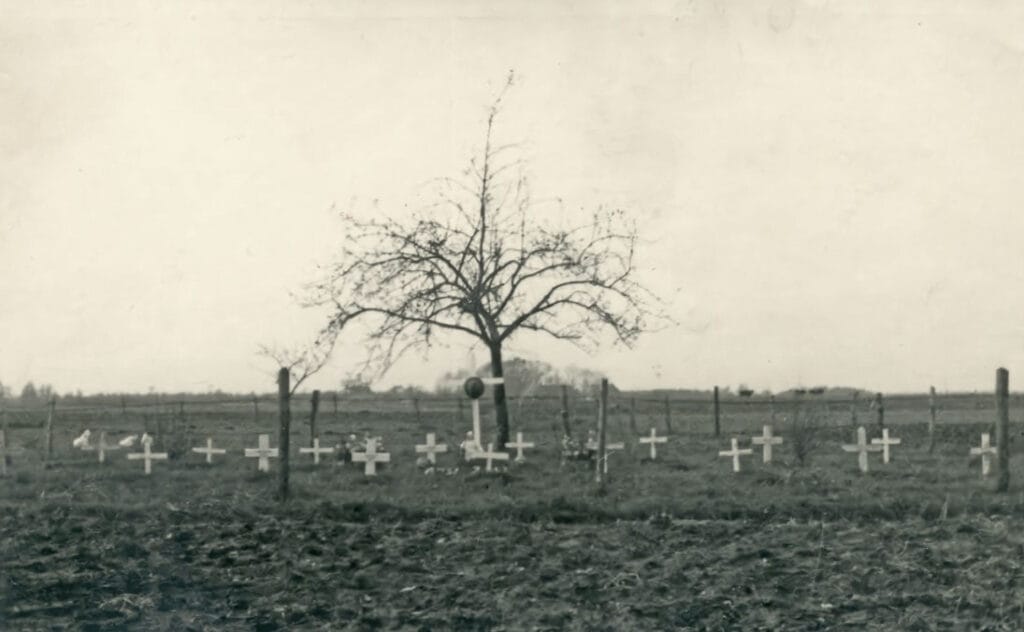
The next day on 20 october 1944 they were buried in a field grave at Begraafplaats A. vd Wijst in Overloon and later, close to each other, reburied on 13 May 1947 at Overloon War Cemetery.
The full letter can be read in the biography of Edward Fenn.
Aftermath
The official notification of his death was sent on 31 October 1944. Lieutenant P.F. Agar of the Infantry Record Office in Perth officially informed his wife Lilian and his family on 1 November 1944. On 6 November 1944, his death was recorded in the official register of deaths.
On 5 February 1945, Lilian was granted a weekly widow’s pension of one pound per week by the Ministry of Pensions. No child benefit was granted, confirming that the couple left no dependent children behind.
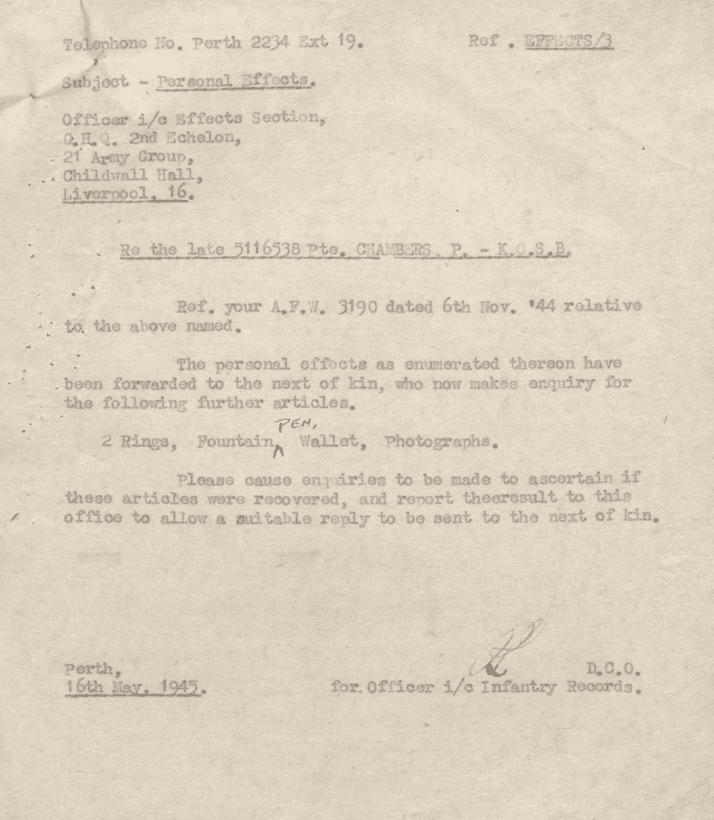
Between November 1944 and April 1945, Percy’s personal belongings were collected from the front. In the spring of 1945, Lilian received an initial parcel containing a pocket diary, photographs, a wallet, stamps, newspaper cuttings and letters.
On 2 May 1945, Lilian wrote a handwritten letter in which she confirmed receipt of these items, but specifically enquired about missing valuables which she knew he had been carrying with him: two rings, a fountain pen, his wallet and their wedding photographs.
An extensive investigation followed. GHQ 2nd Echelon sent an enquiry to the battalion commander (O.C. 1st Bn. K.O.S.B.). It transpired that there had been logistical delays in registered mail bags via Liverpool.
On 27 October 1945, the final report was sent from Perth to Lilian. This concluded the processing of his personal effects and confirmed that his rings and wedding photographs had been buried with him. The commander of the 1st Battalion K.O.S.B. stated:
“The two rings mentioned were definitely buried with him. As nothing is known about the fountain pen and the photographs, it is assumed that these were also buried with him.”
The letter that Reuben Smith sent to Edward Fenn’s family contained a striking paragraph about possessions stolen on the battlefield:
“Ted was brought back to our headquarters and when the officer took his pay book out of his (Ted’s) pocket in the morning, it turned out that the Germans, whilst Ted was lying out in the open, had taken everything he had in his pockets. The only thing they had left him was the cross that hung round his neck.”
This could be the reason why Lilian did not get back all of Percy’s belongings, as she had so hoped.