Kendrick | William Desmond


Biography
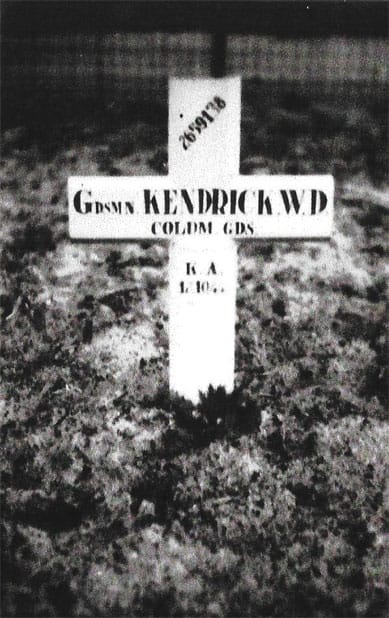
William Desmond Kendrick was killed in action on 12 October, 1944. He was 22 years of age and was a Guardsman in the 4th Battalion of the Coldstream Guards (Service No. 2659138). He was initially buried at Cemetery Th.J. Janssen, Overloon and later re-interred in Grave III.E.11 in the Overloon War Graves Cemetery on 19 May 1947. The inscription on his grave reads: “Through the years we will not forget; in love and memory you are with us yet.”
Family Background
William Desmond Kendrick was the son of Frederick George Kendrick and Mabel Ellen Ovenden who had married in 1919 in the Gravesend District of Kent.
Frederick George Kendrick was born in 1897 in Chalk, Gravesend, Kent. He was the son of Samuel Kendrick and Sarah Jane Kendrick (nee Collier). Samuel was born in 1871 in Birkenhead in Cheshire. Sarah was born in 1873 in Erith, Kent. They had children as follows: Samuel Edward 1892, Annie 1894, Alice 1895, Frederick George 1897, Robert 1899, Albert William 1903, Sarah 1905, Thomas Charles 1907. Their children were born in the Gravesend area, though Chalk was given as the birthplace for Samuel, Frederick and Robert in 1901.
In 1901 Samuel and Sarah were living at 100, Nelson Road, Northfleet, Strood, Kent with their first four children. Samuel was working as a Boiler Maker. In 1911 they were living at 7 Seymour Road, Perry Street, Northfleet with their five youngest children. Samuel was still a Boiler Maker. Frederick was working as a green grocer’s errand boy.
Mabel Ellen Ovenden was born in 1903 in Northfleet, Kent. She was the daughter of William Ovenden and Lizzie Ovenden (nee King). William was born in 1871 in Gravesend and Lizzie was born in 1874 in Northfleet. They seem to have had children as follows: William George1894, Alfred Cornelius 1895, Lizzie 1899, Mabel Ellen 1903. All were born in Strood District except Lizzie who was born in Dartford District. Sadly, William George died in 1895 aged 2.
In 1901 William and Lizzie were living at 30, Taunton Road, Swanscombe, Dartford, Kent. William was working unloading barges. With them were children Lizzie and Alfred. Also present was Lizzie’s father, William King, born 1823 in Stone, Kent who had no occupation at the time and a boarder, also called William King, born 1871 in Northfleet who was a Coal Miner.
In 1911 William and Lizzie were living at 20 East Terrace, Gravesend. Willliam was now a Coal Porter. All their children except Lizzie were present. There too was a 1 year old nephew, William Richard Pullen, born in London. William was working as a Potman. Alfred, aged 16 was out of work with the comment “never did any”.
Following their marriage in 1919, Frederick and Mabel Kendrick had children as follows: Frederick C L 1920, William D 1922, Moireen M 1924 and Eila D 1930. The first three children were born in the Gravesend District and the last child in the Strood District of Kent.
In 1921, Frederick and Mabel were living in the household of Mabel’s parents, William and Lizzie Ovenden, at 2, Hilda Cott, Churchill Road, Gravesend. Present too were Frederick and Mabel’s first child and Mabel’s brother, Alfred C Ovenden. Frederick was working as a Boiler’s Fire Man on a Ferry Boat for the Midland Railway Co. Mabel’s father was working as a Boiler Fireman at the Imperial Paper Mills. Her brother, Alfred, was described as a Disabled Soldier Since Demobilisation. He had no occupation.
By September 1939, Frederick and Mabel were in their own house at 33 Park Avenue, Northfleet, Kent. With them were two unnamed children, probably their youngest two. Frederick was working as a Stoker.
William Desmond Kendrick married Elsie M Palmer in 1942 in the Dartford District of Kent.
Elsie was the daughter of Arthur G Palmer and Elsie M Palmer. Arthur (Snr) was born on 13/3/1900 while Elsie (Snr) was born on 16/10/1901. In September 1939, Elsie was living at 76 Milton Road, Swanscombe, Kent. Her father was working as a Paper Loader at a Paper Mill. There too was her brother Arthur T Palmer, born 10/5/1927. Elsie (Jnr) was working as a Paper Sorter at a Paper Mill.
William and Elsie had two children, both born in Dartford: Pamela A 1943 and Margaret B 1944.
Military Career
William Desmond Kendrick had enlisted in the Coldstream Guards in April 1939.
Following the outbreak of the Second World War, the 1st and 2nd Battalions of the Coldstream Guards were deployed to France with the British Expeditionary Force. They were evacuated from Dunkirk the following year. The 4th Battalion was formed in October 1940 at Elstree and the 5th Battalion in October 1941. In 1941, the 1st Battalion was converted to an armoured role and served with the Guards Armoured Division. In November 1942 the 4th Battalion switched from cars to Churchill tanks. While the 5th and 1st Battalions had entered France in June 1944, shortly after D-Day, the 4th Battalion remained at home until 20 July 1944 when they landed at Juno Beach. In France, they played their part in the battle at Caumont and assisted in the attacks at Vire and Tinchebray. From 15 August until 29 September the 4th Battalion had a relatively quiet time while the 1st and 5th Battalions proceeded through Belgium and the Netherlands to take part in Operation Market Garden. It was only after the failure of that operation to take Arnhem in late September that the 4thDivision was brought more fully into the conflict.
On 29 September they reached Eindhoven and headed towards Nijmegen the following day, crossing the River Maas and arriving in the forests at Mook that night. The initial plan had been for them to support the 8th and 185th Brigades of the 3rd Division in an attack on the Reichswald forest area to the east. However, this was cancelled on 7 October as higher priorities were given to securing the port of Antwerp and in widening the salient along the River Maas by turning south to capture Overloon and Venray. It was with this latter task that the 4th Battalion was to assist the 3rd Division. The country was flooded and heavily wooded making reconnaissance difficult. There was incessant rain and impassable roads. The attack was initially scheduled for 11 October but rain flooded the whole district, so it was delayed until 12 October to allow the ground to dry out to some extent.
The operation began with a heavy artillery barrage at midday on 12 October, after the battalion had spent a drenching night in the woods 2 miles north of Overloon. The Coldstream with 8 brigade were to take Overloon, 1 Sqn. supporting the 1st Suffolks and 3 Sqn. helping the East Yorks., and the Grenadiers with 9th Brigade were to pass through to attack Venray 3 miles further South. The battalion were to be supported by A.V.R.E.s (Armoured Vehicles Royal Engineers – which were Churchill tanks modified in various ways to suit the needs of Assault Engineers) and flails. The Royal Engineers had worked hard to prepare approaches for the tanks through the bogs, dikes and copses which barred their path. At first the advance went briskly until mine-fields were encountered. Here 2 HQ tanks of 4 Tank Coldstream Guards were put out of action, thus destroying two sources of information within a few minutes of each other. There was little first-hand news for some two hours and it was then learned that 2 more tanks had been put out of action by a Panther tank, several of which were previously reported in Overloon. This was the day that William Desmond Kendrick was killed.
Aftermath
Following his death, Guardsman Cyril Arnold Osborne of No. 1 Sqn, 4th Bn Coldstream Guards (No. 2661115) who was known as Arnold wrote the following to William Kendrick’s wife on Thursday, 2 November:
“Dear Mrs Kendrick,
I thought perhaps you like to know, & learn how your husband met his most unfortunate and untimely death.
I have known ‘Ken’ (the nick name he was known by all us lads) ever since the battalion was formed away back in Elstree. He was liked by all & we feel his loss deeply. He was a very likeable fellow, & did his own particular job of work on the tank with confidence & ease, which gained the respect of the crew and troop. We have had some grand times together & I personally have spent some very interesting evenings with ‘Ken’.
I happened to be Ken’s co-driver in the tank on the day he met his death. It was like this – our Squadron went into action on Thursday October 12th. Our tank was in the lead, when a ‘Gerry’ shell hit the tank & set it on fire. I saw ‘Ken’ get out of the tank unhurt & run to safety in a trench some hundred yards or so distance from the tank.
I was the last one to leave the tank, & ‘Ken’ was then apparently safe, under cover. I lay in a ditch some fifty yards in front of Ken. After laying in this position for some considerable time Ken got up to run towards his own unit’s lines. However he had not covered many yards before he was machined gunned. He died straight away. There is one consolation he died a painless death.
It was some time later ere I dare attempt to make for my own unit’s lines & so to safety. I succeeded after many breath taking moments in reaching the squadron & so to safety. But all the glow of excitement of getting back alive, was over shadowed by Ken’s death.
A few days later I went to have a look at the tank, later wended my way down the road to garden & saw Ken’s grave. He had a decent burial, the grave was marked out with white tape. There was a cross at one end, with Ken’s name & Army number upon it and the day he was buried, which happened to be Friday October 13th. At the other end of the grave local country folk had put a vase & filled it with flowers.
I cannot tell you in this letter where the grave is, for Military security. But if I have the good luck to come back to England, I can tell you this.
All the boys out here, including Bernard Butlin (I believe you know him, he was Ken’s own particular pal) & myself express our deepest sympathy, in your sad bereavement in the loss of ‘Ken’ your husband to you & your family.
I am not very good at writing letters of this type, but if this letter has helped you in any way I shall inwardly feel that my last act for Ken has not been in vain.
All the very best,
Arnold
P.S.
If there is anything I can do for you in relation to Ken’s personal kit etc. I will do my best to find out the things you want to know.”
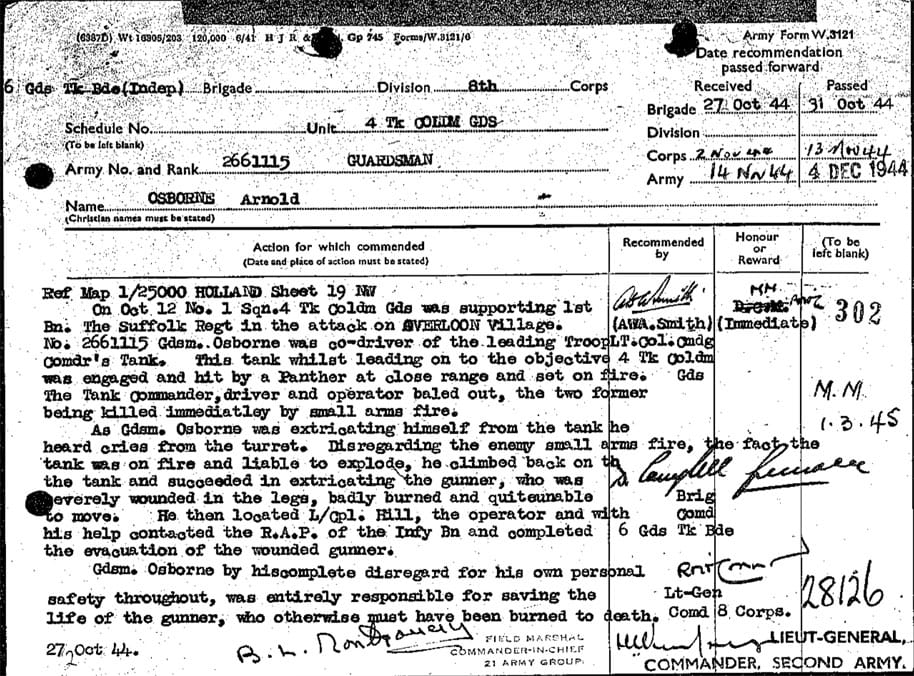
Arnold Osborne was being rather modest about his own part in this incident. The Lt. Col commanding the 4 Coldstream Guards, together with the Brigadier commanding the 6 Guards Tank Brigade and the Lt. Gen. commanding 8 Corps recommended Guardsman Arnold Osborne for the Military Medal. The recommendation stated that:
“On Oct 12 No. 1 Sqn. 4 Tk Coldm Gds was supporting 1st Bn Suffolk regt. in the attack on Overloon Village.
No. 2661115 Gdsm. Osborne was co-driver of the leading Troop Comdr’s Tank. This tank whilst leading on to the objective was engaged and hit by a Panther at close range and set on fire. The Tank Commander, driver and operator baled out, the two former being killed immediately by small arms fire.
As Gdsm. Osborne was extricating himself from the tank he heard cries from the turret. Disregarding the enemy small arms fire, the fact the tank was on fire and liable to explode, he climbed back on the tank and succeeded in extricating the gunner, who was severely wounded in the legs, badly burned and quite unable to move. He then located L/Cpl. Hill, the operator and with his help contacted the R.A.P. of the Infy Bn and completed the evacuation of the wounded gunner.
Gdsm. Osborne by his complete disregard for his own personal safety throughout, was entirely responsible for saving the life of the gunner, who otherwise must have burned to death.”
Cyril Arnold Osborne was awarded the Military Medal on 1 March 1945. He suffered a shot wound to his face just a few weeks later on 30/3/1945 but survived the war and was discharged on 22/4/1946. He had been born on 14/8/1913 and so was 9 years older than William Kendrick.
From the details in Osborne’s recommendation and letter, it is though that the Tank Commander was Lt Longueville who is also buried at Overloon.
Mrs Kendrick also received a letter dated 6 November 1944 from the Rev. A. P Tremlett of the 4 Coldstream Guards. He said the following:
“Dear Mrs Kendrick,
By now you will have heard the sad news of your husband’s death in action & I write to you on behalf of the whole Battalion to tell you how sorry we are & how much we sympathise with you in your great loss. It is a terrible tragedy – he fought magnificently – & though words are always inadequate on these occasions, we did want you to know how sorry we are & how much we sympathise with you.”
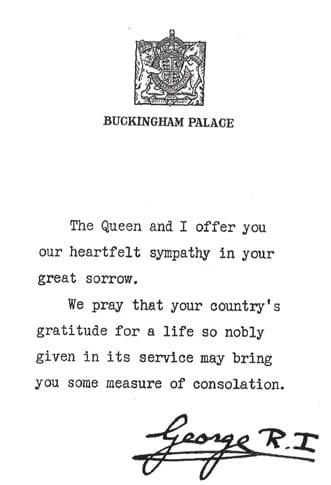
She also received a telegram from the King and Queen.