Longueville | Reginald Francis


Biography
Lt. Reginald Francis Longueville of the Coldstream Guards (Service Number 229117) was killed in action on 12 October 1944. He was initially buried at the Cemetery Th.J. Janssen and subsequently re-interred on 19 May 1947 in grave III. E. 8 at the Commonwealth War Graves Cemetery in Overloon.
Family history
He was the son of Lt. Col. Francis Longueville, D.S.O., M.C., and Gertrude Beatrice Longueville of Forthampton, Gloucestershire. The Longueville family had long connections with the Coldstream Guards.
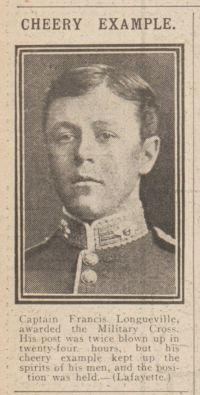
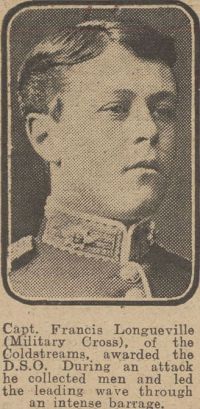
His father, Lt. Col. Francis Longueville, was the son of Thomas and Mary F. Longueville. He was born on 23 December 1892. In 1901 he was living with his parents at Llanforda Hall, Oswestry, Shropshire. He was educated at the Oratory School at Edgbaston in Birmingham. This is a prestigious school which was founded in 1859 by Saint John Henry Newman with the aim of giving boys an education which would fit them for universities and public life, but in a sound Catholic context.
He joined the Coldstream Guards in 1912 and served in WW1. He was promoted from 2nd Lieutenant to Lieutenant in November 1914, then to Captain on 23 February 1916. In July 1916 he was awarded the Military Cross. His post was twice blown up in twenty-four hours, but his cheery example kept up the spirits of his men, and the position was held. He was promoted to acting Major in October the same year, then in November he was awarded the D.S.O. During an attack he collected men and led the leading wave through an intense barrage. From October 1917 to 1919 he was acting as Lieutenant Colonel with the 3rd Battalion. He remained with the Coldstream Guards after the war, presumably returning to the rank of Captain. In April 1926 he achieved the rank of Major. He was regimental Adjutant and O.C. the Guards Depot at Caterham. In September 1934 he was promoted to Lieutenant Colonel in command of the 1st Battalion. He retired on 12 December 1936, though it is understood that he became involved again in WW2 with a role in London in June 1942. He ceased to belong to the Regular Army Reserve of Officers on 15 September 1944 due to ill health.
Reginald’s mother, Gertrude Beatrice Venables, was born on 18/9/1889 in the village of Richard’s Castle, near Ludlow in Shropshire. She was the daughter of Rowland George and Gertrude Venables. Her father was a Barrister. By 1901 they were living at Oakhurst, Selattyn, Oswestry, Shropshire.
Lt. Col. Francis Longueville married Gertrude Venables in 1920 in the Oswestry district of Shropshire. The wedding was reported as follows in the Birmingham Gazette of 7th April 1920:
“Oswestry Wedding – Two Old Shropshire Families United
Two Shropshire County families were united by marriage at Oswestry Roman Catholic Church yesterday. Captain Francis Longueville D.S.O, M.C., Coldstream Guards, son of Mr Thomas Longueville of Lanforda Hall, Oswestry was married to Miss Gertrude Venables, daughter of the late Mr Rowland Venables and Mrs Venables, of Oakhurst, Oswestry. Father Rooney officiated. Captain H.C. Lloyd D.S.O. M.C., Coldstream Guards, was the groomsman. Coldstreamers formed a guard of honour. The bride was given away by her brother Commander Venables R.N. She was charmingly gowned in cream charmeuse. Her only maid was little Miss Diana Campbell, daughter of Brigadier- General John Campbell V.C. Master Thomas Longueville, son of Colonel Longueville, was page. The organist played Elgar’s music and the Bridal March from Lohengrin.”
They went on to have children as follows: Anne Gertrude (26 June 1921), twins Reginald Francis and Olive Mary (17 Nov 1922) and Peter (16 September 1925).
The family residence at the time of the 1939 Register was Southfield House, Forthampton, Gloucestershire but only Anne and Olive were at home with two servants. Anne was shown as working with the Auxiliary Fire Service in Tewksbury. Their parents were away visiting friends at the time. Reginald and his brother Peter were at school at Ampleforth College in North Yorkshire. Both were shown as evacuees. Ampleforth College is a well known Roman Catholic boarding school founded by the Benedictine monks at Ampleforth Abbey.
Military Career
Reginald Francis Longueville matriculated for Christ Church College, Cambridge in 1942.
On 20 March 1942 he was made a 2nd Lieutenant in the Coldstream Guards and then Lieutenant on 1 October the same year. From July 1942 he was in the 1st Battalion then transferred to the 4th Battalion from 14 September 1943.
Following the outbreak of the Second World War, the 1st and 2nd Battalions of the Coldstream Guards were deployed to France with the British Expeditionary Force. They were evacuated from Dunkirk the following year. The 4th Battalion was formed in October 1940 and the 5th Battalion in October 1941. In 1941, the 1st Battalion was converted to an armoured role and served with the Guards Armoured Division. In November 1942 the 4th Battalion switched from cars to Churchill tanks. While the 5th and 1st Battalions had entered France in June 1944, shortly after D-Day, the 4th Battalion remained at home until 20 July 1944 when they landed at Juno Beach. In France, they played their part in the battle at Caumont and assisted in the attacks at Vire and Tinchebray. From 15 August until 29 September the 4th Battalion had a relatively quiet time while the 1st and 5th Battalions proceeded through Belgium and the Netherlands to take part in Operation Market Garden. It was only after the failure of that operation to take Arnhem in late September that the 4th Division was brought more fully into the conflict.
On 29 September they reached Eindhoven and headed towards Nijmegen the following day, crossing the River Maas and arriving in the forests at Mook that night. The initial plan had been for them to support the 8th and 185th Brigades of the 3rd Division in an attack on the Reichswald forest area to the east. However, this was cancelled on 7 October as higher priorities were given to securing the port of Antwerp and in widening the salient along the River Maas by turning south to capture Overloon and Venraij. It was with this latter task that the 4th Battalion was to assist the 3rd Division. The country was flooded and heavily wooded making reconnaissance difficult. There was incessant rain and impassable roads. The attack was initially scheduled for 11 October but rain flooded the whole district, so it was delayed until 12 October to allow the ground to dry out to some extent.
The operation began with a heavy artillery barrage at midday on 12 October, after the battalion had spent a drenching night in the woods 2 miles north of Overloon. The Coldstream with 8 brigade were to take Overloon, 1 Squ. supporting the 1st Suffolks and 3 Sqn. helping the East Yorks., and the Grenadiers with 9th Brigade were to pass through to attack Venray 3 miles further South. The battalion were to be supported by A.V.R.E.s (Armoured Vehicles Royal Engineers – which were Churchill tanks modified in various ways to suit the needs of Assault Engineers) and flails. The Royal Engineers had worked hard to prepare approaches for the tanks through the bogs, dikes and copses which barred their path. At first the advance went briskly. 1 Sqn. went in on the right and 3 Sqn. on the left of the attack. Battalion Headquarters, advancing in the centre, found that the infantry had divided on either side of the village and that it was entering Overloon alone. Nonetheless, headquarters troop advanced only to encounter a minefield. The rear link and the spare rear link tanks both came to grief and the Adjutant was wounded. Now the two forward squadrons also met minefields, and both enemy tanks and anti tank guns were brought to bear upon them. 1 Sqn. lost two tanks to a Panther and Lt. Reginald Francis Longueville, forced out of his own tank by a direct hit, was killed by small arms fire as he tried to board another. Yet both squadrons pressed on. The Royal Engineers cleared the minefields under heavy mortar fire, and by 5pm, the village had fallen.
During his time with the Coldstream Guards, Lt. Longueville was mentioned in despatches, indicating a gallant or meritorious action that he had taken in the face of the enemy.
His old school printed the following obituary in The Ampleforth Journal of January 1945:
“Reggie Longville arrived at Ampleforth as a small boy in September 1934 and joined St Cuthbert’s House. From the first moment, he took to school life like a duck to water, showing little of that shy diffidence or shrinking at the unknown which so often makes a boy’s first term at school something of a trial. From the earliest days, he possessed a supremely cheerful and gay outlook on life, an attitude which distinguished him throughout his short life. Nothing perturbed him or upset his complete love of life and living. To this cheerful outlook were added a natural ease of manner and a power always of adapting himself to his company, qualities which made him so generally popular and so agreeable a companion.
His interest in his work may have been somewhat perfunctory, but during his last year at school he showed powers of concentration and effort which surprised those who thought they knew him. His philosophy of taking things as they came and of letting events work themselves out was not one that nourishes athletic ambition, but his strong and powerful physique found a natural outlet as a very useful Rugger forward of the solid rooting type. He played in the 1st XV and of course for his house and he was a useful cross-country runner.
Beneath the appearance of casual indifference there lay, however, a firmness of purpose and the power to meet and deal with a crisis which manifested itself very clearly in his after-school life. Nor was there anything casual or perfunctory in his religious life, which was always a very real and living thing and meant very much to him.
Reggie was essentially a boy of the countryside, loving everything in it, never happier than when taking part in country sports, hunting, shooting or fishing, in all of which he showed considerable progress. On leaving school in 1940, he went to Sandhurst and then into the Coldstream Guards, his father’s regiment, where, just as at school, he was universally popular among his fellow officers and his men were devoted to him. He went through the summer campaign of 1944 in France and met his end in Belgium. His Battalion Commander wrote of him: ‘From the very first day his troop has been one of the leading ones of the squadron and much of its success was due to his great dash and bravery. He set a superb example in action to everyone. The battalion and the regiment have lost an officer of whom they may well be proud and whose example will be long remembered’. The following extract from a letter from his Squadron Commander shows how he died: ‘His troop was in the lead in this last attack which Reggie himself was leading. I could see him working ahead on the right of the infantry, shooting away like mad with all his guns and passing back his information in his usual cheerful way on the wireless and then it happened. His tank was hit fair and square by a Panther and promptly caught fire. Reggie and the driver both got out unscathed and were seen doubling back for cover, but both were killed outright by snipers’.
To his parents and his brother and sister, we extend the deepest sympathy of all at Ampleforth.”
The driver who died was William Desmond Kendrick who is also buried at Overloon in grave III.E.11. Guardsman Cyril Arnold Osborne was the co-driver of the tank. He and L/Cpl Hill, the Operator, managed to escape. Arnold Osborne climbed back on the tank and succeeded in rescuing the Gunner who was severely wounded and so saved his life. For this he received the Military Medal. Arnold Osborne wrote a letter to William Kendrick’s wife on Thursday, 2 November describing how her husband died. This can be read in William Desmond Kendrick’s biography.
The Tewkesbury Register and Agricultural Gazette of 4 November 1944 reported his death as follows:
“Lieut. R. Longueville – Killed in action
News has been received, officially, in Forthampton, that lieutenant Reginald Longueville, Coldstream Guards, has been killed in action in the recent fighting in Holland. Lieut, Longueville was the eldest son of Colonel and Mrs F. Longueville, Southfields, Forthampton.
Previous to entering the Coldstream Guard, he was a popular member of the Forthampton Platoon of the Home Guard. His loss will be keenly felt by everyone in the Forthampton district. He was 21 years of age”.
He is commemorated on the Coldstream Guards Roll of Honour and at St Mary’s Church, Forthampton, Gloucestershire where his parents lived. A wooden panel in the church porch states:
“The Restoration of this church was made as a thanksgiving to Almighty God for the victory of freedom over tyranny, and the preservation of the homes of the parish and to commemorate those who died through the action of the enemy 1939-1945:
Dora Elsie Brierley
Charles Donald Hemming
Reginald Francis Longueville
Edgar Watson
Dorothy Bryant”
It seems he wasn’t the only member of the family to serve in WW2. The Tewkesbury Register and Agricultural Gazette reported on 9 November 1946 that ten guineas from the “Welcome Home Fund” had been allotted to each of twenty one men and women of Forthampton who had served in the war. Among these were Colonel F. Longueville M.C. D.S.O., R. & P. Longueville and Miss O. Longueville. It was noted that “Mr Reginald Longueville gave his life in action, and Mrs Watson, whose husband was killed by the bomb at the Guards’ Chapel, Wellington Barracks, had since died. Her award as well as five guineas each from Colonel, Mr R. and Mr P. and Miss O. Longueville has been returned to be used towards a much needed bus shelter in the village with a memorial plaque”. It seems that his twin sister, Olive, had joined the W.R.N.S. and was promoted to acting 3rd Officer on 25 June 1944.
Reginald’s sisters, Anne and Olive, went on to marry two brothers whose father was Lt. Col. George Windsor Clive. He, too, had served in the Coldstream Guards. Anne married Francis Archer Windsor Clive in 1945 and went on to have five children. Three of their sons attended Ampleforth College, two of whom, Edward and Other, became Majors in the Coldstream Guards. Anne died on 12 October 2004. Olive married Brigadier Robert C Windsor Clive (also of the Coldstream Guards) in 1949 and went on to have two children, one of whom, George, attended Eton and gained the rank of Lieutenant in the Coldstream Guards and Major in the Royal Yeomanry. Olive died on 28 March 2009. Reginald’s brother, Peter, lived at Ayton Castle, Eyemouth, Berwickshire, Scotland. He died on 17 December 1988.
Reginald’s father, Lt. Col. Francis Longueville, died on 25 June 1969 and his mother, Gertrude Beatrice Longueville, on 15 April 1976. Both were living at Inwood Farm, All Stretton, Church Stretton, Shropshire at the time.
A member of the family is still serving with the Coldstream Guards today.