Sheen | Frank


Biography
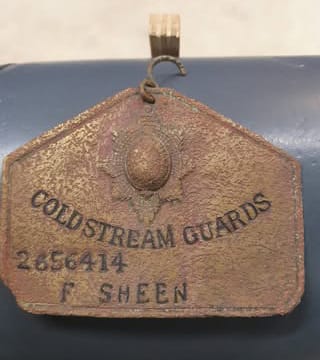
Frank Sheen was killed in action on 14 October 1944 near Overloon. He was 28 years old at the time. He was a Lance Corporal in the 4th Battalion of the Coldstream Guards (Service No. 2656414). He was initially buried just north of the Molenbeek between Overloon and Venray and was reburied on 28 May 1947 in grave IV. C. 5. at the CWGC Overloon Cemetery. The inscription on his grave reads: “Memories linger deeply in a heart that will never forget. His loving wife”.
Family background
Frank was born on 5 August 1915 to Jack and Ada (Alice) Sheen (born Lyon) in the town of Winsford, in the county of Cheshire, England.
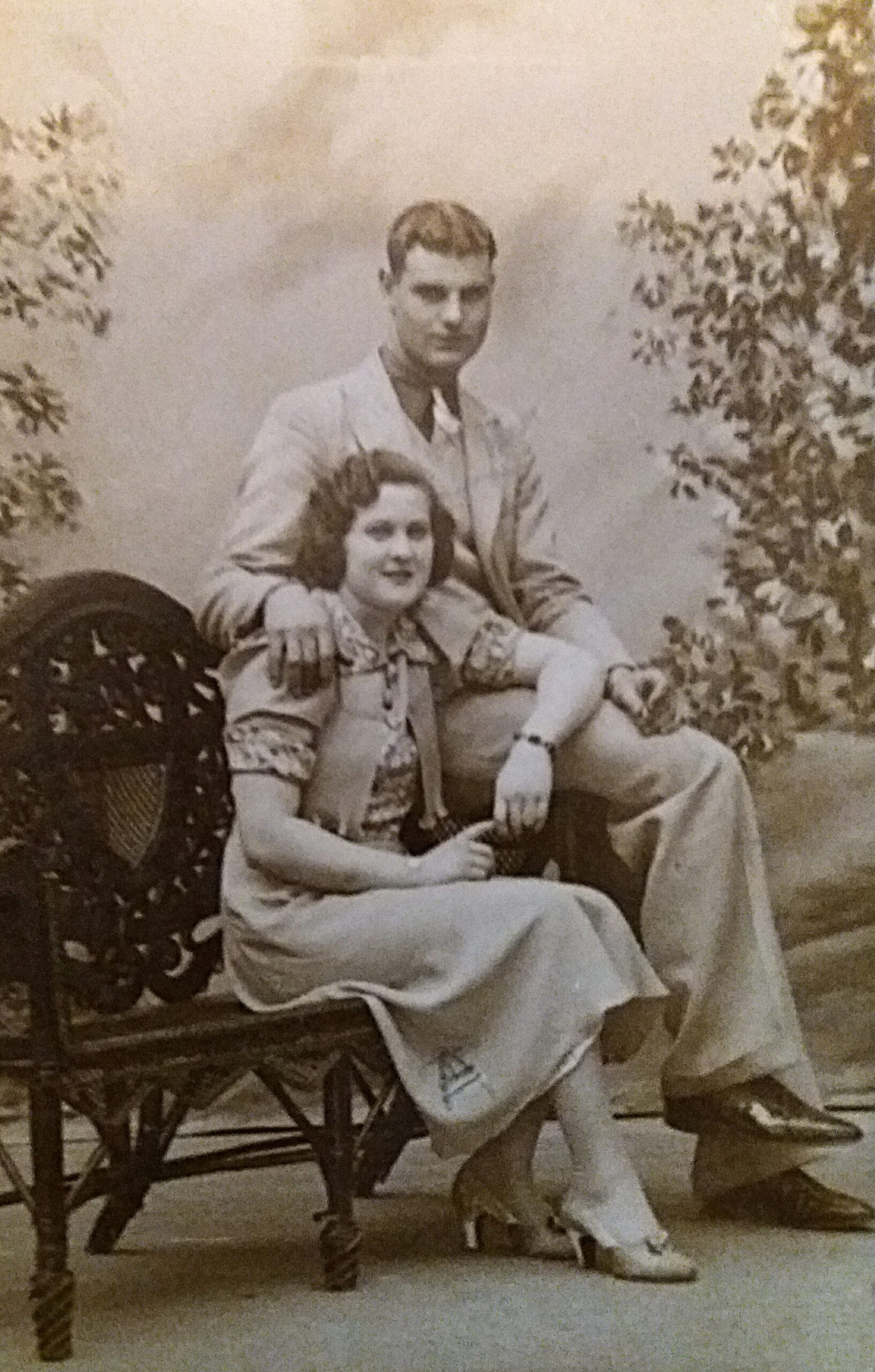
He married Gladys Elsie Moores on 23rd November 1939 in the Liverpool District of Knotty Ash. They had two children – David, born December 1940 and Margaret, born April 1942.
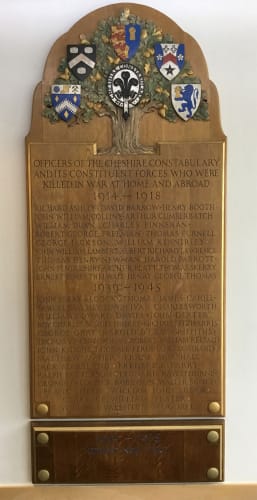
He worked as a police officer with the Cheshire Police until he was called up in London in 1939.
Military career
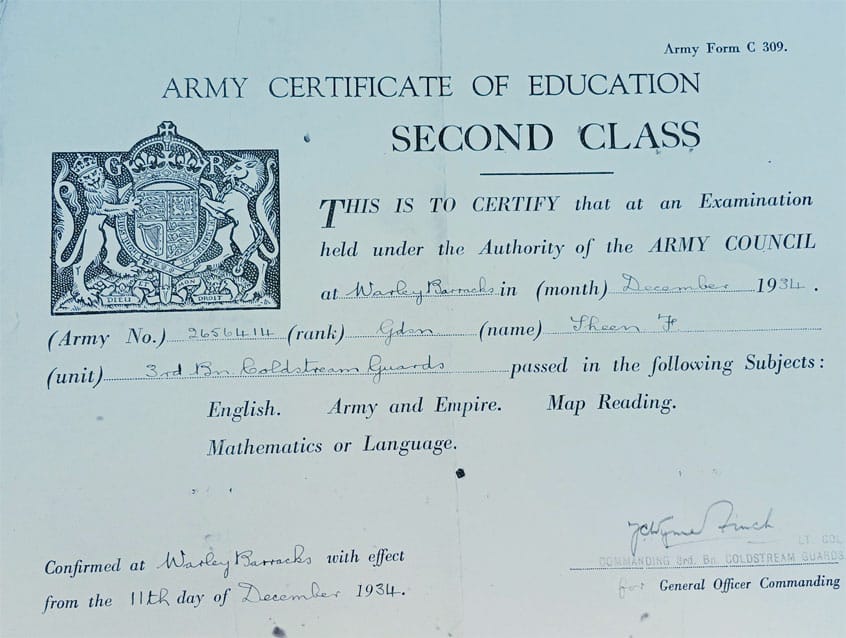
Frank enlisted in the Regular Army in Chester on 5 April 1934. He was posted to the 3rd Battalion, Coldstream Guards, and commenced various training programmes. On 4 July 1934, he obtained a 3rd Class Certificate in Caterham, where he underwent basic training for the Guards. Subsequently, he participated in training for transport duties and stable management at Warley Barracks in Brentwood from 29 October to 7 December 1934, where he was awarded a 2nd Class Certificate on 11 December 1934. The certificate shows that he has passed: English, Army and Empire, Map Reading and Mathematics. In the following years, intensive training continued alongside several battalion reorganisations.
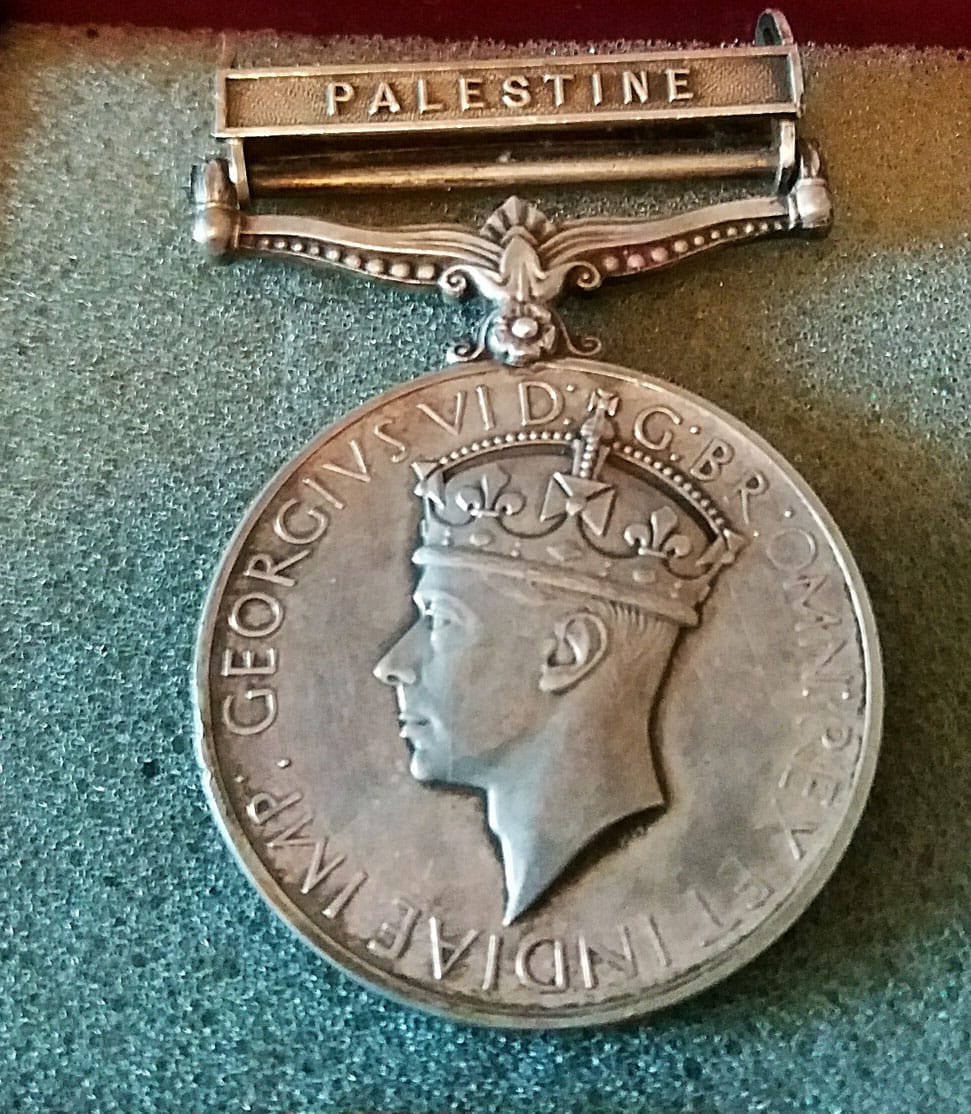
In the summer of 1936, the 3rd Battalion, stationed in Aldershot, was ordered to convert into a machine-gun battalion and began training and reorganising for this new role. However, the reorganisation did not ultimately take place; in late September 1936, orders arrived for a rapid embarkation to Palestine, where an Arab revolt had reached threatening proportions. Frank was among the soldiers deployed on this mission.
Palestine
The battalion, under the command of Lieutenant-Colonel J.A.C. Whitaker, embarked from Southampton on the S.S. Laurentic and landed in Haifa on 1 October. From there, they travelled by train to Jerusalem. During the journey, hostilities had been suspended pending the arrival of the ‘Peel Commission’. This commission landed in Palestine approximately six weeks after the battalion and traversed the country to provide recommendations for resolving the issue of Jewish immigration. Lord William Peel was a prominent British politician, a member of both the House of Commons and the House of Lords, but was most notably known as the chairman of this commission. In 1937, the commission became the first to recommend the partition of Palestine into a Jewish and an Arab state. The battalion’s journey through the Holy Land largely became a sightseeing expedition, and after three months in the country, they returned to Aldershot, arriving on New Year’s Eve.
Training for the war
Frank remained with the Coldstream Guards until 4 April 1938, after which he was transferred to the Reserves as a guardsman pending mobilisation. He was assessed as an intelligent, reliable man who had also performed well as a waiter in the Officers’ Mess and was deemed suitable for a position of trust. Following his discharge, he worked as a police officer with the Cheshire Constabulary until he was mobilised in London in 1939.
In the two years preceding the outbreak of the Second World War, many organisational changes occurred. Several medium machine-gun battalions were established, and by 1939, the Regular Army was fully mechanised. In July and August 1939, officers and men of the Reserve were called up for three weeks of training with the 1st and 2nd Battalions. A number of potential officers were posted to the 2nd Battalion during this period. The Regimental Lieutenant-Colonel interviewed a large number of young men with a view to building up an emergency reserve of officers.
4th Bn Coldstream Guards
In October 1940, the 4th Battalion was formed in Elstree from personnel of the ‘Holding Battalion’, under the command of Lt-Col N.W. Gwatkin, M.V.O. In terms of manpower, the battalion met the ‘Higher Establishment’ (full strength), but it contained only a handful of officers and NCOs and possessed no equipment other than rifles and five impressed vehicles. Approximately 100 guardsmen had to be promoted immediately. As they had been selected from the ranks by experienced company commanders and underwent intensive training for section leaders, most of them fulfilled their new roles admirably. It is likely that Frank was posted to this new battalion at that time.
Upon its formation, the battalion—together with the 4th Battalion Grenadier Guards and the 3rd Battalion Scots Guards—formed the 30th Guards Brigade. The Brigade’s role was to defend part of the south-eastern perimeter of London, and the immediate task of the 4th Battalion was the protection of Fighter Command Headquarters in Stanmore and Hendon Aerodrome. By April 1941, the battalion had developed into an efficient infantry unit; following the formation of the Guards Armoured Division in the autumn, the entire Brigade was ‘armoured’, with the 4th Battalion designated as the associated Motor Battalion.
This change of role necessitated a large-scale reorganisation within the battalion, as a significant number of trained drivers and wireless operators were required. It also led to a turnover of NCOs, as efficient infantry platoon NCOs did not always meet the specific requirements of a motorised sub-unit. In October 1941, the battalion moved from Elstree to quarters in Marston Bigot near Frome to begin training for its new role; the rest of the Brigade, by then renamed the 6th Guards Armoured Brigade, was located in the Codford area to learn how to operate tanks.
In November 1942, the structure of armoured divisions was drastically altered, with an infantry brigade replacing one of the armoured brigades. The 6th Guards Armoured Brigade was ordered to join the 15th (Scottish) Division, which was stationed on the Border at the time. This was a ‘mixed’ division consisting of three infantry brigades and one armoured brigade equipped with heavy infantry tanks.
This further change of role had far-reaching consequences: the armoured battalions had to familiarise themselves with the peculiarities of a new tank—the mighty Churchill—and the unfortunate 4th Coldstream Guards had to give up their cars to focus on mastering heavy armour. They were to go from being one of the fastest-moving mechanised units in the army to the slowest.
It was during this final role change that the battalion truly showed its mettle. For months, the unit was fragmented as officers, NCOs, and men attended courses across England; however, the conversion was completed in record time. By the spring of 1943, the unit was ready to move under its own power to Beckenby Moor in Yorkshire to train with the battalions of the 15th (Scottish) Division.
In September 1943, the battalion participated in ‘Blackcock’, its only large-scale exercise as an ‘Army Tank Battalion’. During this exercise, it moved from Leyburn to Rufford Abbey near Nottingham. There, it spent the winter of 1943–44 training in cooperation with infantry battalions of the 51st (Highland) Division, moving from there to Charing in Kent in April 1944. Many rumours circulated that the battalion would be disbanded or broken up as reinforcements for the Guards Armoured Division, but finally, in July, the battalion moved to Southampton and awaited orders to embark for Normandy.
Normandy
On the afternoon of 20 July 1944, the 4th Battalion, along with the rest of the 6th Guards Tank Brigade, landed on Juno Beach. They moved along tracks bulldozed through cornfields to a concentration area in orchards five kilometres east of Bayeux. Just like the men of the 1st Battalion a month earlier, they had ample time to sample the Norman cider and cheese and to visit the battlefields.
On the evening of 28 July, the men of the 6th Guards Tank Brigade hastily packed their gear and left Bayeux for Caumont to take part in Operation Bluecoat. The objective of ‘Bluecoat’ was to capture the ground between the Vire and the Orne. Hill 309, located near Saint-Martin-des-Besaces in Normandy, was a crucial strategic point captured by the 4th Coldstream Guards on 30 July 1944. The hill was renamed “Coldstream Hill” and played a vital role in breaking through the German defensive lines; today, it serves as a site of remembrance.
A memorial now stands on the hill for Brigadier Sir Walter de Stopham Barttelot, commander of the 4th Coldstream Guards. He was killed in action a few weeks later, on 6 August, when his vehicle struck a mine while he was travelling with his driver. He is buried at the Saint-Charles-de-Percy War Cemetery.
In August, the battalion was split up to fight in separate units, assigned to either the 8th, 9th, or 185th Brigade. This was not welcomed by all units, as they had been trained to fight as a single entity and had successfully done so at Caumont. Nevertheless, they continued to fight together regularly throughout August, including at Tinchebray.
As the front moved further away each day, weeks passed before the brigade could make any move towards the front line. Football matches, ENSA shows (Entertainments National Service Association), and swimming parties helped pass the time in Flers. The brigade trained with the 3rd Division and practiced with rafts and bridging equipment for the river crossings anticipated in future operations. Despite regular entertainment such as cinema visits, dances, and concerts, a sense of frustration and impatience gradually grew.
Operation Market Garden was launched in the Netherlands on 17 September. Once the advance ground to a halt, Churchill tanks were again required to assist the infantry in widening the narrow corridor carved through the Netherlands by XXX Corps. On 24 September, the Brigade received word that they were to move to the front; two days later, the transport vehicles arrived, and on the 27th, the battalions departed for the Netherlands.
Holland
On 29 September, they reached Eindhoven, where they were given a triumphal welcome and enjoyed comfortable quarters. On 30 September, they packed hastily and set off for Nijmegen. They spent the night in Sint-Hubert and crossed the Meuse (Maas) via Grave the following day, 1 October, arriving via Nijmegen in the woods of Mook. There, the battalion once again supported the 8th and 185th Brigades of the 3rd Division. Plans were made to attack the long ridges of the Reichswald, situated a few kilometres to the east. The attack was prepared during five days of torrential rain but was suddenly cancelled on 7 October.
The operation for which the battalion was now destined was of a more modest scale. The Allied corridor had to be widened by clearing the left bank of the Meuse. The 3rd Division, supported by the 4th Grenadiers and the 4th Coldstream Guards, was to attack southwards to capture the villages of Overloon and Venray. The men had built dug-outs for themselves, providing reasonably dry and warm shelter.
On 8 October, Frank wrote a letter to his wife Gladys, knowing they were to depart the next day, heading back across the bridge at Grave towards Mill.
Letter from Frank to his wife Gladys
8 October 1944
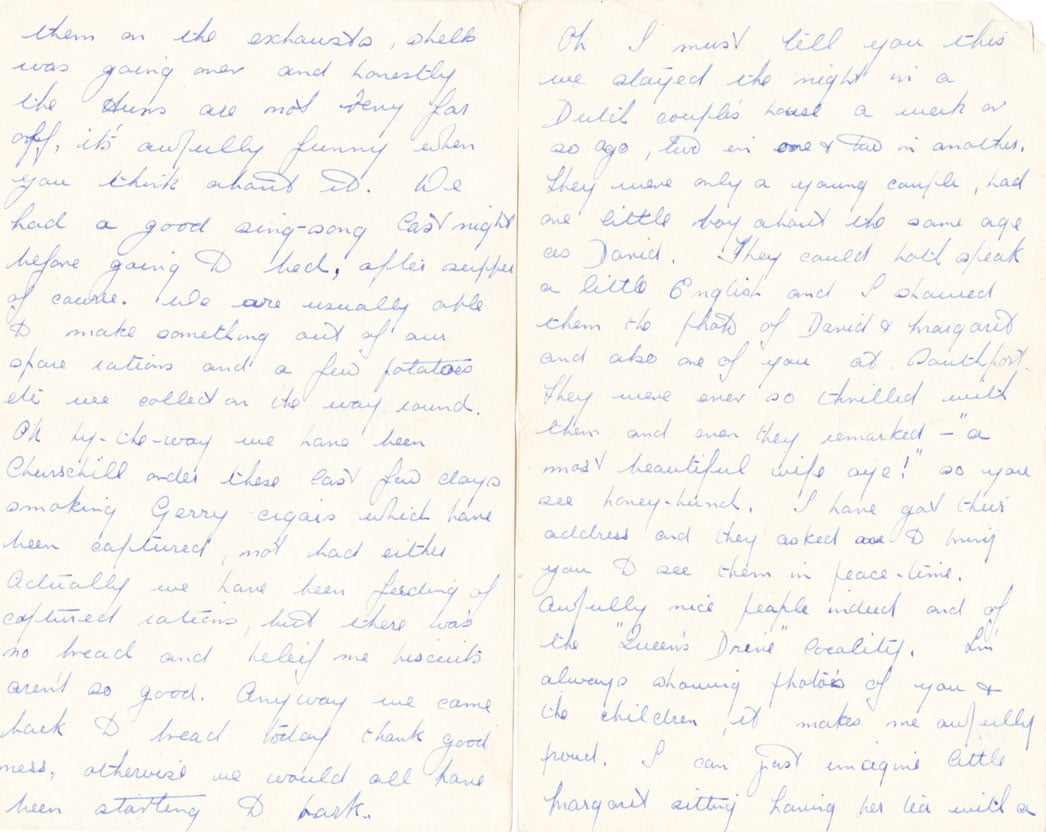
My Dearest Loving Wife, Thanks awfully darling for your two letters they seem to be getting to us much quicker now one 6 days & the other 4 days so that is not bad at all is it. Well my dear things aren’t too bad lately, quite cold at times and a decent bit of activity, but really we can’t grumble it could be much worse really. We haven’t been able to glimpse the Dutch people hardly since we entered Holland, but apparently they all seem overjoyed with the British. At the moment we have got the most gorgeous dug-out. Our crew there is only 4 the commander who is an officer – Troop commander – has his own tent, so we have dug down about a yard and put wood round the sides and put our bivouac over the top. Then we have made a little lean-to affair with another sheet, for our packs and small kit. I have got a small battery and fixed up a little electric light so every-thing is quite cosy. You would be surprised how warm we are sleeping two together. It’s awfully laughable there is shells whistling over both ways. But we don’t take very much notice in fact lots go over and we never hear them. I had to laugh to myself this morning, yesterday I washed my undies and when we started the tank up this morning I dried them on the exhausts, shells was going over and honestly the Huns are not very far off, it’s awfully funny when you think about it.
We had a good sing-song last night before going to bed, after supper of course. We are usually able to make something out of our spare rations and a few potatoes etc we collared on the way round. Oh by-the-way we have been Churchill order these last few days smoking Gerry cigars which have been captured, not bad either. Actually we have been feeding off captured rations, but there was no bread and believe me biscuits aren’t so good. Any way we came back to bread today thank good ness, otherwise we would all have been starting to bark. Oh I must tell you this we stayed the night in a Dutch couple’s house a week or so ago, two in one & two in another. They were only a young couple, had one little boy about the same age as David. They could both speak a little English and I showed them the photo of David & Margaret and also one of you at Southport. They were ever so thrilled with them and even they remarked – “a most beautiful wife aye!” so you see honey-bunch. I have got their address and they asked me to bring you to see them in peace-time. Awfully nice people indeed and of the “Queen’s Drive” locality. I’m always showing photos of you & the children, it makes me awfully proud. I can just imagine little Margaret sitting having her tea with a…
It later turned out to be Frank’s last letter
The Battle of Overloon
On 9 October, they left Mook and set off for Mill, from where they were to launch the attack on Overloon. It was for this final task that the 4th Battalion was called upon to support the 3rd Division. The terrain was waterlogged and densely wooded, which made reconnaissance difficult. Rain fell incessantly, and the roads were virtually impassable. The attack had originally been scheduled for 11 October, but due to the rainfall, the entire district was flooded, leading to a postponement until 12 October to allow the ground to dry somewhat.
The operation commenced at 12:00 hours on 12 October with a heavy artillery barrage, after the battalion had spent a wet night in the woods two kilometres north of Overloon. The Coldstream Guards, together with the 8th Brigade, were tasked with taking Overloon. No. 1 Squadron supported the 1st Suffolks, while No. 3 Squadron assisted the East Yorkshire Regiment. Simultaneously, the Grenadiers with the 9th Brigade were to push through to attack Venray, three kilometres further south.
The battalion was supported by A.V.R.E.s (Armoured Vehicles Royal Engineers)—Churchill tanks adapted for the needs of the Assault Engineers, including mine-clearing devices. The Royal Engineers had worked tirelessly to clear paths for the tanks through the marshes, dykes, and copses. The advance proceeded steadily until minefields were encountered. Here, two HQ tanks of the 4th Coldstream Guards were knocked out, destroying two vital sources of information within minutes of each other. For approximately two hours, little first-hand news was received. It then emerged that two more tanks had been disabled by a German Panther tank, several of which had previously been reported in Overloon. Despite the losses, the village fell by 17:00 hours. However, the enemy held out in a wood on the right flank, necessitating a continuation of the attack the following day. It remained impossible for tanks to approach the wood; three tanks were knocked out during the assault, and a fourth exploded on a minefield while withdrawing.
On 14 October, No. 2 Squadron, alongside the 1st Norfolks, advanced towards the Molenbeek. They met no opposition until they emerged from the woods south of Overloon. Here, they were suddenly engaged by a Panther hidden in the woods they had just vacated. It missed two tanks but knocked out a third—which had already struck a mine—before withdrawing.
As the two leading troops were fully engaged in supporting the infantry, high-velocity shells began whistling over their heads once more. A tank from the rear troop was knocked out before Lieutenant Page-Wood spotted this second Panther. He fired four rounds from his 6-pounder, but they merely deflected off the armour. The Panther retaliated with four shots that went straight through the front of Sergeant Thompson’s tank; miraculously, the crew escaped unhurt.
Another Panther then opened fire on the supporting troop commanded by L/Sgt Gough. Refusing to withdraw and leave his infantry unprotected, he remained stubbornly in the open until his own tank and that of his troop corporal were knocked out—a gallant decision for which he was awarded the Military Medal. An airburst subsequently killed the commander of Lieutenant Page-Wood’s remaining tank.
It was during the fighting on this day that Frank Sheen was killed in action. The exact incident in which he fell remains unknown. Six other Coldstreamers who died that day are also buried in Overloon (Lance-Serjeant Bernard Hillman and Guardsmen G.J. Wright, R.E. Silman, E. Gilbert, J.W. Dalton, and A.T. Churchlow), and at least five others were wounded (Serjeants L.J. Garner and C.F. Higgins, and Guardsmen A. Conn, R.B. Hopkinson, and E.W. Purdy). The six men who died that day were initially buried along the road from Overloon to Venray, south of the woods and about half a kilometre north of the Molenbeek, near where their tanks had been engaged.
On 28 mei 1947 they all were reburied at the CWGC War Cemetery in Overloon.
Aftermath
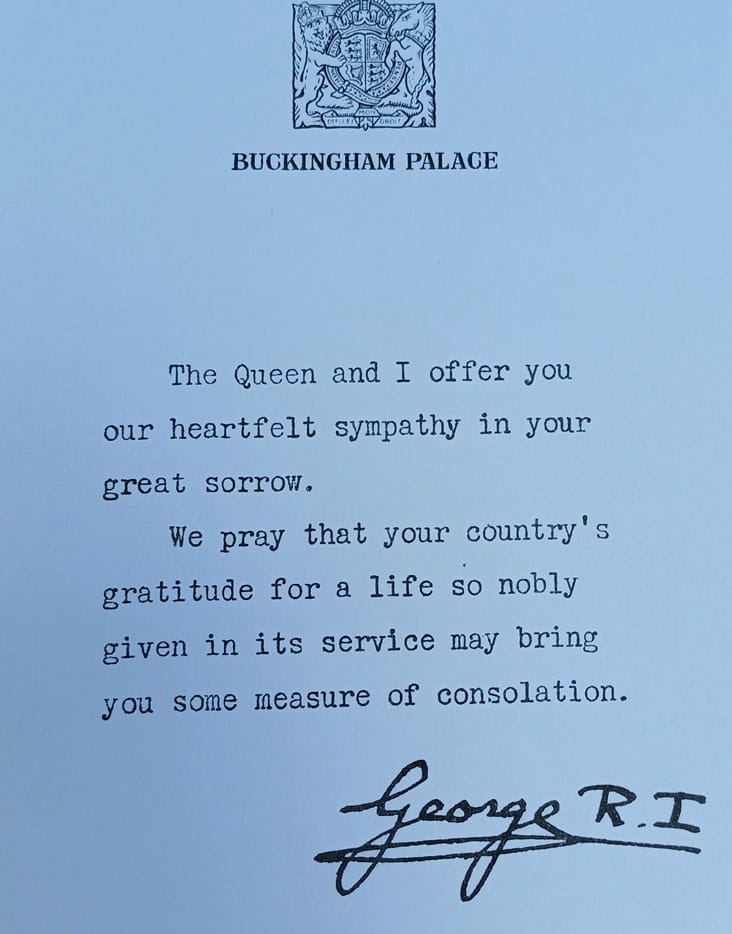
After the war, Gladys received a letter of condolence from the most senior police officer in Cheshire, Chief Constable J. Becke.
Dear Mrs Sheen,
It is with understanding sympathy that I write to condole with you on the death of your husband. I know only too well what a wrench these partings are and what an aching void they leave behind. During the time he was in the Cheshire Constabulary he earned a good reputation for himself and as you can well imagine we thought highly of him. I know no words can help, but sympathy surely does help and you have the sincere sympathy of all members of the Cheshire Constabulary & I hope that that may be some small comfort to you and I can only pray that God may give you strength to bear your irreparable loss. Yours sincerely, J. Becke Chief Constable of Cheshire
In 1948 the grave of Frank was adopted by the Swinkels family from Overloon.
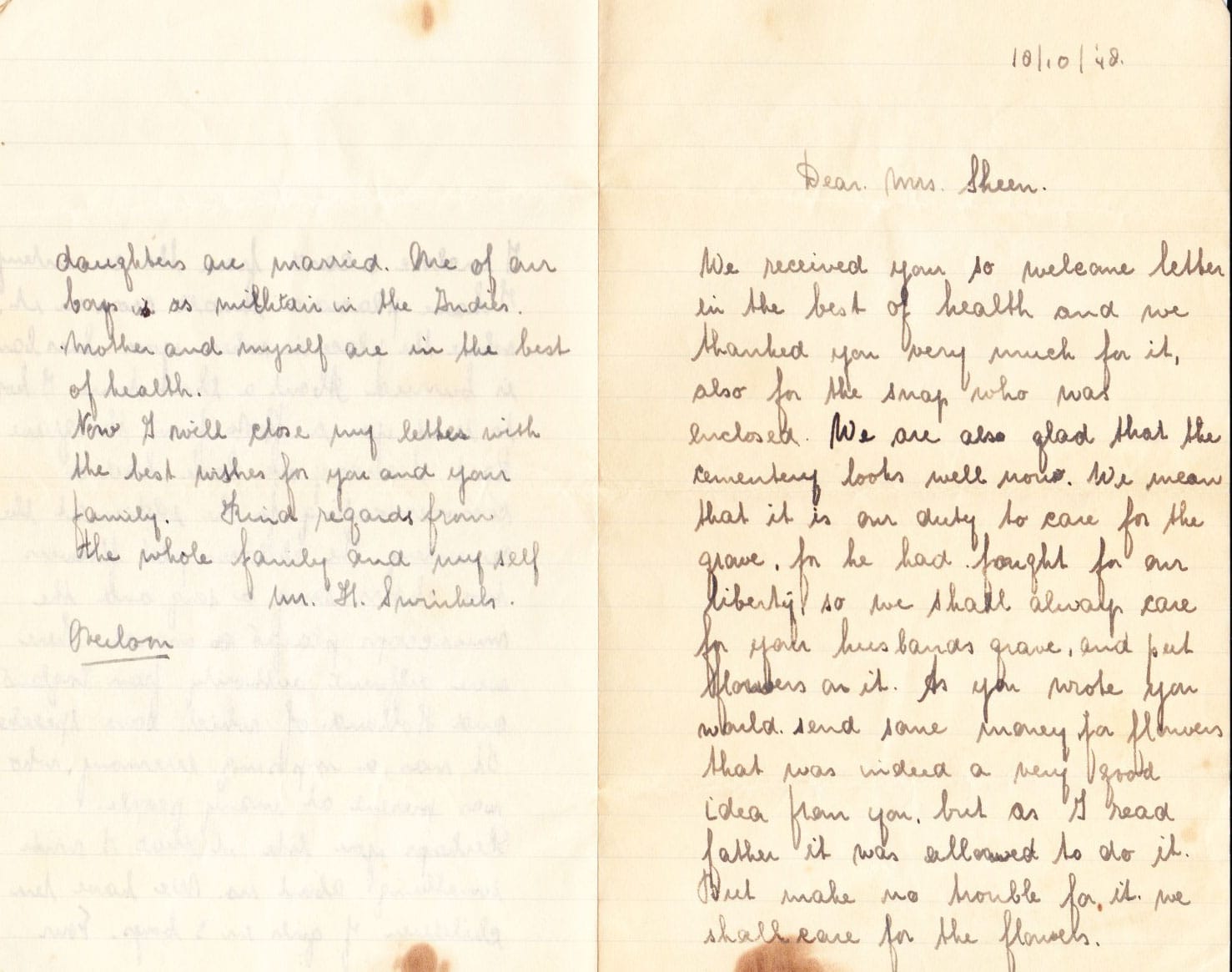
On October 10th 1944 they wrote following letter to Gladys:
Dear Mrs. Sheen.
We received your so welcome letter in the best of health and we thanked you very much for it, also for the snap who was enclosed. We are also glad that the cementery looks well now. We mean that it is our duty to care for the grave, for he had fought for our liberty so we shall always care for your husbands grave, and put flowers on it. As you wrote you would send some money for flowers that was indeed a very good idea from you, but as I read further it was allowed to do it. But make no trouble for it. we shall care for the flowers.
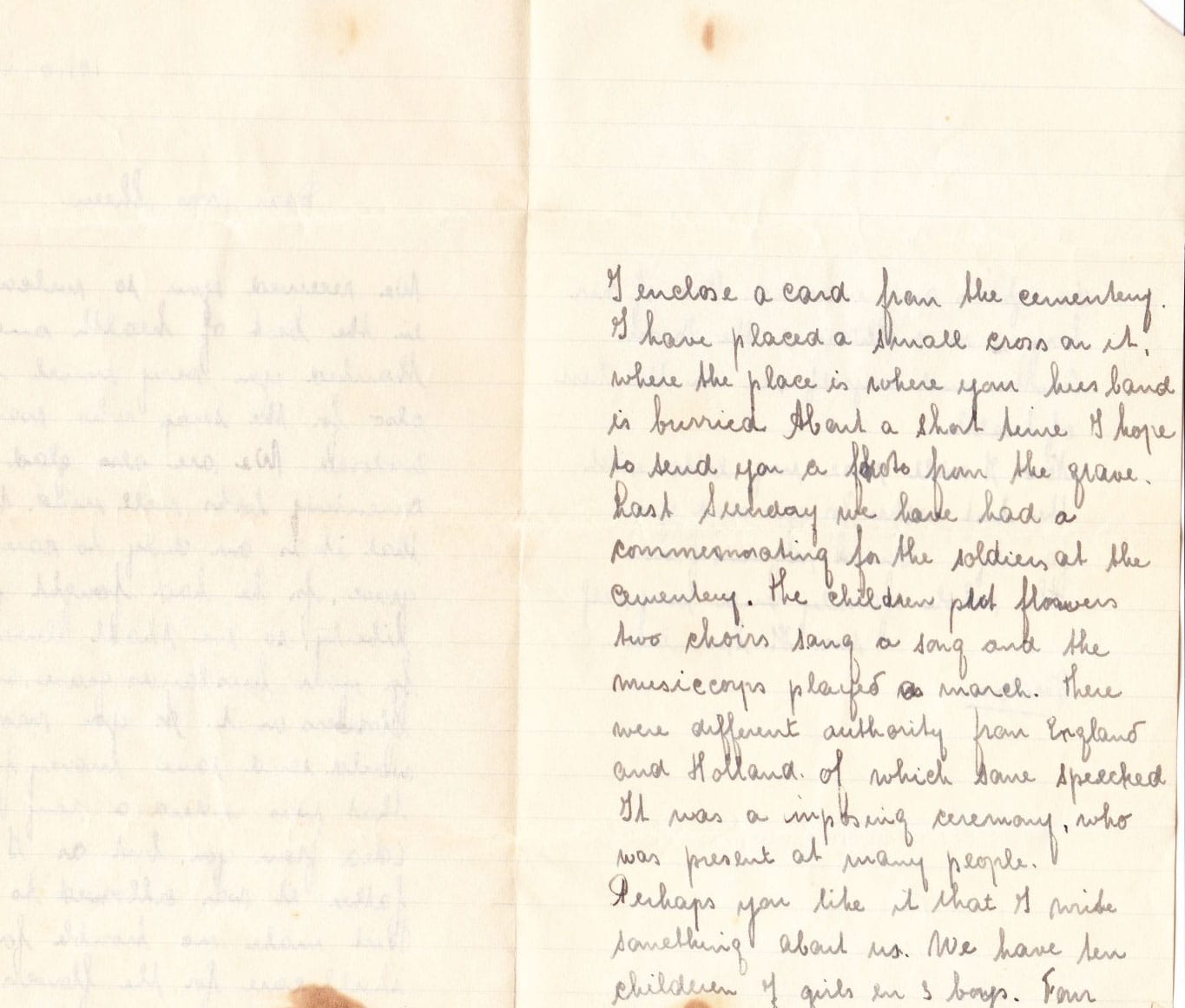
I enclose a card from the cemetery. I have placed a small cross on it, where the place is where your husband is burried. About a short time I hope to send you a photo from the grave. Last Sunday we have had a commemorating for the soldiers at the cemetery. The children put flowers two choirs sang a song and the music corps played a march. there were different authority from England and Holland of which some speeched. It was an imposing ceremony, who was present at many people. Perhaps you like it that I write something about us. We have ten children 7 girls en 3 boys. Four daughters are married. One of our boys is as militair in the Indies. Mother and myself are in the best of health. Now I will close my letter with the best wishes for you and your family. Kind regards from the whole family and my self Mr. H. Swinkels. Overloon
Gladys moved from Liverpool to Ryde on the Isle of Wight in the early 1950s and passed away in 2005.
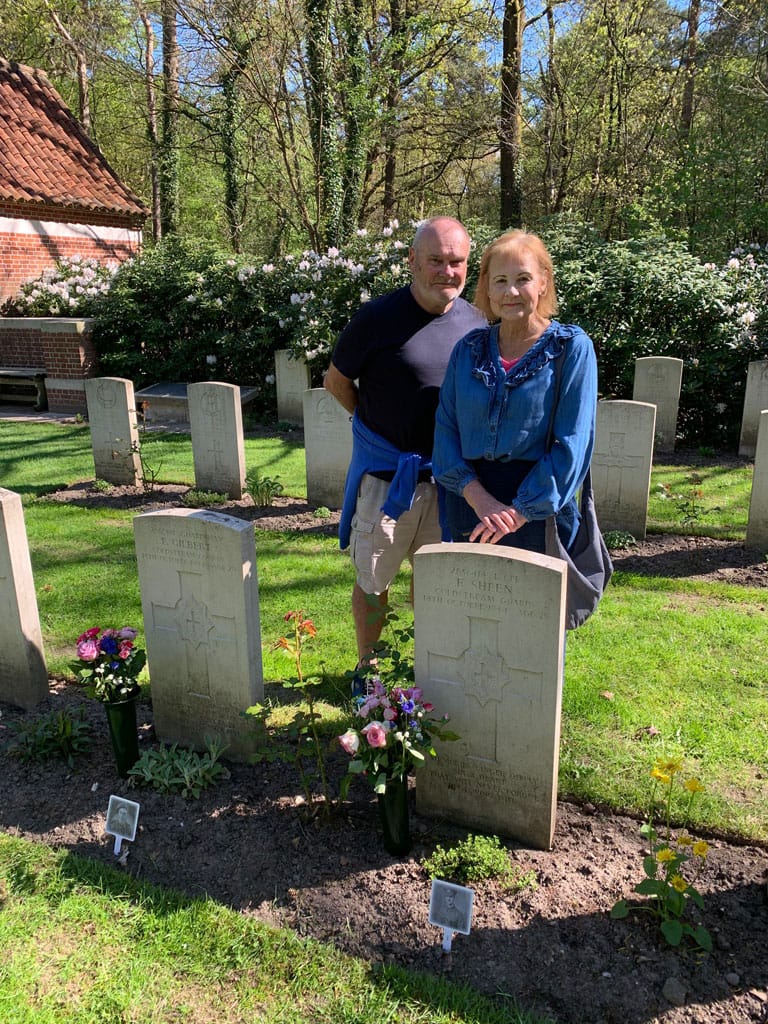
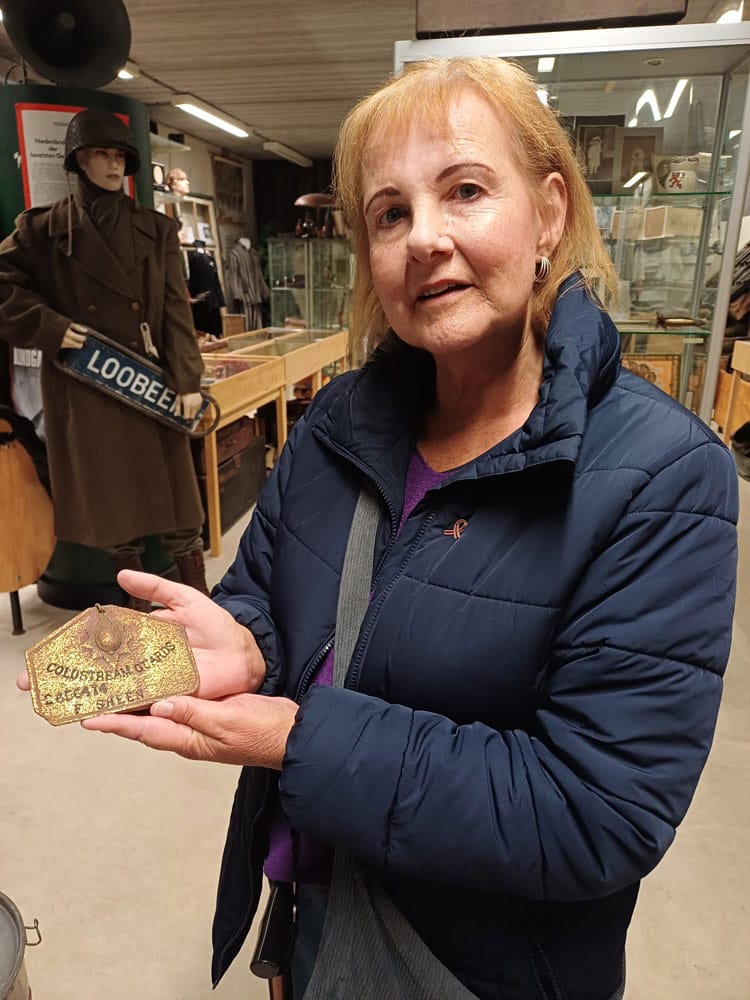
Margaret’s daughter Helen and her husband Steve Barnes visited Overloon in 2011 and 2014 and laid flowers at Frank’s grave before visiting the War Museum in Liberty Park. In 2024, they also attended the 80th anniversary commemoration of the liberation of Overloon.
In 2026 Helen and Steve Barnes returned to Overloon again to visit Frank Sheens grave and spent several days in the neighborhood of Overloon while visiting several memorable sites, among others guided by Overloon War Chronicles.
Photo’s and letters