
Smith | Henry


Biography
Henry Smith (Service No. 6151406) was killed in action on 19 November 1944. He was aged just 21. He was a Private in the 2nd Battalion of the East Yorkshire Regiment. He was initially buried at Cemetery De Kleffen Overloon and re-interred on 30 January 1946 in grave I. A.12 at the CWG cemetery at Overloon. The inscription on his grave reads: “A loving son, most good and kind. Beautiful memories left behind.”
Military Career
Henry initially enlisted as a Private in the East Surrey Regiment on 14 May 1942 at Canterbury. He stated that he was born on 11 February 1923 in Peckham. He gave his address as 25 Cardiff House, Peckham Park Road, SE15. He named his father, also Henry Smith, of the same address as his next of kin. He was described as being 5 ft 4 1/8 in tall, weighed 119 lbs and had hazel eyes and brown hair. He was declared Grade 1 fit. He was a Builder’s Labourer. He gave his religion as Church of England.
He was posted to No. 12 Infantry Training Centre on the day he enlisted. On 19 October 1942 he was posted to the 2/6th Battalion of the East Surrey Regiment. At this time, it was based in Durham. He was absent without leave from 23.59 hrs on 6 December 1942 to 07.10 hrs the following morning. He was confined to barracks for 14 days and forfeited a day’s pay. In March 1943 the Battalion moved to Malton in North Yorkshire.
Henry was transferred to the 9th Battalion of the Somerset Light Infantry on 21 June 1943. In September 1943 the Battalion was transferred from the 45th Infantry Division to the 43rd (Wessex) Infantry Division. At this time, on 5 September 1943, Henry was transferred to the 2nd Battalion of the King’s Shropshire Light Infantry. It was part of the 3rd Infantry Division.
He went absent without leave again from 14.00 hrs on 18 March 1944 to 13.00 hrs on 20 March. He forfeited 2 days pay.
On 2 June he was placed on an X(ii) list which means he was away from his unit, possibly due to injury or illness. On 6 June the 2nd Battalion of the KSLI took part in the D-Day Landings but it seems that Henry was not with them. On 18 June he was sent to 30 Reinforcement Holding Unit and then to 42 RHU on 22 June. This indicates that he was ready to return to a unit. On 2 July 1944 he was assigned to the 11th Battalion of the Durham Light Infantry. At this time, they were fighting in Normandy but it seems that Henry didn’t join them there. He finally arrived in North West Europe on 26 August 1944 when he was also transferred to the East Yorkshire Regiment via RHU 32.
The 2nd Battalion of the East Yorkshire Regiment had taken part in the D-Day landings in June 1944 and lost many men as a consequence. A substantial number of reinforcements joined the Battalion in late July when it had returned across the Orne to Beauville, near Caen in France. It played a part in action to secure a road junction at Vire in mid August but played no further part in the Battle of Normandy. It was at this time that Henry joined them as one of the reinforcements. In September they were in Belgium and successfully crossed the Escaut canal as part of the ill-fated Market Garden operation, arriving in Gemert in Holland on 26 September where they received a tremendous welcome. On 28 September he was given 7 days Field Punishment for irregular conduct, though it is not known what he had done.
October saw the 2nd Battalion involved in some of the heaviest fighting since the end of June, amid continual rain and mud. The battalion played its part in capturing Overloon on 12 to 15 October, suffering 49 casualties. It went on the following day to attack Venray, finally reaching the town on the 17th. By first light on the 18th, the Germans had withdrawn and the battle was over, at the cost of nine “other ranks” killed, forty-one, including one officer, wounded, and eleven men missing. The Divisional Commander described the troops of 3rd Division during this period of fighting as “desperately gallant soldiers with a wonderful spirit”, having concluded that the conditions under which they had fought were “quite Bloody”. On 19 October the battalion moved to the St Servatius area of the town, relieving the 2nd Warwickshire Regiment. Between then and 25 October they succeeded in evacuating seven hundred patients from a mental institution whose water tanks had been destroyed and moving 2200 refugees, stretcher cases and attendants without casualty despite being only 200 yds away from the enemy’s forward line who had the main road approach to the asylum covered by machine guns. The battalion then proceeded west to the area of Deurne / Griendtsveen to fill gaps in another division during the German threat at Meijel, supporting another division with mortar fire while it put in a counter attack.
On 1 November, the battalion moved to relieve the 1st Hereford Regiment at Griendtsveen and remained there for a week, enduring bad weather and enforcing a system of standing patrols by day and roving patrols by night in an area of peat-bogs, marshes and flooded fields. On the 10th, the battalion went into reserve at Overloon and rejoined the 3rd Division, however an incident on the 19th illustrates that there were no `safe’ areas within shelling distance of the front lines. A shell landed on `A’ Company’s cook-house, causing three casualties, and then a sniper hit two soldiers in the same company, killing one. It was on this day that Henry Smith was killed.
He had served for a total of 2 years and 190 days of which 86 days were in North West Europe. He was awarded the 1939/45 Star, France & Germany Star and War Medal 1939/45.
Family Background
Henry Smith was the son of Henry and Clara Smith of Peckham, London.
Henry Smith (Snr) married Clara Sophia Foskett in 1912 in Camberwell district, which is the district which includes Peckham. Henry had been born in 1884 and Clara in 1886, both in Camberwell.
They had children as follows, all in Camberwell: Doris E 1912, Clara J 1914, Jane 1916, Lilian M 1920, Henry 11 February 1923, Nellie E 1926 and Thomas A 1927. However, Doris died in 1915 and Jane in 1917. It is thought Lilian later died in 1936. This left just Clara, Henry, Nellie and Thomas.
In June 1921 the family were living at 26, Hawker Street, Peckham, Camberwell. With them were daughters Clara and Lily. Henry was working as a Carman for Wiggs and Sons Contractors Cartage while Clara was working for Mrs Warne’s Steam Laundry.
Henry’s sister, Clara J Smith, married Thomas G Perry in 1939 in Camberwell. In September 1939 they were living at 32 Hamilton Street, Deptford, Lewisham. Thomas was a general labourer.
In September 1939, Henry’s mother, Clara Smith, was away from London, hop picking in Kent. She was living in a Hop Picker’s Hut at Swarling, Petham. With her was her daughter Nellie and an unnamed child who was probably her youngest child, Thomas. Clara’s married sister, Elizabeth Sarah Nayler, was living in the next hut with another unnamed child. At this time Henry Smith and his father were living at 25 Cardiff House, Camberwell. Henry (Snr) was working as a Builder’s labourer and 16 year old Henry (Jnr) was a Steelworks Labourer. There is a suggestion that there was another, unnamed child present.
Sadly, Henry Smith was killed in action on 19 November 1944 in the Netherlands.
His mother, Clara Sophia Smith, died in Camberwell in 1971. It isn’t known when his father, Henry Smith, died.
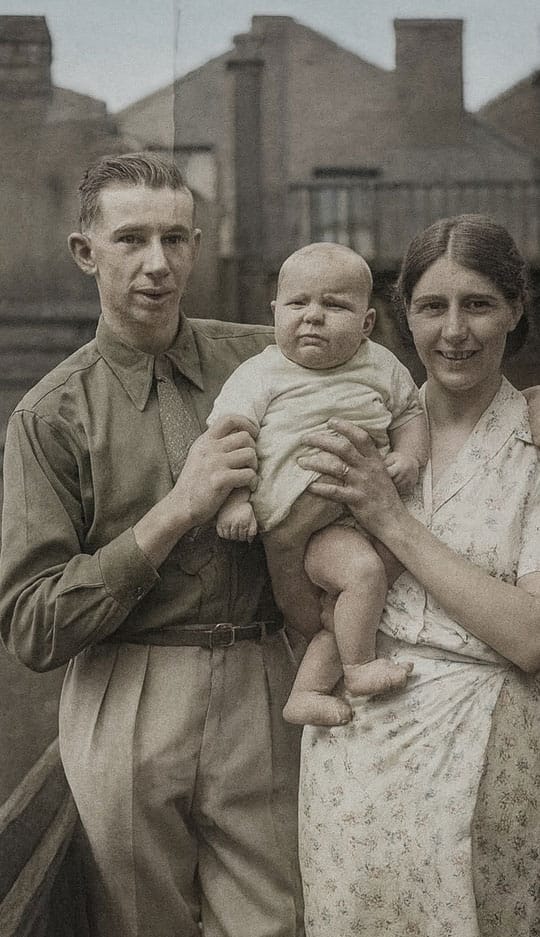
This originally damaged photograph has been restored using AI techniques and, according to his family, bears a striking resemblance to the original.

