Woodland | Reginald William Joseph


Biography
Reginald Woodland (service number 1063511) was killed in action on 15 October 1944. He served with the Royal Artillery, 76 Field Regt. He was initially buried in Oploo and was transferred on 30 January 1946 to his current resting place at Overloon War Cemetery, where he is buried in plot number II.A.13. His gravestone bears the inscription: “In proud memory, Of a beloved son and brother, Loved and missed more, Every day”.
Family background
Reginald was born on 18 January 1907 in Radstock, Somerset, England. His parents were Alfred Woodland (1880–1957) and Lily Humphrey (1879–1953).
He had a sister, Dorothy Alice Woodland (1907-1964), and a brother, Leonard Sydney Woodland (1920-1983).
He continued to live in Radstock and worked as a blacksmith for Mr G Gregory, Braysdown Colliery.
He married Ivy Elizabeth Latchem on 9 December 1933, and their son Henry George Latchem Woodland was born on 29 November 1934. Newspaper reports indicate that this marriage did not appear to be a success.
The wedding took place in the local parish church. The banns of marriage were published three times prior to the wedding, after which Ivy refused to go through with the marriage. Reginald was very upset by this, as he was very fond of her. A few months later, Ivy indicated that she still wanted to marry him, after which he obtained a special licence and they were married in the local church.
They lived together for a few months, but their relationship soon began to show cracks. According to Reginald, he was constantly criticised by his wife. In February 1934, she left him after a number of arguments. He wrote to her and asked her to return to her home, but she refused. Ivy, in turn, later stated that she had indeed made attempts to go home, but that she was repeatedly met with a closed door.
Reginald eventually declared that he was no longer willing to take his wife back because living together would be impossible. Ivy filed for divorce in the magistrate’s court, but the judge refused the request due to lack of evidence.
SUMMARY FROM THE ARTICLE
In April 1935, the Radstock Magistrates’ Court heard the case against Reginald William Joseph Woodland. At the time, he was a stable boy at Ascot Riding Stables. He was accused of abandoning his wife, Ivy Elizabeth Woodland, leaving her dependent on public assistance.
Reginald Woodland had left Radstock after finding work in Ascot through an advertisement in a local newspaper. He stated that he believed he was not legally obliged to contribute to his wife’s maintenance and that he had sought legal advice on the matter. After his departure, he heard nothing more from the Public Assistance Commission and was unaware that his wife was receiving benefits.
While working in the stables at Ascot, Reginald was arrested without warning and taken back to Radstock. As a result of this arrest, he lost his job. The hearing revealed that the Public Assistance Board had paid his wife £21 and 17 shillings since September 1934.
The court sentenced Woodland to one day in prison, which in practice meant that he was released immediately. The magistrates accepted an arrangement whereby his parents would pay 5 shillings a week, and Reginald Woodland himself would pay another 5 shillings a week as soon as he found work again. Reginald also stated that he was willing to take his wife back, provided he could get his job back. With this agreement, the case was closed.
It does not appear that they ever lived together again. The 1939 census shows Ivy living with her parents, together with their son Henry.
According to the inheritance statutes, it was not she, but Reginald’s sister who received his inheritance.
MILITARY CAREER
On 24 August 1925, at the age of eighteen, Reginald enlisted in the Royal Regiment of Artillery. He was medically cleared and found fit for military service.
His training began on 4 September 1925 with the 11th Field Brigade, where he was appointed Gunner. On 5 October 1925, he was posted to the 22nd Field Brigade of the Royal Artillery. These units were part of the regular British army in the period before the Second World War. The field regiments formed the backbone of the artillery and usually operated as an integral part of infantry and armoured divisions.
INDIA
On 5 October 1926, Reginald left for India, where he served with both the 22nd and 32nd Field Brigades. On 16 October 1929, he was presumably transferred to the 7/4 Field Brigade. He remained in India until 22 March 1932, where he obtained his 3rd Class Certificate at Rawalpindi Station. In his assessment, he was described as:
‘An honest, hard-working, reliable and sober man. Works well independently, without supervision.’
RETURN TO ENGLAND
After his returnto England, Reginald was transferred to the Army Reserve. This meant that he was allowed to return to civilian life, but remained available for call-up for active service — known as “service with the colours”. This traditional British term referred to the period of full-time military service, as opposed to reserve status, in which a soldier remained on standby but did not perform daily military duties.
On 24 August 1937, Reginald was called up for service again. Eventually, on 23 September 1939, shortly after the outbreak of the Second World War, he was mobilised in Ascot and assigned to the 76th Field Regiment.
FRANCE 1940
With this regiment, he left for France on 29 January 1940 with the British Expeditionary Force (BEF). There he quickly became involved in heavy fighting and eventually in the dramatic retreat to Dunkirk.
After the German invasion of Western Europe on 10 May 1940, the BEF advanced to Belgium according to the Allied plan. However, the German Blitzkrieg, with its fast armoured divisions and intensive air attacks, broke through the Allied lines at Sedan. This cut off British and French troops in northern France.
During their retreat, British units fought fierce rearguard actions under constant attack from the Luftwaffe. By the end of May, they had been pushed back to a defensive ring around the port city of Dunkirk. There, Operation Dynamo was launched: a large-scale evacuation by sea.
Between 26 May and 4 June 1940, approximately 338,000 Allied soldiers — the majority of the British army — were evacuated by naval vessels and hundreds of civilian ships. Approximately 11,000 British soldiers were killed or taken prisoner. Although virtually all heavy equipment was lost and France capitulated shortly afterwards, Great Britain managed to save the core of its army, enabling it to continue the fight against Germany.
On 3 June 1940, Reginald was among the soldiers who were safely transported to Great Britain.
TRAINING AND REFORM
He remained in Great Britain until 12 July 1944. During this period, the 76th (Highland) Field Regiment — like many other units — was rebuilt and re-equipped. The lessons learned in France were taken to heart. The regiment switched from outdated artillery pieces to modern 25-pounder guns with Quad gun tractors, and later to the self-propelled M7 Priest artillery.
In 1943, the regiment trained intensively with the 3rd British Infantry Division in preparation for the Allied landings in Normandy, Operation Overlord. As part of the 21st Army Group, the regiment developed into a modern, mobile artillery unit specialising in self-propelled operations.
Whereas in 1940 the regiment had been forced to fight as a surprised unit during the retreat in France, by 1944 it was ready as a reformed, well-trained and modern artillery regiment — ready for the coming major operations on the European mainland.
NORMANDY 1944
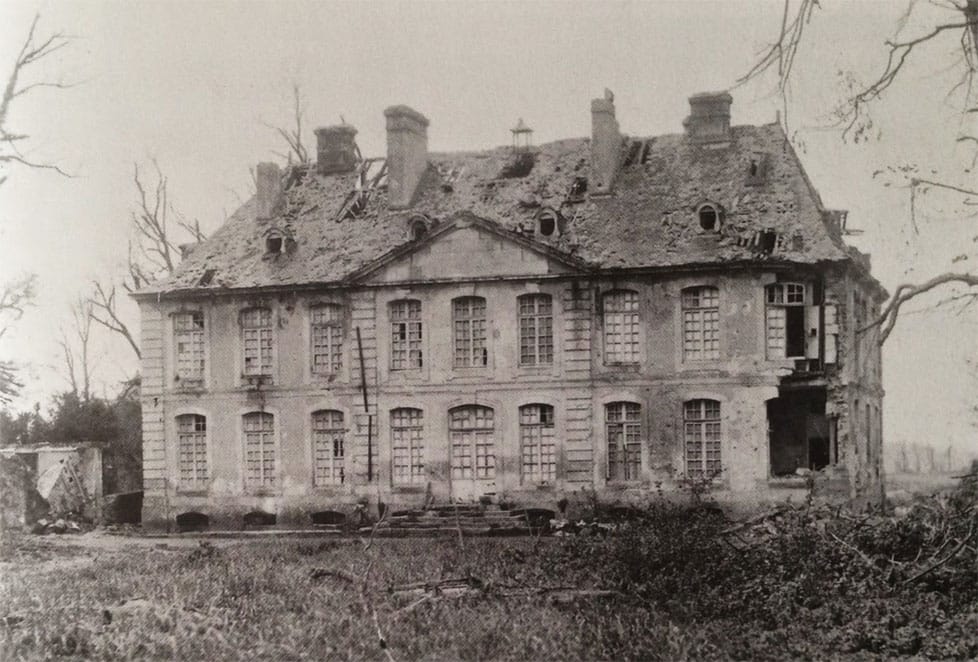
As part of the 3rd British Infantry Division, Reginald arrived in Normandy on 13 July 1944. At that time, the regiment was stationed in La Londe, where it was deployed to defend the Château de La Londe. This castle had been captured from the Germans on 28 June after fierce fighting and heavy losses. After the Allied landings on 6 June 1944, the German occupying forces had used the château as a command post.
The attack on the château proved to be particularly fierce. British units suffered heavy losses, mainly because they had to storm the target without sufficient armoured support. Veterans later described this battle as one of the bloodiest of the Normandy campaign, with hundreds of British casualties. The château was an important, heavily defended target in the Allied attempt to liberate the area around Caen: Operation Goodwood.
Reginald would also have been involved in this operation almost immediately after his arrival in France.
CAEN
The battle for Caen lasted more than a month. Through the attack plan Operation Charnwood, the Allies finally succeeded in taking most of the city on 9 July. At 9.50 p.m. on 7 July, a large-scale bombardment began: 467 Allied aircraft bombarded the city, which was almost completely destroyed within forty minutes. Approximately 300 French civilians were killed. However, this also alerted the Germans in time.
The next morning at sunrise, British and Canadian troops began their attack, supported by a so-called creeping barrage. British and Canadian artillery guns fired continuously at the German positions north of the city, shifting the impact area by about 100 metres every five minutes. The subsequent attack was carried out by 115,000 men and 500 tanks.
Operation Charnwood was followed by Operation Jupiter, Operation Goodwood and finally Operation Atlantic, with the aim of completely capturing Caen and the surrounding areas. It was not until 19 July that this goal was achieved — at an enormous cost: approximately 30,000 British and Canadian deaths and around 3,000 civilian casualties.
After the fighting at Caen, the regiment continued to provide support. On 17 July, they crossed the River Orne via a Bailey Bridge, known as the Escarde Bridge. The following days were relatively quiet, with only sporadic fighting and limited losses.
To recover from the heavy fighting of the previous months and to process the many losses, the commander decided on 26 July to give the entire regiment a day of rest on the beaches of Luc-sur-Mer. According to the war diaries, it was a wonderful day, although even then there were still losses due to enemy fire from positions behind the beaches.
FIGHTING AROUND FALAISE
The regiment then moved westwards, along the south of Bayeux towards Vire. This was probably part of the manoeuvres that led to the closing of the Falaise pocket on 21 August, in which large numbers of German troops were surrounded.
The regiment stayed successively in Vire, Tinchebray and Flers. At the end of August, they advanced further north and on 17 September they crossed the French-Belgian border, north of Mons. On 19 September, they took part in fighting at Lille-Saint-Hubert, where they helped to reinforce the bridgehead.
Between 11 and 19 September 1944, this village was on the front line between German and British troops. The battle to cross the Meuse–Escaut Canal, north of the village, played a crucial role in this. On 19 September, Lille–Saint-Hubert was completely liberated and the regiment moved on to successfully provide support at Hamont.
HOLLAND
On 21 September, they crossed the Dutch border at Weert. In the period that followed, they regularly saw action in Bakel and Gemert, among other places.
At the end of September, the regiment was moved to Molenhoek, a village near Nijmegen, to support the 82nd US Airborne Division, with the 3rd British Infantry Division remaining in reserve. From 1 October, the regiment helped the Americans clear the northern bank of the Meuse, from Mook to beyond Cuijk, to enable the construction of new bridges.
However, the regiment was the first to receive orders to fire artillery at German territory, above the hamlet of Frasselt, which lies directly against the woods of the Reichswald. In September 1944, bombings were carried out here to hit German units and prevent regrouping. Although the attacks were aimed at military targets, it was mainly civilians in the area who were hit by fragmentation bombs. The area would remain a fiercely contested front zone for months to come.
OVERLOON
In the first days of October 1944, they assisted the Americans wherever possible, while preparations were being made for a move to the village of Sint Anthonis. On 9 October, they were almost immediately called into action in the fighting around Oploo, in support of the 3rd British Infantry Division, and began preparations for the attack on Overloon.
At 11:00 on 12 October, they fired red smoke grenades to mark targets for Allied fighter-bombers in the woods southeast of Overloon. These attacks later proved to be particularly successful.
In the first days of October 1944, they assisted the Americans wherever possible, while preparations were being made for a move to the village of Sint Anthonis. On 9 October, they were almost immediately called into action in the fighting around Oploo, in support of the 3rd British Infantry Division, and began preparations for the attack on Overloon.
At 11:00 on 12 October, they fired red smoke grenades to mark targets for Allied fighter-bombers in the woods southeast of Overloon. These attacks later proved to be particularly successful.
At 11:00 that same day, more than 200 Allied guns, positioned at Sint Anthonis, Oploo, Stevensbeek and De Rips, opened fire. In an hour and a half, more than 25,000 shells landed on Overloon. At quarter past twelve, when the village had been reduced to rubble, two infantry battalions advanced. On the western flank was the 1st Battalion of the Suffolk Regiment and on the eastern flank was the 2nd Battalion of the East Yorkshire Regiment through the Stevensbeek woods. They were followed by Churchill tanks from the Coldstream Guards and by so-called Flail tanks, specially equipped to clear minefields.
The infantrymen followed the slowly advancing tanks at a short distance. The first hour went well, but as soon as the East Yorks reached the woods north of Overloon, the Germans put up increasingly fierce resistance. Tanks got stuck in minefields and suffered heavy losses from German anti-tank guns, partly because the marshy terrain forced them to stay on the roads.
Around 3 p.m., the reserve battalion of the 8th British Brigade, the 1st Battalion South Lancashire Regiment, was also deployed to protect the right flank. With the support of the Coldstream Guards, they reached the woods west of Overloon. After a laboriously coordinated attack, the heavily destroyed village was largely in British hands that evening.
On Friday 13 October, the offensive resumed in the early morning. The pattern repeated itself: limited progress, heavy losses and bitter fighting in the surrounding woods. The Germans were pushed back only metre by metre. Four Churchill tanks were put out of action. On 14 October, the regiment remained active in clearing the area east and south of Overloon. This day is seen as the liberation of Overloon, but it came at the cost of many casualties from various regiments such as the Royal Ulster Rifles, King’s Own Scottish Borderers and the Lincolnshires.
On 15 October, one day after the liberation of Overloon, the regiment was ordered to carry out an attack on the village of Smakt, together with the 11th Armoured Division. The attack started from an area guarded by the 2nd Battalion of the King’s Shropshire Light Infantry. The target was the railway line that ran from north to south a few hundred metres west of Smakt.
The advance was difficult because heavy military traffic had made the roads virtually impassable. The attack was supported by the Fife and Forfar Yeomanry and a rolling artillery barrage that moved 100 metres every two minutes. The barrage was to remain at the opening line for 10 minutes. However, due to short range, shells fell in their own territory, causing casualties. The offensive stalled temporarily, after which the barrage was discontinued and replaced by explosive charges.
The terrain consisted of a vast sandy plain with dunes, virtually impassable for vehicles. The commander’s reconnaissance vehicle even had to be towed by a tank to maintain radio contact. Despite opposition, several companies eventually reached the railway line. This was followed by heavy enemy fire, including 105 mm and 88 mm guns, mortars and Nebelwerfers. The losses among the British units were considerable. It is worth mentioning that Sergeant George Harold Eardley of the King’s Shropshire Light Infantry was later awarded the Victoria Cross for his actions that day.
Sadly, Reginald Woodland was killed during the fighting on 15 October 1944. He was temporarily buried in Oploo, on Deurnseweg. Eighty British soldiers were eventually buried in this cemetery, but they were later reburied. Many found their final resting place in Mierlo, others at the Overloon War Cemetery — including Reginald, who was buried there on 30 January 1946 in grave II.A.13.
Reginald received the following medals for his military actions:
1939-1945 Star
France & Germany Star
Defence Medal
War Medal 1939-1945
Photo’s and documents