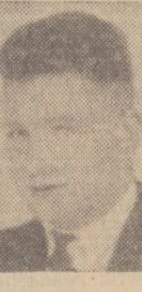
O’Neill John

O’Neill | John

  • First names

    John

  • Age

    29

  • Date of birth

    26-12-1914

  • Date of death

    15-10-1944

  • Service number

    14207563

  • Rank

    Fusilier

  • Regiment

    Royal Northumberland Fusiliers,4th Bn.

  • Grave number

    II. D. 14.

  • John O'Neill

    John O’Neill

    John O’Neill

  • Grave John O'Neill

    Grave John O’Neill

    Grave John O’Neill
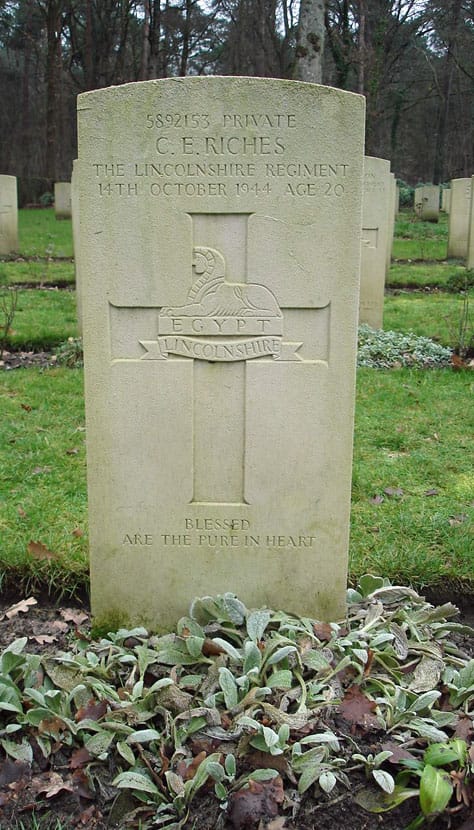
Biography

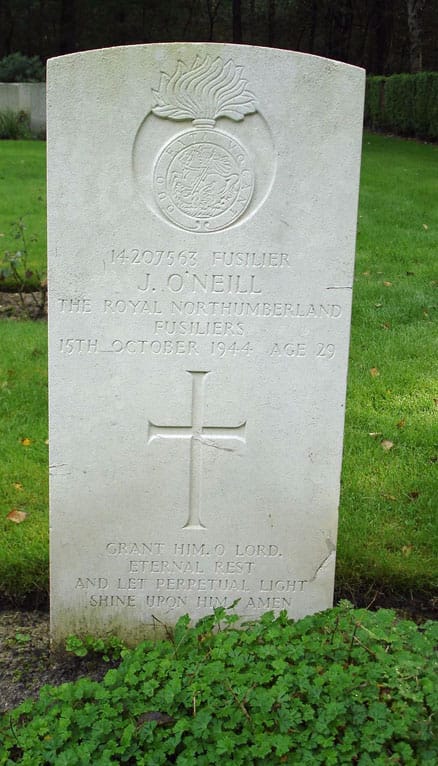
John O’Neill (Service No. 14207563) was killed in action on 15 October 1944. He was a Fusilier in the 4th Battalion of the Royal Northumberland Fusiliers. He was initially buried near the Maria Regina Nunnery in Stevensbeek and re-interred on 22 May 1947 in grave II. D. 14 in the Commonwealth War Graves Cemetery in Overloon. His inscription reads “Grant him, O Lord, eternal rest and let perpetual light shine upon him. Amen,”

Life Before the War

John Stephen O’Neill was the son of Michael O’Neill and Catherine Mary Kate McGrath who had married on 26 January 1909 in Ardragh East on Bere Island in County Cork, Ireland. Michael was a farmer. He had been born in July 1878 and Catherine (who was known as Mary) on 4 August 1887, both on Bere Island. The O’Neills had lived on Bere Island for several generations.

Bere Island or Bear Island (Irish: Oiléan Béarra, although officially called An tOileán Mór meaning “the big island”) is an island in Bantry Bay off the Beara Peninsula in County Cork, Ireland. This is in the far south west of Ireland.

The island was heavily fortified after the failed French invasion through Bantry Bay in 1796 with the construction of Martello Towers and support buildings. Over the next 100 years this continued, leading to the installation of 6 inch and 9 inch guns in 1899 as part of seven coastal batteries to protect the naval anchorage of Berehaven. There was a garrison of British military personnel on the island until 1938. Ardragh East, where John was born, was in the so-called “Red Zone” that was occupied by the British. This cut the island in two with the British area at the eastern end. To be inside the red line meant that the British army could order civilian evacuation to take place within around 48 hours in the event of military action. Thus, it was a strange place in which to grow up.

The British presence on Bere Island provided construction jobs that attracted people onto the island, however, it was regarded as an occupation and this presence was not welcomed by locals. During the Irish War of Independence, Bere island was used as an internment camp holding IRA members. Three Soldiers from the garrison were killed just after coming off the island in 1921 and five houses on the mainland were burnt down as a reprisal.

The Anglo Irish Treaty of 1921 ended the war of independence and resulted in the creation a year later of the Irish Free State as a self governing dominion within the British Empire. It also allowed Northern Ireland to opt out of the Irish Free State and remain part of the United Kingdom. The British withdrew from most of Ireland, but the garrison at Berehaven was one of three deep water ports which were retained as British Sovereign bases. In 1938 Fort Berehaven was handed back to Ireland.

The British Garrison on Bere Island will have been a prominent feature of the O’Neill family’s life.

Michael and Mary O’Neill had children at Ardragh East as follows: Jeremiah (known as Jerry) b 9 February 1910, Margaret b 1911, Cornelius (known as Con) b 4 February 1912, John Stephen 26 December 1914, Michael b 1916, Donal b 1918, Mary b 1920, Brigid Anne b 25 February 1924 and Vincent 1932.

Michael, Mary and Jerry were living at Ardragh East in the 1911 Census.

The earliest image of John was taken about 1918 with his younger brother Michael outside the family home. He is likely to have attended the National School at Lawrence Cove. Here the boys were taught downstairs and the girls upstairs. Children of all ages were in the same class. The children of the British families at the Barracks had their own military school so the local children did not routinely mix with them.

Some families were involved with the Military Barracks, with some employed there and others selling them produce such as eggs.

By April 1926, only the six younger children were still living at home. John’s father was working as a Painter for a department of the British Government, presumably at the Barracks.

Life in the 1930s on the island was something of a struggle for survival for the Islanders. The biggest issues for the largely agricultural community was ensuring that the potato and hay crops succeeded to ensure that the people and their animals got through the winter. Men, women and children all had their roles to play in these tasks.  

A steamboat and a launch made two trips to Castletownbere on the mainland every day. There were no police on the island and little crime.

In the houses the sleeping quarters were upstairs with the kitchen and another room underneath. The kitchen was the heart of the household where cooking and eating was done. It was also used by the women to make quilts and knit. It was the room where, on long winter’s nights, visitors might come and everyone sat by the fire and told stories and sang songs. The other room was used for various purposes such as a dining room when the priest came or a sick room.

In 1931 John carved out his name on a flagstone near the family house with the date inscribed. It remains there as a lasting visible memory.

John seems to have been one for playing pranks. One story goes as follows. The family kept some hens to provide eggs which his father would go to collect each day. He was puzzled when some of the eggs were nothing more than hollow, weightless shells with nothing inside. This went on for some days and his father decided to stay up one night to see if anything was happening. His patience was rewarded when in the early hours he spotted John creeping out of the house to the coop. There was John taking an egg, putting a tiny pinhole in each end of the egg, sucking out the contents and carefully replacing the now empty egg. It isn’t known whether his father saw the funny side of this prank!

A family story demonstrates the tension between the Barracks on Bere Island and the local population. At some point before 1938 a British soldier, who happened to be a boxing champion, came into one of the two Rerrin pubs on Bere Island where John and his friends were drinking. He shouted out offering (rudely with profanities) to fight any Irishmen who was willing. John stepped forward and the fight began outside. According to John’s brother Jerry, John “…kicked him all the way back to his barracks.”

Two photos of John taken in 1934 when he would be around 19 show him in the uniform of the Irish Volunteer Force. They were taken at the Curragh.

An Irish general election in 1932 resulted in the Fianna Fáil Government of Eamon de Valera coming to power, with the support of the Labour Party, pledging to dismantle the limits placed upon Irish independence by the Anglo Irish Treaty. Drawing on the revered heritage of the largely Republican Irish Volunteers, they created the Volunteer Force on 6 April 1934. This part-time militia was intended to appeal to the party’s republican supporters, and to offer them an alternative to membership of the IRA. Twenty-one former republicans had been drafted into the Irish Army as officers to oversee the recruiting of the Volunteer Force. It was hoped it would have 24,000 volunteers. At a local level the Force was run with the assistance of a civilian committee known as a ‘Sluagh’. These became known as ‘Aiken’s Slugs’ after the minister for defence who appointed them. The minister for industry and commerce saw the Volunteer Force primarily as a tool against illegal paramilitary organisations such as the IRA and the Blueshirts. It would give young men an opportunity for military training where they might otherwise turn to these illegal organisations.

It quickly became clear, however, that the Volunteer Force was not as successful as first hoped. It was dogged by a series of problems and recruiting began to tail off. Between March 1934 and March 1939, 16,146 men joined the Force, but when it was reorganised on 1 March 1939 only 3,731 Volunteers re-enlisted. Once WW2 began, the Force was quickly subsumed into the regular army, playing a key role in providing men for the Coast Watching Service, and was finally replaced by An Forsa Cosanta Áituil (FCA) in 1946.

Ireland remained neutral during WW2 although there were ways in which the country helped the Allies including
extensive co-operation between Allied and Irish intelligence and provision of detailed weather reports for the Atlantic Ocean. However, an estimated 70,000 Irish nationals served in the British military during WW2 of which 3,617 died on active service.

It isn’t known how long John remained in the Volunteer Force.

Three of Michael and Mary’s children went to live in England in the mid 1930s. This was a time of hardship in Ireland. The Government elected in 1932 refused to pay “land annuities” owed to Britain under the 1921 Treaty. The British Government retaliated by imposing punitive tariffs of 20% on Irish agricultural imports and limits on the number of cattle imported. By 1936 the average tariff on Irish imports was 45%. This coincided with the Great Depression of 1929-39. These are the factors which resulted in many deciding to leave Ireland for a life elsewhere.

Jerry initially went to Surrey to work as a navvy on the Chessington railway line. He later moved to London where he married Mary Harnedy in 1941. Sadly, she died in 1943 during the birth of their child, Mary. It seems that his wife’s death combined with having a baby to look after may have caused him to have mental health problems which were worsened by later events. Their daughter was brought up in his brother Con’s household. It is thought Jerry was never called up as he was working at Fords in Dagenham which made a wide range of vehicles for the war effort including universal carriers like the one in which John was to serve. They also made Merlin engines for the RAF.

By September 1939 Con was working as a general labourer and living at 37 Durham Avenue, Hounslow, Middlesex. He also served in WW2, possibly in the North Staffordshire Regiment. It is thought that he was evacuated from Dunkirk and was seriously wounded there, though another version of this family story is that he was wounded after D-Day in Normandy. He married Agnes Winifred Warrington in mid 1942 in the Stoke on Trent District. His grandson believes they may have met when his grandmother was looking after him after he was wounded. In September 1939 Agnes had been living at 118 Hassell Street, Newcastle-Under-Lyme in the household of Elizabeth Warrington (b 12 March 1880) a widowed school cleaner. Agnes (b 8 December 1910) was a Greengrocer’s Shop Assistant. Also present was Wilfred Warrington (b 5 November 1904) who was a Colliery Hewer Below Ground.

John is thought to have initially settled in Surrey but this is not certain. It is thought that there was a young woman on the island who had strong feelings for John who was apparently in tears when he left.

By September 1939, John was living at 30 Swindon Road, Wroughton near Swindon in Wiltshire. He was working as a Steel Erector. The head of the household was Daniel Behan (b 17 January 1896) with his wife, Mary Behan (b 10 April 1910). Also present were two other men: Thomas B Fahey (b14 July 1914) and Thomas C Nabbutt (b 25 July 1920). Thomas Fahey was another steel erector and Thomas Nabbutt was a brick layer’s labourer. An unnamed child was also present. The surnames suggest that most of those in this household were Irish.

By 4 February 1941 John was living at Granways, Gran Lane, Hucclecotes, Gloucester. On that day he wrote the following to his sister Brigid at Ardragh East, Bere Island, Co Cork.

“Dear Brigid,
It is about time I wrote you a few lines to let you know I am OK and to thank you for your nice letter and card at Xmas also Vincent and Mary. I also owe a letter to mother I hope she has not been worrying. Well I do hope ye are all well and had a good Xmas I had a very quiet one here, I only wish I had been home and had turkey etc. well maybe another time Brigid. Did ye have a concert at the Drill Shed this time, plenty of movies and dances I expect, I have not been to a picture for months. I live a bit out of the town so after work it is late to go as the last show starts earlier than normal times on account of the black out etc. Did ye hear from the boys lately I hope Jerry wrote, I dropped him a few lines some time before Xmas but he did not reply. Is Con in the same address still, I did not write to him as I had a notion of leaving here for some time but not so far. Murphy that was with me left here at Xmas I missed him as we were together for over a year, so I am on my own now. How is father and the boys, are they still at the Scallops. I hope they had a good share of snow lately not as bad as last year though. The job is not so good as we lose time in bad weather I wish I was back at the Steel work again it is far better. Do you still go to the convent school Brigid, you should be a great scholar now Vincent should get good tuition from you. How is Margaret and all the friends please remember me to all tell mother and Mary I will write to them soon. How is Jerry Murphy and the mission getting on. Well for the present Brigid, Good Bye and God Bless you all. Write soon again. Did any of you hear from Mrs McKenzie lately.
From Brother John”

Military Service

As far as is known, he had no plans to enlist. However, due to unfortunate alcohol related incidents which led to a court appearance, he was given a choice of enlisting vs receiving a different form of punishment. He therefore chose to enlist on 26 February 1942.

By the time he enlisted, he was living at 54 Cartway, Bridgnorth, Shropshire and was described as a Steel Erector. He stated that he was a British Subject but qualified it by saying he was Irish – FS which stands for Irish Free State. He gave his date of birth as 26 December 1914 and that he was born on Bere Island, Co. Cork. He rather oddly stated that his parents were British subjects when they were, in fact, Irish. This may be because they lived in the British occupied area of Bere Island – or because Ireland was in the United Kingdom when they were born. It could even have been an attempt to ensure they benefited from any payments from the British Government should he die or be wounded. He gave his mother, Mrs Mary O’Neill of Ardragh Road, Bere Island, Co Cork as his next of kin.

He was described as being 5ft 11in tall and weighted 180lbs. He had brown eyes and dark brown hair. It was stated that he was in A1 medical condition. He was a Roman Catholic.

On enlistment, the start of his service was deferred until 1 October 1942 when he was posted as a Private to 25 Primary Training Centre (PTC) of the General Services Corps. It may have been deferred because he was doing useful work as a civilian. The General Service Corps had been formed in February 1942. It was formed as a corps to provide specialists but from 2 July 1942 army recruits were enlisted in the corps for their first six weeks so that their subsequent posting could take account of their skills and the Army’s needs. No 25 PTC had been based at the No 5 Training Battalion Royal Army Ordnance Corps at Racecourse Camp, Chepstow but on 16 October it moved to K Camp Donnington, Shropshire.

On 4 December 1942 he was transferred to the Royal Northumberland Fusiliers. He was initially in the 24 Machine Gun Training Centre. This was based at the Depot of the Cheshire Regiment.

On 15 March 1943 he was posted to the 4th Battalion. On 21 June 1943 he was assigned to ‘2’ Company. He held the rank of Fusilier.

The 4th Battalion of the Northumberland Fusiliers had served as a motor cycle battalion in France and Belgium from January to June 1940. After the evacuation from Dunkirk, it served at home until April 1941 when it was transferred to the Reconnaissance Corps and redesignated as 50th Battalion, Reconnaissance Corps in the 50th Division. It spent time in the Mediterranean and Middle East from June 1941 until June 1942 when it returned home and was assigned to the 22nd Armoured Brigade. On 6 June 1942 it became 50th Regiment, Reconnaissance Corps and in March 1943 reverted to the Royal Northumberland Fusiliers as the 4th Battalion. This is the point at which John was posted to the 4thBattalion.

On 25 April 1944, the battalion was suspended. Its personnel formed three independent machine gun companies for the British armoured divisions of the 21st Army Group. The 2nd Independent Machine Gun Company to which John belonged was assigned to the 11th Armoured Division. In June 1942 the 11th Armoured Division had been re-organised so that it was composed of the 29th Armoured Brigade and the 159th Infantry Brigade. The 2nd Independent Machine Gun Company would act as the 159th Brigade fire support group.

By D-Day, the 29th Armoured Brigade consisted of the 23rd Hussars, 2nd Fife and Forfar Yeomanry, 3rd Royal Tank Regiment and the 8th Battalion, Rifle Brigade (Prince Consort’s Own). The 159th Infantry Brigade consisted of the 4th Battalion, King’s Shropshire Light Infantry, 3rd Battalion, Monmouthshire Regiment and the 1st Battalion, Herefordshire Regiment.

Normandy

John’s Service Record shows that he served at home until 12 June 1944. He, along with most of the 11th Armoured Division landed on Juno Beach on 13 June 1944, seven days after D-Day.

It must have been fairly soon after landing in France that he wrote the following letter to his brother, Jerry:

“Dear Jerry
Just a note hoping it finds you in the best of health etc. as it leaves me at present. I hope you enjoyed your holiday. Did you go to Newcastle how did you find everything. I tried to get to see you but we were confined to Barracks since last I seen you. By the way, I am writing this from France. Can’t tell you when I came over however – I am OK and feeling good. I daresay you read all about it in the daily papers you should know more about the fighting than we do here. How is Con doing is he still at the same place. There is nothing for me to write about for now Jerry so I will close this note with my best regards say a prayer for me sometime. Please excuse pencil I expect you will understand.
Good Luck
From John”

The 11th Armoured Division, as part of the VIII Corps, was committed to action on 26 June 1944 as part of Operation Epsom. It entered the Scottish ‘corridor’, opened beforehand by the 15th (Scottish) Infantry Division. Despite mistakes in navigation, which slowed down the 159th Infantry Brigade in Mouen, the 11th managed to seize the bridges at Grainville and Colleville. It then progressed southward to Hill 112 (a dominant feature in the Normandy landscape near the village of Baron) and succeeded in capturing and holding this high ground against increasingly intense German counter-attacks. However, a renewed attack by fresh SS-Panzerdivisions transformed what was intended as a breakthrough into a battle for position. Before the German reinforcements could attack, General Bernard Montgomery ordered a withdrawal from the hilltop.
 
John wrote another letter to Jerry, probably while still in Normandy. He wrote as follows:

“Dear Jerry,
Thanks a lot for your welcome letter received today glad to hear you are OK don’t let the doodlebug get you I was surprised to hear Con was gone overseas I do hope he is OK. There was plenty of his mob here when we landed. I have been with the front don’t worry it’s not so bad just keep dodging shells etc. I’ve had a letter from mother a week back I write her pretty often lately. I also made an allowance …  a week before I came over here she told me she got it OK. You should drop her a line now and then Jerry otherwise it causes her a lot of worry. Glad you went to see Agnes and kids. I don’t suppose you had too much peace with young Mary still such is the way of kids. There is nothing much to write about from here so I’ll have to cut this short write soon again Jerry give my regards to Jack & Mrs O’Leary, for now Good Luck and God Bless. Sincerely yours John”
 
Probably about the same time in early July he wrote again to his sister Brigid as follows:

“Dear Sister,
Just a short note to let you know I am OK and in the best of health hoping all home are the same. I have not had any letter from home since mother’s dated 15th. I have just come from the front line for a rest we are glad of it too just to get away from all the noise good clean up at this rest place. I had a smashing beard on I thought it a pity to shave it off, we are also expecting some form of amusement films or something. Well Mary I am sorry I can’t write much as there is nothing really to say from here in any case I expect you get all the news in the papers such as it is. How is everything going on in the old country these days. I have seen nothing to compare with it yet what I would give to set foot on it right now. Give my best regards to all home friends also all the boys don’t bother with the girls. Good Luck and God Bless you all write soon if you have any snaps of Vince or any of the family send them along if allowed. Your loving brother John.”
 
The 11th Armoured was then moved to the east of Caen to spearhead Operation Goodwood. Planning and execution errors, coupled with strong German defences, led to a tactical British defeat. Goodwood was cancelled on 20 July, with the 11th Armoured being withdrawn from the front line to rest and refit. In only two days of fighting, it had lost 126 tanks.

The 11th Armoured was directed again to the west, to take part in Operation Bluecoat. Beginning on 30 July 1944 it seized Saint-Martin-des-Besaces. The division spotted an intact bridge on the Souleuvre river, which enabled it to drive the Germans back. The division liberated Le Bény-Bocage on 1 August and quickly progressed southward. Although severely weakened at that time, the German army remained ever-present and dangerous. From 5 August, the 11th Armoured worked with the Guards Armoured Division and 15th (Scottish) Infantry Division to push back a counter-attack of the 9th SS Panzer Division.

A photo taken around the time of Operation Bluecoat of a carrier which seems to have got into difficulty while in a convoy with others including a flail tank is thought to include John sitting on the carrier.

After being replaced in VIII Corps by the 3rd Infantry Division, the 11th Armoured was attached to XXX Corps. It progressed eastward hard on the heels of the Germans, who were retreating after the failure of the Mortain counter offensive. The 11th Armoured seized Flers on 17 August.

He again wrote to his sister Brigid on 19 August as follows:

“Dear Sister
A few lines to let you know I am OK and well thank God hoping it finds all home the same. I received mother’s letter two days back also one from Aunt Julia, mother said she was not so well with her leg, I do hope it is not too bad. She certainly has had some bother with it in the past to my knowledge. Things are going well out here Brigid will be good when its all over we have been in the thick of it mother says you read all about it in the press. How is Vince enjoying his holidays they tell me he is quite a man well I hope he is always all right sorry I have no news to tell you so don’t tell me off Write soon again for now all the best to you all friends and neighbours and God Bless you Your loving brother John.”
 
John also wrote another letter to Jerry on 21 August as follows:

“Dear Jerry,
Just a few lines hoping it finds you fit and well as it leaves me at the moment. I wrote you a bit back and I have been wondering if you had received it OK as I should like a line from you just to know you are well. Also mother always asks for you, why not drop her a line. Do you get much bother from the buzz bombs now, they must be a nuisance. How is Jack and Mrs O’Leary also Othe hier? Well Jerry the war should not last very long more don’t you think we have been going some lately, we should turn it in soon, we get in the front line a lot. I hear from home a lot they are all well but mother’s leg is not so well lately. I have not much news to tell you Jerry so excuse this note. I will be anxious to hear from you also hoping to see you soon so for now Good Luck and God Bless Your loving brother John”

John was clearly concerned about Jerry who was struggling following the loss of his wife.

Once the battle for the Falaise gap was over, the 11th Armoured liberated L’Aigle on 23 August and crossed the Seine on 30 August.

After a night move, and an unprecedented advance of 60 miles in one day, the division liberated Amiens on 1 September. Advancing to Lens, then Tournai, the division was then committed to the fight for Antwerp, which it liberated on 4 September.

Belgium

John wrote again to his brother Jerry on 7 September 1944 as follows:

“Dear Jerry,
I received your welcome letter 2 days back and I’m very glad to know you are OK and well which goes for me also at the moment. Agnes told me you had been to her place for a week I daresay you enjoyed the change to a quieter quarter. Mother always inquires about you Jerry you should drop her a line as she only worries. I have not struck up with Con yet but I should imagine he is some distance from me. We have been on the move some for the past few weeks am now in Antwerp we were the first to enter the city and what a welcome we got they simply mobbed us, it was a smashing place quite a lot of English speaking people in it would not mind staying here they’re crazy for English cigs. Well Jerry for now I will say Cheerio and Good Luck Write soon again and God Bless.
Sincerely your Brother John”

This was the last letter which Jerry was to receive from John.

A photo taken in late September 1944 shows John in Antwerp. He is seated wearing his beret at the back on the right of a universal carrier. The Number 64 on the vehicle confirms it belonged to the Royal Northumberland Fusiliers. This is the last known image of John. He is wearing what looks like rosary beads around his neck. The carrier had a heavy Vickers Machine Gun at the front. This was used for support fire.

Two days after it liberated Antwerp, the 11th Division tried to establish a bridgehead over the Albert Canal, but the attempt, due to intense enemy fire, was not successful. After this failure, 11th Armoured had to cross much further to the east, at Beringen.

Holland

The division was not directly committed to Operation Market Garden. Instead, it was tasked with securing the right flank of the operation. Attached to VIII Corps, it began moving on 18 September. Advancing in two columns, it managed to reach the US 101st Airborne Division at Nuenen, while on the 22nd, its engineers established a bridge over the Zuid-Willemsvaart canal. The division could then make an encircling move around Helmond, forcing the Germans to withdraw on 25 September.

John found time to write a letter to a friend, Markie O’Sullivan, on 19 September, although the last page appears to be missing. It reads as follows:

“Dear Markie,
I received your most welcome letter yesterday and boy I read and reread that letter it was as good as somebody coming and telling me the ficking war was over – that’s no kidding – and I want to thank you sincerely yes Pal it brought me back to Bere Island for a little while again and cheered me up no end.

You don’t realise what a letter means especially from one you think a lot of to us fellows, I must admit I have neglected a lot of my best friends although since coming out here I have caught up with a lot of overdue correspondence. I am very pleased & glad to know all you folk are in the very best Markie but then you were always hale and hearty tell your father I certainly will stand him a pint with pleasure but I don’t imagine one would do him a lot of good so let’s hope its more.

So you tell me all the boys are married or heading that way, which kind of leaves me on my own, I am surprised to hear you were getting spliced just can’t imagine you a family man, so your trips to the Cross have not been in vain, and you have made a good choice as Mary was a nice kid when I knew her. Ask her if she remembers when you and I tried to fiddle her for a pack of smokes with a dud coin. You also must have signed a truce with Jerry by now, yes Markie them were the days. By the way while I have a chance and am on the subject I want to wish you both the very best of luck and everything that goes with it the best I can do at the moment and also would you please ask Bernie Harrington to wish the same to Lizzie when they write her again yes I thought a lot of her and often wondered how she was doing.”

The Cross refers to the cross roads in Ardragh where Markie’s future wife lived. There was a dancing platform outside their small shop. Her father had been on the opposite side of the political divide to Markie’s family hence the reference to a truce. The Lizzie Harrington referred to later emigrated to the USA. Was it possible that she was the young lady who had strong feelings for John when he left Ireland.

By the night of 26 September, the Division was in the St Anthonis area with 159 Brigade Battalions stationed both there and around Oploo. They remained in this vicinity until 29 September.

By this time, Operation Market Garden had failed to capture the bridge at Arnhem. The Allies were left in a narrow corridor through the Netherlands. It was decided that it was necessary to widen this corridor by attempting to push the enemy back to the east of the River Maas. It was initially the 7th US Armoured Division which was tasked with working from the north to clear the enemy from Overloon, Venray and Venlo.

On 29 September 159 Brigade of the 11th Armoured Division was therefore ordered to hand over to the Americans and move back to Gemert. They remained there until 7 October. By that time, the American attempt to capture Overloon had failed and they handed over to the British.

By the night of 7 October, 159 Brigade HQ was back in St Anthonis. It was grouped with the 4 KSLI, 1 Herefords, 2 Fife and Forfar Yeomanry and one battery of 75 Anti Tank Regiment. The 1 Herefords were in woods north of Overloon and just south east of Stevensbeek. The 4 KSLI were in Mullem, west of Vortum and the 2 Fife and Forfarshire Yeomanry were in Sambeeksche Heide. These last two areas are to the north east of Overloon, along a railway line running north south to the east of and parallel to the River Maas.

The 2nd Independent Machine Gun Company of the Royal Northumberland Fusiliers (RNF 2 IMGC) to which John belonged were with them. Their headquarters was just north of St Anthonis. The 1st and 3rd Platoons were under the command of the Company itself, with the 3rd Platoon based just east of St Anthonis and the 1st Platoon based in the woods south east of Stevensbeek. The 2nd Platoon was under the command of the 1st Herefords and located with them. The 4th Platoon was under the command of the 4 KSLI and located with them at Mullem.

Here the Brigade remained until 15 October supported by the 2 IMGC. The Brigade carried out aggressive patrolling, often taking prisoners from whom intelligence could be gleaned. They also faced shelling and mortaring.

Meanwhile, on 12 October, the 3rd Division began the attack on Overloon. This started with medium bombers bombing areas behind enemy lines and continued with an Artillery barrage followed by the main attack. Although 159 Brigade was not involved, it seems that RNF 2 IMGC may have played a part in supporting this attack, though this may have been limited to the initial movement as all the platoons remained in their initial locations. By nightfall the main east / west road from Overloon had been reached with some troops in Overloon and in the woods to the west and slightly south. The following day, the 3rd Division continued their advance and by the end of the day had two Brigades in the wood south of Overloon. Their attack continued on 14 October but by 15 October there was a pause while they considered how they were to cross the Molenbeek – a stream proving an obstacle between Overloon and Venray which was flooded and where bridges had been destroyed.

The 4 KSLI and 1 Herefords had continued with their aggressive patrolling while this attack was in progress. They experienced less shelling and mortaring as the 3rd Division succeeded.

On 15 October, 159 Brigade was given the task of clearing an area to the east of the 3rd Division in the area south of Schafferden with artillery and air support in order to give them elbow room for the attack on Venray. Schafferden lies just north east of Overloon on the road to Vierlingsbeek.

At 0900 the Tactical Brigade HQ moved to an area on the road between Stevensbeek and Overloon which was the location of the HQ of the 1 Herefords.

The first phase of the operation was an attack in the morning by 4 KSLI from Schaartven which was a mile to the east of Overloon directed down a road towards the village of Smakt which lay further to the east of Overloon and adjacent to the railway line running north/south and parallel to the River Maas. First, at 0630 hrs, the 4 KSLI had to move from their base at Mullem to the start point. The War Diary states that the route for the 4 KSLI was not an easy one as they had to pass through Overloon where heavy traffic had turned the roads and tracks into a very bad state. However, a later source suggests that they were never closer than a mile from Overloon and did not pass through it.

One troop of the Fife and Forfar Yeomanry and one section of Machine Gunners from the Royal Northumberland Fusiliers were in support of each of A and C companies which were the two forward companies. The role of the RNF 2 IMGC Gunners was to provide sustained suppressive fire using Vickers machine guns and 4.2-inch mortars to support the infantry’s advance. The company was fully mechanised, utilizing Universal Carriers and 15-cwt trucks to move their heavy equipment.

The operation began at 1030 with a rolling Artillery Barrage which moved at the rate of 100 yards in 2 minutes as well as the option to call for concentrations of artillery. The barrage was to dwell on the opening line for 10 minutes. Unfortunately, some guns fired short, dropping in the area of the starting line and causing some casualties. The barrage eventually moved on but the momentum of the attack was halted until the offending guns ceased. The attack proceeded and the barrage was called off with concentrations being fired instead.

The ground over which the Battalion moved was a large sandy waste, scarred with dunes and impassable for all vehicles except tanks and carriers (with difficulty). The Commanding Officer’s Scout Car was towed by the Fife and Forfar Regimental Commander’s tank all the way in order to maintain communications with the rear radio link. C Coy on the left met with some opposition but dealt with it speedily. It was well supported by tanks and machine guns. They then pushed on to the limit of exploitation which was the railway near Smakt without further incident. A Coy on the right met opposition further on and dealt with some of it. B Company were then moved to the right of A Coy to deal with this. The Battalion consolidated with C and A Companies forward, B Company on the right and D Company on the left rear. Bn HQ was sited in D Coy area. D Coy had experienced some difficulty from mines on the main road which ran down their left boundary. As soon as the enemy appreciated the changed situation he commenced to shell and mortar the area. A and B Companies which were on the right were subjected to heavy ‘stonking’ from 105 mms, 88 mms, mortars and Nebelwerfer. There was quite an amount of airburst fired. The action cost the 4th Battalion KSLI 6 men killed, 29 wounded and resulted in a number of prisoners of war being taken.

The War Diary of the RNF 2 IMGC seems to manage to record this operation very briefly but wrongly records it as happening on 13th rather than 15th October, just as it wrongly recorded the initial attack on Overloon as 11th rather than 12th October. It states that 4 Platoon advanced with the 4 KSLI clearing woods east of Overloon. They were engaged in close fighting at 70-80 yds with the leading infantry coy. They ended the day just north west of Schaartven with the 4 KSLI further to the east.

It was on this day that John O’Neill was killed. The family believe that Con met up during the war with someone involved in Operation Aintree who said that John may have been killed by friendly fire. It may well be that he was killed when the Artillery Barrage which started the operation that day fell short, though this has not been proved conclusively.

He was initially buried in Stevensbeek which lies north of Overloon and south of St Anthonis. This was a few miles north west of where John was probably killed. There was a temporary cemetery opposite a Regimental Aid Post situated in a primary school. Although John’s record says he was killed in action, it may be that he was initially wounded and transported back to the RAP but did not survive the journey. The first burials had taken place in the temporary cemetery on the previous day. The RAP was next door to a Monastery and on 15 October, a Catholic army chaplain held a Holy Mass for the men buried the day before in the chapel of the Monastery. Nuns at the nearby Maria Regina Nunnery tended the graves. A total of 17 men were eventually buried in the cemetery. They had died between 13 October 1944 and 26 November 1944. Thirteen were with 185 Brigade, two with the Royal Artillery, one from the Middlesex Regiment and just John from the 4 RNF. All were re-interred at Overloon.

Aftermath

At the time of his death, John had served 2 years and 233 days (including the 216 days when his service had been deferred). Of this, 121 days had been in North West Europe. He was awarded the 1939/45 Star, France & Germany Star and War Medal 1939/45.
 
The Staffordshire Sentinel of 1 November 1944 announced John’s death as follows:
 “Many Newcastle friends will learn with regret of the death in action overseas of Fusilier John O’Neill, son of Mr and Mrs M O’Neill of County Cork, Eire. His brother Private Cornelius O’Neill is serving overseas and his sister-in-law, Mrs C O’Neill, lives at 118 Hassell Street Newcastle”

When his father was told of his son’s death, he was so upset he spent four days alone in the fields below the family home for hours on end.

On 23 March 1945 John’s personal effects were sent to his mother at Ardragh East, Bere Island. These consisted of a wallet, a note wallet, a leather purse, a nail file in a case, a chrome wrist watch, wrist strap metal, 3 religious medallions, a Rosary with cross and medallion, another cross, his identity disc, a personal letter, 3 coins and 2 guilders.

Michael O’Neill died on 6 February 1959 and his wife Mary just a couple of weeks later on 24 February 1959.

Con’s wounding followed by John’s death added to Jerry’s stress. After the war, he married Mary Donoghue from Coornishal, near Leap, County Cork in Becontree (Dagenham, Essex). He and Mary had four children. Under an Irish naming convention, normally the first boy would be named after his paternal grandfather, but Jerry chose to name him John after his brother. Jerry died on 22 May 1983.

Con and Agnes O’Neill had two children as well as bringing up Jerry’s daughter. Con died in 1980 in Newcastle under Lyme. Agnes Winifred O’Neill died in 1998 in the Stoke on Trent district. Their son and grandson later served in the Royal Navy. Margaret settled in Ballinakilla and married Patrick Kelly, son of Timothy Kelly and Johanna Lynch, Ballydonegan (Allihies Parish). Donal worked in the care and maintenance of the Military Barracks and lived in Ardragh. Mary married Michael McCarthy of Cloughland, son of Michael McCarthy and Nora Hurley, Bantry and had six children. Michael and Vince lived at home. Vince died in 2021. Brigid married Thomas McNamara and lived in Ballincollig and had eight children.

Jerry O’Neill’s son, named John O’Neill, visited the cemetery at Overloon in August 1994 with his family to mark the 50th anniversary of John’s passing later that year. Brigid’s son, Michael McNamara, had also visited John’s grave some years earlier.

John’s namesake has expressed his appreciation of the kindness and dedication which the Dutch people display to the servicemen who gave their lives for the liberation of their country, especially in the light of the suffering which they endured during the war.

Photo’s with family and comrades

  • John and Michael outside the old house on Bere Island

    John and Michael outside the old house on Bere Island

    John and Michael outside the old house on Bere Island

  • Bere Island Family O'Neill in 1930

    Bere Island Family O’Neill in 1930

    Bere Island Family O’Neill in 1930

  • John Grandmother, Mary and one of John's brothers

    John Grandmother, Mary and one of John’s brothers

    John Grandmother, Mary and one of John’s brothers

  • The  house of O'Neill family on Ardra East

    The house of O’Neill family on Ardra East

    The house of O’Neill family on Ardra East

  • John O'Neill on the right in Irish Volunteer Force costume

    John O’Neill on the right in Irish Volunteer Force costume

    John O’Neill on the right in Irish Volunteer Force costume

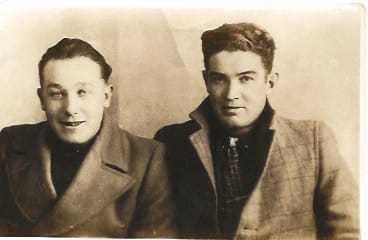
  • John  and unknown person

    John and unknown person

    John and unknown person

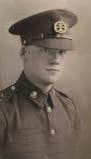
  • John in Irish Army in 1934

    John in Irish Army in 1934

    John in Irish Army in 1934

  • John in Operation Bluecoat in Anthony Beevor Book

    John in Operation Bluecoat in Anthony Beevor Book

    John in Operation Bluecoat in Anthony Beevor Book

  • John with baret at the back in jeep in Antwerpen in 1944

    John with baret at the back in jeep in Antwerpen in 1944

    John with baret at the back in jeep in Antwerpen in 1944

Photo’s of his letters

  • Letter to Jerry July 1944

    Letter to Jerry July 1944

    Letter to Jerry July 1944

  • Letter to Brigid July 1944 page 1

    Letter to Brigid July 1944 page 1

    Letter to Brigid July 1944 page 1

  • Letter to Brigid July 1944 page 2

    Letter to Brigid July 1944 page 2

    Letter to Brigid July 1944 page 2

  • Letter to Brigid July 1944 page 3

    Letter to Brigid July 1944 page 3

    Letter to Brigid July 1944 page 3

  • Letter to his friend Markie

    Letter to his friend Markie

    Letter to his friend Markie

  • Letter to his friend Markie

    Letter to his friend Markie

    Letter to his friend Markie

  • Letter to Brigid 1941 page 1

    Letter to Brigid 1941 page 1

    Letter to Brigid 1941 page 1

  • Letter to Brigid 1941 page 2

    Letter to Brigid 1941 page 2

    Letter to Brigid 1941 page 2

  • Letter to Brigid 1941 page 3

    Letter to Brigid 1941 page 3

    Letter to Brigid 1941 page 3

  • Letter to Brigid 1941 page 4

    Letter to Brigid 1941 page 4

    Letter to Brigid 1941 page 4

Photo’s after his death

  • Mass card John O'Neill

    Mass card John O’Neill

    Mass card John O’Neill

  • Location temporary burial place in Stevensbeek

    Location temporary burial place in Stevensbeek

    Location temporary burial place in Stevensbeek

  • Ladies from the village visiting the grave

    Ladies from the village visiting the grave

    Ladies from the village visiting the grave

  • Stevensbeek Monastry

    Stevensbeek Monastry

    Stevensbeek Monastry

  • Maria Regina Nunnery in Stevensbeek

    Maria Regina Nunnery in Stevensbeek

    Maria Regina Nunnery in Stevensbeek

  • Maria Regina Nunnery now in Stevensbeek

    Maria Regina Nunnery now in Stevensbeek

    Maria Regina Nunnery now in Stevensbeek

  • A Bloody Victory cover of the book by Dan Harvey with photo of John O'Neill in Jeep

    A Bloody Victory cover of the book by Dan Harvey with photo of John O’Neill in Jeep

    A Bloody Victory cover of the book by Dan Harvey with photo of John O’Neill in Jeep

  • Relatives of John visiting his grave in Overloon

    Relatives of John visiting his grave in Overloon

    Relatives of John visiting his grave in Overloon

Sources and credits

FindMyPast and Ancestry for Military records, census data, English birth, marriage and death records
Commonwealth War Graves Commission records
Irish National Archives for the 1926 Census
Information on the family from the Annals of Beara by Riobard O’Dwyer from Malc Sutton
Heritage Cork Website – Bere Island – articles on Life in the 1930s by Jim “Sonny” Murphy and Inside the Red Line by Joe Cahill
History Ireland Website for information on the Volunteer Force
The Irish Story Website for information on the Economic war 1932-38 by John Dorney
Wikipedia for information on Bere Island, Anglo Irish Treaty, Irish neutrality in WW2, General Service Corps, 4th Bn Royal Northumberland Fusiliers, 11th Armoured Division, 185th Infantry Division,
Gloucester Citizen 12 August 1941
Service Record for John O’Neill from the National Archives via his nephew, John O’Neill
Researching the Lives and Records of WW2 Soldiers – website – information on No 25 PTC
Vickers MG Collection and Research Association website for information on No 24 MGTC
Traces of War Website for War Diaries of 159 Brigade, 185 Brigade, 15/19 The King’s Royal Hussars, 3 Monmouth Regiment, 2 Fife and Forfar Yeomanry, 4 KSLI, 2 KSLI
Normandy  War Guide Website for War Diaries of 3 Royal Tank Regt,75th Anti Tank Regiment,
Staffordshire Sentinel of 1 Nov 1944
Piet Peters and Hugo Levels for access to the RNF 2 Independent Machine Gun Company War Diary
Photographs of John O’Neill and Family, Letters of John O’Neill to his brother Jerry and family research thanks to his nephew, John O’Neill
Letters written by John to his sister Brigid from her daughter, Sarah Bermingham
Letter from John to Markie O’Sullivan courtesy of his son, Christopher O’Sullivan
Assistance from Andy O’Neill, Con O’Neill’s grandson
After Antwerp, the long haul to victory : the part played by 4th Bn King’s Shropshire Light Infantry in the overthrow of the Third Reich September 1944 to May 1945 by Ned Thorburn
Antony Beevor’s D-Day: The Battle for Normandy – possible photo of John
Photo of John on cover of Dan Harvey’s “A Bloody Victory, The Irish at War’s End: Europe 1945”
Photographs of the temporary graves at Stevensbeek and information on the RAP and temporary cemetery from Henk Pouwels.
Assistance from members of the Bere Island Facebook Group – and assistance from Annemarie Healy in finding this group

Research Elaine Gathercole
Continue reading

Tannock William

Tannock | William

  • First names

    William

  • Age

    21

  • Date of birth

    13-11-1924

  • Date of death

    18-11-1944

  • Service number

    2765552

  • Rank

    Corporal

  • Regiment

    King’s Own Scottish Borderers, 1st Bn.

  • Grave number

    II. B. 12.

Grave William Tannock

Grave William Tannock

Grave William Tannock

Biography

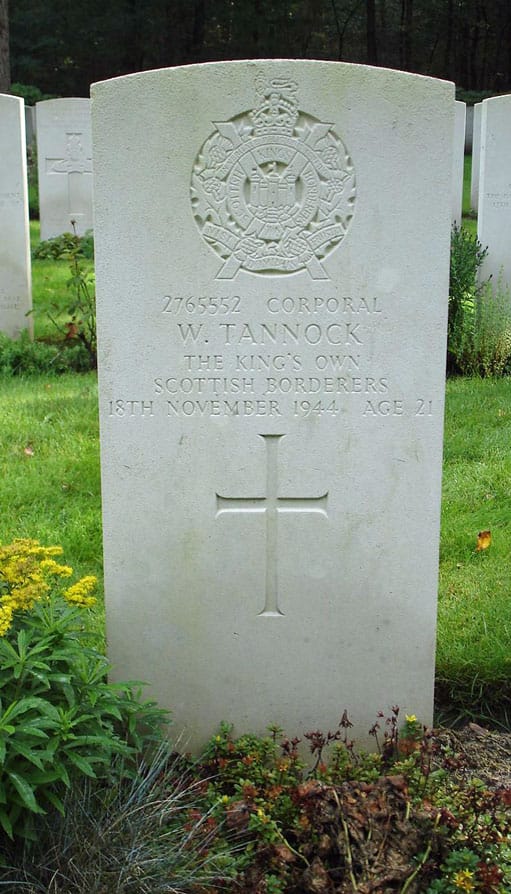
William Tannock was killed in action on 18 November 1944. He was a Corporal in the 1st Battalion of the King’s Own Scottish Borderers (Service No. 2765552), aged just 20. He was initially buried at Cemetery A. vd Wijst in Overloon and re-interred on 13 May 1947 in grave II. B. 12 in the Overloon CWGC Cemetery.
 
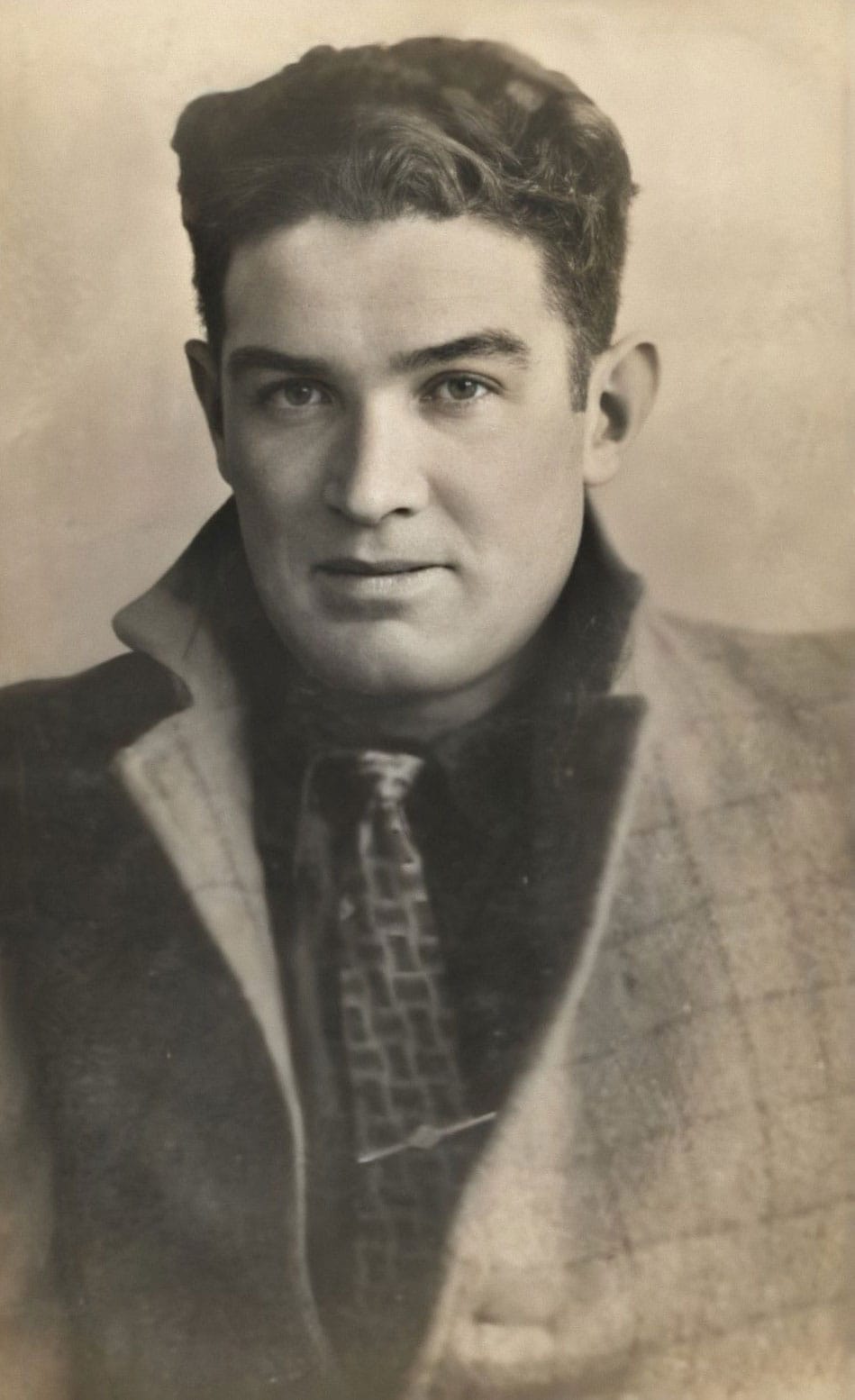
No photo of William has yet been found. Should anyone reading this have a photo of him or further information regarding him – or if they are aware of any errors in his biography below can they please contact the Foundation.

Family Background

William Tannock was born on 13 November 1924 at 35 Graham Avenue, Radnor Park, Clydebank.

His parents were James Tannock and Elizabeth Meredith who had married on 3 March 1899 at St Thomas’ Manse in Leith. This was under the auspices of the Church of Scotland. James was 24 and working as a Carter and Elizabeth (known as Lizzie) was 18 and a Millworker. They were both living at 6 Giles Place, Leith at the time.
James’ father was given as John Tannock, also a carter, and his mother was Agnes Tannock (nee Duff). Lizzie’s father was William Meredith, a mason, and her mother was Agnes Meredith (nee McLean).
 
Their first son, John, was born on 31 December 1899 at Railway Huts, Fountainhall, Stow which is near Galashiels in the Scottish Borders. His father was still working as a carter. The address may suggest his work was connected with the railway. Oddly, the family could not be found in the 1901 Census.
 
They had a second child called David on 12 January 1902 at Kerse Lane in Falkirk, Stirlingshire. James was now working as a Rope Runner. However, just a few weeks later, on 27 February, their first child, John, died of Bronco Pneumonia which he had been suffering from for 7 days. Although James was described as a Rope Runner at David’s birth, he was now described as an Engine Driver.
 
A third child called William was born in 1904 at 27 Main Street, Ayr. James was working again as a Carter. Another child called Mary was born on 1 May 1906 at High Pleasance, Falkirk. James was back working as a Rope Runner at this time. On 28 July, 1907, another child, James, was born at 6 Eastvale Place, Glasgow. James was now working as a Waggon Shunter.
 
However, on 22 September 1907, not long after James’ birth, his sister Mary died aged just 16 months at Belvidere Hospital in Glasgow of Varicella Cerebral Congestion – a complication of chickenpox. James was described as a Contractor Labourer. Just a few weeks later, on 15 October 1907, William aged 3 years also died, this time in at Ruehill Hospital of cerebro – spinal fever. This is now called bacterial meningitis. James was now described as a Dock Labourer. The family address at the time of these deaths was still 6 Eastvale Place, Kelvinhaugh in the Partick area of Glasgow.
 
A fifth child called Andrew was born on 20 January, 1910 at Chapel Place in Inverkeithing in Fife. James was now described as a General Labourer.
 
Once again, the family couldn’t be found in the 1911 census, suggesting they had not filled it in.
 
A sixth child, John, was born on 16 January 1912 at 33 Sherriff Brae, Leith. James was once again described as a Dock Labourer.
 
All this suggests a family who were continually on the move and that James’ work was often of a quite temporary nature.
 
By 1914, it seems that the family had moved to Gateshead in County Durham, England. Here, they had a daughter, Abigail, in 1914.
 
It seems that James enlisted at London in the Royal Engineers on 8 September 1915, during WW1. His service number was 118842. He was a Pioneer in the 7th Labour Battalion and was paid 3 shillings a day. His address on enlistment was given as 3 Bankfield Lane, Gateshead. His occupation was given as a Labourer. He stated that he was 42 years old, suggesting he was born around 1873. He had married on 3 March 1899. His wife, Elizabeth Tannock, was given as his next of kin. His four surviving older children were listed, but not his youngest child, Abigail.
 
He embarked with the British Expeditionary Force for France on 17 September 1915. However, he was admitted to hospital on 22 January 1916, probably somewhere near Rouen [or Argues]. He seems to have been moved from one hospital to another on 28 January and again on 10 February. He was finally transferred back to England on 12 February, arriving at the War Hospital in Bradford, Yorkshire on 13 February. It was stated that he was sick. One possibility is that he may have suffered from the effects of gas warfare. He was transferred to the 3rd Prov. Company on that date and then discharged on 7 April 1916 from Chatham as his service was no longer required. He had served for 244 days. On discharge, his age was now given as 44 and his occupation was as a Navvy. His intended place of residence was given as 4 Cook’s Yard, Off Bankwell Lane, Gateshead – the same address as that now given for his wife. His conduct was described as satisfactory and his military character as good. He was awarded the 1915 Star, British War Medal and Victory Medal.
 
He and Elizabeth went on to have another daughter, Elizabeth, in 1917 in Gateshead, but she died the same year. Another child, Robert Henry Tannock, was born on 16 May 1918 at 11 Cook’s Yard, Bankwell Lane, Gateshead. His father was once again described as a General Labourer. Another daughter, Agnes, was born in Middlesborough in 1921.
 
Once again, the family could not be found in the 1921 Census.
 
It seems that by 1924 they had returned to Scotland as Wiliam was born 13 November 1924 at 35 Graham Avenue, Radnor Park, Clydebank. Their last child, Ellen Tannock, was born in 1927 in Old/West Kilpatrick.
 
Between 1925 and 1939, six of William’s siblings married. David married Emily Johnston in Old/West Kilpatrick in 1925 and went on to have six children in the north east of England. James married Rose Wigmore in Old/West Kilpatrick in 1931 and had two children there in 1932 and 1933 but then had another in Yorkshire in 1940. They later lived in Birkenhead on the Wirral peninsula. Andrew married in 1929 in Old Kilpatrick and went on to have five children there. Abigail married John Gaughan in 1933 in Old/West Kilpatrick but no children were found. Robert Henry married Catherine Curran Robertson in Old/West Kilpatrick in 1939 and had one child in Belshill in Glasgow.

Military Career

William Tannock enlisted in Glasgow on 19 March 1941 and was despatched as a Private to the 70th (Young Soldiers) Battalion of the Black Watch (Royal Highland Regiment) at Milnathort. Milnathort lies between Perth and Dunfermline in Scotland. He stated that his date of birth was 2 February 1923, suggesting that he was 18. His service record stated that his birth certificate gave his date of birth as 13 November 1923, making him 17. However, his birth date was registered as 13 November 1924, suggesting he was actually only 16 when he enlisted.
 
His address was given as 35 Graham Avenue, Clydebank, Dumbartonshire which is the same street in which he was born. He and both his parents were Scottish. He named his father, James Tannock, at the same address as his next of kin, although this was changed to his mother at 166 Duntocher Road, Clydebank, possibly on 17 December 1943. His occupation was given as Labourer. However, this could not be verified as his employer’s business destroyed by enemy action. He was just under 5ft 6in tall and weighed 132 ½ lbs. He was described as having a fresh complexion, grey eyes and brown hair. His religion was Presbyterian. His educational grade was given as D and his medical condition was Grade 1.
 
It is interesting that he enlisted just 5 days after what is known as the Clydebank Blitz. This was a pair of air raids conducted by the Luftwaffe on the shipbuilding and munition-making town of Clydebank in Scotland. The bombings took place on 13 and 14 March 1941. The town was largely destroyed and it suffered the worst destruction and civilian loss of life in all of Scotland. 1,200 people died, 1,000 people were seriously injured, and hundreds more were injured by blast debris. Out of approximately 12,000 houses, only eight remained undamaged. Many industrial targets were severely damaged. It may be that this inspired him to join up – and may explain how his employer’s business had been destroyed.
 
On 15 February 1942, the 70th (Young Soldiers) Battalion of the Black Watch became the 1st Battalion Highland Regiment which was now William’s regiment. It was based at Broughty Ferry at the time. Broughty Ferry is just to the east of Dundee in the east of Scotland. This is the area in which the Battalion remained until mid November.
 
The transcript in the war diary of an item in the 1 o’clock news of 19 May 1942 told of a visit by a journalist to what he described as this “infant regiment” which had only just been formed. He said that the main purpose of this regiment was to ensure a steady flow of well trained youth and strength to its older brother regiments. He said that when they reached 20 every man was posted to another regiment. Most wanted to go to a Highland Regiment and most had an idea of which one they wished to go to. So far, all had got the one they wanted.
 
The troops spent their time training and carrying out various exercises. Men were regularly moved out to other Regiments while others joined the Regiment from elsewhere.
 
On 2 October 1942 William was fined 7 days pay for lending out a pair of boots without permission two days previously – a relatively minor misdemeanour.
 
Between 14 and 18 November 1942, the Regiment moved down to England. Most were stationed at Freckenham Camp near Bury St Edmunds in Suffolk. However, B and D Companies were sent to Wisbech in Cambridgeshire to work on the sugar beet harvest. B and D companies moved again on 28 November. B company moved to Littleport, north of Ely in Cambridgeshire while D Company continued with beet lifting at Haddenham.
 
William remained with this Battalion until 3 March 1943 when he was transferred to the King’s Own Scottish Borderers, presumably to the 1st Battalion which he was in at the time of his death. He was again still a Private.
 
Here he headed back to Scotland, as the 1st Battalion of the King’s Own Scottish Borderers transferred on 6 March 1943 to Acharacle on the Ardnamurchan Peninsula in western Scotland, having just been issued with extra clothing. They began training here on 8 March and the War Diary indicates that the purpose of the training was to harden the troops “and from the looks of the hills there isn’t much doubt that it will.”
 
However, between 23 and 26 March the Battalion transferred again to Stobs Camp at Hawick in the Scottish Borders where they remained until mid October 1943. Here their time was again spent training for what was to come.
 
While based here, they sometimes had spells in other locations. In particular, from 19 to 27 April nearly the whole Battalion spent time on Combined Operations Training at Inverary on Loch Fyne. Here they practiced landing exercises for what was to become D-Day. However, they were glad when they got back to Hawick as it had rained every day in Inverary. A major focus was training on firing ranges as they were required to be first class shots by 31 July. They also spent time on marches, sometimes of around 12 miles which they seemed to enjoy.  In early July most of the men were able to have around a week’s leave.
 
From 22 July to 9 August they were again at Inverary for more training on landings. The Battalion suffered the death of a Corporal Clark during a field firing exercise as he was hit by a 3in piece of mortar shrapnel. This time they started with 4 glorious days of weather before it started raining again, so they were again glad to be back at Hawick.
 
Various exercises in September were held jointly with the 2nd Battalion Lincolnshire Regiment and the 2nd Battalion Royal Ulster Rifles with whom they would fight in Europe.
 
Once again by early September one company was undertaking farming work, being distributed far afield such as to Yetholm near the English border, though it was said that the men seemed to enjoy it. They were officially thanked for helping to get the harvest in. On 1 October the War Diary reported that “The famers have returned to the fold.”
 
Another exercise away from Hawick took place from 5 to 13 October at Tighnabruaich. It was described as a tented camp in a sea of mud where many came down with ‘flu.
 
On 17 October the Battalion left Stobs Camp for Selkirk as they switched location with the 2nd Lincolnshires. Training continued here as usual. In early January 1944 the Battalion was again at a different location for around a week. This time it was at the Muir of Ord in North East Scotland in a tented camp where they were practicing landing and moving off a beach. Many men seemed able to take some leave in February 1944.
 
Towards the end of April the War Diary gets less explicit about locations. There was a briefing on 25 April for an operation, then on 29 April, a move was made to “different locations” in readiness for embarkation. During May, they seem to have been based in the south of England as there are references to the South Downs and Waterlooville. On 26 May, the camp was sealed and preparations began for Operation Overlord on 27 May. They moved to the marshalling area on 31 May and commenced embarkation on 4 to 5 June, but the operation was postponed for 24 hours.
 
They finally landed at Queen Beach on 6 June, first reaching the assembly area at Hermanville sur Mer and then moving first to Colleville sur Orne and then St Aubin D’Arquenay where they spent the night. The next day they moved to Periers sur le Dan in readiness for an attack on Cazelle. However, it was reported clear of enemy so they moved on to a wood just north east of Le Mensil. They remained on the left end of this wood the following day with the 2nd Battalion Royal Ulster Rifles on the right. They moved back to an assembly area near Le Mensil on 9 June while the 2 RUR put in an attack on Cambes. When they got pinned down, the 1st KOSB put in an attack which succeeded, but with some casualties. They consolidated in this area the following day.
 
Over the next days they suffered a degree of shelling causing some casualties. The Battalion operated patrols in various areas, sometimes encountering the enemy with casualties on both sides.
 
On 20 June the Battalion took over from the 2 RUR at Le Mensil in the Brigade reserve area. On 21 June approximately 15 enemy shells fell in the Battalion area killing 5 men and wounding 11 others. A casualty record indicates that William Tannock was wounded that day. It isn’t thought that this can have been very serious. While he was placed on a list indicating that he was away from his Battalion that day as a result there was no later mention of it.
 
The Battalion took over from the 2nd Lincolnshires at Cambes on 29 June and on 8 July took over form the 2nd KSLI at Le Homme before moving on to near Lebisey. This was in preparation for an attack with the Canadians and the 2 RUR on Caen the next day. They cleared the town with little difficulty and were welcomed by the French people. They then moved to Plumetot for a rest period before moving to Breville on 16 July.
 
On 18 July, they moved to an assembly area at Le Mensil before commencing an attack towards Troarn. They made some progress but faced strong opposition. The attack continued the following day but had to withdraw back to their previous position due to heavy casualties. On 31 July they moved to the army reserve at Bieville.
 
On 2 August they moved to Longraye then to an area north of Foret D’Eveque two days later. On 6 August they succeeded in taking Montisanger without facing any opposition. On 8 August they moved to La Groudiere then La Planche. On 9 August they successfully attacked Vire along with the 2 RUR. The Battalion nearly had to get involved in an attack on Tinchebray but other Regiments were successful, allowing the Battalion to stay in reserve. On 13 August they took over at Viessoix. On the 16th  they moved towards Tinchebray then Flers but the enemy were withdrawing. On the 17th they swept a large area south of Flers. They found a holiday atmosphere and were covered in flowers. On 20 August they moved on to La Chapelle au Moine. While there, they had a draft of 3 officers and 60 other ranks – some of whom were from the Battalion who had previously been wounded. On 22 August, William was appointed to the rank of Lance Corporal.
 
On 3 September they moved 147 miles to Hacqueville south west of Rouen. They were still in reserve. On 6 September they moved a short distance to Etrepagny. On 16 and 17 September they moved on into Belgium, by passing Brussels and reaching an area to the south of the Meuse Escaut Canal near Lille St Hubert. On 19 September the 2 RUR and 2 Lincs were the assault battalions charged with crossing the canal with the 1 KOSB following. They reached Achel by the 20th and were welcomed by the population.
 
They entered the Netherlands on 21 September at Budel, where the troops were again given a great welcome by the inhabitants. On 22 September, William was appointed to the rank of Corporal. They moved on to Liessel on 24 September where they undertook patrols of the area east of the Deurne Canal.  On 28 September the Battalion took up positions further north covering a cross roads at Milheeze, then on 1 October they moved further north again to St Hubert where they were again very well received by the inhabitants. They remained here until 12 October carrying out patrols but also undergoing training and having time to relax a little.
 
The rapid push up through Belgium and the Netherlands had been in support of Operation Market Garden where airborne troops had landed with the aim of taking several key bridges, with the infantry drive being in support of the attack. However, this failed when it proved impossible to take the bridge at Arnhem. It had left the allies in a very narrow salient with threats from both east and west. It was decided to try to clear the enemy back to the Meuse by capturing Overloon and Venray to the south.
 
On 12 October they moved to an area just west of St Anthonis. On this day the 8th Brigade attacked towards Overloon and by 1700 hours the 1st Suffolks had captured the town and had taken up a position just to the South of it. On the 13 to 15 October the Battalion took part with other Battalions in clearing woods to the west and south of Overloon. During this action 3 men were killed and 12 were wounded. The following day the Battalion continued south through more woods, but that afternoon they were ordered to take over the positions of the 4th KSLI east of Overloon in the Smakt area. During the take over one man was killed and 3 wounded by Nebelwerfers (Moaning Minnies).
 
They remained in this position until 4 November.  From here, they could patrol the area west of the railway line and observe movements of Germans on the east side and target them. They were often heavily shelled and mortared but also made good use of the Artillery to retaliate. Mines on the railway crossing points prevented attempts to cross the railway. On one occasion, on 22 October, when a platoon did cross to see if the enemy had withdrawn from the houses in Smakt, they were surprised by enemy machine guns concealed in the houses. One officer and 19 other ranks were presumed killed or taken prisoner with only 5 being able to escape. In this period 33 men were wounded, 10 were killed and 21 were missing.
 
On 4 November the Battalion handed over to the 2 Royal Ulster Rifles and 2 Lincolns and moved to just outside St Anthonis. Here the routine was 48 hours rest and sleep, and the remaining 72 hours spent in cleaning weapons, ammunition and kit and checking stores and equipment. Some enjoyed 48 hours in Brussels, and most could attend the cinema in Mill.
 
They remained near St Anthonis until 9 November when they moved back to the Overloon area. On 14 November they moved into positions west of the railway line in the area of Smakt which were held by the 2 Lincolns. The take over began before first light when they took over exposed forward positions and standing patrols thought to be under enemy observation. The take over was completed by 1415 hrs. However, Cpl Drummond, who is also buried at Overloon, was killed by a sniper that afternoon.
 
Again, while in this location, they faced the threat of the enemy from across the railway line and from attempts by the enemy to cross it. There was also a certain amount of shelling from across the line.
 
The War Diary entry for 18 November states the following: “A fairly quiet morning. During the afternoon the forward Coys were heavily mortared, Cpl Tannock of A Coy being killed.”
 
He was initially buried near houses today at Schaartven along with 9 other men from his battalion and 11 others from other battalions. All were reburied in Overloon on May 13, 1947.
 
William had served for 3 years and 245 days of which 167 days were in North West Europe. He was awarded the following medals: 1939/45 Star, France & Germany Star and the Defence Medal. He is commemorated on the Clydebank War Memorial.
 
His remaining personal effects which consisted of a wallet, hair clasps, letters and photos were later returned to his parents at 166 Duntocher Road, Parkhill, Clydebank, Scotland.

Other Family Members in WW2

William’s brother, Robert Henry Tannock, was also involved in WW2. He was a Private in the 7th Battalion Seaforth Highlanders (Service No. 3133574). He was already in the Army at the time of the Clydebank Blitz in March 1941. He was put in detention around that time for going absent without leave and “losing the King’s property.” He had taken his wife who was pregnant with their daughter to a place of safety, away from the danger of the blitz. He had made her wear his tin helmet. This took more days than his leave allowed, hence his punishment. 
 
His Battalion sailed for France on 16 June, 1944 as part of the 46th (Highland) Infantry Brigade of the 15th (Scottish) Division. Their first major action was Operation ‘Epsom’, the attack to seize the crossings over the river Odon, in preparation for the advance south from Caen. This action lasted for 5 days from 26 to 30 June. On 30th June, after failing to make the decisive breakthrough around Caen, General Montgomery called a halt to ‘Epsom’. In this operation 34 men were killed, 147 wounded and 22 were missing. Robert Henry Tannock died of wounds on 2 July, 1944. It is likely that he was wounded in his operation. He is buried in grave VII.F.10 at Ryes War Cemetery in Bazenville.
 
Their elder brother, John, also served in WW2. At some stage he was in the Palestine Police. After the war he was stabbed in the back for singing “Oh Christmas Tree” which sounded like The Red Flag to the stabber.
 
It is thought that their sister, Abigail’s, husband also served in the war and it is believed that Abigail herself served in some capacity as she was good with machinery.

Aftermath

Willliam’s two youngest sisters married in 1948. Agnes married William Chapman in Old/West Kilpatrick and Emily married David Moyes in Clydebank.
 
Agnes is thought to have gone on to have two children in Newcastle while Emily had two in Dumbartonshire.
 
William’s Brother John felt a responsibility for his deceased brother Robert’s wife and child. She agreed to marry him but, as she was a Catholic, they had to get special dispensation from the Pope to do so. They married in 1950 in Milngavie in Glasgow. Catherine went on to have a second child with John.
 
William’s mother, Elizabeth Tannock, died aged 70 on 7 October 1952 in the Western Infirmary in Glasgow. Her address was given as 20 King Street, Clydebank. Her husband was described as James Tannock, Contractor’s Labourer. Her death was registered by her son who lived at 21 Craigend Drive, Milngavie.
 
His father, James Tannock, died in 1960 at the Henry Brock Hospital, Alexandria, Anderston, Lanarkshire. His address was given as 20 King Street, Whitecrook, Clydebank. His son, Andrew, of 166 Duntocher Road, Parkhall, Clydebank registered the death.

Sources and credits

From Scotland’s People, FindMyPast and Ancestry websites: Civil and Parish Birth, Marriage and Death Records; Census Records, Electoral Rolls; Military Records
King’s Own Scottish Borderers website
1st KOSB War Diaries  (Royalscotskosbwardieries)
The Highlander Museum website
War Diary 7th Seaforth Highlanders
Wikipedia Clydebank Blitz
From Amanda Scheffer Scheffer/Hair family tree on Ancestry
William Tannock’s War Record from Philip Tannock,(National Archives ref WO 423/555361)
Assistance from: Philip Tannock, Frank Skelly, Catherine Lee (great nephews and great niece of W. Tannock)

Researchers: Nicole van Loon, Elaine Gathercole

Continue reading

Roberts Dennis

Roberts | Dennis

  • First names

    Dennis

  • Age

    26

  • Date of birth

    14-04-1918

  • Date of death

    12-10-1944

  • Service number

    3653314

  • Rank

    Lance Serjeant

  • Regiment

    South Lancashire Regiment, 1st Bn.

  • Grave number

    IV. B. 9.

  • Dennis Roberts

    Dennis Roberts

    Dennis Roberts

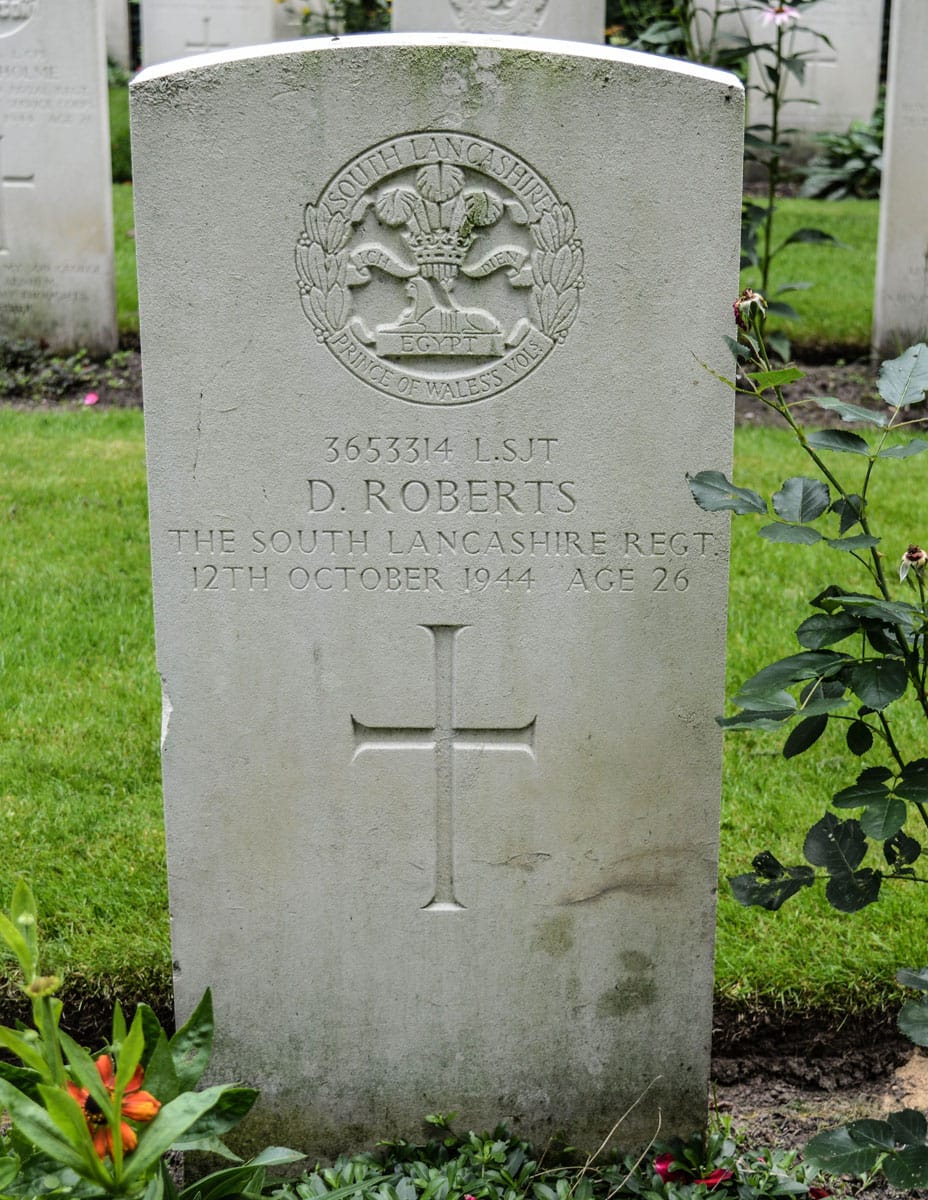
  • Grave Dennis Roberts

    Grave Dennis Roberts

    Grave Dennis Roberts

Biography

Dennis Roberts was killed in action on 12 October 1944 in the vicinity of Overloon. He was aged 26 at the time. He was a Lance Sergeant in the 1st Battalion of the South Lancashire Regiment (Service No. 3653314). He was initially buried 2km west of Overloon, south of the Overloon to Oploo road and re-interred on 27 May 1947 in grave IV. B. 9 in the Overloon CWG Cemetery.

Family background

Dennis was the son of Robert Roberts and Annie Catherine Patrick who had married in Bangor, Caernarvonshire in Wales in 1906.

Robert was born on 23 April 1882 in Bangor and Annie on 28 June 1883 in Llanllechid near Bangor.

They had children as follows: Eirwen b1907, David Glyn b 1909, Catherine b 1910, Idris b 7 June 1914 and Dennis b 14 April 1918. Eirwen and David were born in Llandygai just outside Bangor and Catherine and Idris in Pontypridd, suggesting the family moved there between 1909 and 1910. Dennis was born in the West Derby district of Liverpool, suggesting that the family had moved from Pontypridd to Liverpool between 1914 and 1918. Eirwen was brought up by her grandparents though visited the family often.

In 1911 Robert and Annie were living with David and Catherine at 5 Berw Road Pontypridd, Glamorganshire. Robert was working as a Carter in the building trade.

By June 1921, Robert and Annie were living at 61, Freeland Street, Kirkdale, Lancashire with David, Catherine and Dennis. Robert was working as a Match Room Foreman for Maguire, Patteson & Parmer, Match Manufacturers.

Dennis’ sister, Catherine, married John McKenzie in 1929 in Liverpool. They had two children. Sadly, Dennis’ brother David died in 1934 aged just 24 and his sister Catherine died in 1935, also aged 24, both in Liverpool.

Military career

On 14 April 1936, which was his eighteenth birthday, Dennis enlisted as a Private at Liverpool in the 1st South Lancashire Regiment (The Prince of Wales’ Volunteers). He signed up in the Regular Army under their normal terms of engagement which was for 7 years in the colours then 5 years in the reserves.

Prior to enlisting he had been working as a Milk Roundsman. He was described as being 5 ft 3 ¼ in tall with a fresh complexion, blue/grey eyes and auburn hair and was considered medically fit.

His parents were living at this time at 25 Moss Street, Garston, Liverpool.

He seems to have successfully passed examinations on 9 July 1936 and 20 March 1937. He was appointed as a
Lance Corporal on 17 November 1937 and promoted to Corporal on 1 May 1939.

Britain had declared war on Germany on 3 September 1939. At this time, the 1st Battalion of the South Lancashires were based at Dover.

On 18 September, Dennis married Annie Harle Bishop at Dover Registry Office. Annie had been born in 1919 in West Derby, Lancashire to James and Ethel Bishop. In 1921 she had been living with her parents and sister at 44, Manningham Road, Liverpool, Walton on the Hill, Lancashire. Her father had been born in Liverpool in 1884 and her mother in 1892 in Pelton, County Durham. Her father was a Water Manufacturer but was out of work at the time.

Dennis’ Service Record seems to give her address initially as 26 Burman Road, Allerton, Liverpool 19 but this was later crossed out and replaced by 259 Old Chester Road, Lower Tranmere, Birkenhead.

In September 1939, Dennis’ parents were living at 3 Springwood Avenue, Liverpool with their son, Idris. Robert was employed as a Match Machine Attendant but was on a pension due to ill health. Idris was a General Labourer. An unnamed child was also present, probably a grandchild.

Dennis was sent to France on 6 October 1939 with his Battalion as part of the British Expeditionary Force. He was evacuated from Dunkirk on 1 June 1940.

However, he was declared a deserter on 19 June 1940, rejoining his unit on 16 July 1940. He was tried for deserting on 29 July 1940. He was found not guilty of deserting but was found guilty of being absent without leave. He was sentenced to undergo Field Punishment for 56 days and reduced to the ranks. He was sent to the Detention Barracks in Hull on 5 August 1940, though may have returned to his unit on 12 August to serve the rest of his sentence. It is likely that his incident may have been a result of trauma he had experienced in France.

On 15 October 1940 he was again appointed as a Lance Corporal suggesting that he was still considered to be a good soldier.

On 5 February 1941 he was transferred to the 8th Battalion of the Northumberland Fusiliers. He was admitted to a Casualty Reception Station on 28 March and discharged on 9 April. On 17 April he was admitted to Shaftesbury Military Hospital. He was transferred to Battle Hospital in Reading on 25 April and discharged from there on 5 May. The reason for his admission to hospital is not known.

While in hospital, on 30 April 1941, he was posted to the 3rd Battalion of the Reconnaissance Regiment. However, just over a week later, on 10 May 1941, he was transferred back to the 1st Battalion of the South Lancashire Regiment.

He passed a test as a Specialist Driver In Charge (wheeled) on 12 June 1941 and was promoted to Acting Corporal on 11 September 1941. It was converted to a War Substantive position on 10 December 1941 as he had held the acting rank for 3 months. However, on 29 December 1941 he was severely reprimanded and forfeited 2 days’ pay for absence.

Dennis and Annie had a daughter in Dorchester, Dorset late in 1941. His absence may have been to enable him to see his daughter.

On 31 July 1942, he was attached to the 4th Anti Tank Regiment of the Royal Artillery at Hitchin. However, on 11 August he was admitted to Chalk Dell Hospital in Hitchin, being discharged from there on 25 August. He was granted leave from 31 August to 9 September 1942.

He was admitted to the “9th Field Ambulance” on 28 January and discharged on 4 February 1943. This suggests he had again had an injury or illness.

He seems to have only had around one or two weeks leave in each year of the war.

The Battalion embarked for North West Europe on 3 June 1944, landing at Sword Beach on D-Day, 6 June. At this time, the 1st Battalion of the South Lancashire Regiment was part of the 8th Infantry Brigade (which included the 1st Suffolk Regiment and 2nd East Yorkshire Regiment) attached to the 3rd Infantry Division, nicknamed Monty’s Ironsides.

Dennis was appointed as Lance Sergeant on 10 June.

He was wounded on his right knee by a mortar on 25 June. At this time, the Battalion was based at Le Landel during the attack on Chateau de la Londe which was part of the battle for Caen. He returned to the UK on the 26th to be admitted to the Royal Hampshire County Hospital. He was placed on what was called the Y List for men away from their regiments due to sickness, hospitalisation etc. At that point, his rank reverted to War Substantive Corporal.

He was posted to the 5th Infantry Division on 11 July 1944 and there were plans to transfer him to 103 Reinforcement Holding Unit on 24 August, but this was cancelled. He was posted back to the 1st Battalion of the South Lancashire Regiment on 4 October 1944 in North West Europe.

Meanwhile, the 1st South Lancashires had continued to play its part in the war in Normandy then from 16 to 18 September they moved through Belgium to reach Lille St Hubert, just south of the Dutch border south of Eindhoven. They reached Weert in the Netherlands by the 22nd.  On 27 September they moved on again to reach Bakel which is just north east of Eindhoven. The following day they moved again slightly further north to Mortel to allow the American 7thArmoured Division to occupy the area at Bakel. The Americans were moving through to St Anthonis. The Battalion remained at Mortel until 1 October when they moved further north to Heumen which is just south of Nijmegen and north of Cuijk and then to nearby Mook on 3 October. It was while they were in Mook that Dennis will have re-joined them.

By this time, Operation Market Garden further to the north had failed to take the bridge at Arnhem. This left the Allies in a narrow corridor through the Netherlands. An attempt had been made by the American 7th Armoured Division on 30 September to widen this corridor east to the River Meuse by attacking Overloon from their position at St Anthonis, but this attack had failed.

The 1st Battalion of the South Lancashire Regiment remained at Mook until 8 October when they moved south to Wanroy. It had been decided that the Americans were to withdraw and leave widening the corridor through Overloon, Venray and Venlo to the British. Initially, it was intended that the attack on Overloon would begin on 11 October. However, this was postponed until 12 October due to the very wet weather and ground conditions.

On 12 October the attack started at noon with a very heavy artillery barrage. The 2 East Yorks led the attack on what was described as Dog Wood to the west of Overloon while the 1 Suffolks targeted Overloon itself. Both achieved their objectives by 1500 hours, but with some mopping up still to do. The 1 South Lancs were initially held in reserve but at 1700 hours A and D Companies were ordered to advance to clear a remaining area with one troop of the 3 Grenadier Guards in support of each forward Company. B and C Companies and one further troop of Grenadier Guards were in reserve. They met very little opposition and by dusk were in position on the forward edge of a clearing. However, it was on this day that Dennis Roberts was killed in action along with five others from his Battalion who were killed that day and are now buried alongside each other. He died only eight days after rejoining his battalion.

Dennis was awarded the 1939-43 Star on 3 August 1944 and subsequently the France and Germany Star and Defence Medal. His wife was awarded a pension with an allowance for their child.

Dennis’ brother, Idris, had married Vera Mangin in 1944 in Liverpool, but died there aged just 31 in 1945.

Dennis’ father died in 1946 at 26 Burman Road Liverpool and his mother in early 1957. She is buried at Allerton Cemetery on Merseyside. Sadly, they had seen four of their five children die in their lifetime.

Annie Roberts went on to marry for a second time in late 1946 in Birkenhead. However, she died aged just 34 in 1953 in Wallasey, Cheshire. Her husband went on to remarry.

Dennis’ sister, Eirwen, married John Mervin Connolly in 1958 in Liverpool. She died in 1975.

Dennis’ daughter married and had two children.

Sources and credits

From FindMyPast website: Civil and Parish Birth, Marriage and Death Records; England Census and 1939 Register Records; Electoral Rolls; Military Records
“Researching WW2” website for help with Abbreviations used in WW2
1 South Lancashire Regiment War Diaries from Normandy War Guide and Traces of War Websites
Wikipedia for information on the 1 South Lancashire Regiment
National Army Museum for information on the 1 South Lancashire Regiment
Service Record for Dennis Roberts from the National Archives ref WO 423/487306
Photo from Dennis’ granddaughter via Findagrave and Ancestry
Assistance from Dawn Hughes (granddaughter of Dennis’ cousin).

Research Elaine Gathercole


Continue reading

Crouch Herbert

Crouch | Herbert

  • First names

    Herbert William

  • Age

    38

  • Date of birth

    10-06-1907

  • Date of death

    07-10-1944

  • Service number

    7930069

  • Rank

    Lance Serjeant

  • Regiment

    Royal Armoured Corps, Inns of Court Regiment

  • Grave number

    II. D. 12.

  • Herbert William Crouch

    Herbert William Crouch

    Herbert William Crouch

  • Grave Herbert Crouch

    Grave Herbert Crouch

    Grave Herbert Crouch

Biography

  
Herbert William Crouch was killed in action on 7 October 1944 in the vicinity of St Anthonis. He was aged 38 at the time. He was a Lance Sergeant in the Royal Armoured Corps, Inns of Court Regiment (Service No. 7930069). He was initially buried just east of St Anthonis at the premises of M. Jansen at Boxmeerseweg A 62 St Anthonis, Oploo and re-interred on 21 May 1947 in grave II. D. 12. in the Overloon CWG Cemetery. The inscription on his grave reads: “A life so nobly given has gone but is not forgotten.”

Family background

Herbert William Crouch (who was known to family and friends as Bob), was the son of Herbert Crouch and Emily White who had married in Brentford district, Middlesex in 1906. Herbert had been born on 25 June 1878 in Hanwell and Emily on 29 May 1876 in Southall Green. They had seven children, all in Hanwell as follows: Mabel Emily 1906, Herbert William 10 June 1907, Mary Louisa Minnie 1909, Sidney James 1910, Ethel M 1912, Percy O 1914 and Leonard A 7 July 1917.  However, Ethel died in 1913.
 
In 1911 Herbert and Emily were living at 59 St Dunstan’s Road, Hanwell with their first four children which included Bob. Herbert was a labourer who was building horses’ stables. Also present was Herbert’s widowed mother, Mary Elizabeth Crouch, who had been born in Oxford in 1842.
 
In 1921, the family were at the same address with their six surviving children. Herbert was now working as a temporary hand for the Superintendent of Central London District Schools. Their eldest daughter, Mabel, was working as a General Domestic Servant. Also present was Mary Pratt, a 73 year old boarder.
 
Bob married Mabel Florence Bloomfield in October 1931 in Hanwell Union Church. The West Middlesex Gazette described their wedding as follows:
“Crouch – Bloomfield
In Hanwell Union Church on Saturday the Rev JT Stevens officiated at the wedding of Mr Herbert William Crouch, eldest son of Mr and Mrs Crouch, of 59 St Dunstan’s Road, Hanwell and Miss Mabel Florence Bloomfield, eldest daughter of Mr and Mrs Bloomfield, of 25 Lawn Gardens, Hanwell. Mr Southcombe played appropriate organ pieces for the ceremony.
 
The bride in white crepe de chine with lace coatee and necklet of pearls held a shower bouquet of red roses. She was given away by her father, Mr Sidney Crouch brother of the bridegroom performing the duties of best man.
 
Miss Gwen Bloomfield (sister) and Miss Ivy Hickey acting as bridesmaids, wore green crepe de chine and lace, and crystal necklets, the gifts of the bridegroom, holding bouquets of cream roses. Blue silk, with hat to match and navy crepe de chine, trimmed with beige, with a navy hat, were worn by the bridegroom’s and the bride’s mothers respectively.
 
A reception was held in Hanwell Library, and a happy couple left to spend the honeymoon at West Malling, Kent, after which they will live at 106 Beresford Avenue, Hanwell”.
 
Mabel was the daughter of William Chapman Bloomfield and Charlotte Florence Birkin who had married in 1905 in the Lewisham district of London. William was born on 9 December 1880 in Lee in Kent while Charlotte was born on 22 June 1879 in Kensington, London. They had three children as follows, all in Hanwell: Ernest Walter 1 February 1906, Mabel Florence 1 March 1907 and Gwendoline Emma 1908.
 
In 1911 William and Charlotte were living at 25 Lawn Gardens, Hanwell with Mabel and Gwendoline. William was working at a Licenced Conductor for a tram company. Their son, Ernest, was living with his grandparents, Chapman James and Emma Mary Bloomfield at 134 Fernbrook Road, Lewisham and his aunt, Carrie Emma Bloomfield. Chapman was a Greengrocer born in 1849 in Lee, Kent, Emma was born in 1851 in London and Carrie was born in 1879 in Lee and was an assistant in a fancy shop. In 1921, William and Charlotte were still living at 25 Lawn Gardens with all three of their children. William was still working as Tram Conductor for London United Tramways Co.
 
On 20 April 1938 Mabel’s sister Gwen, still of 25 Lawn Gardens, aged 30 and working as a nurse travelled from Liverpool to St John’s Newfoundland, Canada
 
In September 1939, Bob and Mabel were living at 65 Daryngton Drive, Ealing. Bob was working as a Printer. They seem to have been living with Lewis G and Moira E Ashby who had both been born in 1906. Lewis was a Storekeeper. There too were Mary E Ashby aged 7 and David F Ashby aged 3. Another unnamed child was present – but it is not thought that Mabel and Bob had any children.
 
At this time, Bob’s parents were still living in St Dunstan’s Road, but only their son Leonard was with them. Herbert was retired but available for work while Leonard was working as a Joiner Woodworker.
 
Mabel’s parents were living on their own, still at 25 Lawn Gardens and William was now working as a Trolley Bus Conductor.
 
An article in the Middlesex County Times of 28 October 1944 after Bob’s death gives more information about his life before the war:
“Lived to Help Others
Official notification has been received by Mrs H.W. Crouch of 17 Briarbank Road, Ealing, of the death of her husband – killed in action in Holland.
 
Sergt. Herbert W. Crouch was 38 years of age and the eldest son of Mrs Crouch and the late Mr H. Crouch, of 59 St Dunstan’s Road, Hanwell. ‘Bob’ Crouch, for as such he was known to all his friends, was educated at St. Mark’s School, Hanwell. At 12 years of age he became a member of the 16th Thames Valley Company Boys’ Brigade, which was attached to Union Church, Hanwell. This proved to be the beginning of a life lived chiefly for helping others, for he served the ‘16th’ for 10 years, with a keenness and loyalty that has seldom been equalled in the history of the company, and when, having held every non-commissioned rank, he finally accepted a commission, he filled his new position with dignity and great usefulness for several years.
 
At the time of his ‘call up’ for military service, nearly four years ago, he was showing great promise as outdoor representative from Messrs. Farmer and Sons Ltd of 295 Edgware Road, W2, a firm of printers and stationers with whom he had been apprenticed upon leaving school.
 
Ever a firm advocate of physical fitness, he was himself a first class athlete, and gained special prowess at gymnastics, football, high jump, etc. He was a ‘good sportsman’ in the truest sense.
 
He interested himself in associations of mutual benefit and was for several years a delegate to the London and Provincial Yearly Dividing Friendly Society, West London District, Jersey Lodge 42
 
Previous to the outbreak of war, he was a keen supporter of the movement for ‘worldwide moral re-armament’. He was for 20 years a member of the Union Church, Hanwell and held during that period several responsible positions i.e. assistant Sunday School Superintendent, Bible Class Leader, steward. Football Club secretary etc.
 
‘Sincerity’ was the keyword of all his service and his gay and buoyant spirit provided him with a capacity for helping and encouraging all those whose lives he touched.
 
Mrs Crouch wishes to express her very deep appreciation of the many tokens of sympathy she has received.
 
A memorial service will be held at the Union. Church at 6:30 PM tomorrow.”

Military career

It seems that Bob had enlisted in the autumn of 1940.
 
Between the wars, the Inns of Court Regiment consisted of one squadron of cavalry and two companies of infantry. The two infantry companies were converted to light tank cavalry squadrons in 1937 and two years later formed the Royal Armoured Corps Wing, Sandhurst. In 1939, the mounted squadron joined a cavalry training regiment in Edinburgh, but this was disbanded in 1940. From 23 January 1941 until 15 January 1943, the regiment was part of the 9th Armoured Division in Great Britain. From 1943, it was under the direct command of I Corps, the assault formation of 21 Army Group and later led the advance of 11th Armoured Division.
 
During the campaign in Northwest Europe of 1944–45, the Inns of Court, organised as an armoured car regiment, was the reconnaissance asset of I Corps. It was organised in four squadrons. Of these, C Squadron
landed on Juno Beach with the 3rd Canadian Infantry Division with the aim of advancing inland at speed to destroy the main crossings from Thury-Harcourt to a point five kilometres south of Caen and preparing four crossings on the Odon River for demolition. The other three squadrons did not arrive at Juno Beach until 30 June.
 
The Regiment played its part in the Battle for Normandy, involved in reconnaissance and other activities. On 28 August they crossed the Seine and ended the month around Amiens. Then began the advance up through northern France, Belgium and the Netherlands. The individual squadrons had different roles. Given what each was doing at the time of Herbert’s death, it is likely that he was in B Squadron.
 
Generally, the action in the first week of September was a push towards Antwerp. They then moved eastward, carrying out recces on various parts of the Albert Canal and patrolling it to prevent enemy movement to the south of it. By 19 September, D Squadron had moved into the Netherlands with the others following in the next few days. The move northwards continued between Eindhoven and Asten and Someren and then on to Helmond.
 
By the last few days of the month, the regiment had moved over to the west bank of the River Maas between Cuijk and Vierlingsbeek. Here they carried out patrols, often encountering enemy. However, by early October A and C Squadrons were back further south, taking it in turns to patrol between Deurne, Meijel and Liessel or to be in reserve. B Squadron continued to patrol the west bank of the Maas between Beugen, Boxmeer and Sambeek and D Squadron were in this same area but were in reserve on 7 October when Herbert was killed. It is therefore most likely that Herbert was in B Squadron.
 
By day Armoured Car patrols were maintained in each village with observation posts in church towers, windmills and convents. By night these patrols were withdrawn behind the railway line about 1,000 yards back from the river and the villages became “No Man’s Land” in which both sides patrolled, the Germans coming over the river by boat to steal food or, as stated in the War Diary, “ to renew amorous connections”.  Spasmodic shelling of the villages was carried out by the Germans, but the Regiment retaliated using their superiority in artillery.  These were the circumstances on the day Herbert was killed, probably somewhere near Boxmeer. This fits with where he was buried, slightly further back towards St Anthonis.

Aftermath

It seems that Bob’s father was spared hearing of his son’s death as he himself died on 30 July 1944, as announced in the Middlesex County Times of 5 August 1944:
“Crouch – On July 30, 1944, at 59, St Dunstan’s Road, Hanwell, W.7., Herbert, beloved husband of Emily Crouch, passed peacefully away in his 66th year.”
 
A major obituary to Bob immediately following his death has already been shown. However, a significant number of family members paid tributes to him in the Middlesex County Times of 6 October 1945 as follows:
 
Crouch – In everlasting memory of ‘Bob,’ H.W. Crouch (Sergt. R.A.C.) Who was killed in action on October 7, 1944, liberating the people of Antwerp.
He is one of many who have given their all, that we may have another chance to build a new world. O valiant heart.
His loving wife, Mabel.
 
Crouch – In proud and loving memory of my dear son and brother, Sergt. H.W. (Bob) Crouch, killed in action in Holland, October 7, 1944.
His smiling face and loving ways
Are pleasant to recall.
He always had a cheerful smile
And died beloved by all
From mum, brothers and sisters and Auntie Min.
 
Crouch – In loving memory of our dear brother, Sergt. Herbert (Bob) Crouch, killed in action in Holland, October 7, 1944.
Beautiful memories are all we have left.
We loved him too dearly e’er to forget
From Sid, Win and Janet.
 
Crouch – In loving memory of our dear brother, Sergt.  H.W. (Bob) Crouch, killed in action in Holland, October 7, 1944.
A loving brother, true and kind
He was to all in heart and mind
From Louie and Bill.
 
Crouch – In proud and loving memory of Bob, killed in action, Holland, October 7th, 1944.
All the joy you found in life, in such great measure you shared with those around you. Where you went was love, happiness, friendly speech and the laughter of little children.
Mum and Dad Bloomfield and Gwen.”
 
Bob’s mother, Emily Crouch, died in 1964 in Ealing and his wife, Mabel F Crouch, died in 1996 in Watford.

Sources and credits

From FindMyPast website: Civil and Parish Birth, Marriage and Death Records; England Census and 1939 Register Records; Electoral Rolls; Military Records; British Newspaper Archive
Wikipedia – Inns of Court Regiment
War Diary for Inns of Court Regiment from Traces of War
West Middlesex Gazette 3 October 1931
Middlesex County Times 5 August 1944
Middlesex County Times 28 October 1944
Middlesex County Times 6 October 1945

Research Elaine Gathercole, Tracey van Oeffelen


Continue reading

Know unto God three unknown airmen

Known unto God graven Overloon

FACES FROM THE PAST

Author: Arno van Dijk
 
The Commonwealth War Graves Commission cemetery in Overloon, popularly known as the English cemetery, contains 281 graves. Each with its own story. In this report series, the Overloon War Chronicles Foundation highlights such a special story every time. This time

Known unto God (? – 1943?)
Grave number 4, section IV, row A
 
Known unto God (? – 1943?)
Grave number 5, section IV, row A
 
Known unto God (? – 1943?)
Grave number 6, section IV, row A

The mystery of the three airmen

 “Be careful for nothing; but in every thing a prayer and supplication with thanksgiving let your requests be made known unto God.”
(Source: King James Bible, Paul’s letters to the Philippians, chapter 4, verse 6)

One of the mysteries at the Overloon War Cemetery concerns three British airmen buried next to each other in section IV.
But the identities of these three men remain unknown.
As far as is known, they crashed near the German city of Mönchengladbach in 1943.
It is also known that these three men were temporarily buried at the American cemetery in Margraten (South Limburg) and that they were transferred to Overloon after the war.
 
The story goes that the names, and therefore the identities, of these three men were known when they were buried in Margraten, but that something went wrong during the transfer to Overloon, so the names were not linked to their respective graves. As a result, the words “Known unto God” can still only be found on their headstones.
 
Who are these men? Can their names be traced somewhere? Where exactly did they crash and under what circumstances? And why did things go so wrong with the administration during their transfer to Overloon?

Read the full study below.

Mystery of the three airmen

Sources and credits

For all sources, see the full list in the study above.

Continue reading

Riches Charles

Riches | Charles Ernest

  • First names

    Charles Ernest

  • Age

    20

  • Date of birth

    13-01-1924

  • Date of death

    14-10-1944

  • Service number

    5892153

  • Rank

    Private

  • Regiment

    Lincolnshire Regiment, 2nd Bn.

  • Grave number

    I. B. 9.

  • Charles Ernest Riches

    Charles Ernest Riches

    Charles Ernest Riches

  • Grave Charles Riches

    Grave Charles Riches

    Grave Charles Riches

Biography

Charles Ernest Riches was killed on 14 October 1944 at Overloon. He was aged 20 and a Private in the 2nd Battalion of the Lincolnshire Regiment (Service No. 5892153). He was initially buried at the Vogelsangs Farm near Overloon and re-interred in grave number I. B. 9. at the Commonwealth War Grave Commission Cemetery at Overloon on 15 July 1946.

Family background

Charles Ernest Riches was the son of Pymer James Riches and Catherine McPherson Riches (nee Studdy).
 
Pymer James Riches had been born in the Medway district of Kent on 16 June 1869. He was the son of James Riches and Ann P Riches (nee Pymer). James had been born in 1829/30  and Ann in 1830/1, both in Wareham, Norfolk.
 
In 1871, James and Ann were living at Dale End, Chatham, Medway, Kent. James was working as a Telephone Line Man. With them were three children: Ann Lavinia born 1865 in St Giles, Cambridgeshire, William Foster born 1868 in Histon, Cambridgeshire and Pymer James himself who had been born in Chatham in 1869. This suggests that the family moved from Histon to Chatham between 1868 and 1869.
 
By 1881, the family had moved to 3, Warwick Place, Daventry, Northamptonshire. James was working as a Telegraph Clerk and so was in the Civil Service. The same three children were present plus a fourth, Arthur, who was born in Daventry in 1875. At this time Annie was working as a Boot Fitter while William was a Boot Rivetter.
 
In 1891 they were living at 40, Warwick Street, Daventry. James was now described as a Telegraph Pensioner. With them were children William and Arthur, working respectively as a Shoe Rivetter and Shoe Clicker, and a granddaughter, Emma Riches born in 1885 in Daventry. Annie and Pymer James were no longer at home. It isn’t known where Pymer James Riches was at this time.
 
Catherine McPherson Studdy had been born on 13 December 1877. She was the daughter of William Studdy and Elizabeth (or Isabella) Studdy (nee Guthrie). William had been born in 1837 in Walker (or Long Benton), Northumberland (now a part of Newcastle). Elizabeth had been born in 1836/7 in Belford, Northumberland. They had married in1861 in Newcastle.
 
In 1871 William and Isabella (as she was referred to then) were living at Campbell Street, Westgate, Newcastle upon Tyne. William was an Ale Porter Agent and Isabella was described as an Ale Porter Agent’s wife. With them were four children as follows: James William b 1863, Peter Robert b 1865, Mary Elizabeth b 1867 and Hugh McPherson born 1871. The first three were born in the Elswick area of Newcastle while Hugh was born in the St John’s area of Newcastle. Also present was a servant, Elizabeth Ann Chantler born 1853 in the St John’s area.
 
In 1881, William and Elizabeth were living at 8, Tindal Street, Westgate, Newcastle upon Tyne. William was now a Draper’s Assistant but was unemployed at the time. James, Peter, Mary and Hugh were still with them. However, two more children were present: Margaret A (Meggie) b 1874 and Catherine herself born in 1877  – both born in Newcastle. James was working as a Butcher and Peter as a Warehouseman Draper.
 
William Studdy died in Gateshead, County Durham in 1889.
 
By 1891, Elizabeth was therefore widowed and living at 105, Marian Street, Gateshead, Co. Durham. With her were her four younger children: Mary, Hugh, Margaret and Catherine. Hugh was working as a Provisions Warehouseman.
 
In 1895, Pymer James Riches married Catherine McPherson Studdy in the Chester le Street district of County Durham.
 
In 1901 Catherine Riches was living at 40, Saltwell Road, Gateshead, Co. Durham in the household of her widowed mother Elizabeth Studdy. Elizabeth’s son, Hugh McPherson Studdy, and a granddaughter Catherine McPherson Studdy born in Newcastle in 1893. Hugh was working as a General Cartman and was still single. With Catherine were her first two children: James William b 1897 and Mary Elizabeth b 1899, both in Newcastle (though Mary may actually have been born in Gateshead). Again, it isn’t known where Pymer was at this time.
 
By 1911, Pymer (now known as James) and Catherine were living at Redheugh Hall, Rose Street, Gateshead, Co. Durham. Pymer was working as a Horse Keeper to Colliery Bank. Their children, James  and Mary, were still with them as were four more children as follows: Sarah Allison b 1902, Meggie Ann b 1905, Catherine McPherson b 1907 and Elizabeth Fraser b 1909 – all born in Gateshead. James William was working as a Token  Lad (above ground).
 
Redheugh Hall had been part of the Redheugh estate which had existed since the 13th Century. The Hall was a late 17thCentury House. The setting of the house was ruined when the Newcastle and Carlisle Railway was built between the house and River Tyne. In 1835 the house was leased to a glass manufacturer from Newcastle. The railway was moved in 1839 but the estate was put up for sale in 1850 as building plots for villas. It was only sold after 1871 when the Redheugh Bridge opened, increasing access to the site from Newcastle. Much of the land was built on, but the Hall stood empty. In 1912 it was a storehouse, with hay held in the eighteenth century drawing room. Then it was sold to the Redheugh Colliery Company. It would be in this latter period when the Riches family lived in part of it.
 
Between 1917 and 1919 Pymer and Catherine had moved to Daventry in Northamptonshire. In June 1921 they were living at Drayton Grange. Pymer was now working as a Gardener for AW Priestly. With them were Sarah, Catherine and Elizabeth plus four more children: Edith Louise b 1911, Hilda Margaret b 1913, Dorothy b 1917 and Peter Robert b 1919. Peter was born in Daventry and the others in Gateshead. Their two eldest children and Meggie Ann were no longer at home. Another child, Ralph Allison Riches, had been born in Gateshead in 1915. In June 1921, he was a patient in the General Hospital, Billing Road, Northampton.
 
Charles Ernest Riches was born in Daventry on 13 January 1924. He was therefore the youngest of Pymer and Catherine’s twelve children
 
In September 1939, Pymer and Catherine were living at 10 Williams Terrace, Daventry. Pymer was now working as a retired Baker/Confectioner and Catherine was a Laundress. With them was Charles and an undisclosed record suggesting the presence of another child. This was likely to have been Hugh McPherson Bishop (known as “Mac”) who was the son of Pymer and Catherine’s daughter, Mary Elizabeth Riches. She had married Victor Bishop in 1916 and had two children, one of whom was Mac who was born in 1920. It seems her husband had abandoned her and she died in 1927, leaving her mother to bring up Mac. Charles was working as a Baker and Confectioner.

Military Career

The 2nd Battalion of the Lincolnshire Regiment served with the British Expeditionary Force (BEF) and returned from Dunkirk after the battles of France and Belgium in 1940. Charles will have been too young to have been in the Army at that stage. The Battalion then spent the next four years training in various parts of the United Kingdom before taking part in the D-Day landings in June 1944.
 
It is thought that Charles joined up in the Army around May 1943.
 
The Battalion landed in France on 6 June where they spent the night just south of Lion sur Mer. They engaged the enemy in areas north of Caen during June and early July.
 
It is known from a Casualty Record that Charles was wounded while in Normandy, but the exact date is not recorded. A total of 36 men from the same Battalion were similarly recorded as wounded on the same list. Those from other regiments on those lists were shown as wounded between 25 June and 13 July.
 
The Battalion was involved in Operation Charnwood on 8 to 9 July. This was intended to capture Caen. While it was a tactical success for the Allies, they lost 3,817 troops during the operation. It is likely that it was in this battle that Charles was wounded. The Battalion War Diary records that 113 Other Ranks were wounded and 23 killed on 8 July.
 
The Battalion moved on to fight in Operation Goodwood where a further 211 Other Ranks were wounded and 18 killed on 20 July. This is another possibility for when Charles was wounded. It is not known how severe his injury was or when he was able to rejoin his unit. The Battalion continued to fight in Normandy during August and early September before moving rapidly on into Belgium on 16 September and then Deurne in the Netherlands on 25 September. This was part of the Allied push towards Arnhem in Operation Market Garden which ultimately failed to take the bridge at Arnhem.
 
On 9 October 1944 the Battalion found itself in Haps, just south of Nijmegen and North of Overloon. It was to take part in Operation Aintree in the coming days with the aim of taking Overloon to the south and then Venray before finally eliminating a German bridgehead on the River Maas near Venlo. They were ordered to move south to St Anthonis on the 11th, but this was postponed to the 12th due to bad weather. The move was completed on the 12th and they then moved slightly further west on the 13th, though with one man killed and 3 wounded.
 
On the 14th, the plan was for B Company to be guided through a wood held by the Royal Ulster Rifles to its front edge from where they would carry out a recce to check if a stream was passable and if the north eastern corner of a wood to the south was held by the enemy. However, the guides were late and the move through the wood was slower than expected, so the recce did not take place. At 7.30am the Company began to advance south out of the wood under a 10 minute concentration of artillery fire. However, before the Company had advanced 100yds the enemy opened fire from a track about another 100 yds ahead. The advance continued and the track cleared of the enemy. This yielded about 10 prisoners and a few dead. As soon as the prisoners were clear, enemy defensive fire came down on the Company and four or five machine guns opened up from the left flank. 12 Platoon were ordered to advance under covering fire from 10 Platoon but in so doing lost about half their number. The Company Commander issued an order to retreat back to the Royal Ulster Rifles’ position. By this point one Lieutenant and 34 other ranks had been killed or wounded. It was decided to launch an attack at 1530 hours with D and A companies in the lead. The enemy had been seen moving in the area of the stream in front of the wood. It was thought that the enemy holding the Battalion objective were probably a Company strong. Immediately the attacking force came into the open they were subjected to intense artillery and mortar fire but they pressed steadily on to reach their objective. During this action the Battalion again suffered very heavy casualties. This was the day on which Charles Ernest Riches was killed in action.

Aftermath

His death was reported in the Newcastle Evening News of 3 November 1944. He was described as Private Charles E Riches, 2nd Lincolnshire Regiment, youngest son of Mr and Prs P J Riches, of 10 William Terrace, Daventry (late of Redheugh Hall, Gateshead).

It was also reported with his photograph in the Northampton Mercury  of 3 November 1944. It is thought to read as follows: “Official information has been received that Pte Charles Ernest Riches youngest son of Mr and Mrs Riches of William Terrace, Daventry has been killed in action in North West Europe. Pte.  Riches who was 20 joined the army over a year and a half ago before which he was a ?? in the Daventry Civil Defence Service. He attended Daventry Abbey School after which he was employed in Daventry Coal Supply. A boxer, Pte. Riches was a member of Daventry Boys’ Club. A brother L.A.C Peter Robert Riches is serving in the RAF.”

As seen in this article, Charles’ brother also served in WW2. So too did their sister Dorothy’s husband. He served in the Northampton Yeomanry alongside Charles and Peter’s nephew Mac who had been brought up with them almost as a brother as they were of similar ages.

Pymer J Riches died in Daventry in early 1945, just a few months after his son.

Catherine M Riches may have died in 1951 in Meriden Warwickshire.

Sources and credits

From FindMyPast website: Civil and Parish Birth, Marriage and Death Records; England Census and 1939 Register Records; Electoral Rolls; Military Records
Lincolnshire Regiment War Diaries via Traces of War Website and the Normandy War Guide Website
Wikipedia – information on the Lincolnshire Regiment and Operation Charnwood.
Newcastle Evening Chronicle of 3 Nov 1944
Photo and information from the Northampton Mercury 3 Nov 1944
Assistance from Beverley Whittaker, Charles’ niece.

Research Elaine Gathercole
  

Continue reading

Follow us

e-mail: overloonwarchronicles@gmail.com
address:
Holthesedijk 2 a, 5825JG Overloon

Chamber of Commerce: 83346422
Bank: NL04 RBRB 8835 3869 69
Stichting Overloon War Chronicles
BIC / SWIFT code RBRBNL21

©2021 Overloon War Chronicles