Wright Robert

Wright | Robert

  • First names

    Robert

  • Age

    23

  • Date of birth

    16-09-1921

  • Date of death

    14-10-1944

  • Service number

    11052155

  • Rank

    Private

  • Regiment

    King’s Own Scottish Borderers, 1st Bn.

  • Grave number

     IV. B. 2.

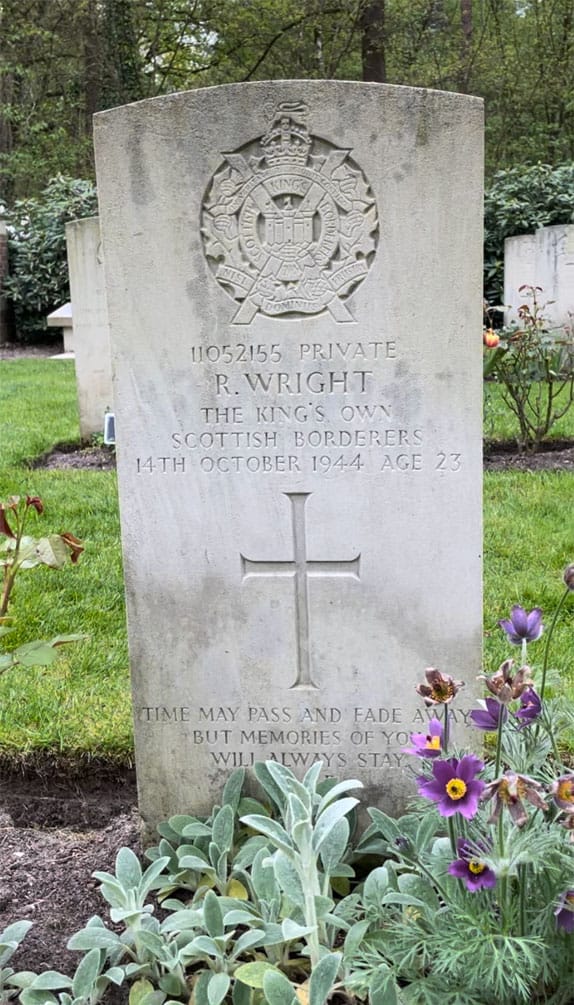
Grave Robert Wright

Grave Robert Wright

Grave Robert Wright

Biography

  
Robert Wright (Service Number 11052155) was killed in action on 14 October 1944. He was aged 23 and a Private in the 1st Battalion of the King’s Own Scottish Borderers. He was buried temporarily in the premises of the Widow Goemans near Overloon and re-interred on 27 May 1947 in grave IV. B. 2. in the Overloon Commonwealth War Graves Cemetery. The inscription on his grave reads “Time may pass and fade away but memories of you will always stay R.I.P.”

No photo of Robert has yet been found. Should anyone reading this have a photo of him or further information regarding him – or if they are aware of any errors in his biography below can they please contact the Foundation.

Family background

Robert was the son of William and Annie Wright, of South Moor, Stanley, Co. Durham.

William Wright married Annie Williams in 1904 in the Lanchester district of County Durham. William Wright was born on 2 March 1884 at Howden le Wear in Co Durham and Annie Williams on 9 August 1884 at Lamerton, near Tavistock in Devon.

In 1911 William and Annie were living at 66 Maple Street, South Moor, Stanley, Co Durham. William was working as a Coal Miner Stoneman. With them were children as follows: Elizabeth Jane 1904, Robert 1905, William 23 October 1906 and Stephanie 12 March 1909.  Elizabeth was born at South Moor, Stanley, Robert and William at Annfield Plain and Stephanie at West Stanley. However, young Robert died in 1916 in the Lanchester District aged just 10.
 
By June 1921 they were living at 81, Poplar Street, Stanley, Co. Durham. William was working as a Miner Pumpman for the South Moor Colliery Company. Lizzie Jane, William and Stephanie were still at home, but two more children had been born: Thomas in 1914 and Annie in 1917 in the same area. The second child named Robert Wright was born on 16 September 1921.
 
By September 1939 Annie and William were living at 17 William Street, Stanley, Co Durham. Only William and Robert were still with them. William (Snr) was not working as he was permanently sick. William (Jnr) was unemployed. Robert was working as a Bank Hand at a Colliery.

Military career

Robert Wright enlisted on 17 April 1941. He gave his address as 17 William Street, South Moor, Stanley, Durham. His father, William Wright, was given as his next of kin at the same address as Robert. Robert stated that he had been employed as a general labourer and his religion was Church of England. He was described as being 5 ft 6 ¼ in tall, weighed 120lbs, had grey eyes and light brown hair.
 
He was placed in the 236 Search Light Training Regiment of the Royal Artillery and was immediately posted as a Gunner to the 565 Search Light Battery Royal Artillery. The primary role of a Search Light Battery in the UK was to illuminate enemy aircraft for Anti Aircraft guns or night fighters to engage, although providing directional beacons for friendly aircraft was a valuable secondary role. The 565 Search Light Battery is thought to have been part of  53 Search Light Regiment.
 
On 2 March 1944 he was transferred from 53 Search Light Regiment to No 10 Infantry Training Centre of the Royal Scots Regiment as a Private. He was “put away” to the 10 Bn Cameronians on 13 June 1944. This means it was a temporary assignment, with the Royal Scots remaining as his home Regiment. He was posted to the X (iv) list of the 21stArmy Group on 11 August 1944 and from there to No 32 Reinforcement Holding Unit / 101 Reinforcement Group on 18 August. These postings mean that he was being held as a reinforcement, ready to be sent to a fighting unit when required.
 
He was finally sent to North West Europe on 18 August 1944. On 23 August 1944 he was transferred to the 1st Battalion King’s Own Scottish Borderers.
 
The 1st Battalion of the KOSB had landed on Queen Beach on D-Day, 6 June 1944. They had played their part in Operation Goodwood in July as part of the larger battle for Caen. The Battalion saw some action at Vire on 9 August but was held in reserve during attacks at Tinchebray. From 20 August to 3 September they had a period of training. It was during this period that Robert joined them as a reinforcement.
 
From 5 to 16 September they were in Etrepangy where they again rested, receiving a further 30 Other Ranks as reinforcements to add to the 6 officers and 91 Other Ranks they had already received since D-Day.
 
They then moved quickly past Brussels and through Leuven to support the 2nd Battalion of the Royal Ulster Rifles and 2nd Battalion of the Lincolnshire Regiment as they crossed the Meuse Escault Canal and on into Belgium and the Netherlands, reaching Milheeze on 28 September. At this point the war diary mentions that the bath unit arrived and “the whole battalion felt clean again for the first time since Etrepagny”, which was over 3 weeks previously.
 
On 1 October they reached St Hubert where they were very well received by the inhabitants. They remained there until 12 October. They spent their time training but also had time for relaxation. A soccer match was arranged against the Regiment’s 6th Battalion on St Hubert’s football field. They lost 4 – 1 and the Pipe Band played at half time and at the end of the match. They also had two film shows on the 10th and 11th. The diary notes that they left St Hubert on 12 October after a pleasant stay of 10 days.
 
On 12 October they reached an assembly area just west of St Anthonis. On that day, the 1st Suffolks succeeded in capturing Overloon and took up a position just to the south of the town.
 
At 1320 on 13 October, the Battalion began its attack on the western part of a wood south west of Overloon, south and west of the property known as Helderse duinen today. They started from a position just north of the east/west Overloon to Oploo road. One squadron of Churchill Tanks (4th Grenadier Guards), one squadron of Flail tanks and one squadron of Flamethrowers led the way. By 1700 hours the leading troops had succeeded in reaching a point about 200 yds from the southern edge of the wood and this is when the Battalion consolidated for the night. No enemy were encountered until the forward companies got into position, and then isolated machine guns opened up occasionally and continued to do so till an hour after nightfall. From the time that the whole Battalion was in the wood, the enemy put down fairly heavy artillery, mortar, and Nebelwerfer fire on the wood.
 
On 14 October, the Royal Ulster Rifles attacked the woods to the east of the Battalion and then consolidated their position. The Lincolns then passed through the RUR and put in an attack on a wood a bit further south of them. They were attacked by machine guns and suffered casualties, causing them to have to withdraw to the RUR positions. For the rest of the day, the enemy put down a large amount of fire on the Brigade area, quite a large proportion of which was from Nebelwerfers. In the afternoon, the Lincolns with two companies of RUR with heavy supporting artillery and machine gun fire succeeded in reaching their objective of a wood further to the south.
 
During this day, the 1st KOSBs explored further to the south and west corners of the wood where they were based, destroying two machine gun posts and killing six of the enemy and wounding others. Recce patrols also ascertained that there were enemy in a wood to the south and that a stream would present an obstacle to tanks. In was on this day that the Battalion had three men killed and twelve wounded from shelling and mortaring. One of the three killed was Pte. Robert Wright and another was Sgt. Alexander Gay Graham. Robert was initially buried on the premises of Widow Goemans while Alexander was buried on the premises of HJ Hendricks. Both are near the junction of Peelkampweg and Vredepeelweg, south west of Overloon. The third man killed was Private William Joseph Simmons who was initially buried a little further to the south in the wood. Alexander Gay Graham and Robert Wright were later re-interred alongside each other at the Overloon War Cemetery while William Joseph Simmons was later re-interred at Mook War Cemetery.
 
Robert’s next of kin was informed on 23 October 1944.
 
He had served for a total of 3 years and 181 days of which 58 were in North West Europe.
 
He was awarded the following medals: War medal, 1939-45 & France & Germany Stars and the Defence Medal.
 
It is thought that Robert’s mother, Annie Wright, died on 19 May 1953, and his father, William Wright, on 7 June 1955, both in Stanley.

Sources and credits

From FindMyPast website: Civil and Parish Birth, Marriage and Death Records; England Census and 1939 Register Records; Electoral Rolls; Military Records; British Newspaper Archive
King’s Own Scottish Borderers website
1st KOSB War Diaries (Royal Scots KOSB war diaries)
Wikipedia Moonlight Batteries Royal Artillery
Royal Artillery 1939-45 Website
Service Record WO 423/1231234 of Robert Wright from National Archives

Research Elaine Gathercole
  

Continue reading

Moore George

Moore | George

  • First names

    George

  • Age

    29

  • Date of birth

    09-05-1915

  • Date of death

    18-10-1944

  • Service number

    3769934

  • Rank

    Lance Corporal

  • Regiment

    South Lancashire Regiment, 1st Bn.

  • Grave number

    II. A. 8.

  • George Moore

    George Moore

    George Moore

  • Graf George Moore

    Graf George Moore

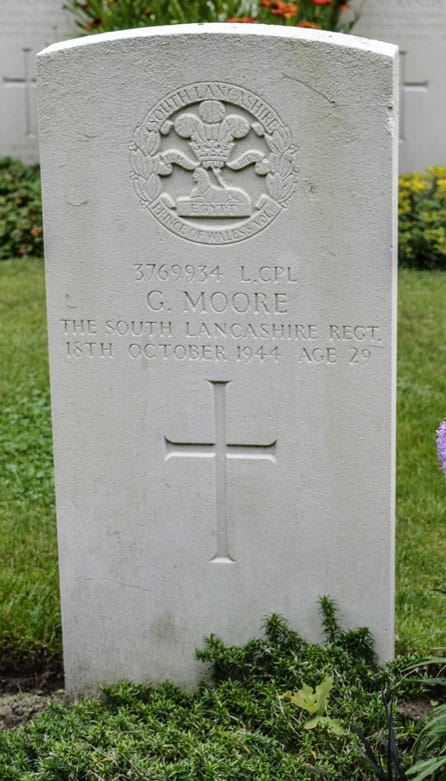
    Grave George Moore

Biography

George Moore (Service Number 3769934) died of his wounds on October 18, 1944. He served with the 1st Battalion, South Lancashire Regiment. He was initially buried at Deurneseweg in Oploo and was reinterred on January 28, 1946, in grave II.A.8 at the Overloon War Cemetery.

FAMILY BACKGROUND

George Moore was born on May 9, 1915, in West Derby, Lancashire, England. His parents were George Moore (1890–1953) and Sarah Alice Moore (née Bateman) (1894–1979). His father was a baker, and his mother was a homemaker. In 1918, during the First World War, his father served with the Royal Army Medical Corps.

George had the following siblings: Alice (1913), Albert Leonard (1918), Esther (1921), Lilian (1924), William Harold (1927), Jennie (1931), and half sister, Jean (1936).

The family lived at 56 Uxbridge Street, Edge Hill, Liverpool, and later moved to 19 Marmaduke Street in Liverpool.

MILITARY CAREER OF GEORGE MOORE

Early Years and the Territorial Army (1934–1937)

On April 17, 1934, the 18-year-old George Moore enlisted in the Territorial Army. He was posted to the 5th Battalion of the King’s Regiment (Liverpool). In 1934, 1935, and 1936, he faithfully attended the mandatory 15-day annual training camps. At the time, he lived at 19 Marmaduke Street and worked as a railway porter.

On October 20, 1936, he was honorably discharged from this battalion, only to be declared officially fit for active service with The King’s Regiment the following day in Seaforth. He listed his father, George Moore of 22 Mozart Street, Lodge Lane, Liverpool, as his next of kin. During his training, George proved to be a dedicated student, obtaining his 3rd Class Education Certificate in 1936 and his 2nd Class Certificate in 1939 while stationed in Peshawar, British India.

A Global Stage of War

During the Second World War, the King’s Regiment was spread across various fronts:

  • British India (now Pakistan/India): The 1st and 13th Battalions guarded the borders. They later formed the core of the famous “Chindits”, fighting the Japanese deep in the Burmese jungle.
  • England and Europe: The 5th and 8th Battalions defended the home front until participating in the Normandy landings in 1944.
  • Mediterranean: The 2nd Battalion fought in North Africa and took part in the invasions of Italy and Greece.

Although the regiment was ceremonially based in Liverpool, its men fought all over the world: from the beaches of France to the mountains of Pakistan and the jungles of Burma.

Service in British India: The Transport Section

On November 10, 1937, George was assigned as a Private to the 1st Battalion and sent to Peshawar, near the Afghan border. He was placed in the transport section. Because of the rugged, mountainous terrain of the Khyber Pass, trucks were unusable; the unit relied entirely on mules for transporting ammunition and supplies.

Caring for these animals was a demanding daily task. George was described by his superiors as a quiet, respectful, and cheerful worker with excellent prospects. In September 1938, he was officially rated as a skilled rider with “good knowledge of animal management.”

Incidents with Mules

Despite his skill, George seemed to be a magnet for accidents involving these headstrong pack animals:

February 1939: During an exercise, another soldier’s mule bolted, causing a panic. George was thrown from his mule and kicked while on the ground.

July 1939: While riding to the “Grass Farm,” a passing mule reared and kicked George’s right ankle. He had to return to the barracks on his own despite great pain.

August 1941: While walking behind his animal to put away a currycomb, the mule kicked out unexpectedly, striking his right knee and resulting in two days of hospitalization.

Discipline and Promotion

His Service Record also showed the human side of the young soldier. During his early service in Devonport, he once stayed away for four days without leave, which earned him a reprimand. In India, discipline became stricter; minor offences, such as an incomplete uniform or briefly leaving his post, were punished with ‘C.B.’ (Confined to Barracks). Nevertheless, he remained ambitious. His educational certificates led to his promotion to Lance Corporal on 11 March 1943.

From 2 August 1943 to 28 January 1944, he served in India with the 13th Battalion of the King’s Regiment. The 13th King’s provided the bulk of the British contingent for the “Chindits” (Burmese word for Lion). The Chindits, officially known as Long Range Penetration Groups, were special operations units of the British and Indian armies that saw action in 1943-1944 during the Burma campaign of the Second World War. Their operations consisted of long marches through extremely difficult terrain, carried out by malnourished troops who were often weakened by diseases such as malaria and dysentery. Controversy remains about the extremely high number of casualties and the questionable military value of the Chindits’ achievements. George may have been involved in these operations.

THE ROAD TO THE EUROPEAN FRONT

On 28 January 1944, George left the port of Bombay and returned to England. After passing through various training centres, he underwent a medical examination in June 1944 and was found fit for active service in North-West Europe.

In the summer of 1944, administrative changes followed in quick succession:
In July, he was placed on the S.O.S. list (Struck Off Strength) in preparation for a new assignment.
On 11 August, he was added to an S.O.S. Reinforcement Draft group.
On 21 August 1944, he was officially assigned as T.O.S. (Taken On Strength) to the 1st Battalion, South Lancashire Regiment. For this, he gave up his stripes and became a Private again. That same day, he left for France.

Normandy and the Falaise Pocket

George joined a battalion that had already been through heavy fighting. The 1st Battalion had landed on Sword Beach at Colleville-sur-Mer on D-Day. The landing and advance cost the lives of more than 100 Lancashires, including their commander. After fierce fighting at Pegasus Bridge, the bloody battle for Caen and the capture of Chateau de La Londe, the battalion took part in the offensive at the Falaise Pocket.

When George joined his unit on 21 August, the encirclement of German troops had just been completed and the Battle of Normandy was coming to an end. After a short period of rest and training in northern France, the regiment marched through Belgium towards the Dutch border.

Operation Market Garden and the Battle of Overloon

Operation Market Garden commenced on 17 September 1944. The Allies’ plan was to advance rapidly through the Netherlands by dropping airborne troops at the bridges over the Meuse, Waal and Rhine rivers. The aim was to capture and secure these bridges, in combination with a simultaneous armoured attack on a narrow front from Belgium. Both the East Lancashires and the South Lancashires took part in this operation on the flanks of the main axis; the South Lancashires were on the right flank.

To this end, on 18 September, the South Lancashires, together with the Suffolks and Yorkshires, first formed a bridgehead to Sint-Huibrechts-Lille. This was followed by patrols towards Kaulille, where the temporary headquarters were established the following day. In the two days that followed, the Meuse-Scheldt Canal was crossed and on 20 September, the battalion entered Hamont. The plan was to advance to Weert the following day, but that first joint attack failed due to fierce German resistance.

After several days of reconnaissance, George and his battalion arrived in Bakel via Maarheeze, Leende, Heeze, Geldrop and Helmond. This route took them through an area that had already been liberated by the 11th British Armoured Division. They were then deployed on 3 October in Mook, just south of Nijmegen. This was part of the offensive in Operation Market Garden, which ultimately failed because the bridge at Arnhem could not be captured. As a result, the Allies ended up in a narrow corridor through the Netherlands. On 30 September, the American 7th Armoured Division had already attempted to widen this corridor by attacking from their position at Sint Anthonis Overloon, but this attack also failed.

The battalion remained in Mook until 8 October and then moved south towards Wanroij. On 9 October George was promoted again to Lance Corporal. It had been decided that the Americans would withdraw and that the British would take on the task of widening the corridor via Overloon, Venray and Venlo. Initially, the attack on Overloon was to begin on 11 October, but due to the very wet weather and poor soil conditions, it was postponed until 12 October.
On 12 October, the attack began at 12 noon with a very heavy artillery bombardment. The 2 East Yorks led the attack on the area described as “Dog Wood”, west of Overloon, while the 1 Suffolks focused on Overloon itself. Both units reached their objective at 3 p.m., after which mopping-up operations followed. The 1 South Lancs had previously been held in reserve, but at 5 p.m., the A and D companies were ordered to advance to clear a remaining area. Each front company was supported by a troop from the 3 Grenadier Guards. They encountered little resistance and by evening they had taken up their position on the edge of a clearing west of Overloon.

The Attack on Overloon and Venray

The next day, they advanced a little further south. On 14 October, however, they were ordered to go to the road between Rouw and Halfweg (northeast of Overloon) to secure control of a junction leading to Schaartven. Meanwhile, the 1st Suffolks and 2nd East Yorks were struggling to cross the Molenbeek and attack Brabander and Venray. On 17 October, George’s battalion followed the 2nd East Yorks to the north-western edge of Venray, where they were ordered to take the southern part of the town. Although Venray had been almost completely cleared, heavy artillery fire continued and minefields were discovered. On this day, Venray was officially liberated.

However, the planned advance to Venlo had to be abruptly halted a day later, on the orders of Supreme Commander Eisenhower. The liberation of the Scheldt estuary was given priority. The strategy for the advance south was reconsidered and attention shifted to patrols east of Venray. As a result, Venray remained a front-line town for months; despite its liberation, artillery fire continued to be a daily occurrence.

It was on this day, 18 October 1944, that George Moore was wounded and died of his injuries that same day.
He had served for 7 years and 363 days.

He was buried together with a number of comrades on Deurneseweg in Oploo and reburied on 28 January 1946 at Overloon War Cemetery.

George Moore was posthumously awarded the following medals for his service: 1939-43 Star, France & German Star, Defence Medal, and the War Medal.

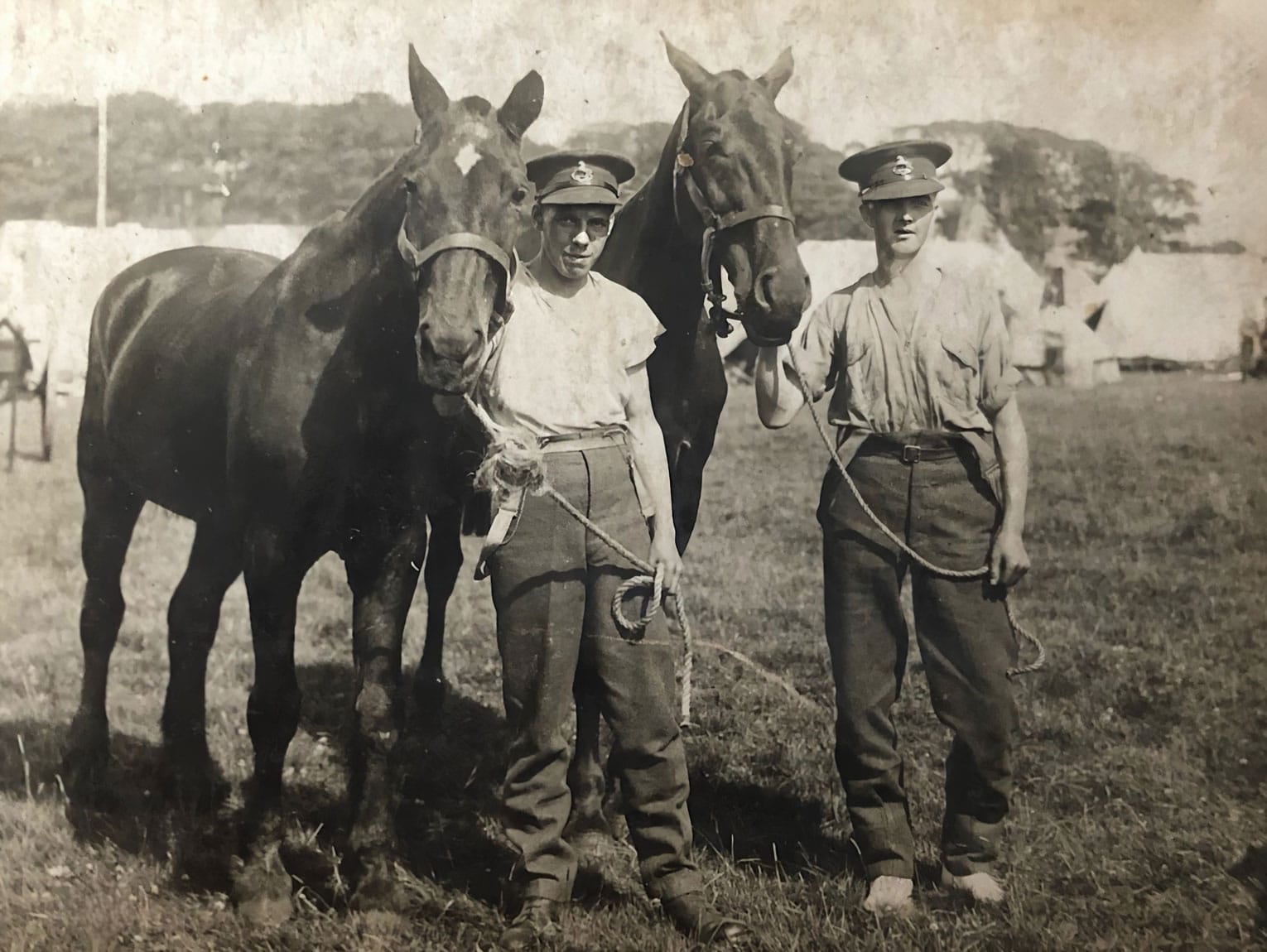
  • George Moore (right) and comrade with regimental horses

    George Moore (right) and comrade with regimental horses

    George Moore (right) and comrade with regimental horses

  • Vader George Moore

    Vader George Moore

    Vader George Moore

  • Moeder Sarah Alice Bateman Moore

    Moeder Sarah Alice Bateman Moore

    Moeder Sarah Alice Bateman Moore

Sources and credits

Ancestry Civil and parish birth, marriage, and death records; English census and records from 1911, 1921, and 1939; electoral rolls; military records and family trees.
Ancestry family tree Eric Bateman
Wikipedia for 1st South Lancashire Regiment, King’s Regiment (Liverpool), 13th King’s Regiment
War Diaries 1st South Lancashire Regiment
Service Record WO 423/362060 of George Moore from the National Archives
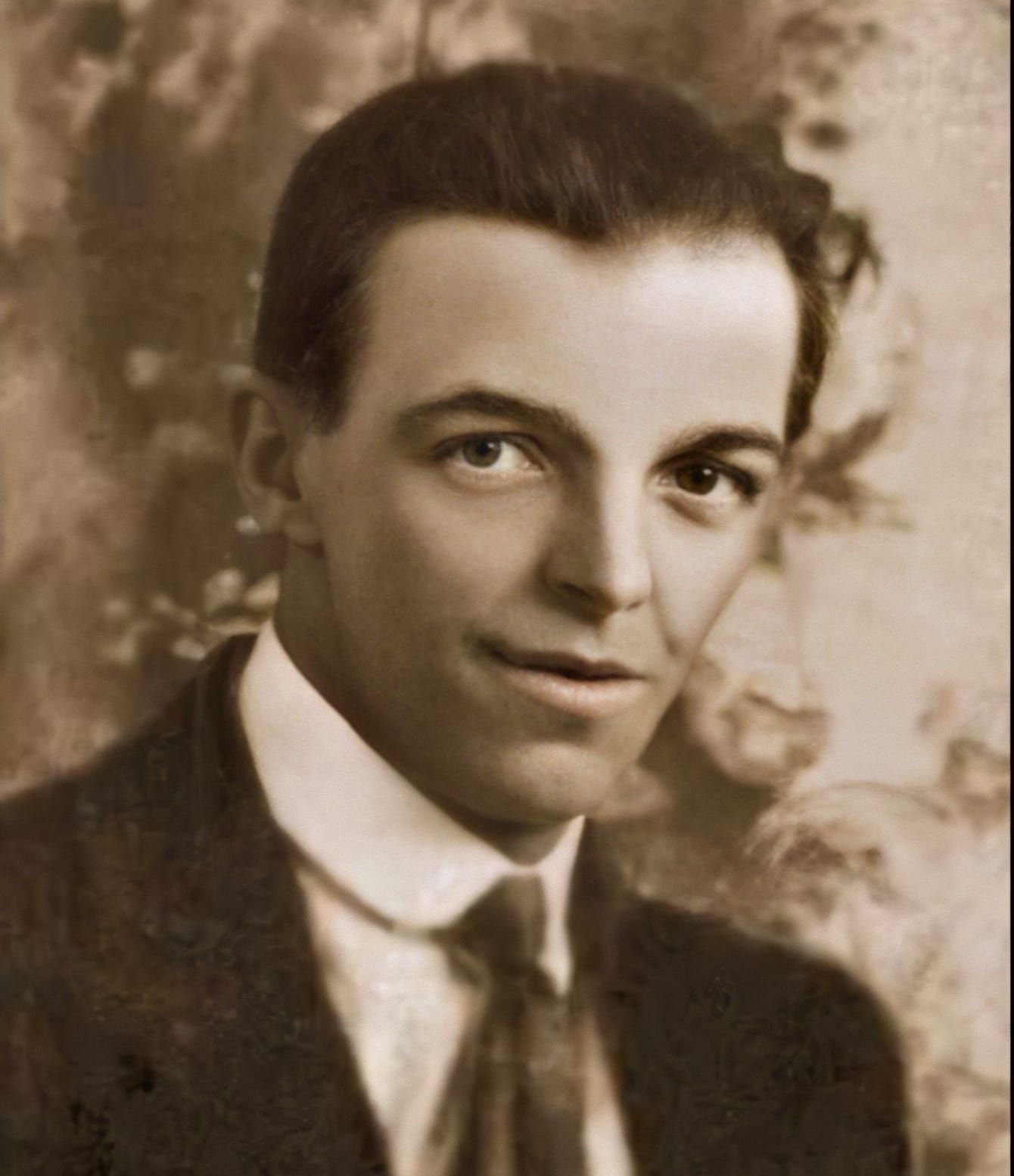
Kevin Moore and Leo Janssen for the photo of George
Eric Bateman for the photos of George’s parents

Research Anny Huberts

Continue reading

Laggett Ronald Charles

Laggett | Ronald

  • First names

    Ronald Charles

  • Age

    20

  • Date of birth

    03-06-1924

  • Date of death

    27-04-1945

  • Service number

    14388156

  • Rank

    Private 

  • Regiment

    The Queen’s Royal Regiment (West Surrey),1/6th Bn.

  • Grave number

    IV. A. 7.

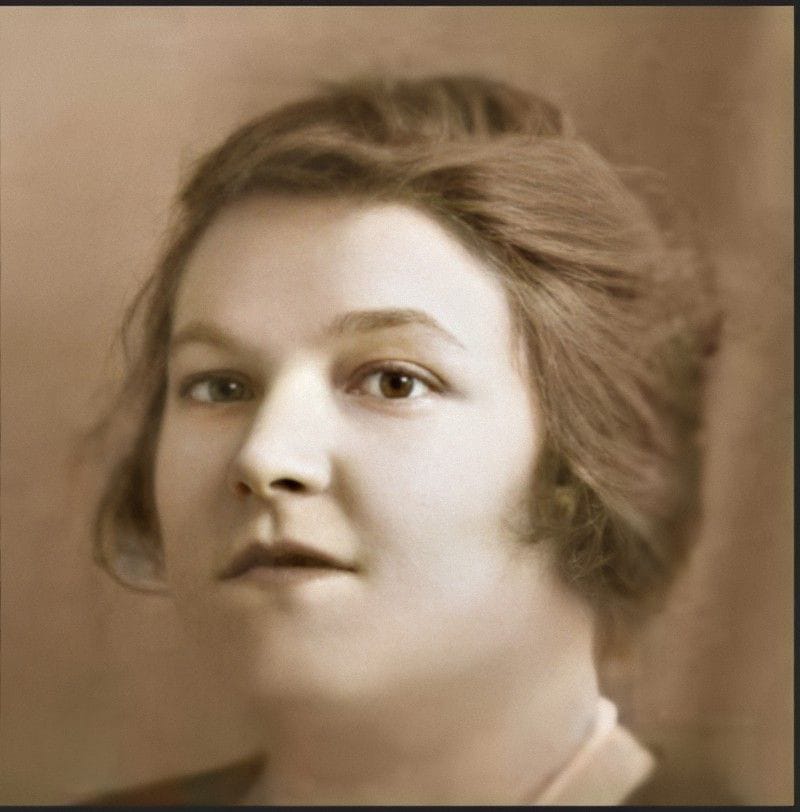
  • Ronald Charles Laggett

    Ronald Charles Laggett

    Ronald Charles Laggett

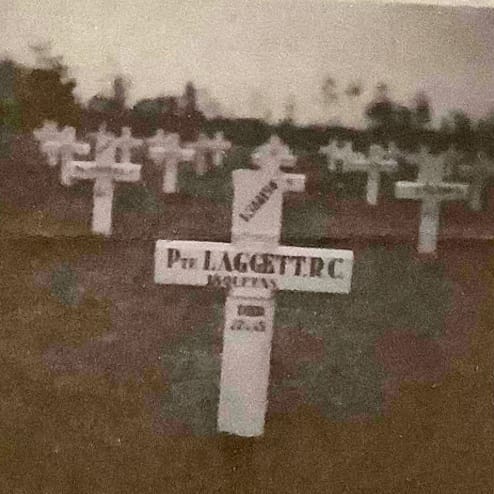
  • Grave Ronald Charles Laggett

    Grave Ronald Charles Laggett

    Grave Ronald Charles Laggett

Biography

Ronald Laggett (service number 14388156) died on April 27, 1945, as a result of a heart rhythm disorder. He was 20 years old and was a soldier in the Queen’s Royal Regiment (West Surrey), 1/6th Battalion. He was initially buried at Margraten Cemetery in the Netherlands and reburied on May 1, 1947, in grave IV.A.7 at Overloon War Cemetery. The inscription on his grave reads: “Rest eternal grant them, shed on them the radiance of the heavenly light”. 

Family background

Ronald Charles Laggett was born on June 3, 1924, in Westhampnett, Sussex, England.
His parents were Charles Morris Laggett (1879–1962) and Edith Warren (1889–1975).

He had at least four sisters: Nellie Laura (1910–1976), Edith May Laggett (1918–1994), Vera Gertrude Laggett (1921–1999), and Irene Joan Laggett (1926– ).

They lived at 4 Scott Street in Bognor Regis, West Sussex in southern England. Charles, his father, was a gardener. Ronald was a milk roundsman when he enlisted.

Bognor Regis

Bognor Regis is a town and seaside resort in West Sussex on the south coast of England. Bognor used to be a fishing (and smuggling) village with a harbor, until it was transformed into a seaside resort. It was a place located in a frontline province at war; of a people who endured the dangers and hardships of wartime, prepared to face the invader, opened their doors to displaced persons and housed military personnel, and contributed in numerous ways to the broader war effort.

On the beach between Bognor Regis and Aldwick lies the wreck of a floating pontoon that was once part of the Mulberry floating harbors used by the Allies to invade the French coast on D-Day, June 6, 1944. It broke loose during a storm on June 4, the day before it was due to cross the English Channel to Arromanches, and was left behind. Shortly after D-Day, it washed up on the beach.

They were designed in 1942 and then built in less than a year in the utmost secrecy. Within hours of the Allies creating bridgeheads after D-Day, sections of the two prefabricated harbors were towed across the English Channel from southern England and placed off the coast of Omaha Beach (Mulberry “A”) and Gold Beach (Mulberry “B”), along with old ships that would be used as breakwaters.

The Mulberry B harbor at Gold Beach was used for ten months after D-Day, supplying more than two million men, four million tons of supplies, and half a million vehicles before it was completely decommissioned. The partially completed Mulberry A harbor at Omaha Beach was damaged by a severe storm on June 19. After three days, the storm finally subsided and the damage was found to be so severe that the harbor was abandoned and the Americans resorted to landing troops and equipment on the open beaches.

Military background

Ronald Charles Laggett began his military career on December 17, 1942, with the Queen’s Royal Regiment. After completing his basic training, he was transferred to the 2nd Battalion of the East Surrey Regiment in Great Britain on April 27, 1943. While the active battalions of this regiment were fighting in North Africa and Italy, Ronald and his battalion focused on defending the homeland and preparing for the invasion of Europe.

On April 16, 1944, he returned to the 1/6 Battalion of the Queen’s Royal Regiment. Training during this period was extensive and intense. While the troops practiced cooperation with the RAF, war was already looming: during their exercises in England, the troops were regularly fired upon by enemy German machine guns from the air.
On April 28, a Reinforcement Unit of this battalion was established, to which Ronald was assigned, under the command of Captain G.A.R.N. Warren, awaiting deployment.

In May 1944, the battalion was fully prepared for Normandy. Vehicles were waterproofed and the troops were prepared with tactical training, lectures, and inspections. While the vehicles traveled by road to the coast, the troops traveled by train to the assembly camps. The men received their mess tin rations and French francs to get through the first week in France. In early June, they embarked at the Royal Albert Dock and Tilbury Docks, after which their convoy anchored at Southend, waiting for the go-ahead.

The Landing and the Battle of the Bocage

While the first waves of soldiers stormed the beaches on June 6, Ronald was briefed on the progress in the camps. Between June 7 and 9, his convoy sailed through the Strait of Dover under cover of a smoke screen. On June 10, 1944, the arrival at Gold Beach was complete and the entire battalion gathered at Sommervieu, near Bayeux.

For Ronald, the battle in France had now officially begun.
As part of the 131st Brigade of the famous 7th Armored Division (the “Desert Rats”), Ronald marched through the treacherous Normandy countryside. It was a war of attrition in the “Bocage”: an area full of dense hedges where a German ambush could lie behind every bush. The advance took them past places such as Briquessard, Grentheville, and Fontenay-le-Marmion.

August 3, 1944: The Day of the Disappearance

At the beginning of August, the battalion was near Aunay-sur-Odon / Jurques, a little south of Caen, during Operation Bluecoat. The day of August 3 began hopeful with a successful ambush on a German column, but in the afternoon disaster struck.

At 2:50 p.m., the enemy launched a massive counterattack with infantry and tanks under cover of a smoke screen. The fighting was unprecedentedly fierce; although German tanks were destroyed, the British anti-tank guns were put out of action and the positions were overrun. Around 4:00 p.m., D Company and parts of B Company were completely overrun by the advancing German armour.

In the chaos of this surprise attack, the toll was assessed: the battalion suffered heavy losses with 161 casualties, including 23 dead, 45 wounded, and 93 missing. This was the day Ronald Laggett was reported missing. He was one of the men who fell into enemy hands during the fierce fighting.

Prisoner of War: Stalag IV-B and IV-D

After the chaotic fighting on August 3, 1944, Ronald Laggett’s fate remained unclear for some time. While his unit attempted to restore the lines, he was officially registered as missing. Only later did confirmation arrive that he had been taken prisoner during the surprise attack on his company. From the battlefield in the Normandy “Bocage,” an uncertain journey deep into the German Reich began for him. He was registered as prisoner of war number 71010 and transferred to Stalag IV-B.

Stalag IV-B was one of Nazi Germany’s largest and most multinational prisoner-of-war camps. The camp was located about 8 kilometers northeast of the town of Mühlberg, in what is now the state of Brandenburg. Upon his arrival, Ronald found a huge, fenced-in city of barracks, where tens of thousands of men from all corners of the world were imprisoned.

The camp was a melting pot of nationalities: in addition to British soldiers like Ronald, the Germans also held Polish, French, Australian, Soviet, Yugoslavian, South African, and Italian prisoners of war. Despite the harsh conditions, the scarcity of food, and the constant threat from the guards, a close-knit community developed among the Allied prisoners in Stalag IV-B.

For Ronald, this meant the end of his active participation in the war, but the beginning of a new, exhausting ordeal: surviving behind barbed wire, far from the front, awaiting eventual liberation.

Life in the camp was a daily struggle against the elements. Stalag IV-B was extremely overcrowded, especially in early 1945 when no fewer than 30,000 prisoners – including 7,250 British – were crammed together. Hygiene was poor, food rations were minimal, and diseases such as tuberculosis and typhus claimed the lives of some 3,000 prisoners.

From this main camp, many prisoners were sent as forced laborers to various Arbeitskommandos in the region. In early 1945, an evacuation order was suddenly issued. In the chaos of the approaching front, the prisoners of war were hastily loaded onto transport trucks before the lines shifted again.

It is not known whether Ronald was still in Stalag IV-B because, according to his Service Record, he was transferred at an unknown date to Stalag IV-D in Torgau, a town on the Elbe that would later become world famous as the place where the American and Soviet armies first met. Stalag IV-D was not a traditional barracks camp, but consisted of requisitioned buildings in the city itself, including a former printing plant and a non-commissioned officers’ school.

Although Torgau served as the administrative center for tens of thousands of forced laborers in the surrounding mines and factories, in the final phase of the war, the main camp also served as a “Heilag”: a gathering place for sick and wounded prisoners who were eligible for repatriation or exchange. There were hopes of a return home, but these exchanges never took place because the British army command feared that exchanged German prisoners would immediately be deployed back to the front.

Liberation and the Tragic End

The long-awaited freedom came at the end of April 1945. While the Red Army liberated Stalag IV-B on April 23, Allied troops reached Torgau on April 25. Ronald was finally liberated in Bennewitz, near Leipzig.

However, after months of undermining, poor nutrition, and the enormous physical and mental pressure of camp life, his body was exhausted. He was transferred to an American evacuation hospital in Naumburg for medical care. The hope of a safe return home was now within reach, but it was not to be. Just a few days after his liberation, his heart gave out; Ronald Laggett died in the hospital from the effects of a heart rhythm disorder (complete heart block).

Ronald survived the hell of the Bocage, the ambush of his company, and the hardships of the German camps, only to succumb in the early days of peace.

A year of hope and fear

While the world celebrated victory in Europe in May 1945, Ronald’s parents, Mr. and Mrs. Laggett from Bognor Regis, entered a grueling period of uncertainty. They knew that their son had been captured in Normandy in August 1944, but after that, there had been virtually no news. During the entire period that Ronald was away from home, they had received only one letter from him.

Month after month, there was no news of his release or repatriation. While other soldiers returned home, the door at 4 Scott Street remained closed.

The shock was therefore immense when, on May 20, 1946— more than a year after the actual liberation of the camps — an official message from the War Office finally arrived. It was not the announcement of his return, but the news of his death. Only then did his parents learn that their son had died thirteen months earlier, shortly after his liberation by the Americans in Bennewitz.

The bitter timing of the news was particularly painful: Ronald would have celebrated his 22nd birthday the following Monday.

Shortly after the official notification, an article appeared in the local newspaper of Bognor Regis under the headline: “Bad news for parents in Bognor: Son died shortly after liberation.” The newspaper described the tragic turn of events and expressed its condolences on behalf of the entire community of Bognor Regis. The article summarized the young soldier’s sacrifice: called up in 1943, captured during the Battle of Normandy, and dying just when freedom was within reach.

The letter from the War Office concluded with words of deep sympathy for the parents, who after a year of uncertainty saw their hopes turn definitively to mourning. Ronald Charles Laggett died for freedom, but the scars of his struggle were long borne by those who waited for him in Bognor Regis.

Ronald was initially buried by the Americans in Margraten in the Netherlands, but in 1947 he found his final resting place at the British Overloon War Cemetery also in the Netherlands in Grave IV. A.7. He rests there as one of the many who lived to see liberation, but did not live to experience freedom itself.

Ronald had served for 1 year and 175 days in the UK and 322 days in North West Europe. He was awarded the 1939-45 Star, the France & Germany Star, and the War Medal 1939/45.

He is commemorated on the War Memorial in Bognor Regis.

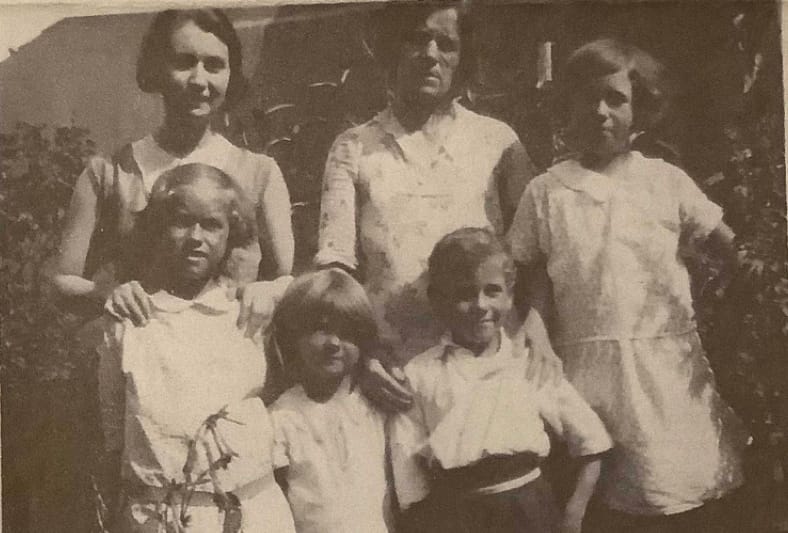
  • Edith Laggett and her children

    Edith Laggett and her children

    Edith Laggett and her children

  • Grave Ronald Laggett in 1947

    Grave Ronald Laggett in 1947

    Grave Ronald Laggett in 1947

  • Stalag-IV-B-camp

    Stalag-IV-B-camp

    Stalag-IV-B-camp

  • Krantenartikel over overlijden Ronald Laggett

    Krantenartikel over overlijden Ronald Laggett

    Newsarticle about Ronald Laggett source unknown

  • Ronald Charles Laggett

    Ronald Charles Laggett

    Ronald Charles Laggett

  • Bognor Beach WW2 by local photographer Frank Alouette

    Bognor Beach WW2 by local photographer Frank Alouette

    Bognor Beach WW2 by local photographer Frank Alouette

  • War Memorial Bognor Regis

    War Memorial Bognor Regis

    War Memorial Bognor Regis

  •  War Memorial Bognor Regis

    War Memorial Bognor Regis

    War Memorial Bognor Regis

Sources and credits

Ancestry Civil and parish birth, marriage, and death records; English census and records from 1911, 1921, and 1939; voter rolls; military records and family trees.
Wikipedia Queen’s Royal Regiment (West Surrey)
Wikipedia Stalag IV-B and IV-D
Prisoner of War Museum
The Queens Royal Surrey Regiment website
West Sussex Record Office Blog
War Diaries 1/6 Bn the Royal Queens Regiment 
Service Record WO WO 423/537243 of Ronald Charles Laggett from the National Archives
Elske Dusselaar-van Kammen and Emma Jane Gwen for Ronald’s photo and newspaper article

Research Anny Huberts

Continue reading

Tull Ronald Alfred Edward

Tull | Ronald

  • First names

    Ronald Alfred Edward

  • Age

    31

  • Date of birth

    26-05-1913

  • Date of death

    15-10-1944

  • Service number

    14601169

  • Rank

    Private

  • Regiment

    Royal Norfolk Regiment, 1st Bn.

  • Grave number

    III. B. 7.

  • Ronald Tull

    Ronald Tull

    Ronald Tull

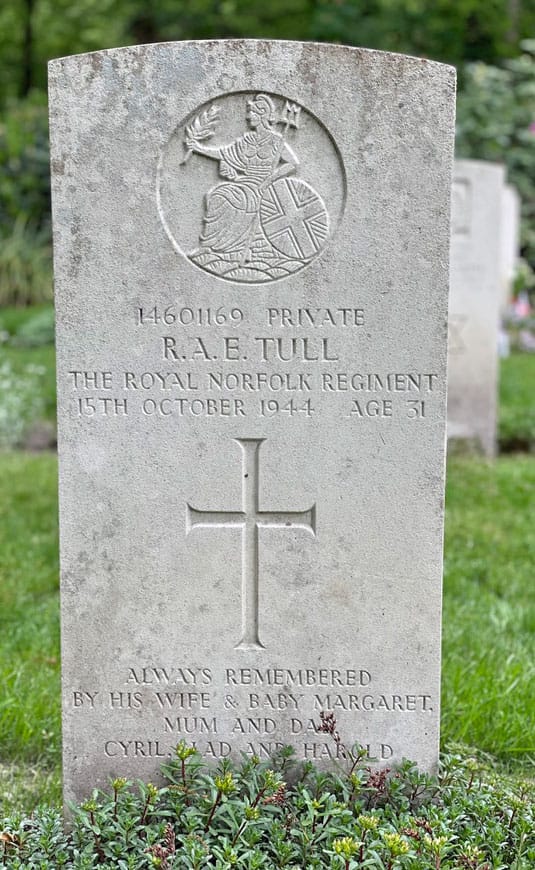
  • Grave Ronald Tull

    Grave Ronald Tull

    Grave Ronald Tull

Biography

Ronald Tull (Service Number 14601169) was killed in action on 15 October 1944. He was 31 years old and a soldier in the 1st Battalion of the Royal Norfolk Regiment. He was initially buried in the cemetery on Venrayseweg in Overloon and later reburied on 17 May 1947 in grave III. B. 11 at Overloon War Cemetery. His grave bears the inscription: “Always remembered, By his wife & baby Margaret, Mum and dad, Cyril, Glad. and Harold”.

Family background

Ronald was born on 26 May 1913 in Alverstone, Hampshire. His parents were Albert Edward Tull (1881–1954) and Lillian Mary Day (1882–1960).
He had two brothers, Cyril Albert (1908-1984) and Harold, and a sister, Gladys Lillian M. (1910-1981). In 1911, they lived at Lynwood, 22 Mortimer Rd, Brockhurst, Gosport, Hants.

In 1942, Ronald married Lena Ruby Henrietta Sawyer in Dorchester, Dorset. In 1944, his daughter Margaret was born, whom he sadly never met.

Margaret married Richard J Lymer in 1966 in Gosport, Hampshire. They had two children: Stephen Richard Lymer, born in 1967 in Portsmouth, and Kerry Lorraine Lymer, born in 1970 in Portsmouth.

Military career

It is not known yet when Ronald joined the 1st Battalion of the Royal Norfolk Regiment, but it was probably in 1941.
The battalion landed on Sword Beach in Normandy on D-Day (6 June 1944). It was deployed in operations in Normandy throughout June, July and August before being given a longer period of rest in Tinchebray from 17 August, where it also received reinforcements to replace the many dead and wounded.
In September, they marched through France and Belgium and reached Helmond in the Netherlands on 25 September. Here they were greeted by an exuberant crowd, while they were still fighting the enemy. B Company was assigned the task of defending the eastern side of Helmond after being informed by higher authorities that the Germans would launch a counterattack that night. They were very concerned about their location and combat positions, fields of fire, etc.

Lt. GDH Dicks MC of B Coy later told his story. He recalls, after checking the accommodation for the platoon:

 “ I turned to leave the house. I was immediately attacked by approximately 50 nurses who insisted that I come with them to the hospital opposite to give the inmates their first view of liberation. I had no option -in spite of the preoccupation of my mind – I was hauled across the road by each arm by a couple of lusty Dutch nurses, followed by at least eight of the lads being meted out with the same pleasant treatment. The scene inside the hospital of patients waving white and feeble hands at a dirty, begrimed, equipped and armed British subaltern would have been fit for any academician.
 
At last I made my escape and then had to sort out the others who had been hauled inside. I have often thought since about that bunch of boys – how happy they were at that moment. Cariello (killed March 1), Halls (killed October 14), Gorbell (killed October 14), McMorrine (wounded October 14), Taylor (wounded October 16).”

They left Helmond on 29 September, crossed the Meuse at Grave, and travelled via Heumen to the Maldens Vlak on 1 October. They remained there until 11 October, after which they moved to Cuijk and then to St Anthonis and Oploo on 12 October.
The Allied advance had been halted at Arnhem, but in the east, in the area up to the Meuse River, there was still considerable resistance, and the plan was to move south in October 1944 to clear the area up to Venray. Overloon, which lies north of Venray, was captured on 13 October and the 1st Battalion of the Norfolk Regiment spent the night of the 13th in the woods around Overloon. The plan was to move south towards Venray on the 14th, but to do so they had to cross a stream called the Molenbeek. However, the enemy had a clear view of the British troops over a distance of 1,000 metres when they left the cover of the forest.
In May 1945, Lt. GDH Dicks MC wrote a personal account of his experiences that day while recovering from injuries he sustained in March 1945.

 “Next morning, 14 October 1944, we received our orders for the attack. B Company was to be one of the two forward companies having the thankless task of first bumping and locating the enemy. Friar [Lt. D.B. Balsom]  was given the task of being the leading platoon with Company HQ next, then my platoon, then Ray’s [Lt. R. S. Hilton] platoon. Ray and I would travel with Company HQ.
 
Inevitably, we soon came under fire from the German lines and Friar’s platoon suffered casualties. Everybody took to the deep ditches either side of the road and crawled forward cautiously. I have a constitutional aversion to crawling, so very soon I began to shuffle along using my hands and feet, with my knees off the ground. Result – one bullet through my haversack. I subsided for a time but soon my constitution overcame my caution and once more I raised my body. Result – another bullet through my haversack. I did not risk a third chance. Eric [Major, E.A. Cooper-Key MC, OC B Coy] and his batman soon after rose and did a spirited dash forward to Friar to get information and then called us up to receive orders for the assault.
 
The plan was for Friar to remain where he was and by fire to keep the Germans’ heads down. Ray and I were to form up on each side of the road – Ray on the right and I on the left.
 
I formed up behind a ramshackle farm-house and then moved out into the open on the left of the road with two sections in line as per battle drill with about 5 yards between each man. I felt as naked as the day I was born.
 
We moved forward at a walking pace with the Churchill tank rumbling along behind. A Spandau opened up and I saw the tracer bullets go through our ranks and a figure fall. It was Halls, 8 Section Bren gunner  – shot (as I afterwards learnt) through the heart. He was on the extreme left of the section, and the fire had come, I noticed, from a projecting copse on our left front. The sections had automatically gone to ground. Cpl. Smith recovered the Bren gun from the body of the dead soldier; and L/Cpl. Grimble, the other Bren gunner in the forward sections, was blazing away merrily although I feel he only had a vague idea in which direction the Spandau lay.
 
Rather than waste time telling him the exact position, I doubled over to Eric and indicated the area to him, information which he immediately passed on to the tank commander who gave the wood a liberal burst from his Besa. Eric also ordered me to keep my platoon where they were while he ordered Friar to pass through me with supporting fire from my Brens. Our initial objective was a cross road which had the code name ‘Cartwright’. Friar had gone to ground about 150 yards in front of me, so Eric ordered my platoon to move forward once again to pass through Friar and achieve ‘Cartwright’. However, as I approached Friar, he yelled that he had reached ‘Cartwright’, and I therefore ordered my men to ground about 70 yards short of him and reported back to Eric.
 
It was now about 10:30 AM and we had achieved our objective. My casualties up to that point had been one killed (Halls), one wounded (Hart – shrapnel in the forehead) and one bomb-happy (a soldier who, rather surprisingly, had broken down when we first came under fire).
 
I suddenly became aware that there was a German tank about 300 yards down the road near a blazing farmhouse, and that it had been responsible already for knocking out three Churchills which were littered untidily over the landscape. At this stage Sgt. Parker became a little bored with ditches and decided to sit upright to see what was happening in the world. He immediately received two bullets for his pains, one in the side and one in the shoulder, a third just chipping the rim of Harry Blowing’s tin-hat. Even this did not disturb his tranquillity – he casually collected his haversack which he had taken off and walked off down the road in full view of the enemy in search of the RAP.
 
Artillery fire began to increase and the cursed nebelwerfer opened up frequently and dropped clusters of shells in our vicinity in between ferocious displays by the German tank. Our troubles were increased by our own artillery who were trying to eliminate the tank. Running true to form some of their shells were falling short or hitting the tops of trees just in front of our position, with the inevitable result that casualties occurred to our own troops.
 
I began to look forward rather eagerly to the hours of darkness, but the day seemed interminable. About 5pm, Gorbell in 8 section decided to leave his trench to urinate. As he crawled back, he received a sniper’s bullet in the back – and he died within a minute. His last words were characteristic. ‘The bastards have got me’”.

A total of eleven men from the Royal Norfolk’s were killed that day. The battalion managed to cross the Molenbeek on 16 October and Venray was captured on the 18th. Between 13 and 18 October, the battalion suffered 43 fatalities and nearly 200 wounded, and Overloon and Venray were severely damaged.

Sadly, Ronald Tull was also killed on 15 October. He was buried together with many of his comrades on Venrayseweg in Overloon and later reburied on 14 May 1947 at Overloon War Cemetery in grave III. B. 7.

Letters from Ronald, Captain Mercer and adoptive father of the grave

In August 1944, Ronald wrote a letter to his brother Cyril describing the conditions in which he had been fighting over the past few months. On 30 October 1944, his Captain J. Mercer wrote a letter of condolence to Lena, Ronald’s wife. In February 1948, Lena received a letter from Mathy’s Brothers, who had adopted Ronald’s grave.

The letters can be read below.

  • Letter from Ronald to his brother Cyril

    Letter from Ronald to his brother Cyril

    Read the letter

  • Letter from Captain Mercer

    Letter from Captain Mercer

    Read the letter

  • Letter from adoptant Mathy’s Broeren

    Letter from adoptant Mathy’s Broeren

    Read the letter

Family pictures

  • Ronald Tull standing upper left  with his comrades

    Ronald Tull standing upper left with his comrades

    Ronald Tull standing upper left with his comrades

  • Marriage Ronald Tull and  Lena Sawyer 1942

    Marriage Ronald Tull and Lena Sawyer 1942

    Marriage Ronald Tull and Lena Sawyer 1942

  • Lena and daughter Margaret

    Lena and daughter Margaret

    Lena and daughter Margaret

  • Parents  Albert and Lillian Tull at the grave of Ronald

    Parents Albert and Lillian Tull at the grave of Ronald

    Parents Albert and Lillian Tull at the grave of Ronald

  • Baby Margaret

    Baby Margaret

    Baby Margaret

  • Grave Ronald Tull in 1947

    Grave Ronald Tull in 1947

    Grave Ronald Tull in 1947

  • Newspaper article about Ronald's death

    Newspaper article about Ronald’s death

    Newspaper article about Ronald’s death

Sources and credits

Ancestry Civil and parish birth, marriage, and death records; English census and records from 1911, 1921, and 1939; electoral rolls; passenger lists, military records, and family trees.
Wikipedia for information about the Royal Norfolk Regiment, 1st Bn.
Tracey van Oeffelen for contacting Ronald’s family
Stephen Lymer for the photos and information about his grandfather Ronald.
This biography was compiled by our foundation based on our own research and stories from other soldiers who served in the same regiment or participated in the same battle on that day. This was partly based on collective work within the foundation.

Research Tracey van Oeffelen, Anny Huberts

Continue reading

Vickers George

Vickers | George

  • First names

    George

  • Age

    23

  • Date of birth

    22-08-1920

  • Date of death

    12-10-1944

  • Service number

    4470006

  • Rank

    Private

  • Regiment

    South Lancashire Regiment, 1st Bn.

  • Grave number

    IV. B. 4.

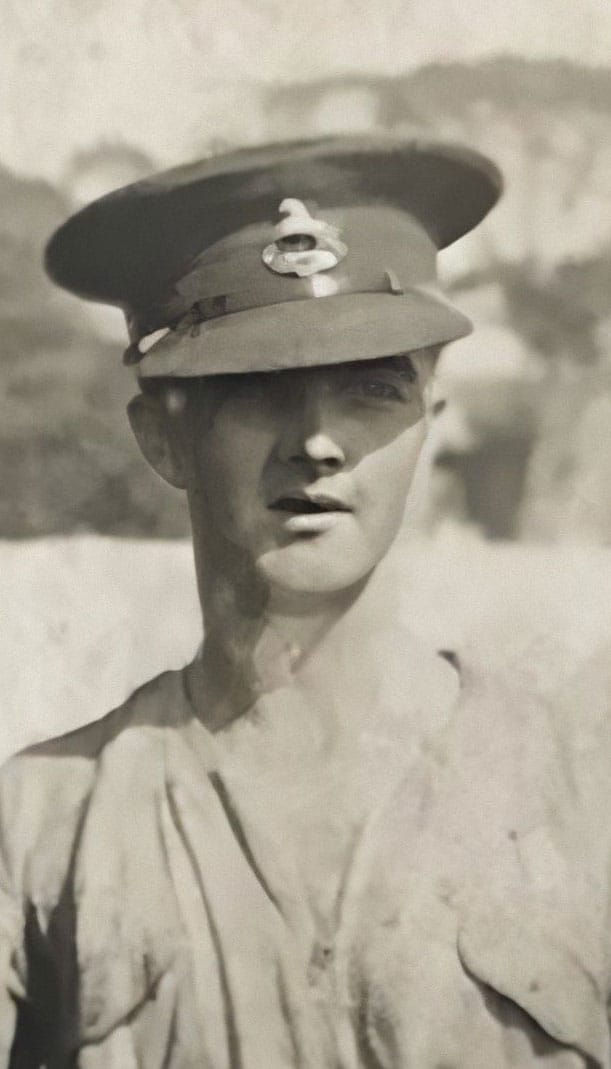
  • George Vickers

    George Vickers

    George Vickers

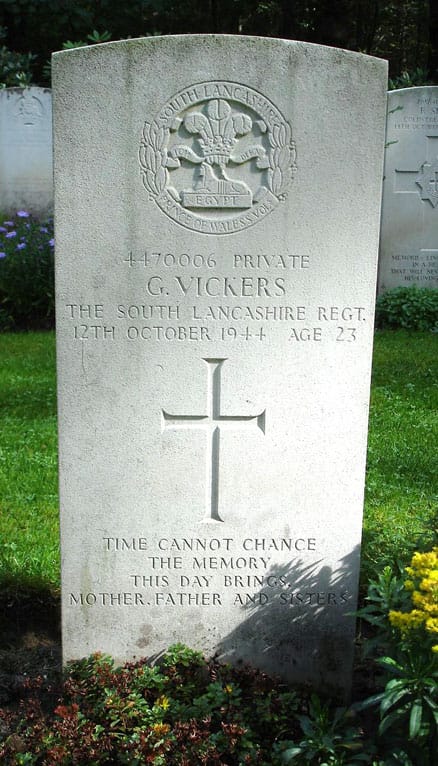
  • Grave George Vickers

    Grave George Vickers

    Grave George Vickers

Biography

George Vickers (Service No. 4470006) was killed in action on 12 October 1944 aged 23. At that time, he was a Private in the 1st  Battalion of the South Lancashire Regiment. He was initially buried at the premises of Widow Goemans which lay south west of Overloon and subsequently re-interred on 27 May 1947 in grave IV. B. 4 at the Overloon Commonwealth War Graves Cemetery. His inscription reads “Time cannot change the memory this day brings. Mother, Father and sisters.”

Family background

George Vickers was the son of Alfred Vickers and Elizabeth Murphy who had married in South Shields in 1913.
 
Alfred Vickers was born on 11 January 1881 in Blaydon which lies on the south bank of the River Tyne west of Gateshead. He was the son of Thomas Vickers and Mary Ann Hymer who had married in the Darlington District of County Durham in 1872. Thomas was born in 1851/3 in Sadberge near Darlington and Mary Ann in 1853 in Middlesborough. Thomas and Mary Ann had eight children between 1872 and 1886. However, two of their children died in childhood.
 
In 1881, Thomas and Mary were living at Railway Side, Wood House, Winlaton, Gateshead. Thomas was a Railway Pilot Guard. With them were two of their children, though their eldest was staying with his grandfather, Francis Vickers, at Dean Head Farm, Coatham Mundeville, Darlington.
 
Alfred’s mother died in 1889 in Gateshead aged just 36 leaving Thomas as a widower. In 1891 he was still a Railway Goods Guard and was living at Railway Sidings, Bottle House Yard, Winlaton, Gateshead. With him were four of his children, including Alfred.  A servant named Sarah Schultz who was born in Sunderland in 1872 was present. There too were three visitors. These included Sarah Schultz’ mother, Ann, and brother Charles, and also Richard Stewart born 1885 in Sunderland. Charles was a Blacksmith.
 
In late Spring 1891, Thomas Vickers married Sarah Schultz in the Gateshead district. They went on to have eight more children between 1891 and 1903. All except the first were born in Gateshead. Sadly, two died in infancy.
 
By 1901, Thomas and Sarah were living at 29, Davidson Street, Gateshead. Thomas was still working as a Railway Goods Guard. Alfred and two other children from Thomas’ first marriage were still living with their father and step mother along with five of the children from his later marriage.  Alfred was working as a Brickmaker’s Labourer.
 
By 1911 Thomas and his wife were living at 51 Bank Street, Gateshead. Thomas was a North Eastern Railway Goods Guard. All six children from his second marriage were present but none of those from his first marriage. Two sons were working as Colliery Pony Drivers Below Ground.
 
Thomas died in 1916 in Newcastle. In June 1921 Sarah was living at 53 Bank Street, Gateshead. One of her step sons and three of her own unmarried children were with her. Also, there was a married daughter, husband and child. Sarah Vickers died in 1926 in Gateshead. One of her sons may have died in the same year.
 
Alfred Vickers married Elizabeth Murphy in 1913 in South Shields, County Durham. Elizabeth was born on 1 February 1885 in Durham. Little more is known about Elizabeth. They had five children in South Shields as follows: Thomas Alfred 1914, Elizabeth 1915, Jenny 24 April 1918, George 22 August 1920 and Theresa 7 January 1923. However, Elizabeth died in early 1917 in South Shields.
 
In June 1921, Alfred and Elizabeth were living at 42, Charles Street, Jarrow, County Durham. Alfred was a General Labourer at Palmer’s Shipbuilding Company, Jarrow On Tyne. With them were Thomas A  (referred to as Alfred), Jenny and George. One of Alfred’s brothers was also working as a Shipyard Labourer at Palmer’s at this time. Thomas Alfred died on 19 October 1928 aged 14, leaving just George and his two surviving sisters.
 
In September 1939 Alfred and Elizabeth were living at 35 Union Street, Jarrow. Alfred was working as a General Labourer. With them were Jenny and George. Jenny was shown as incapacitated. George was working as a Machinist (Metal Sawyer). George’s sister, Theresa, was working as a domestic servant for Thomas G and Gladys M Percival at 66 St Mary’s Avenue, Whitley Bay, Northumberland.
In 1941 George was working at Palmer’s shipyard. His sister Theresa told her son that George was sacked from Palmer’s. His mother was so upset that she went to the yard to complain to the manager – but to no avail. Working in a ship yard may have meant that George would not have been called up.

Military career

George enlisted as a Private in the Army on 12 February 1942. He signed on for the duration of the war. He was described a 5 ft 5 ¾ in tall, weighed 131 lbs and had grey eyes and fair hair. He was classified as Grade A1 medically. He had been working as a Labourer. He gave his religion as Roman Catholic. He gave his address as 14 Berkley Square, Jarrow on Tyne. He was not married and gave his father as his next of kin. He was at the same address but was referred to as Frederick Vickers vs Alfred.
 
George was initially posted to No. 4 Infantry Training Centre and then, on 19 June 1942, to the 14th Battalion of the Durham Light Infantry. This Battalion was used for Home Defence duties at that time.
 
George left the UK for the Middle East on 24 August 1942, seeming to arrive there only on 17 October 1942. He was then posted to the 9th Battalion Durham Light Infantry on 4 November 1942. This Battalion spent the war with 151st Brigade, 50th (Northumbrian) Infantry Division until transferred elsewhere in December 1944. This Division had just been involved in intensive fighting in Libya in which the Division suffered many casualties and went into reserve near Tobruk on 7 November.  No doubt, George was intended to be one of the reinforcements.
 
However, not long after he had arrived, on 15 November 1942, he lacerated his foot. It seems that by 15 January 1943, it was found to have gone septic so he was put on a list of men that were sick. On 5 February 1943 the Officer Commanding the battalion decided that George was to blame as he was not on duty when he sustained the injury.  However, it was deemed that it wouldn’t interfere with his future efficiency. It seems that he may not have fully recovered until 15 March 1943 when he was put on a list of men waiting to be assigned to a unit.
 
On 31 March 1943 he was compulsorily transferred to the 6th Battalion of the Green Howards in Tunisia. They were also part of the 50th (Northumbrian) Infantry Division. This division had returned to the front line in mid March when the Eighth Army reached the Mareth Line in Tunisia. On 20 to 24 March they had been involved in the Battle of the Mareth Line which again cost many casualties.
 
In early April, the 6th Green Howards were involved in the successful Battle of Wadi Akarit in the push up the eastern coast of Tunisia. The Eighth Army’s attack north along this coast and the First Army’s advance from the west, led eventually to the surrender of Axis forces in North Africa on 13 May 1943.
 
Meanwhile, on 24 April the 50th Division was ordered back to Alexandria in Egypt by road, arriving on 11 May. Based in the Nile Delta, they trained on the Great Bitter Lake and on the Gulf of Aqaba in amphibious landing techniques for the Allied invasion of Sicily.
 
George Vickers’ Service Record indicates that on 30 June 1943 he embarked on H Force. This was a naval formation which played a role in the conquest of Sicily in July 1943, codenamed Operation Husky. The 50tth Northumbrian Division sailed from Suez in Egypt. Landings were made on 10 July in difficult weather conditions. By 17 August the Allies had taken Sicily and the Axis forces had left.  
 
The 50th Division learned it was to return to Britain as it was chosen as one of the divisions to take part in the campaign in North West Europe. They left Sicily in mid October.
 
On 29 August George was struck off the strength of the Middle East Force and transferred to the British North Africa Force. He was still in the 6th Green Howards. On 17 October 1943 he embarked for the UK where he disembarked on 8 November 1943.
 
His sister Theresa told her son that she could remember him coming home looking very brown with the sun.
 
He was initially posted to No.101 Reinforcement Holding Unit and then, on 21 March 1944, to an Infantry Training Centre. He was posted to the 14th Battalion Durham Light Infantry on 30 March. By this time this battalion’s role had been changed to being a reception centre for returning PoWs and convalescents. It may be he was suffering from an illness as on 8 April 1944 he was admitted to Stannington Military Hospital in Northumberland from where he was discharged on 18 April.
 
He was posted briefly to the 11th Battalion of the West Yorkshire Regiment on 10 May 1944, then to No 40 Reinforcement Holding Unit on 2 June  and No 39 Reinforcement Holding Unit the following day. These moves will have been in preparation for him being used as a reinforcement following D-Day. He was posted to the 1st Battalion of the South Lancashire Regiment on 25 June 1944.
 
Following the evacuation from Dunkirk in 1940, the 1st Battalion of the South Lancashire regiment was in the 8th Infantry Brigade (which included the 1st Suffolk Regiment and 2nd East Yorkshire Regiment) attached to the 3rd Infantry Division, nicknamed Monty’s Ironsides. With this division, it landed at Sword Beach on D-Day. They
suffered heavy casualties on 22 to 27 June while attempting to capture the Chateau de la Londe in Normandy. On 26 June they received 22 reinforcements from the West Yorkshires. It may be that George Vickers was one of these.
 
However, only two days after he was posted to them, he suffered gun shot wounds to his right hand and arm. He was treated at a Field Ambulance but on 28 June he was put on the Duke of Rothesay, a merchant ship being used as a hospital ship, and taken back to the UK and again put on the sick list. He was sent to No 122 Medical Convalescence Depot which was based at Trentham Park in Stoke on Trent.
 
He was posted back to his battalion on 22 August 1944. It is not mentioned in his Service Record, but it seems that George was wounded again sometime around late August / early September while still in Normandy.
 
The Battalion moved out of Normandy on 16 September and moved in three stages through Belgium to reach Lille St Hubert, just south of the Dutch border, south of Eindhoven. Here they were to assist the East Yorkshire and Suffolk Regiments to make a bridgehead over the Escaut Canal which they crossed on 20 September to reach Hamont, just west of the Dutch border and then reaching Weert in the Netherlands by the 22nd, despite the Allied forces facing difficulties from bridges which had been destroyed.
 
They remained in this vicinity until 25 September when C Company moved eastward towards Schoor as part of a plan to clear the west bank of a canal which lay further east. The whole Battalion were expected to take part in this the following day, but it had been decided that they were to move to Maarheeze that day, so only C Company took part in this. Their progress was slow, so they were ordered to disengage and continue after the rest of the Battalion to Maarheeze. On 27 September they moved on again to reach Bakel which is just north east of Eindhoven. The following day they moved again slightly further north to Mortel to allow the American 7th Armoured Division to occupy the area at Bakel. The Americans were moving through to St Anthonis. The Battalion remained at Mortel until 1 October when they moved further north to Heumen which is just south of Nijmegen and north of Cuijk and then to nearby Mook on 3 October.
 
By this time, Operation Market Garden further to the north had failed to take the bridge at Arnhem. This left the Allies in a narrow corridor through the Netherlands. An attempt was made by the American 7th Armoured Division on 30 September to widen this corridor east to the River Maas by attacking Overloon from their position at St Anthonis, but this attack failed.
 
The 1st Battalion of the South Lancashire Regiment remained at Mook until 8 October when they moved south to Wanroij. It had been decided that the Americans were to withdraw and leave widening the corridor through Overloon, Venray and Venlo to the British. Initially, it was intended that the attack on Overloon would begin on 11 October. However, this was postponed until 12 October due to the very wet weather and ground conditions.
 
On 12 October the attack started at noon with a very heavy artillery barrage which caused considerable damage to the already evacuated village of Overloon. The 2 East Yorks. led the attack on what was described as Dog Wood to the west of Overloon while the 1 Suffolks targeted Overloon itself. Both achieved their objectives by 1500 hours, but with some mopping up still to do. The 1 South Lancs. were initially held in reserve but at 1700 hours A and D Companies were ordered to advance to clear a remaining area with one troop of the 3 Grenadier Guards in support of each forward Company. They met very little opposition and by dusk were in position on the forward edge of a clearing to the west of Overloon. However, this was the day on which George Vickers was killed in action.
 
He had served for a total of 2 years and 243 days of which 1 year and 73 days were in the Middle East and North Africa and 52 were in North West Europe.
 
George was awarded the 1939/45 War Medal, Africa Star with 8th Army Clasp, 1939/45 Star, France and Germany Star and the Defence Medal.
 
His death was reported in two local newspapers as follows:
Shields Daily Gazette 1 Nov 1944: “Private George Vickers, son of Mr & Mrs A Vickers of 14 Berkely Street, Jarrow, is officially reported killed in action in North West Europe. He was 23 and when called up in 1941 was employed at Palmer’s Hebburn.”
 
Newcastle Evening Chronicle 6 Nov 1944: “Pte George Vickers (23) S.L.R. son of Mr & Mrs A Vickers of 14 , Berkley Street, Jarrow.”
 
By 6 December, the Army had a different address for his father of 47 Naworth Terrace, Primrose, Jarrow on Tyne.
 
It is possible that his mother, Elizabeth, died in 1962 in South Shields District and his father, Alfred, in 1965 in Durham North East District, but these are not certain.

Sources and credits

From FindMyPast website: Civil and Parish Birth, Marriage and Death Records; England Census and 1939 Register Records; Electoral Rolls; Military Records
Service Record for George Vickers National Archives Ref WO 423/827120
1 South Lancashire Regiment War Diaries from Normandy War Guide and Traces of War Websites
Wikipedia for information on Durham Light Infantry Battalions, 50th (Northumbrian) Infantry Division, the 1st South Lancashire Regiment
National Army Museum for information on the 1 South Lancashire Regiment
WW2 Talk – assistance on WW2 Abbreviations
Commando Veterans Website – assistance on X Lists
Photos and information from Shields Daily Gazette 1 November 1944, Newcastle Evening Chronicle 6 Nov 1944
Assistance from George’s nephew, Alfred Thorp

Research Elaine Gathercole


Continue reading

Gray | John Henry

Gray | John Henry

  • First names

    John Henry

  • Age

    42

  • Date of birth

    29-01-1903

  • Date of death

    11-05-1945

  • Service number

    883381

  • Rank

    Bombardier

  • Regiment

    Royal Artillery

  • Grave number

    IV. A. 1.

  • John Henry Gray

    John Henry Gray

    John Henry Gray

  • Grave John Henry Gray

    Grave John Henry Gray

    Grave John Henry Gray

Biography

John Henry Gray died on 11 May 1945 from injuries sustained in a traffic accident. He was 42 years old and was a Bombardier (service number 883381) with the Royal Artillery. He was buried at the American Military Cemetery in Margraten in the Netherlands and reburied on 1 May 1947 at Overloon War Cemetery in grave IV.A.1.

Family Background

John Henry Gray was born on 29 January 1903 in Old Kilpatrick, Dunbartonshire, Scotland. His parents were John Gray (1863–1927) and Annie McKeever (1878–1956).

His siblings were: Helen Gray (1898–1898), Margaret Gray (1900–1985), Patrick Gray (1901–), Mary Gray (1904–), Anne Gray (1906–1997), Bella Gray (1907–1992), Sissy Gray (1908–1911), Winnifred Gray (1911–), Thomas Gray (1915–1955) and William Gray (1916–1977).

He married Agnes Doyle in Paisley on 27 July 1923 and they went to live at 13 Underwood Lane. Later they lived at 96 Seedhill Road, also in Paisley.
They had six children, all born in Paisley: John 22 October 1924, Margareth Doyle 25 September 1926, William Henry 31 August 1928, Thomas 6 June 1930, Agnes 16 January 1933 and Terence 21 August 1936.

John worked as a motor driver.

Military career

John enlisted in the Royal Regiment of Artillery on 12 May 1938, at the recruiting office of the 156th Infantry Brigade.
On 29 September 1939, he was mobilised into the British Army, shortly after the outbreak of the Second World War. His mobilisation took place in Stranraer, Scotland, after which he was deployed for service within the United Kingdom.

His first posting was with the 5th Battalion of The King’s Regiment, an infantry unit of the Territorial Army. In this early period, their duties consisted mainly of home defence, including guarding vital infrastructure, ports and communication lines, as well as military training and readiness services. The battalion was mainly stationed in north-west England and southern Scotland, areas of strategic importance in the early years of the war.

In 1940, as German air raids on Britain intensified, he was transferred from the infantry to the Royal Artillery. After retraining at a Basic Artillery Training Centre, he was assigned to the 225th Heavy Anti-Aircraft Battery, becoming part of the British air defence during the Battle of Britain and the subsequent Blitz.

In addition to his duties as an artilleryman, he was formally appointed as a Vehicle Mechanic and was required to maintain recognised technical proficiency. His work included the maintenance and repair of military vehicles, tractors for anti-aircraft guns and associated equipment, which were essential for the deployability of Heavy Anti-Aircraft units. On 12 January 1944, he was officially classified as a Vehicle Mechanic, Group A, Class III, recognising him as a skilled executive mechanic.

His Service Record shows that he served in various units of the Royal Artillery between 1941 and 1944. In the early years of the war, he served with the 58 Anti-Tank Regiment, the 223 Anti-Tank Regiment, the 3rd Reserve Regiment, and in June 1943, he joined the 97 Anti-Tank Regiment.

During this period, he steadily rose through the ranks. He was promoted from Gunner to Lance Bombardier, then to Bombardier, and subsequently held positions as Acting Bombardier and War Substantive Bombardier. He remained in England during these years and would later fight on the North-Western Front.

France

On 17 June 1944, he arrived in France as part of the 21st Army Group. The 21st Army Group was commanded by General (later Field Marshal) Bernard Montgomery.
During the fighting in Normandy, this Army Group was involved in the Battle of Caen and the fighting for the Falaise Pocket, among other things.
After Operation Dragoon, the 21st Army Group formed the left flank of the Allied advance in north-western Europe. It was responsible for capturing the ports and eliminating the V-1 and V-2 launch bases along the coasts of France and Belgium. On 4 September 1944, the Belgian port city of Antwerp was captured.

Belgium

On 20 December 1944, John was assigned to the 31 Reinforcement Holding Unit, which was part of the 101 Reinforcement Group. This unit had already been in the area for a few months and consisted mainly of Royal Artillery officers and other ranks, who had been supplied from various regiments. There was a great deal of training, from map reading to shooting exercises, rifle exercises, weapons training and vehicle training. But there was also personal training to stay strong, and football was played regularly.

The unit was stationed in Bourg Leopold, Belgium, 70 km southeast of Antwerp.

Leopoldsburg (Bourg-Léopold) was an important strategic military location during the Second World War, with the Camp of Beverloo. During the First and Second World Wars, the camp was occupied by German troops. Part of the camp was also used by the Germans as a prisoner-of-war camp. After the Battle of France, 10,000 members of the Hitler Youth, who formed the 12th SS Panzer Division Hitler Youth, were trained at the camp. During the war, it was also used as a transit camp for the Holocaust. In May 1944, the camp was bombed by the Allies and fierce fighting ensued, resulting in many casualties.

The months of January and February 1945 in Bourgh Leopold were relatively quiet, with occasional attacks by enemy aircraft, but normal support activities continued.

Holland

In April, the unit left in three groups by train for Gennep at the river de Maas in North Limburg in the Netherlands.

Following the construction of two crucial Meuse bridges by the British Engineers, an impressive tent camp was established on the outskirts of Gennep at the Maaskemp in April 1945. This large-scale transit camp, which resembled a small village in both size and structure, played a key role in the logistics of the Allied advance. Various British regiments utilized this facility to recuperate during their journey to or from the front lines in Germany, with the flow of troops streamlined via the “German line” railway connection.

As the Maaskemp served as a transit hub, Gennep saw a constant stream of rotating regiments, ranging from troops arriving fresh from England to units returning from heavy combat in France or Germany for leave or regrouping. Additionally, especially during the lead-up to the liberation, large groups of British artillerymen were stationed in the immediate vicinity to support the further push into the Reichswald.

The first group of the Unit from John arrived on 18 April, the second on 19 April and the third on 20 April. They stayed in tents or houses. Some of the houses were watertight, but all were in “filthy” condition, as described in the War Diary. Their tasks consisted of normal support duties, and they were also assigned to escort three groups of prisoners of war, consisting of three officers and 100 other ranks, to Germany every day.

These transports of prisoners of war took place from 1 to 7 May. The accommodation in Gennep was used to its full capacity, as each train carried between 800 and 1,000 soldiers every day. It was an emergency situation, but it meant that the unit could deploy 1,250 reinforcements every day where they were most needed. As hostilities decreased, this number dropped to 500 to 600, and the future role of the Reinforcement Holding Unit was reviewed.

On 11 May 1945, John Gray was sadly killed in a very tragic traffic accident. The information his wife Agnes received was that he was transporting German POW’s, and a bridge that he drove over was mined and it blew up killing him. His Service Record shows that there was insufficient evidence to identify a guilty party. His death was marked as Killed in Action.
He was buried at the American military cemetery in Margraten in South Limburg in grave CCC-2-33. On 1 May 1947, he was reburied at Overloon War Cemetery in grave IV.A.1.

John received the following medals for his military actions:
1939-1945 Star
France & Germany Star
Defence Medal
War Medal 1939-1945

  • German POW with British soldiers February 1945. Source IWM and Stichting Erfgoed Gennep

    German POW with British soldiers February 1945. Source IWM and Stichting Erfgoed Gennep

    German POW with British soldiers February 1945. Source IWM and Stichting Erfgoed Gennep

  • German POW with British soldiers February 1945. Source Stichting Erfgoed Gennep

    German POW with British soldiers February 1945. Source Stichting Erfgoed Gennep

    German POW with British soldiers February 1945. Source Stichting Erfgoed Gennep

  • Street in Gennep Februari 1945 Source Stichting Erfgoed Gennep

    Street in Gennep Februari 1945 Source Stichting Erfgoed Gennep

    Street in Gennep Februari 1945 Source Stichting Erfgoed Gennep

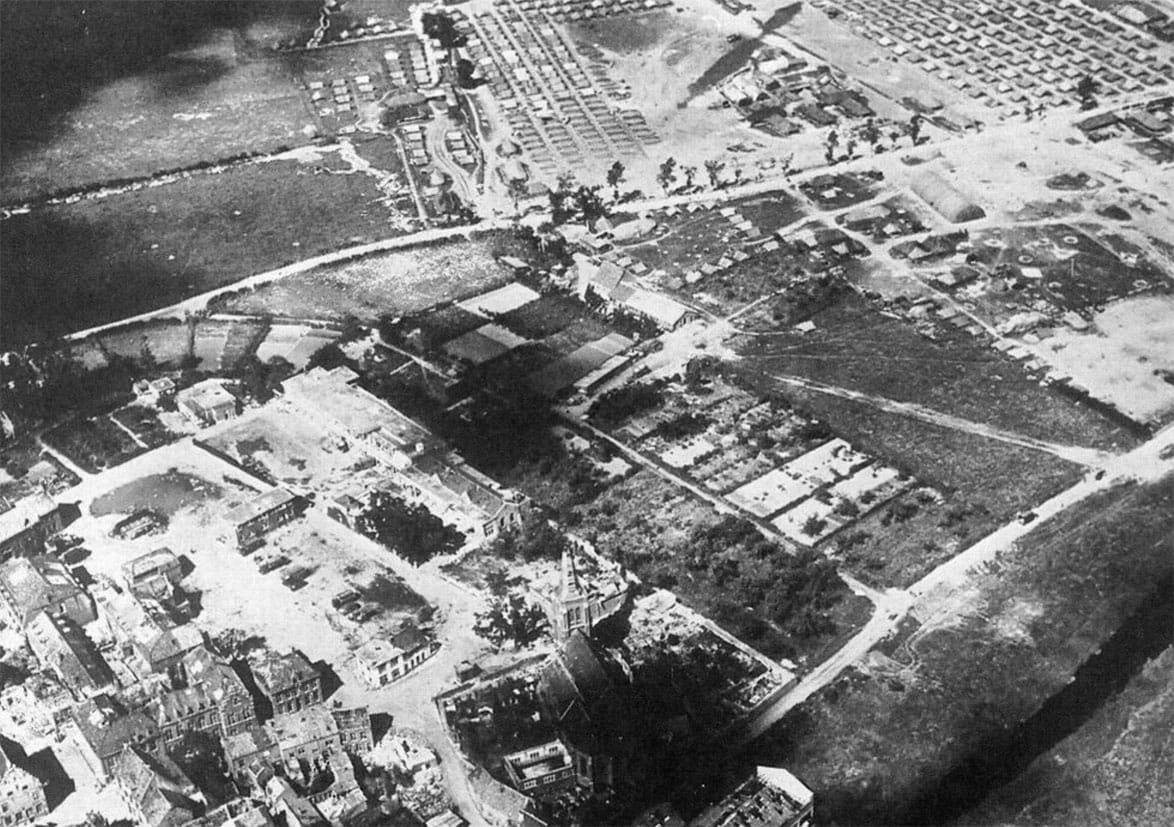
  • Transitcamp in Gennep 1945

    Transitcamp in Gennep 1945

    Transitcamp in Gennep 1945

  • City Centre Gennep 1945

    City Centre Gennep 1945

    City Centre Gennep 1945

Sources and credits

Ancestry Civil and parish birth, marriage, and death records; English census and records from 1911, 1921, and 1939; electoral rolls; passenger lists, military records, and family trees.
Wikipedia
War Diaries 31 Reinforcement Holding unit WO 171-3692 and WO 171-8205
Robert Clark of researchingww2.co.uk for the above War Diaries
Service Record WO 423/202335 of John Henry Gray from the National Archives
Stichting Erfgoed Gennep for the photo’s
Liberationroute

Research Anny Huberts

Continue reading

Follow us

e-mail: overloonwarchronicles@gmail.com
address:
Holthesedijk 2 a, 5825JG Overloon

Chamber of Commerce: 83346422
Bank: NL04 RBRB 8835 3869 69
Stichting Overloon War Chronicles
BIC / SWIFT code RBRBNL21

©2021 Overloon War Chronicles