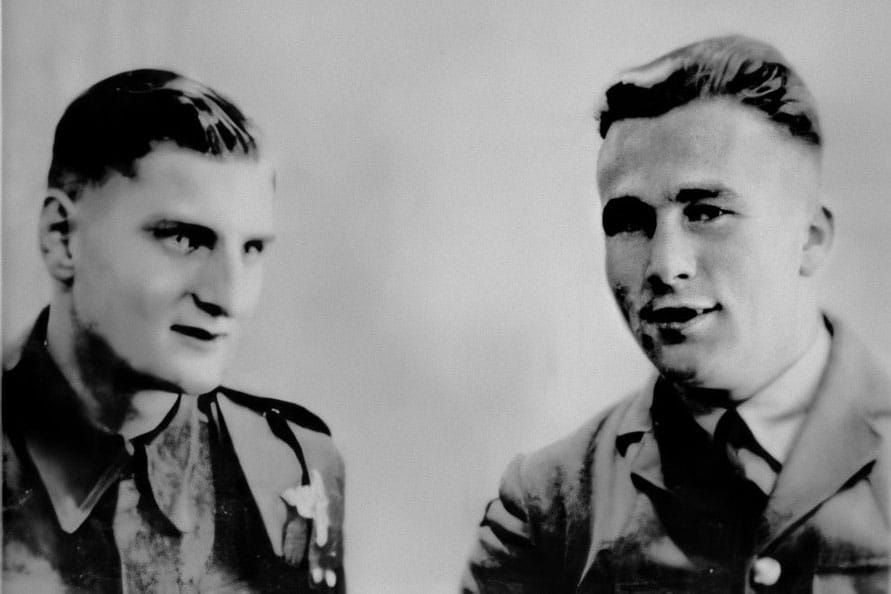
Golesworthy Charles Edward

Golesworthy | Charles Edward

  • First names

    Charles Edward

  • Age

    25

  • Date of birth

    18-04-1919

  • Date of death

    16-04-1945

  • Service number

    947759

  • Rank

    Gunner

  • Regiment

    Royal Artillery, 64 Medium Regt.

  • Grave number

    III. A. 11.

Grave Charles Golesworthy

Grave Charles Golesworthy

Grave Charles Golesworthy

Biography

Charles Edward Golesworthy (Service No. 947759) was killed in action on 16 April 1945, aged 26. He was a Gunner in the Royal Artillery, 64 Medium Regiment. He was initially buried at Margraten and subsequently re-interred on 1 May, 1947 in grave III. A. 11 at the Overloon Commonwealth War Graves Cemetery.

No photo of Charles Edward Golesworthy has yet been found. Should anyone reading this have a photo of him or further information regarding him – or if they are aware of any errors in his biography below can they please contact the Foundation?

Family background

Charles was the son of Joseph Charles and Mabel Mary Golesworthy of Battersea, London. Mabel’s maiden name was Bundy.
 
Charles’ father, Joseph Charles Golesworthy, was the son of Caleb Samuel Golesworthy and Mary Ann Arthurs who had married in 1865 in the St James’ district of Westminster. However, both Caleb and Mary Ann came from Devon.  Caleb was born in 1841 in Honiton and Mary Ann in 1842 near Tiverton. They had eight children between 1869 and 1888, of whom Joseph was the sixth, born on 14 November 1881 in Battersea.
 
Caleb was working as a Carrier’s Fitter in 1871, then a Carriage or Coach Finisher from 1881 to 1911, latterly in the railway industry. By 1921 he was described as a Cabinet Maker.
 
In 1871 Caleb and Mary were living with their first child in New Road, Sussex Street, Battersea, Wandsworth. By 1881, they were living at 19, Crichton Street, Clapham, Wandsworth with their first five children. They also had three lodgers. By 1891 they were living at 19, Gonsalva Road, Battersea, Wandsworth with all eight children. However, Mary Ann Golesworthy died in 1896 in Wandsworth district.
 
In 1901 Caleb was still living in Gonsalva Road with four of his younger children, including Joseph who was working as an Engine Stoker. By 1911 Caleb was living on his own at 15  Foley Place Wandsworth Road, Wandsworth. At this time, Joseph was living at 59A Wix’s Lane Battersea in the household his brother in law and sister, Frederick G and Rose J Martin, and their two children. Joseph was now working as a Brass Foundry Core Maker.
 
In June 1921 Caleb, aged 80, was living at the Queenswood Boarding House, King’s Avenue, Clapham. It was reported in the Streatham News of 8 May 1925 that Caleb S Golesworthy aged 84, an inmate of Swaffield Road Institution, Wandsworth, had a fall in the yard while at exercise on March 13, fracturing his right leg. He was taken to St James’ Hospital, where he died on April 27, the cause of death being senile decay, accelerated by the accident.
 
Charles’ Mother, Mabel Mary Bundy, was the daughter of Edward Bundy and Eliza Mary Moore who had married in the Strand district of London in 1886. Edward was born in 1859/60 in Woolwich, Kent and Eliza in 1859 in Devizes, Wiltshire. They had three children in Battersea between 1887 and 1890 of whom Mabel, born 9 September 1887, was the eldest. The youngest died in the year she was born. Edward Bundy was a Carpenter or Joiner.
 
In 1891, Edward and Eliza were living with their two surviving children at 14, Lockington Road, Battersea, Wandsworth. However, Eliza died in 1894 in Wandsworth aged just 34. Edward seems to have married again as in 1901 Edward was shown with wife Emma Bundy (born 1859 in Aston Abbots, Buckinghamshire) at 14, St Philip Street, Battersea with Edward’s two children.
 
It seems that Emma Bundy may have died in 1908 in South Stoneham, Hampshire, aged 49. In 1911, Edward, now shown as a widower, was living at 70 Gonsalva Road Battersea. Both Mabel and her brother were living with him. Mabel was working as a dressmaker. They were living in the same road as the Golesworthy’s had lived in 1901, so may have overlapped. Edward Bundy died in 1914 in Wandsworth aged 54.
 
Joseph C Golesworthy married Mabel M Bundy in Wandsworth in 1917.
 
Charles E Golesworthy was born on 18 April 1919 in Battersea, London. He was their only child.
 
In 1921, Joseph and Mabel Golesworthy were living  with Charles at 123, Ingelow Road, Battersea. Joseph was working as a Labourer in a Brass Foundry (Wray Ltd, Asgrove Roadd), but was out of work at the time. They were at the same address in September 1939. Joseph was a Core Maker in a Brass Foundry. Charles was working as a Metal Machinist Improver (Milling & Turning etc. ).
 
Joseph C Golesworthy died in 1954 and Mabel Mary Golesworthy in 1973, both in Lambeth.

Military career

Charles E Golesworthy joined the Royal Artillery, 64 Medium Regiment, on 18 October 1939. He gave his address as 123 Ingelow Road, Battersea SW8. He gave his father, Joseph Charles Golesworthy, as his next of kin, also of Inglelow Road.
 
Charles was described as being 5ft 9in tall and weighed 139lbs. He had brown eyes and dark brown hair. His medical grade was A1. His religion was Church of England. He had been working as a Machinist Improver.
 
On enlistment, Charles was posted as a Gunner to the 212 Battery of the 64th Medium Regiment of the Royal Artillery. 64 (London) Medium Regiment RA (TA) was formed as a duplicate of 53 Medium Regiment with two batteries in 1939.
 
Charles was sent to the Middle East on 14 November 1940. Earlier in 1940, Italy had declared war on Britain and France, and invaded Egypt. However, the large Commonwealth garrison stationed there swiftly repelled them, pushing them back to the Italian colony of Libya by December 1940.
 
In January 1941 the 212 Battery was in Mena in Egypt. In February it went to the 68 Medium Regiment to make a 6 inch Howitzer Regiment for Eritrea. Charles’ Service Record confirms that he was in what it calls Sudan from 15 February 1941 and was attached to the 68th Medium Regiment on 21 February 1941. The Battery was in Eritrea in March, Libya in May then Syria in June before reuniting with 64 Medium Regiment in August 1941 in Syria. On 15 August 1941 Charles was appointed as Driver i/c. By October 1941 the Regiment was in El Tahag in Egypt.
 
Meanwhile, in February 1941, Erwin Rommel’s Panzerarmee Afrika landed in Tripoli, at roughly the same time as Winston Churchill withdrew many of his troops to fight in Greece. After arriving in Libya, Rommel quickly repelled the Allies back into Egypt by April 1941. He outflanked and outfought them at every turn. The Allies left a force of mainly Australian troops in the port of Tobruk. These brave soldiers denied Rommel access to the Mediterranean.
 
Back in Egypt, the Allied Forces regrouped as the Eighth Army of which the 64 Medium Regiment was now a part. These troops then launched a counteroffensive in late 1941 – known as Operation Crusader – to relieve the besieged ‘rats of Tobruk’, who had held out against Rommel’s bombardment for almost eight months.
 
Only a few months after Operation Crusader, after receiving supplies and reinforcements from Tripoli, the Axis attacked again, defeating the Allies in the Battle of Gazala in June and capturing Tobruk. The Axis forces drove the Eighth Army back over the Egyptian border. The 212 Battery was reduced to 4 guns and other 250 men were lost during the withdrawal. Their advance was stopped in July only 90 miles (140 km) from Alexandria in the First Battle of El Alamein. This took place between 1 July and 27 July 1942. It was during this battle that Charles was taken prisoner.
 
He was initially noted as “missing known to be wounded” in the Western Desert, Egypt on 6 July 1942 but this was soon altered to just “missing”. His father only seems to have been informed of the fact he was missing on 7 August 1942 and that he wasn’t wounded on 7 October 1942.
 
He was found to be a Prisoner of War in Italian hands on 19 October 1942 and his father was informed by 29 October.  His mother received a message from her son as follows: “Fit well don’t worry will write when possible ‘love.”
 
He was then transferred to Stalag IVA in Germany with PoW number 247677. The date of this move is unknown, but he was certainly there by 7 February 1944 when his father was informed. This Camp was at Hohenstein in Ostpreußen (POW Number 247677). It was located 20 miles East North East of Dresden.
 
His father received a card from him telling them that he had been transferred to Stalag IVF on 4 October 1944  – but the Army only seem to have caught up with this on 11 April 1945. Stalag IVF was located at Hartmannsdorf, Saxony which was west of Dresden. The POWs were assigned to various Arbeitskommando (“Work detachments”) locally. The camp was liberated by American forces in April 1945.
 
Charles was killed by aerial activity after liberation on 16 April 1945. His father was only informed of this on 1 August 1945.
 
At Overloon, Charles lies alongside Robert Stanley Bertram Jones who was killed in a similar fashion on the day before Charles, also after being liberated from Hartmannsdorf.
 
Charles had served in the Army for 5 years and 181 days, of which 1 Year and 234 days were in North Africa and 2 years and 285 days was as a PoW.
 
He was awarded the 1939-45 Star, Africa Star and 1939/45 War Medal.
 
Joseph C Golesworthy died in 1954 and Mabel Mary Golesworthy in 1973, both in Lambeth.

Sources and credits

From FindMyPast website: Civil and Parish Birth, Marriage and Death Records; England Census and 1939 Register Records; Military Records, Electoral Rolls
Ancestry Military records
Service Record for Charles Edward Golesworthy for National Archives reference WO 423/191024
Streatham News 08 May 1925
Wikipedia Stalag IV-A and Stalag IVF, North African Campaign
Streatham News 08 May 1925
Wikipedia Stalag IV-A and and Stalag IVF, North African Campaign
https://ra39-45.co.uk/units/medium-regiments/64-london-medium-regiment-rata
https://history.companyofheroes.com/el-alamein/battle-of-el-alamein-ww2/

Research Sue Reynolds, Elaine Gathercole

Continue reading

Gilmour Hugh

Gilmour | Hugh

  • First names

    Hugh

  • Age

    27

  • Date of birth

    16-03-1917

  • Date of death

    14-10-1944

  • Service number

    4202384

  • Rank

    Private

  • Regiment

    Lincolnshire Regiment, 2nd Bn.

  • Grave number

    I. C. 1.

  • Hugh Gilmour

    Hugh Gilmour

    Hugh Gilmour

  • Grave Hugh Gilmour

    Grave Hugh Gilmour

    Grave Hugh Gilmour

Biography

Hugh Gilmour (Service No. 4202384) was killed in action on 14 October 1944. He was a Private in the 2nd Battalion of the Lincolnshire Regiment and was 27 years old. He was initially buried at the farm of Vogelsangs family in Overloon and subsequently re-interred on 15 July, 1946 in grave I. C. 1 at the Overloon Commonwealth War Graves Cemetery. His inscription simply reads “R.I.P.”.

Military Career

It isn’t known when Hugh enlisted with the 2nd Battalion of the Lincolnshire Regiment, though given his age, it is likely to have been early in the war. 
 
This Battalion took part in the D-Day landings in June 1944 and was then engaged throughout the Normandy Campaign, taking part in Operation Charnwood and Operation Goodwood.
 
They remained in Normandy until 15 September. They then took part in the push up through Belgium and the Netherlands with the aim of supporting the airborne troops engaged in Operation Market Garden. Following the failure to take the bridge at Arnhem in late September, the Allied Forces were left in a very precarious narrow salient through the Netherlands. It was the aim of Operation Aintree to widen this salient by heading south from Nijmegen to take Overloon and then Venray before finally eliminating a German bridgehead on the River Maas near Venlo.
 
On 9 October 1944 the Battalion found itself in Haps, just south of Nijmegen and North of Overloon. They were ordered to move south to St Anthonis on 11 October, but this was postponed to the following day due to bad weather. The move was completed on 12 October and they then moved slightly further west the next day, though with one man killed and 3 wounded.
 
On the 14 October, the day on which Hugh died, the plan was for B Company to be guided through a wood held by the Royal Ulster Rifles to its front edge from where they would carry out a recce to check if a stream was passable and if the north eastern corner of a wood to the south was held by the enemy. However, the guides were late and the move through the wood was slower than expected, so the recce did not take place. At 7.30am the Company began to advance south out of the wood. However, before the Company had advanced 100 yds the enemy opened fire from a track about another 100 yds ahead. The advance continued but came under such heavy fire with so many casualties that the Company Commander issued an order to retreat back to the Royal Ulster Rifles’ position. By this point one Lieutenant and 34 other ranks had been killed or wounded. Following a recce by the Company Commanders, it was decided to launch an attack at 1530 hours with D and A companies in the lead. The enemy had been seen moving in the area of the stream in front of the wood. It was thought that the enemy holding the Battalion objective were probably a Company strong. Immediately the attacking force came into the open they were subjected to intense artillery and mortar fire but they pressed steadily on to reach their objective. During this action the Battalion suffered very heavy casualties including four officers killed and another four wounded.
 
A total of 27 men of the 2nd Battalion of the Lincolnshire Regiment who died that day are buried alongside each other at Overloon, including Hugh Gilmour.

Family background

Hugh McNeil Gilmour was the son of William Gilmour and Catherine Maxwell who had married in Hamilton, near Glasgow in Scotland on 30 December 1895. William was born on 24 September 1875 in Hamilton and Catherine on 22 November 1875 (or possibly 1876) in Kilwinning, Ayr.
 
They had children as follows: Harry 1898, Jane McGarry or Garry 4 December 1900, William 1902, Helen Tierney 9 November 1905, Catherine Maxwell 20 January 1908, George 1 May 1911, John 1914, Hugh McNeil 16 March 1917. The first four were born in Hamilton, Catherine in Larkhall, the next two in Kirkintilloch and Hugh in Glasgow.
 
In 1901 William and Catherine were living at 6 Brown Street in Hamilton. With them were their first two children. William was working as a Coal Miner.
 
In 1917, William was recorded as an Insurance Agent at the time of Hugh’s birth which was at 3 Edward Street in the Anderston district of Glasgow.
 
In June 1921, William and Catherine were living at that same address  – an address which seemed to include several families so was probably a Glasgow tenement.  With them were all eight children. The family of 10 were living in just 2 rooms. William was still working as an Insurance Agent for the Liverpool Victoria Friendly Society. Harry was working as a Labourer for Inglis & Co Boilermakers;  Jeanie, as a Shop Assistant (General Produce); William as an Electrician for M Austin and Helen as a Message Girl for the St. George Co-op Society. Hugh was referred to here as Hugo.
 
By 1931, William and Catherine seem to have moved to Thornleigh, Stockport Road, Bredbury Cheshire. With them were their daughters, Helen Tierney Gilmour and Catherine Maxwell Gilmour. Younger children may have been present but wouldn’t be shown on this source.
 
Their son, John Gilmour, died in late 1931 in Stockport district aged just 17.
 
Three of William and Catherine’s children married in the next few years: George to Ann C Davey in 1933 in Manchester South; Helen to Thomas Nolan in 1934 in Stockport and Catherine to Ross Hogg in 1936 in Stockport.
 
In September 1939, William and Catherine were living at 54 Broadway, Bredbury, Cheshire. With them were Hugh and their married daughter Catherine Hogg and her husband Ross. Also present was a child named John Gilmour, born 12 December 1928. It isn’t certain who this was. William was now working as a Demolition Contractor and Hugh was a Demolition Contractor Motor Driver. Ross Hogg was a Public Works Labourer.
 
Hugh’s brother, George Gilmour, was living with his wife and first child at 85 Councillor Lane, Cheadle, Cheshire. George was also working as a Demolition Contractor and his wife was working as a Nurse.
 
Hugh’s sister, Helen Nolan, was living with her husband and first child at 231 Gorton Road, Stockport. Thomas was working as a Fitters’ Labourer (Motor Transport).
 
Sadly, Hugh Gilmour was killed in action on 14/10/1944.
 
The Manchester Evening News of 4 November 1944 reported his death in a North West Roll of Honour among many others as follows:
“Pte. Hugh Gilmour (Lincs. Regt.), aged 27, Broadway, Bredbury (killed).”

Sources and credits

From FindMyPast website: Civil and Parish Birth, Marriage and Death Records; England Census and 1939 Register Records; Electoral Rolls; Military Records
Lincolnshire Regiment War Diaries via Traces of War Website
Wikipedia – information on the Lincolnshire Regiment, Operation Charnwood
Manchester Evening News of 4 November 1944

Research Byran Johncock, Elaine Gathercole
  

Continue reading

Shipp John Richard

Shipp | John Richard

  • First names

    John Richard

  • Age

    19

  • Date of birth

    04-1925

  • Date of death

    14-10-1944

  • Service number

    14660353

  • Rank

    Private

  • Regiment

    Lincolnshire Regiment, 2nd Bn.

  • Grave number

    I. B. 11.

Grave John Richard Shipp

Grave John Richard Shipp

Grave John Richard Shipp

Biography

John Richard Shipp (service number 14660353) was killed in action on 14 October 1944 at the age of 19. He was a private in the 2nd Battalion of the Lincolnshire Regiment.
He was initially buried at De Kleffen Cemetery in Overloon and reburied on 15 July 1946 at Overloon War Cemetery in grave I.B.11.

No photo of John Richard Shipp  has yet been found. Should anyone reading this have a photo of him or further information regarding him – or if they are aware of any errors in his biography below can they please contact the Foundation?

Family background

John was the only son born to Richard Shipp (1868–1968) and Mathilda (Tilly) Prior. His parents had been married before and had children from previous marriages. John had eight half-brothers and sisters.

His father Richard had previously been married to Sarah Jane Marshall (1873-1924) and had the following children with her: Albert Shipp (1899-1962), Elsie Mary Shipp (1900-1970), Florence Charlotte Shipp (1901-1980), Bertha Shipp (1903-1985), Ruth Shipp (1906-1985) and Kitty Marion Shipp (1908-1996).

His mother Mathilda was previously married to William Ernest Barker (1884-1916) and had two children with him: Charles William Barker (1908-1914) and Ethyl May Barker (1911-1984).

In April 1917, after the death of her husband William, she married Ernest Thornhill (1882-1923). After Ernest’s death, she married Richard Shipp in October 1924 and they had a son, John Richard Shipp, in April 1925. He was born in Glanford Brigg in Lincolnshire.

Later, John and Mathilda moved to 46 John Street in Scunthorpe, also in Lincolnshire.

Military career

John subscribed to the Territorial Army and was posted to the General Services Corps. On 15th July 1943 he was posted to the 57 Primary Training Wing. 

On 26 of August 1943 he was transferred to the Lincolnshire Regiment. From 18th November 1943 he was posted to the 2nd Bn of the Lincolnshire Regiment and according to his Service Record active for the NW Europe theatre from 5th of June 1944. He landed in France in June 1944 at the Normandy beaches. 

The 2nd Bn Lincolnshires took part in the D-Day landings in June 1944 and was then engaged throughout the Normandy Campaign, taking part in Operation Charnwood and Operation Goodwood.
They remained in Normandy until 15 September. They then took part in the push up through Belgium and the Netherlands with the aim of supporting the airborne troops engaged in Operation Market Garden which ultimately did not fully succeed following the failure to take the bridge at Arnhem in late September. 
Following the failure to take the bridge at Arnhem in Operation Market Garden in late September 1944, the Allied Forces were left in a very precarious narrow salient through the Netherlands. It was the aim of Operation Aintree to widen this salient by heading south from Nijmegen to take Overloon and then Venray before finally eliminating a German bridgehead on the River Maas near Venlo.
 
On 16 and 17 September the Battalion moved into Belgium near Mons. They found that the civil population were very enthusiastic, particularly in the area of the Belgian frontier. They then joined in the effort to cross the Escaut Canal where all the bridges had been blown by the enemy. They succeeded with other regiments in this difficult task in the face of opposition and a bridge was complete by 19 September. The Battalion moved on to Achel on 20 September where all ranks were able to get a night’s sleep under cover and then Hamont the following day where they remained until 25 September while the 11 Armoured Division took Deurne in the Netherlands. The Battalion moved to Deurne that day and took over from the 11 Armoured Division with the 2nd Battalion Royal Ulster Rifles. They remained in this area, sometimes engaging with the enemy who were on the east side of a canal. On 29 September they moved north to Milheeze and then Haps on 1 October.

The base of the 2nd Lincolnshire Regiment stayed in Haps from the 1st till the 12th of October. From there, attempts were made to clear the west side of the Meuse between Cuijk and Oeffelt. This was done together with 2nd Bn Royal Ulster Rifles, the 1st Bn King’s Own Scottish Borderers and 3rd Reconnaisance Regiment (9th Brigade 3rd Infantry Division).  
On the east side of the Meuse, resistance remained strong, particularly in Middelaar, Milsbeek, and Gennep. The stone factory in Milsbeek served as the main center of opposition, as its tall chimney functioned as an observation post from which German artillery coordinated the defense. On the east side of the river, the enemy was also attacked from Plasmolen.

Between 1 and 7 October, the Ferry House in Oeffelt — Het Veerhuis — was repeatedly occupied by the enemy and then retaken by British forces. Patrols of the 2nd Lincolnshire Regiment discovered that the Ferry House had once again fallen into German hands. Despite heavy British artillery bombardments, German troops continued to appear around the stone factory in Milsbeek.

On 4 and 5 October, the chimney of the Milsbeek factory was finally brought down, and the church in Middelaar was reduced to rubble. On 6 October, the 2nd Lincolnshire Regiment launched another attack on the Ferry House — this time successfully. This first week of October the Batallion lost three comrades, who were temporarily buried at the village square in Haps and later in 1946 reburied at Overloon War Cemetery.

On 9 October 1944 the Battalion were ordered to move south to St Anthonis on 11 October, but this was postponed to the following day due to bad weather. The move was completed on 12 October.
They were kept in reserve for the battle that was being fought around Overloon. The 8th Infantry Brigade was tasked with capturing Overloon and advancing to Venray. Shortly before nightfall, they heard that Overloon had fallen and that the battalions of the 8th Division were struggling to hold their ground.

On Friday, 13 October the aim was for the Royal Ulster Rifles, followed by the King’s Own Scottish Borderers and then the Lincolnshires to clear wooded areas just west and south of Overloon in which the Germans had entrenched themselves, then cross a stream called the Molenbeek between Overloon and Venray. They would be supported by Churchill Tanks of the 4th Tank Grenadier Guards. The Lincolnshires therefore moved down to a position just north west of Overloon that day.
In addition to the difficult terrain, two other factors played a crucial role – the Germans had dotted the entire area with their dreaded “Shuhminen.” These wooden mines were difficult to detect. They didn’t tend to kill but inflicted severe injury to the victim’s legs. In addition, the German troops had a strategic observation point from Venray’s church tower. Any Allied troop movement would be watched and relayed to their artillery which would result in a barrage of shells.

The Royal Ulster Rifles and the King’s Own Scottish Borderers began the attack on the forests. However, it soon became apparent that they were barely making any progress, leaving the Lincolnshires out of the battle all day. Nevertheless, the Lincolnshires suffered one man killed and 3 wounded.

On the 14 October, the plan was for B Company to be guided through a wood held by the Royal Ulster Rifles to its front edge from where they would carry out a recce (reconnaissance)  to check if a stream was passable and if the north eastern corner of a wood to the south was held by the enemy. However, the guides were late and the move through the wood was slower than expected, so the recce did not take place. At 7.30 am the Company began to advance south out of the wood. Before the Company had advanced 100 yds the enemy opened fire from a track about another 100 yds ahead. The advance continued but came under such heavy fire with so many casualties that the Company Commander, Anthony Frith Smith, issued an order to retreat back to the Royal Ulster Rifles’ position. By this point one Lieutenant and 34 other ranks had been killed or wounded.

Following a reconnaisance by the Company Commanders, it was decided to launch a full battalion attack at 15.30 hours with the support of the whole of the Divisional Artillery and an additional tank division on the right flank. The enemy had been seen moving in the area of the stream in front of the wood. It was thought that the enemy holding the Battalion objective were probably a Company strong. Immediately the attacking force came into the open they were subjected to intense artillery and mortar fire which was just as bad as in the early morning but this time they pressed steadily on to reach their objective. During this action the Battalion suffered very heavy casualties including four officers killed and another four wounded.

It was on this day that sadly, John Richard Shipp was killed in action. 

The fallen soldiers were buried the following day at noon on the Vogelsangs family farm on Helderseweg in Overloon. They were later reburied at the British cemetery “De Kleffen”, on the site where the War Museum is now located.

On 15 July 1946, a total of 27 men from the 2nd Battalion of the Lincolnshire Regiment who had died on 14 October 1944 were reburied side by side at the Overloon war cemetery. John is buried in grave I. B.11

John’s medals

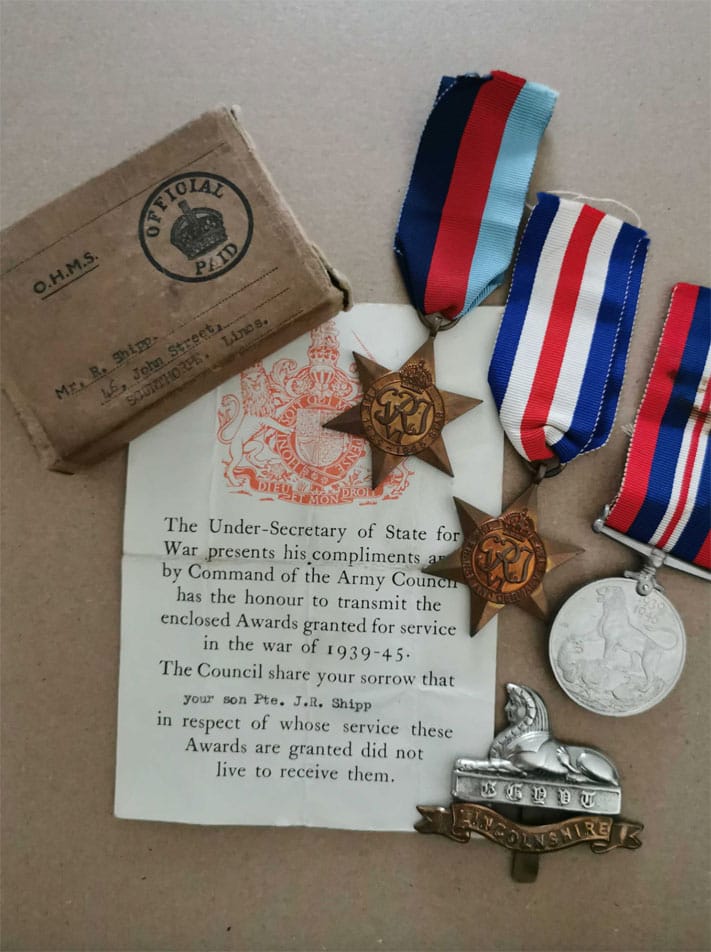
War medals John Richard Shipp

John was awarded several medals. A condolence medal slip, the original box addressed to his father and a Lincolnshire regiment cap badge from his effects.

Medals are: 
The 1939-45 Star
The France and Germany Star
The 1939-45 War Medal

These 3 medals are standard for a soldier who landed in France after D-Day and had served less than 3 years. Johns parents received a certificate but there are no extra medals for casualties

Sources and credits

Ancestry Birth, Marriage, Death records and Family Trees
War Diaries Lincolnshire Regiment 2nd Bn 
Service Record WO 423/408451 for John Shipp from the National Archives

Nigel Shipp for some information and the photo of the medals. 

This biography has been compiled by our foundation based on our own research and stories from other soldiers who served in the same regiment or participated in the same battle on that day. Part of this work was carried out collectively within the foundation.

Research Anny Huberts

Continue reading

Hawksby | John Victor

Hawksby | John Victor

  • First names

    John Victor

  • Age

    23

  • Date of birth

    06-12-1920

  • Date of death

    14-10-1944

  • Service number

    1445252

  • Rank

    Private

  • Regiment

    Lincolnshire Regiment, 2nd Bn.

  • Grave number

    I. D. 1.

  • John Victor Hawksby

    John Victor Hawksby

    John Victor Hawksby

  • Grave John Victor Hawksby

    Grave John Victor Hawksby

    Grave John Victor Hawksby

Biography

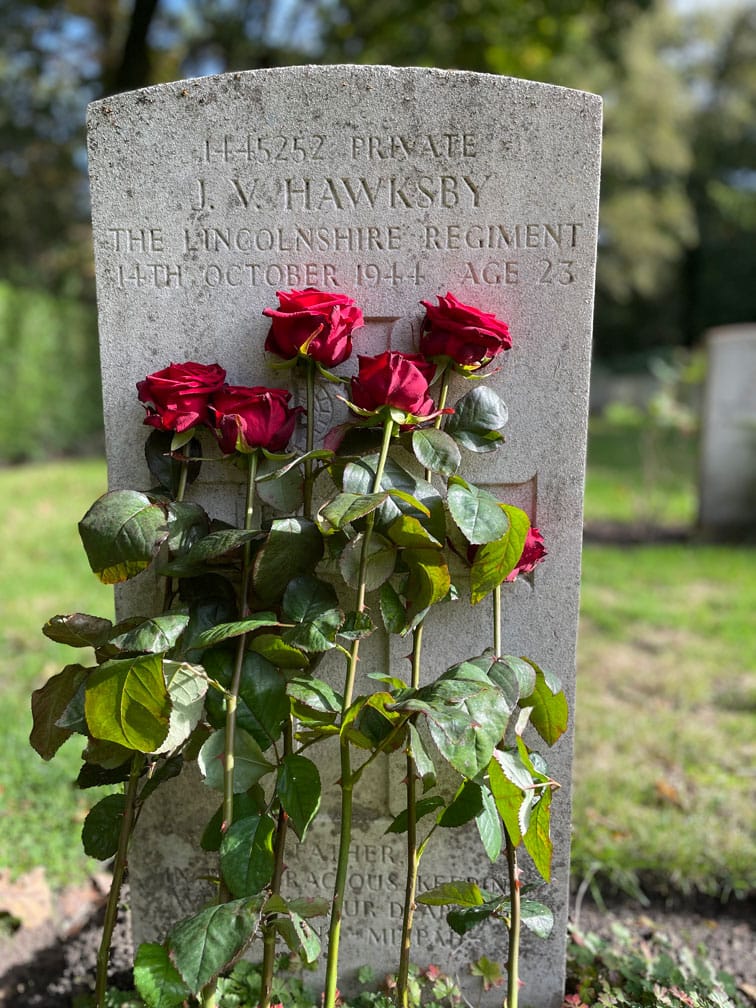
John Victor Hawksby died of his injuries on 14 October 1944 in Overloon, aged 23. He was a soldier in the Lincolnshire Regiment, 2nd Battalion (service number 1445252). John was initially buried at the farm of Vogelsangs in Overloon and reburied on 15 July 1946 at the Overloon war cemetery in grave I. D.1. The inscription on his grave reads: ‘Father, In Thy gracious keeping We leave our dear one Sleeping. -Mizpah-

Family background

John Victor was born in 1920 and was the son of John Edward Hawksby (1892–1958) and Elizabeth Thompson Evers (1898–1984). He was the brother of Eric Hawksby (1926–1976).
They lived in West Hartlepool, Durham, England.

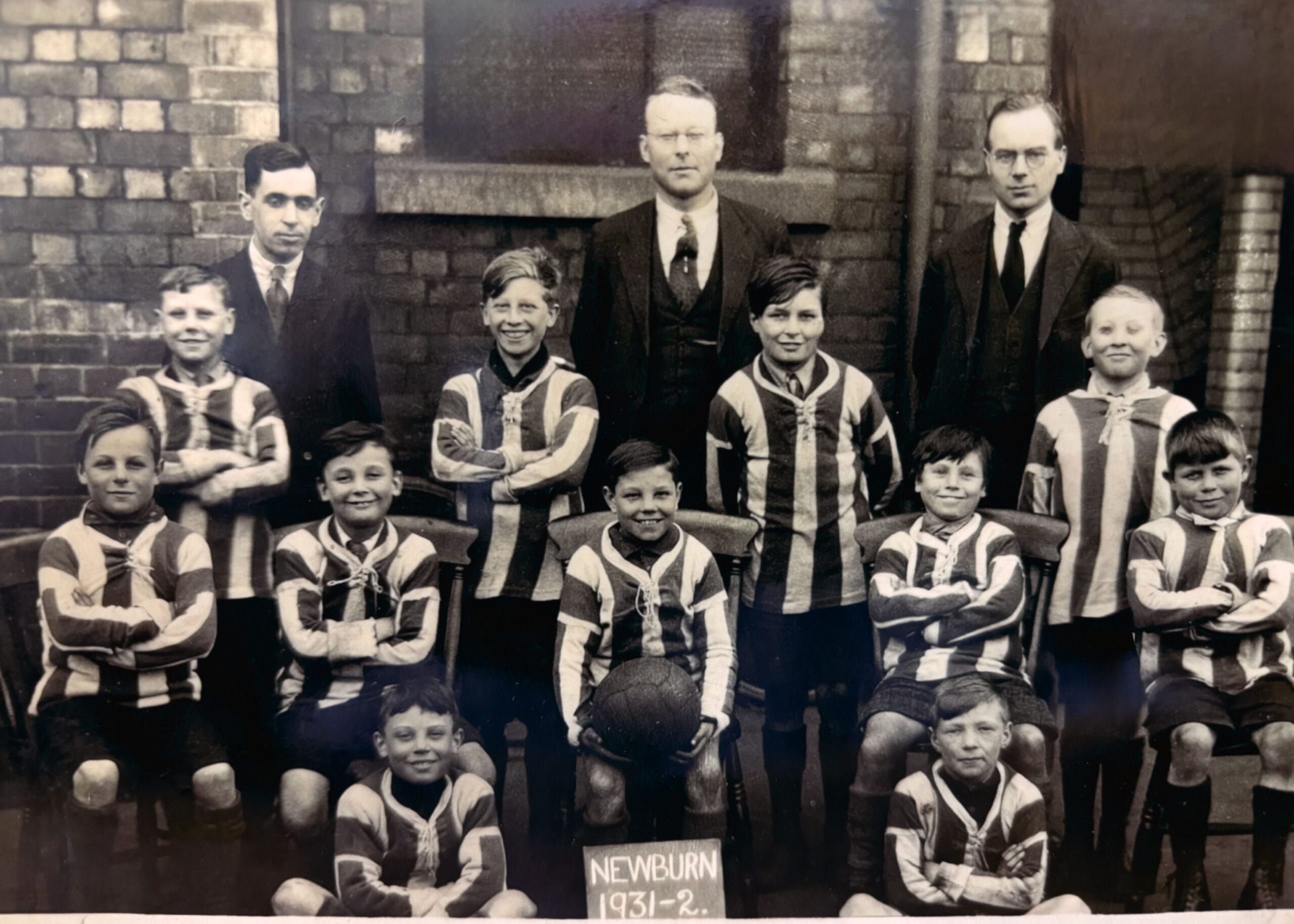
John (named Vic by his family) attended Newburn School in West Hartlepool and then worked in the construction industry. He was a member of the St John Ambulance Brigade and the Durham Heavy Brigade T.A. (Territorial Army) in Hartlepool, through which he was called up for service at the outbreak of war. He was subsequently transferred to the infantry, the North Staffordshire Regiment, most probably the 6th battallion which was the only Staffordshire battalion which landed in Normandy.
With this battalion he landed in Normandy in June 1944 and was wounded in August 1944. 

The 6th Battalion had been in France for less than two months when, in August 1944, along with other infantry units of 59th Division, it was broken up to supply replacements to other British units, due to a severe shortage of infantry replacements throughout the Army at the time. It is likely that because of that John Victor was assigned to the Lincolnshire Regiment 2nd Bn after he recovered from his wounds.

Lincolnshire Regiment 2nd bn

The 2nd Bn Lincolnshires took part in the D-Day landings in June 1944 and was then engaged throughout the Normandy Campaign, taking part in Operation Charnwood and Operation Goodwood.
They remained in Normandy until 15 September. They then took part in the push up through Belgium and the Netherlands with the aim of supporting the airborne troops engaged in Operation Market Garden which ultimately did not fully succeed following the failure to take the bridge at Arnhem in late September. 
Following the failure to take the bridge at Arnhem in Operation Market Garden in late September 1944, the Allied Forces were left in a very precarious narrow salient through the Netherlands. It was the aim of Operation Aintree to widen this salient by heading south from Nijmegen to take Overloon and then Venray before finally eliminating a German bridgehead on the River Maas near Venlo.
 
On 16 and 17 September the Battalion moved into Belgium near Mons. They found that the civil population were very enthusiastic, particularly in the area of the Belgian frontier. They then joined in the effort to cross the Escaut Canal where all the bridges had been blown by the enemy. They succeeded with other regiments in this difficult task in the face of opposition and a bridge was complete by 19 September. The Battalion moved on to Achel on 20 September where all ranks were able to get a night’s sleep under cover and then Hamont the following day where they remained until 25 September while the 11 Armoured Division took Deurne in the Netherlands. The Battalion moved to Deurne that day and took over from the 11 Armoured Division with the 2nd Battalion Royal Ulster Rifles. They remained in this area, sometimes engaging with the enemy who were on the east side of a canal. On 29 September they moved north to Milheeze and then Haps on 1 October.

The base of the 2nd Lincolnshire Regiment stayed in Haps from the 1st till the 12th of October. From there, attempts were made to clear the west side of the Meuse between Cuijk and Oeffelt. This was done together with 2nd Bn Royal Ulster Rifles, the 1st Bn King’s Own Scottish Borderers and 3rd Reconnaisance Regiment (9th Brigade 3rd Infantry Division).  
On the east side of the Meuse, resistance remained strong, particularly in Middelaar, Milsbeek, and Gennep. The stone factory in Milsbeek served as the main center of opposition, as its tall chimney functioned as an observation post from which German artillery coordinated the defense. On the east side of the river, the enemy was also attacked from Plasmolen.

Between 1 and 7 October, the Ferry House in Oeffelt — Het Veerhuis — was repeatedly occupied by the enemy and then retaken by British forces. Patrols of the 2nd Lincolnshire Regiment discovered that the Ferry House had once again fallen into German hands. Despite heavy British artillery bombardments, German troops continued to appear around the stone factory in Milsbeek.

On 4 and 5 October, the chimney of the Milsbeek factory was finally brought down, and the church in Middelaar was reduced to rubble. On 6 October, the 2nd Lincolnshire Regiment launched another attack on the Ferry House — this time successfully. This first week of October the Batallion lost three comrades, who were temporarily buried at the village square in Haps and later in 1946 reburied at Overloon War Cemetery.

On 9 October 1944 the Battalion were ordered to move south to St Anthonis on 11 October, but this was postponed to the following day due to bad weather. The move was completed on 12 October.
They were kept in reserve for the battle that was being fought around Overloon. The 8th Infantry Brigade was tasked with capturing Overloon and advancing to Venray. Shortly before nightfall, they heard that Overloon had fallen and that the battalions of the 8th Division were struggling to hold their ground.

On Friday, 13 October the aim was for the Royal Ulster Rifles, followed by the King’s Own Scottish Borderers and then the Lincolnshires to clear wooded areas just west and south of Overloon in which the Germans had entrenched themselves, then cross a stream called the Molenbeek between Overloon and Venray. They would be supported by Churchill Tanks of the 4th Tank Grenadier Guards. The Lincolnshires therefore moved down to a position just north west of Overloon that day.
In addition to the difficult terrain, two other factors played a crucial role – the Germans had dotted the entire area with their dreaded “Shuhminen.” These wooden mines were difficult to detect. They didn’t tend to kill but inflicted severe injury to the victim’s legs. In addition, the German troops had a strategic observation point from Venray’s church tower. Any Allied troop movement would be watched and relayed to their artillery which would result in a barrage of shells.

The Royal Ulster Rifles and the King’s Own Scottish Borderers began the attack on the forests. However, it soon became apparent that they were barely making any progress, leaving the Lincolnshires out of the battle all day. Nevertheless, the Lincolnshires suffered one man killed and 3 wounded.

On the 14 October, the plan was for B Company to be guided through a wood held by the Royal Ulster Rifles to its front edge from where they would carry out a recce (reconnaissance)  to check if a stream was passable and if the north eastern corner of a wood to the south was held by the enemy. However, the guides were late and the move through the wood was slower than expected, so the recce did not take place. At 7.30 am the Company began to advance south out of the wood. Before the Company had advanced 100 yds the enemy opened fire from a track about another 100 yds ahead. The advance continued but came under such heavy fire with so many casualties that the Company Commander, Anthony Frith Smith, issued an order to retreat back to the Royal Ulster Rifles’ position. By this point one Lieutenant and 34 other ranks had been killed or wounded.

Following a reconnaisance by the Company Commanders, it was decided to launch a full battalion attack at 15.30 hours with the support of the whole of the Divisional Artillery and an additional tank division on the right flank. The enemy had been seen moving in the area of the stream in front of the wood. It was thought that the enemy holding the Battalion objective were probably a Company strong. Immediately the attacking force came into the open they were subjected to intense artillery and mortar fire which was just as bad as in the early morning but this time they pressed steadily on to reach their objective. During this action the Battalion suffered very heavy casualties including four officers killed and another four wounded.

It was on this day that sadly, John was wounded and died of his wounds.

The fallen soldiers were buried the following day at noon on the Vogelsangs family farm on Helderseweg in Overloon. 

On 15 July 1946, a total of 27 men from the 2nd Battalion of the Lincolnshire Regiment who had died on 14 October 1944 were reburied side by side at the Overloon war cemetery. John is buried in grave I. D. 1.

Letters from Vic to home

  • Letter August 2nd 1944

    France August 2nd 1944

    Dear mum,

    I am answering your letter written last week, the 27th and as today is Wednesday 2nd and I got yours on Monday. You can see it’s not taking long for them to get here now, but I still haven’t got the papers (newspapers) so that’s two lost by now. I think I’ve seen all I’m going to of them. 
    I’m glad the bairns (children) got the cards, I’ve sent one to Gran, one to Aunt Mary and one to Aunt Nell as well, they and the writing paper I found in the same Bosch kit in a village we took a fortnight ago last Sunday.

    I’ve been busy but I’ve managed to pull through ok as yet. 
    The only thing I don’t like is this mortars. By the way, you remember my saying about the Major, well sorry to say he’s not with us anymore, mortar shrapnel got him so I’ve lost at least one good friend. 

    You people at home seem to be busy. Lately seeing relations. I have been away from the family for donkey’s ages (a long time), still I suppose everybody likes a visit West (West Hartlepool) now and then. 
    I bet Bills Nell will be cut up a lot over Bill but she will have to keep her chin up the same as the rest of us and hope for the best, anyway if she is in West she may cheer up a little. 

    I wish I was at home now. I would certainly change with anyone as doesn’t like the idea of buzz bomb repairs (John Victor was a bricklayer before the war), anything would do instead of this, I could certainly do with a rest. I’ve not had my boots or my slacks (trousers) off since I joined the battalion. 

    I’m making up for the time I spent in England with the RA (Royal Artillery). I’ve seen enough Jerrys lately to last me a lifetime, a lot of them are only 15 or 16 years old so that’s one thing that the papers are telling you that I can definitely vouch for as I’ve seen their paybooks and dates of birth. This calling up at such an age has been going on for a while. I saw a pay book the other day, a lad only 18 now who’s date of enlistment was may 1942. They are from the Hitler Youth movements and regular fanatics. 

    The weather here is much the same as at home, you know, one day boiling hot and next dull and foggy so we can’t really grumble. 
    Well folks I shall close down once more with love to all at home, remember me to all and thank them for remembering me,

    Your loving son
    Vic

  • France 10th September 1944

    France 10th September 1944

    Dear Mum, Dad and Eric,

    I am well settled in now and have no grumbles except your cigs haven’t reached me yet but other lads say it usually takes a month for theirs so I am still hoping, my other crib (demand) is for writing arterial. I am now using some I’ve scrounged (found/borrowed) and we can’t get anymore. So if you can?

    I hear the Pools (Hartlepool Utd. FC) beat the Quakers (Darlington FC) 4-2 but it wasn’t your shouting that let me know. 

    We heard the wireless, a civvy (civilian) set where we are now, the electricity came on yesterday and the householders who own the barn we are in treat us like their own family we have had a bit of a change just lately. She gives us all sorts of things such as apples and pears and peaches of course food as well but we refuse it as they don’t get so much themselves so I’m happy enough with this war as it stands. 

    The news is good lately and I don’t think it’ll be long before I’m giving my settee and the wireless at home a good bashing. 
    I am at present with the others of course doing bags of peace time soldiering in preparation for the victory march through the Unter den Linden or at least that is what I surmise it is for. 

    So you had best tell Jake to hang on a while and I shall be back for his wedding, not that I want to do Eric out of a job but I should like to be there all the same. While you are about it you can tell Gran to hurry up with her flags or else she will be too late and that would never do I suppose. 

    I hope dad is feeling fit for work now he’s had a good spell off now and I hope he feels the difference, it’s just what he wanted isn’t it. 
    I’m still looking forward to that drink with him even if he’s found a list of jobs for me as big as Sydenham Road ( John Victor’s home address) I suppose he’s been looking around taking notice of what needs doing while he’s been home, still I shall be only too glad to do them. 

    Well folks I’ve no more news so as usual I’ll sign off with love to Cheeky Charlie, gran, uncle Gus in fact all the family by and large

    Your loving son
    Vic

Aftermath

Ouders van John met kinderen Vloet op Overloon War Cemetery in 1948
Parents of John with children Vloet at Overloon War Cemetery

After the war, Toon and Dora Vloet from Overloon took care of John Victor Hawksby’s grave and welcomed John’s parents in 1948. Family members also visited Overloon in 1958, and their son Jan Vloet, who was born in 1945, visited John’s brother Eric Hawksby in England in the late 1960s. In 1975, Jan, his wife and children travelled to visit the family in England.
Eric’s widow, Muriel, and her children also visited Jan Vloet’s family and met Toon and Dora in Overloon.

Since then, contact has been maintained and John’s grave is still adopted by the Willems-Vloet family.

80th anniversary of the liberation of Overloon 2024

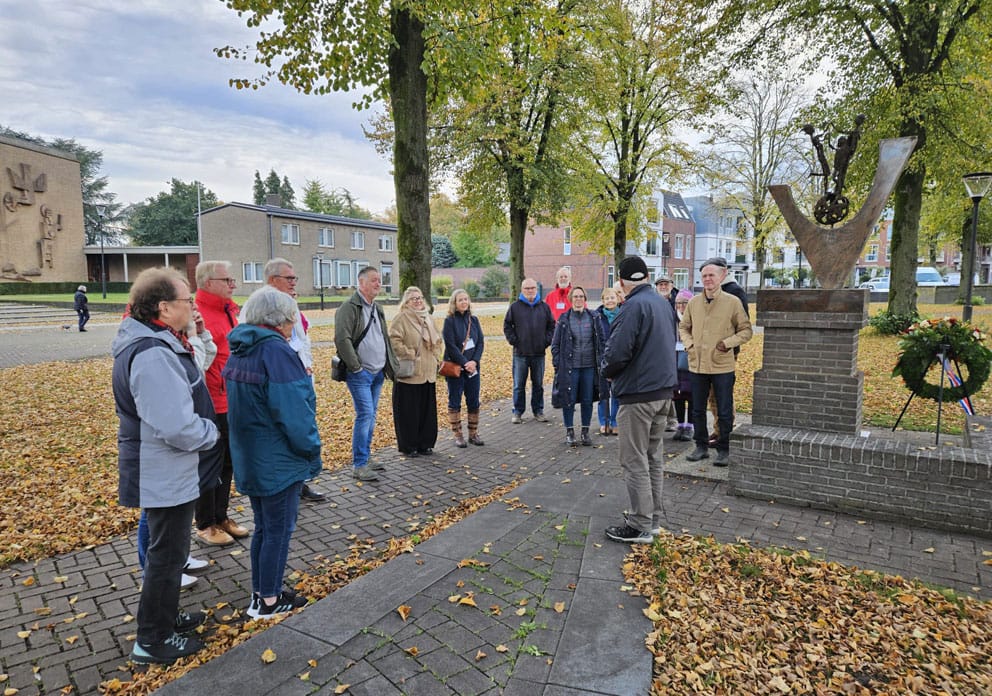
During this weekend, John Hawksby’s family and friends visited Overloon to take part in all the commemorative ceremonies. They also joined a battlefield tour that took them through the area where John fought and where he was buried until he finally found his final resting place at Overloon War Cemetery in 1946.

  • School football team Newburn

    School football team Newburn with John Hawksby sitting left in front row

    School football team Newburn with John Hawksby sitting left in front row

  • John Edward Hawksby, father of John and Eric in WWI uniform

    John Edward Hawksby, father of John and Eric in WWI uniform

    John Edward Hawksby, father of John and Eric in WWI uniform

  • John Victor Hawksby

    John Victor Hawksby

    John Victor Hawksby

  • John Victor Hawksby

    John Victor Hawksby

    John Victor Hawksby

  • Hartlepool Daily Mail 16-11-1944

    Hartlepool Daily Mail 16-11-1944

    Hartlepool Daily Mail 16-11-1944

  • Ian Hawksby at the grave of John Hawksby

    Ian Hawksby at the grave of John Hawksby

    Ian Hawksby at the grave of John Hawksby

  • Clint Dougherty Ro Dougherty Jeanne Willems-Vloet  Julie Hawksby Ian Hawksby Tiny Willems

    Clint Dougherty Ro Dougherty Jeanne Willems-Vloet Julie Hawksby Ian Hawksby Tiny Willems

    Clint Dougherty Ro Dougherty Jeanne Willems-Vloet Julie Hawksby Ian Hawksby Tiny Willems

  • Roses at John's grave

    Roses at John’s grave

    Roses at John’s grave

  • Roses at the grave at the 80th liberation of Overloon

    Roses at the grave at the 80th liberation of Overloon

    Roses at the grave at the 80th liberation of Overloon

  • 80 years remembrance at Overloon War Cemetery

    80 years remembrance at Overloon War Cemetery

    80 years remembrance at Overloon War Cemetery

  • Battlefield tour 14-10-2024

    Battlefield tour 14-10-2024

    Battlefield tour 14-10-2024

  • Battlefield tour 14-10-2024

    Battlefield tour 14-10-2024

    Battlefield tour 14-10-2024

  • Ian and Julie Hawksby at the farm yard Vogelsangs Helderseweg Overloon

    Ian and Julie Hawksby at the farm yard Vogelsangs Helderseweg Overloon

    Ian and Julie Hawksby at the farm yard Vogelsangs Helderseweg Overloon

  • Temporary grave location of John Hawksby

    Temporary grave location of John Hawksby

    Temporary grave location of John Hawksby

John Victor and his love for music

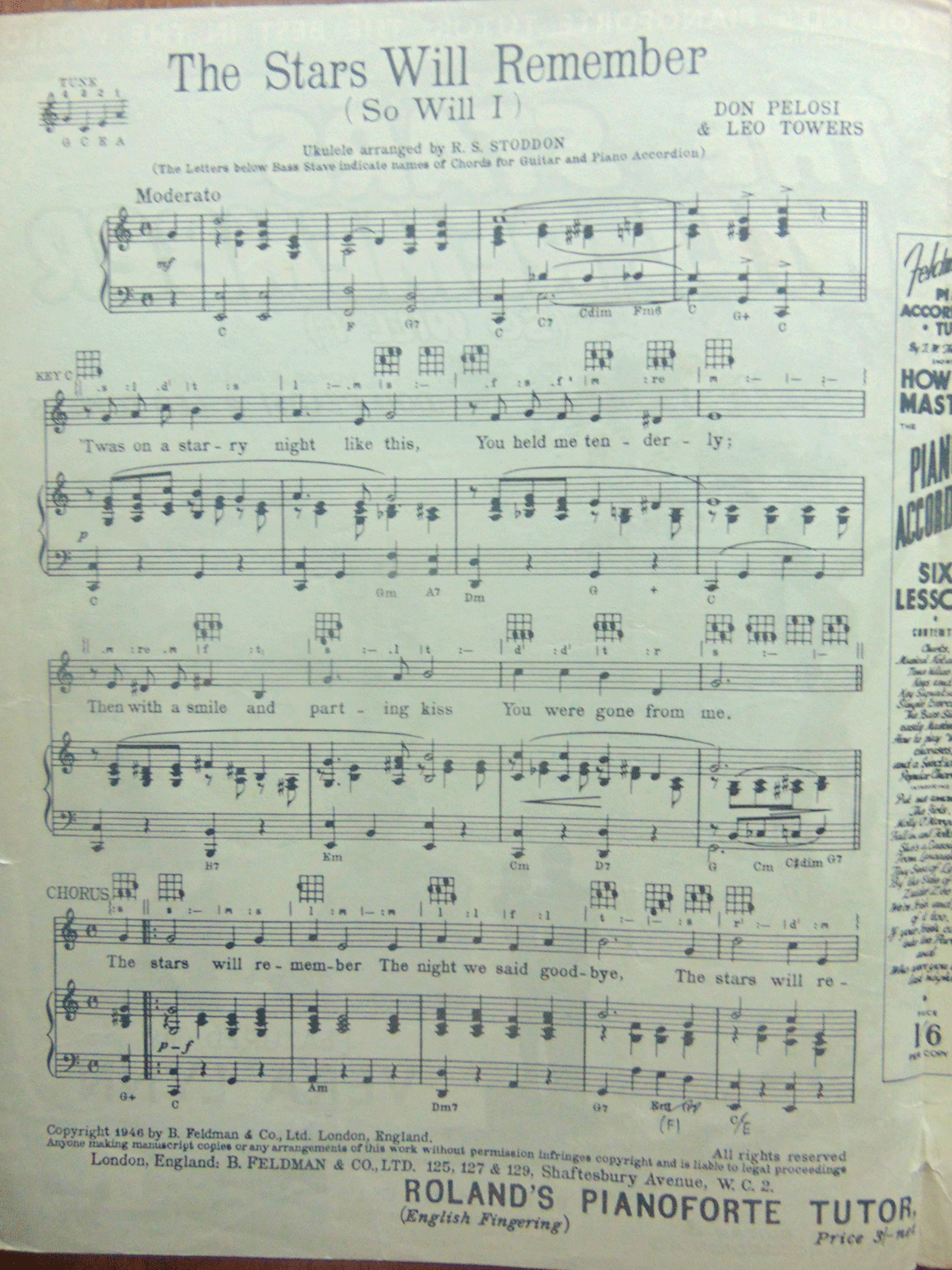
John loved music and had a beautiful singing voice himself. One day, he went with his brother Eric to a record shop in Hartlepool, where there was a recording booth. He loved the song “The Stars Will Remember” and decided to record it there. After the brothers had chatted for a while, John began to sing.

The recording was found many years after the war, when his brother Eric had passed away. Eric’s son Ian and his friend Clint Dougherty did their utmost to edit the recording and remove all unnecessary noise.
The song was written by Don Pelosi and Leo Towers and the lyrics are very poignant.

Don Pelosi was an Italian-born British songwriter who wrote many hits in the 1940s and 1950s. During the war, songs such as ‘The Stars Will Remember’, ‘Good Morning Sergeant Major’ and ‘When the Poppies Bloom Again’ were very popular and were covered by artists such as Vera Lynn and Frank Sinatra.

THE STARS WILL REMEMBER, SO WILL I

The stars will remember the night we said goodbye
The stars will remember, so will I
A rose as a token, a kiss that brought a sigh
The stars will remember, so will I
And now the stars and I, we share the lonely lane
But in my solitude, it seems I hear you call my name
The world may forget you as time goes passing by
But stars will remember, so will I
And now the stars and I, we share the lonely lane
But in my solitude, it seems I hear you call my name
The world may forget you as time goes passing by
But stars will remember, so will I.

Listen here to the recording

BATTLEFIELD TOUR TO HELDERSEWEG OVERLOON

During the commemorative weekend marking the 80th anniversary of the liberation of Overloon, on 14 October 2024, exactly eighty years after his death, his voice could be heard again during a battlefield tour. John’s song was played on Helderseweg in Overloon, at the place where he and many of his comrades were temporarily buried at the time. It was an impressive and moving moment, shared by all those present — including the other families of the soldiers who lost their lives in Overloon.

Watch the video of this beautiful moment on Helderseweg.

Sheet music The Stars Will Remember (So Will I)

  • Sheet music The Stars will  remember and so will I

    Sheet music The Stars will remember and so will I

    Sheet music The Stars will remember and so will I

  • Sheet music The Stars will  remember and so will I

    Sheet music The Stars will remember and so will I

    Sheet music The Stars will remember and so will I

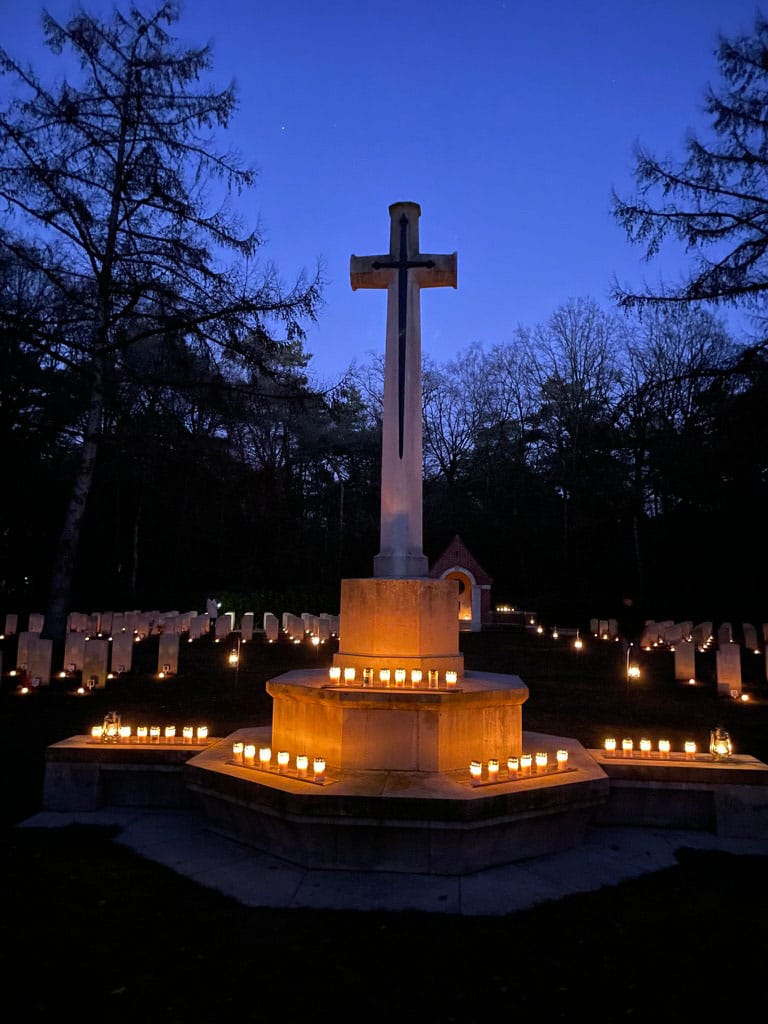
Christmas Eve 2025 Lights on War Graves Overloon

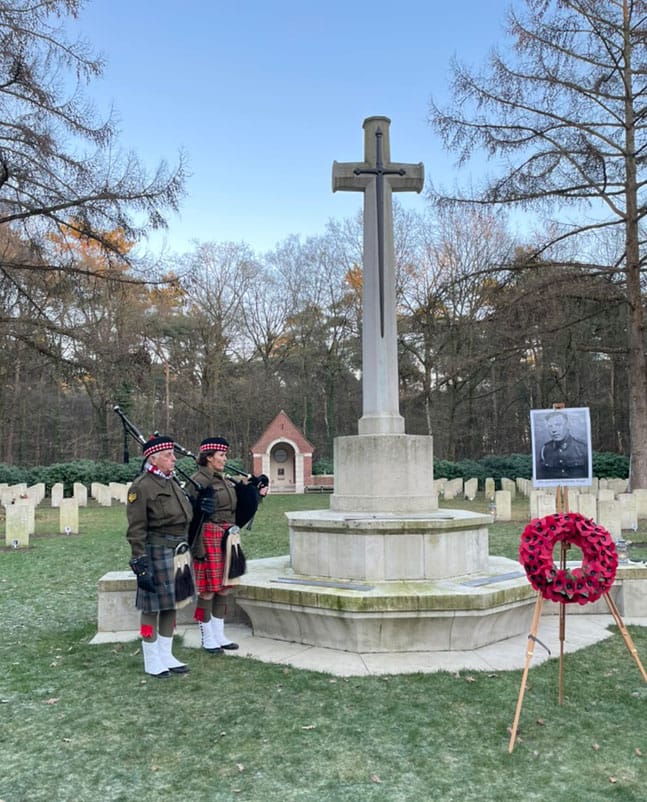
On Christmas Eve 2025, the story of John Hawksby’s life was told in a trilogy by Overloon War Chronicles and Jeanne Willems-Vloet, who adopted his grave. The unique audio recording of the song sung by John and recorded on tape before he went to war was also played.

It was an impressive ceremony attended by hundreds of interested parties, veterans, adopters and residents of Overloon.

The 281 candles placed at the graves on this occasion created an extra beautiful and emotional atmosphere, while Fanfare Vriendenkring played the song “The Stars Will Remember”, which they had rehearsed especially for this occasion.

For an extensive photo report, see our foundation’s Facebook post.

A number of recordings and compilations of the ceremony were made by local photographers and Omroep Land van Cuijk.

Photo reportage by Albert Hendriks of Overloon Nieuws 

Reportage by Omroep Land van Cuijk

Compilation of Lights on War Graves by Geert Arts

A quote from the Christmas Eve speech by the foundation’s chairman, Hennie de Hoog:

‘The story of John Victor Hawksby shows who these men in the cemetery were before they became soldiers. Ordinary people with dreams and families, just like you and me. The photographs at the graves give them back their faces. The candles on Christmas Eve show that the connection between Overloon and these 281 men is still very much alive, even more than eighty years later.’

  • John's grave at Christmas Eve 2025

    John’s grave at Christmas Eve 2025

    John’s grave at Christmas Eve 2025

  • Bag pipers during Trilogy

    Bag pipers during Trilogy

    Bag pipers during Trilogy

  • John's grave and the candles

    John’s grave and the candles

    John’s grave and the candles

  • Lights on war Graves Overloon War Cemetery Christmas Eve 2025

    Lights on war Graves Overloon War Cemetery Christmas Eve 2025

    Lights on war Graves Overloon War Cemetery Christmas Eve 2025

Sources and credits

Wikipedia
Ancestry birth and death records
War Diaries Lincolnshire Regiment 2nd Bn
Toon and Dora Vloet
Jan and Truus Vloet
Tiny and Jeanne Willems-Vloet
Ian and Julie Hawksby

Clint Dougherty for editing the music recording
Terence Birnie for the sheet music

This biography has been compiled by our foundation based on our own research and stories from other soldiers who served in the same regiment or participated in the same battle on that day. Part of this work was carried out collectively within the foundation.

Research Anny Huberts

Continue reading

Hillman Bernard David

Hillman | Bernard David

  • First names

    Bernard David

  • Age

    23

  • Date of birth

    1921

  • Date of death

    14-10-1944

  • Service number

    2658964

  • Rank

    Lance Serjeant

  • Regiment

    Coldstream Guards, 4th Bn.

  • Grave number

    II. A. 14.

  • Bernard David Hillman

    Bernard David Hillman

    Bernard David Hillman

  • Grave Bernard David Hillman

    Grave Bernard David Hillman

    Grave Bernard David Hillman

Biography

Bernard David Hillman died of wounds on 14 October 1944 in the vicinity of Overloon. He was aged 23 at the time. He was a Lance Sergeant in the 4th Battalion of the Coldstream Guards (Service No. 2658964). He was initially buried at Cemetery Venraysweg which is just south of Overloon and re-interred on 14 May 1947 in grave II. A. 14. in the Overloon CWG Cemetery. The inscription on his grave reads: “In Memory of Someone Dear who Heard God’s Call. Rest in Peace. Loved by All.”

Family Background

Bernard David Hillman was the son of David Bernard Hillman and Rose Sophia Claridge who had married in Pontypridd in 1920.

Bernard’s father, David Bernard Hillman, was the son of (Ernest) Moritz Hillman and Augusta Stender who had married in Shoreditch, London in 1875. Moritz had been born in 1851 in Saxony in Germany while Augusta had been born around 1852 in Ludwigslust in Mecklenburg in Prussia, Germany. They had at least 7 children born between 1876 and 1896 of whom David was the youngest – born on 10 February 1896 in Pontypridd in Glamorganshire. The family name was originally Hillmann.

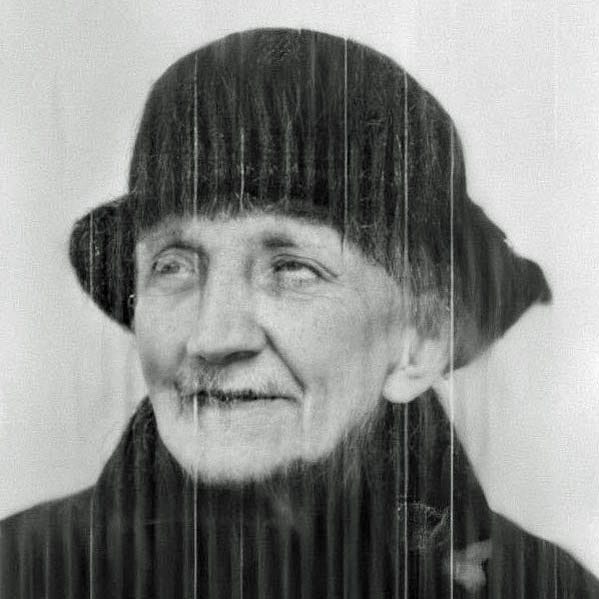
Augusta Hillman
Augusta Hillman

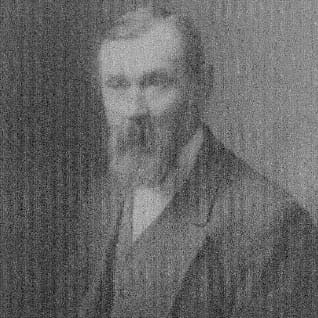
Ernest Hillman
Ernest Hillman

 In 1881 Moritz and Augusta were living at 1, New Court, Cambridge Holy Trinity, Cambridge with their first two children. Moritz was working as a Pastry Cook. By 1891 they were living at 8, Brooklyn Road, Bath, Somerset with their first five children. Moritz was working as a Baker. The birth places of their children suggest that they moved from Cambridge sometime after 1889.

By 1896 they had moved to Pontypridd as that is where David Bernhard (later Bernard) Hillman was born. In 1901 they were living in Union Street Pontrypridd with their five youngest children. Moritz and Augusta were both shown as a Confectioners and two daughters were shown as bottling confectionery. By 1911 they were living at 22 Union Street but now with just David and his brother still with them. Also present was a boarder and his daughter. Moritz was now described as a Baker Serviceman.
 
Bernard’s mother, Rose Sophia Claridge, was the daughter of William Edwin Claridge and Frances Sophia Prymer who had married in Mile End Old Town in London in 1894. This was William’s second marriage. He had previously married Ellen West in 1884 in Poplar. He and Ellen had a child called William later in 1884, but he died shortly after birth. In 1891 William and Ellen were living at 32, Strode Road, West Ham, London. William was born in 1854 in London and was a warehouseman. Ellen was born in 1865 in Dartford, Kent. Ellen died in 1894 in Dartford, aged 30.

William married Frances Sophia Pymer in Mile End shortly after his first wife’s death in 1894. Frances was born in 1862. William and Frances had two girls: Rose Sophia on 26 June 1896 and Florence Elsie in 1899 – both in Mile End. Frances died in early 1901 in Mile End leaving William as a widower for the second time. In 1901, William was living at 30, Parr Road, East Ham with his two young daughters and a 74 year old widowed servant called Martha Hall. He was working as a Bricklayer’s labourer. By 1911 William had moved to 91 Richard Street Pontypridd with his two daughters. He was working as a Mason Labourer. Rose aged 15 was acting as his housekeeper.
 
David Hillman married Rose Claridge on 5 April,1920 in Pontypridd. Bernard David Hillman was born in April 1921 at 68 King Street Treforest, Pontypridd.
 
In June 1921 David, Rose and 2-month-old Bernard were recorded as visitors at Sunnyside, Aylestone Hill, Hereford, All Saints, Herefordshire. David was shown as working for “Mr D C Pontypridd”. There too was David’s mother, Augusta, also shown as a visitor. It wasn’t clear who the head of this household was however David Hillman completed the census form. Various other visitors and boarders were also present. These included Kathleen Simmons, who was a 14-year-old visitor and Bert and Florence Hillman, both aged 29 and shown as boarders (with Bert born in Pontypridd and Florence in Hereford). Kathleen Simmons was Augusta’s granddaughter – the eldest daughter of Mary Elizabeth Hillman (known as Polly) who had married Joseph James Simmons in 1906. Bert Hillman was Augusta’s son. Bert Hillman was working as a Fruit Merchant. Also there were Alice Workman a 15 year old nurse and Evelyn Workman a 19 year old servant – both from Hereford. Three more boarders were also present – Lawrence and Mabel Beatrice Lax born in Hereford in 1914 and 1920 respectively and Daniel Haret, a Farm Dealer, aged 58 born in Hereford.

At this time, Rose’s father and sister were living at 68, King Street, Treforest, Pontypridd, where Bernard had been born. William was still a Mason’s labourer but was shown as unemployed. Florence was working as a Commercial Traveller but also shown as unemployed. There too was Joseph Thompson Lloyd who was a visitor – born in 1896 in Barry, Glamorgan and working as a Boilermaker, but again unemployed. Rose’s father died in 1935 in Leominster, Herefordshire.

Eatmor Fruit Store
Eatmor Fruit Store

On 31 May 1924, David and Rose had another son, Rone Robert Edward, again at 68 King Street, Pontypridd. His father was shown as a Commercial Motor Driver at this time.

By 1927, David and Rose along with their sons, had moved to 4 Church Street Leominster, Herefordshire where Sylvia Elsie Sophia was born on the 16 April 1927. David Bernard Hillman was employed as a shop assistant in a Fruiterer’s shop at this time.

On 2 November 1930 Augusta Hillman, aged 80, died from “Senile Decay”. Her address at that time was
22 Union Street, Pontypridd. Her daughter, M.E. Simmons of 4 Station Terrace, Pontypridd reported her death. On 5 July 1935 Ernest Moritz Hillman, aged 80, also died from “Senile Decay”. His address at the time was 4 Station Terrace, Pontypridd and his daughter, M.E. Simmons registered his death.
 
By September 1939, David and Rose Hillman were living at 115 Charlotte Street, Portsmouth with their son Rone. David was working as a Shopkeeper. Rone was working as an Air Speed Apprentice. Their daughter Sylvia was living at 4 Station Terrace, Pontypridd with her aunt, Mary E Simmons and two of her daughters. Mary was now widowed. By this time, Bernard David Hillman had joined the Army.

Rone en Bernard Hillman
Rone and Bernard Hillman

Military Career

Bernard had enlisted in the Coldstream Guards by 1938. A military record indicates that he had been living in Portsmouth but had been born in Glamorganshire in Wales.
 
Following the outbreak of the Second World War, the 1st and 2nd Battalions of the Coldstream Guards were deployed to France with the British Expeditionary Force. They were evacuated from Dunkirk the following year. The 4th Battalion was formed in October 1940 at Elstree and the 5th Battalion in October 1941. In 1941, the 1st Battalion was converted to an armoured role and served with the Guards Armoured Division. In November 1942 the 4th Battalion switched from cars to Churchill tanks.
 
While the 5th and 1st Battalions had entered France in June 1944, shortly after D-Day, the 4th Battalion remained at home until 20 July 1944 when they landed at Juno Beach. In France, they played their part in the battle at Caumont and assisted in the attacks at Vire and Tinchebray. From 15 August until 29 September the 4th Battalion had a relatively quiet time while the 1st and 5th Battalions proceeded through Belgium and the Netherlands to take part in Operation Market Garden. It was only after the failure of that operation to take Arnhem in late September that the 4th Division was brought more fully into the conflict.

On 29 September they reached Eindhoven and headed towards Nijmegen the following day, crossing the River Maas and arriving in the forests at Mook that night. The initial plan had been for them to support the 8th and 185th Brigades of the 3rd Division in an attack on the Reichswald forest area to the east. However, this was cancelled on 7 October as higher priorities were given to securing the port of Antwerp and in widening the salient along the River Maas by turning south to capture Overloon and Venray. It was with this latter task that the 4th Battalion was to assist the 3rd Division. The country was flooded and heavily wooded making reconnaissance difficult. There was incessant rain and impassable roads. The attack was initially scheduled for 11 October but rain flooded the whole district, so it was delayed until 12 October to allow the ground to dry out to some extent.

The operation began with a heavy artillery barrage at midday on 12 October, after the battalion had spent a drenching night in the woods 2 miles north of Overloon. The Coldstream with 8 Brigade were to take Overloon, 1 Sqn. supporting the 1st Suffolks and 3 Sqn. helping the East Yorks., and the Grenadiers with 9th Brigade were to pass through to attack Venray 3 miles further South. The battalion were to be supported by A.V.R.E.s (Armoured Vehicles Royal Engineers – which were Churchill tanks modified in various ways to suit the needs of Assault Engineers) and flails. The Royal Engineers had worked hard to prepare approaches for the tanks through the bogs, dikes and copses which barred their path. At first the advance went briskly until mine-fields were encountered. Here 2 HQ tanks of 4 Tank Coldstream Guards were put out of action, thus destroying two sources of  information within a few minutes of each other. There was little first-hand news for some two hours and it was then learned that 2 more tanks had been put out of action by a Panther tank, several of which were previously reported in Overloon. Despite the losses, the village had fallen by 5pm. However, the enemy still held out in a wood on the right flank so the attack continued the following day. It was still impossible for tanks to approach the wood and three tanks were knocked out during the attack and a third blew up on a minefield as it withdrew.

Bernard David Hillman

On 14 October the 2nd Squadron advanced with the 1st Norfolks towards the Molenbeek Canal. They met no opposition until they emerged from the woods to the south of Overloon. Here they were suddenly attacked by a Panther which had hidden in the woods they had just left. It missed two tanks but knocked out a third which had gone up on a mine before it retired.
 
When the two leading troops were fully occupied supporting the Infantry, high velocity shells again began whistling overhead. One tank of the rear troop was knocked out before Lt Page-Wood spotted this second Panther. He directed four shots from his 6pdr. at it but these just bounced off its armour. The Panther replied with four shots which went straight through the front of Sgt. Thompson’s tank but the crew miraculously bailed out unhurt.

Another Panther then opened up on the support troop commanded by L/Sgt. Gough. He refused to withdraw and leave his infantry unprotected and sat doggedly in the open until his own tank and that of his Troop Corporal had been knocked out  – a courageous decision for which he won the Military Medal. An air burst shot then killed the commander of Lt Page-Wood’s remaining tank.

It was on this day that Lance Sgt Bernard David Hillman was wounded and then died of his wounds. It isn’t known in which of the incidents he was wounded. Six other men from the Coldstream Guards who died that day are also buried at Overloon (Lance Cpl F Sheen and Guardsmen GJ Wright, RE Silman, E Gilbert, JW Dalton, AT Churchlow) and a least five others were wounded (Lance Sgt LJ Garner and CF Higgins and Guardsmen A Conn, RB Hopkinson and EW Purdy). The other six men who died that day were initially buried alongside the Overloon to Venray road, south of the woods and about half a kilometre north of the Molen Beek, near to where their tanks were attacked. Bernard was buried about a kilometre further north, in the woods just to the east of the same road. It may be that an attempt was being made to transport him back to Overloon or he was being carried back to the Regimental Aid Post at Overloon or the hospital at Oploo for treatment when he died, so he was buried in this location.

Aftermath

Family members commemorated Bernard at various times in the Pontypridd Observer from 1945 to 1953.
 
On 5 May 1945 the following item appeared:
“No happy returns, only beautiful memories, to dear Bernard on his 24th Birthday, killed in action October 1944. To the world a soldier; To us, the world – Ever remembered by his Aunty Polly and cousins Kathleen, Evelyn, Grace, Violet and Beryl.”
 
Aunty Polly was Bernard’s father’s sister, Mary Elizabeth Simmons, and the others mentioned were her daughters.
 
On 4 May 1945 the following item appeared:
“Hillman – In affectionate memory of Sgt Bernard Hillman (Coldstream Guards), born May, 1921, and died of wounds October 1944. – Always in my thoughts and sadly missed by Aunt Elsie.”
 
On 1 May 1953 the following item appeared:
“Hillman – In loving memory of Bernard Hillman born May 4 1921 died in active service October 1945 (sic) (late Coldstream Guards ) – Always remembered by Auntie Elsie, Uncle Egerton and the Boys!”
 
Auntie Elsie was Bernard’s mother’s sister, Florence Elsie Claridge, who had married Egerton SG de Morgan in 1932 and with whom she had three boys.

Bernard's ouders bij het graf in Overloon
Bernard’s parents at the grave in Overloon

Bernard wasn’t just remembered by his family in Britain but was remembered in Overloon too. After the war, Wilhelm van Kempen and his wife Regina Wientjes adopted Bernard’s grave. At the time, they lived on the Oplosedijk. Later generations of this family have continued to adopt his grave. Members of this family were able to meet Bernard’s parents on a visit to his grave and, on a more recent visit, to meet Bernard’s nephews.

David and Rose Hillman had returned to Wales and were living at 27a Islewyn Road, Upper Boat, Pontypridd, Glamorgan. This area, near Pontypridd, was an area of temporary pre-fabricated housing (mainly bungalows) to accommodate the return of service people after the war. David’s occupation at the time was Chauffer and Handyman.

Rone en Marion Hillman 1950 in South-Normanton
Rone and Marion Hillman 1950 in South-Normanton

A young lady called Marion Davis had met Bernard during social occasions held for Service men and women at Welbeck and Rufford Abbeys in Nottinghamshire during the war. She was a nurse working in Chesterfield although living with her parents and sisters in South Normanton, Derbyshire. Over the period of the war, she and Bernard had exchanged letters and met up.

When Bernard was killed, Rone (known as “Bob”) became an emotional support for Marion and their romance gradually blossomed. Marion and Rone were married on 22 March 1950.
 
Initially, they lived in the village of Gwaelod-y-garth, near Pontypridd. Here they raised 2 sons: David Robert (born 1950) and Bernard Frank (born 1953).
 
Around 1953, Bob and Marion came to live at 14 Islewyn Road to be near his parents.

David Bernard en Rose 1964
David Bernard and Rose 1964

In June 1957, Bob and Marion and family moved to Sutton-in-Ashfield Nottinghamshire. Bob began a career working as a miner in a local colliery. Marion remained at home looking after their third child Richard John, who was born later in 1957. Around 1964 David and Rose moved to live with daughter Sylvia and Bill in Chard, Somerset.

In April 1966, they came to live near Bob and Marion at 33 Langford Street, Sutton-in-Ashfield. By now their health was failing. David Bernard died on 13 January 1967 from heart failure. He was described as a retired chauffeur and handyman. Rose’s mental health declined and she went into a nursing home at Upton, near Newark. She died on 28 December 1968.

Bob died on 28 November 1978 and Marion on 17 July 2003.

Sources and credits

From FindMyPast website: Civil and Parish Birth, Marriage and Death Records; England Census and 1939 Register Records; Electoral Rolls; Military Records; British Newspaper Archive
Wikipedia – info on Coldstream Guards
National Army Museum Website: Coldstream Guards
6th Guards Tank Brigade the Story of Guardsmen in Churchill Tanks by Patrick Forbes
The Coldstream Guards, 1920-1946, by Michael Howard and John Sparrow via Hathitrust
Pontypridd Observer 5/5/1945, 4/5/1947, 1/5/1953.
Assistance from Piet Peters regarding location of the temporary grave
Assistance from Connie van Mill who has adopted Bernard’s grave
Photo and additional family information provided by David Hillman, Bernard’s nephew

Research  Elaine Gathercole, Leo Janssen

Continue reading

James Richard

James | Richard

  • First names

    Richard

  • Age

    33

  • Date of birth

    06-02-1912

  • Date of death

    17-03-1945

  • Service number

    14565794

  • Rank

    Private

  • Regiment

    Hampshire Regiment, 2nd Bn.

  • Grave number

    III. A. 10.

Grave Richard James

Grave Richard James

Grave Richard James

Biography

Richard James was killed in action on 17 March 1945 whilst being held as a prisoner of war. He was a Private in the 2nd Battalion of the Hampshire Regiment (Service No. 14565794). He was initially buried in Margraten Cemetery and and re-interred on 1 May 1947 in grave III.A.10. in the Overloon CWG Cemetery. The inscription on his grave reads: “In proud memory of my husband. He will stand as a symbol of everything fine.”

No photo of Richard James has yet been found. Should anyone reading this have a photo of him or further information regarding him – or if they are aware of any errors in his biography below can they please contact the Foundation?

Military Career

During the Second World War the 2nd Battalion of the Hampshire Regiment was deployed to North-West Europe but had to be evacuated from Dunkirk in 1940. It then remained in the United Kingdom, before landing at Algiers in November 1942 during Operation Torch and fought in the Tunisian campaign. The Battalion was then attached to 128 (Hampshire) Brigade, 46th Division and took part in the Salerno landing in September 1943. By early October 1943, the whole of southern Italy was in Allied hands. However, the next stage of the Italian campaign became a grinding and attritional slog against well-prepared defenses in terrain and weather conditions which favoured defense. It took until mid-January 1944 to fight through three auxiliary defensive lines to reach the Gustav Line, the backbone of Germany’s Winter Line defenses.

Richard James enlisted on 18 March, 1943 in Worcester. He was based in the UK until 12 December 1943 when he was sent to North Africa. He went missing while in Italy and it was found that he had been captured on 19 January 1944. It is likely that he was captured during the failed attempt to cross the Garigliano River.

The Garigliano River lay at the western end of the Gustav Line. The 46th Division were tasked with crossing this river on 19 January 1944. The Garigliano was flowing very fast, and although one Company of the 2nd Battalion succeeded in getting over and establishing a cable control for the boats which followed, the cables became snagged, broke and the boats were swept downstream. Try as they might, no troops got over the river other than the one Company of 2nd Battalion and as dawn approached the attack was abandoned and the battalions returned to their former positions.

It may be that Richard was one of those who succeeded in getting across, only to be captured. A respondent to an online forum mentioned that his Grandfather crossed the Garigliano on 19 January and was taken prisoner on the 20th at 9 o’clock. He had said that the lieutenant they were with assessed the situation and surrendered rather than get into a pointless firefight. Richard and three other men of the 2nd Hampshire Battalion (Privates E S Glover, C Smith G D Woodhouse) were reported missing that day – but mistakenly attributed to the Worcestershire Regiment. This was later corrected in April 1944.

A letter indicates that Richard was held as a Prisoner of War (No. 279233) at Stalag IV-B Mühlberg (Elbe) and transferred in April 1944 to Stalag IV-G. Stalag IV-B was one of the largest prisoner-of-war camps in Germany during World War II. It was located 8km north-east of the town of Mühlberg in the Prussian Province of Saxony, just east of the Elbe river and about 48 km north of Dresden. Stalag IV-G was not a camp in the usual sense, but a series of Work Camps scattered throughout the state of Saxony, administered from a central office in Oschatz, a small town situated between Leipzig and Dresden. Here, men were assigned to 76 separate Arbeitskommando (“Work details”), working in agriculture, forestry, and industry. The Arbeitskommando varied in size from around 20 to over 100 men, who worked between 8 and 11 hours a day, 6 days a week, with only Sundays free. The area around Oschatz was one of the last to be liberated at the end of the war.

Richard was killed during an aerial bombardment on 17 March 1945. A Red Cross inspection took place at this camp on 11-16 March. The following was stated in the report: “Report of deaths: The Delegate of the Protecting Power regrets having to report the deaths of 24 British prisoners of war who, during the air-raid on Leipzig on February 27th, 1945, were killed. These POW were in well-built slip trenches with their German guards but received a direct hit and were killed immediately.” It is likley that Richard was killed in similar circumstances the day after the Red Cross delegation left.

Family History

Richard James was the son of Thomas and Ellen James and the husband of Iris James, of Saltley, Birmingham.
 
Thomas James James married Ellen Morris in 1901 in Aberystwyth, Cardiganshire, Wales. Thomas and Ellen were both born in Aberystwyth – Thomas on 29 October 1874 and Ellen on 9 January 1875. They had children as follows: David 14 May 1904, Jane 1905/6, John 1907/8, Thomas 14 May 1910, Margaret 1911, Richard 6 February 1912 and Elizabeth Miriam 1916. David, Jane and John were born in Bargoed, Glamorganshire while the others were born in Gelligaer, Glamorganshire. Bargoed is in the valley of the Rhymney River, south east of Merthyr Tydfil in the South Wales Coalfield. Gelligaer is a little to the south west of Bargoed, north east of Pontypridd.
 
In 1911 the family were living at 19 Glyngaer Terrace, Gelligaer. Thomas was employed as a Colliery Rider – below ground. Their first five children were with them, as was Thomas’ sister, Margaret James, a spinster aged 63. She was employed as a dressmaker.
 
In 1921 they were living at 35, Penybryn Terrace, Gelligaer. Thomas was in the same occupation with the Powell Duffryn Steam Coal Co. but was out of work at the time. All their children except Margaret were living at home. David was a Coal Miner/Hewer, also at the Powell Duffryn Steam Coal Co. but was also out of work. Jane was in General Domestic Service for a Private Employer. John had been working for D J Isaac, Dairy Man, but he too was out of work.
 
In September 1939 they were still at the same address. Thomas was now shown as Incapacitated – as was his son Thomas. Only their sons David and Thomas were still at home. David was working as a Colliery Rider (Below Ground).
 
Richard James married Iris Phillips in Birmingham on 9 April, 1938. Iris’ granddaughter recalled being told that Iris dressed in the flapper style for their marriage. “Apparently they both could do a cracking Charleston.”
 
Iris Phillips was the daughter of Harry Phillips and Christina Hope who married in the Pontypridd district in 1917. They had three children: Reginald on 16 November 1917, Iris on 6 January 1921 and Audrey H in 1926. In September 1939 Harry and Christina were living at 2, Dynevor Terrace, Nelson, Llanfabon, Glamorganshire. Nelson is just south west of Gelligaer. Harry was born in 1893 in Hereford in England and was a Coal Miner/Hewer at Guest Keen & Nettlefold, Dowlais, Cardiff, Colliers but was out of work at the time. Christina was born in 1983 in Nelson, Glamorganshire. With them were Reginald and Iris.
 
Reginald Phillips married Susan J Begbie in Birmingham in 1938.
 
In September 1939 Richard and Iris James were living at 64 Rock Road, Solihull, Warwickshire. They were living in the same house as Reginald and Susan J Phillips, an undisclosed child, and Edward F Gregory, a married bricklayer born 4 April 1911. Both Richard and Reginald were Capstan Lathe Hands.
 
Iris’ address at the time of Richard’s death in 1945 was 2 Scott Grove, Olton which is in Solihull.
 
After James’ death, Iris married Henry J Newton in 1946 in Birmingham. They went on to have four children, all in Birmingham: Ronald H in 1947 who died in infancy, Patricia A in 1948, Alan H in 1949 and Ronald in 1951.
 
Iris died on 21 December 2002 in Birmingham.
 
Iris and Henry Newton’s granddaughter told the following story: “My Nan was waiting in the window when an end of war street party was happening, waiting for Dick as she called him to come home  – but on that day she received a telegram I think from one of his friends.” She says that Iris had loved Richard and never forgot him.

Sources and credits

From FindMyPast website: Civil and Parish Birth, Marriage and Death Records; England Census and 1939 Register Records; Electoral Rolls; Military Records including Casualty Lists; British Newspaper Archive
Richard James’ Service Record via Elske van Kammen
https://www.nam.ac.uk/explore/royal-hampshire-regiment
https://www.royalhampshireregiment.org/about-the-museum/timeline/the-italian-campaign-after-salerno/
Wikipedia: Italian Capmaign
Wikipedia: Stalag IV-B and IV-G
Pegasus Archive – Visitof Red Cross to Stalag IV-G 11-16 March 1945
Assistance from Sheila Barry, Lucy Cooper, Jennifer Golland – and their Ancestry Trees

Research Elske van Kammen, Elaine Gathercole

Continue reading

Follow us

e-mail: overloonwarchronicles@gmail.com
address:
Holthesedijk 2 a, 5825JG Overloon

Chamber of Commerce: 83346422
Bank: NL04 RBRB 8835 3869 69
Stichting Overloon War Chronicles
BIC / SWIFT code RBRBNL21

©2021 Overloon War Chronicles