Ewbank Donald

Ewbank | Donald

  • First names

    Donald

  • Age

    25

  • Date of birth

    1919

  • Date of death

    10-11-1944

  • Service number

    5771938

  • Rank

    Private

  • Regiment

    Royal Norfolk Regiment, 1st Bn.

  • Grave number

    III. D. 13.

  • Donald Ewbank

    Donald Ewbank

    Donald Ewbank

  • Grave Donald Ewbank

    Grave Donald Ewbank

    Grave Donald Ewbank

Biography

Donald Ewbank died aged just 25 on the 10th November, 1944 in the Battle of Overloon. He was a Private (Reg. No. 5771938) in the 1st Battalion of the Royal Norfolk Regiment which suffered particularly high levels of casualties in that battle. His death came sometime after the main involvement of the Regiment in taking Overloon and Venray when the Regiment was involved in carrying out patrols, still in dangerous circumstances, in Venray.

He was born on 11th August 1919 at 6 Walliker Street, Kingston upon Hull. His mother was Amy Ewbank who was a Draper’s Assistant who lived at that address. It is thought that she was living with her parents at the time. No father’s name was given, indicating that Donald was born out of wedlock. Amy had an earlier child named Doreen in 1917, also out of wedlock.

Amy’s parents were Thomas Ewbank and Marion Elizabeth Mellon who had married in 1888. Thomas had various jobs in his life including Railway Clerk, Railway Canvasser, Tramway Conductor and School Attendance Officer, though he was out of work along with his two sons in 1921. Marion’s father was a Master Mariner and Humber Pilot.

Amy Ewbank married Albert Victor Lucas in 1920 in Hull.

At around the time that Amy was planning to marry Albert Lucas, her mother was ill and Amy was helping look after her. This meant that she struggled to look after two young children. She chose to keep Doreen and put Donald in the care of the Board of Guardians of Sculcoates Union Workhouse on Beverley Road in Hull. This is therefore where Donald Ewbank was recorded at the time of the 1921 census when he was aged just 1 year and 9 months. However, Amy found it difficult to pay what was required to keep him in this care. He was therefore put into the care of Doctor Barnado’s Charity which looks after vulnerable children.

In the 1921 census, Amy and Albert Lucas were living with her sister Marion and brother-in-law Herbert Jones in Hull. Present too was Amy and Albert’s 3 months old first child, Phillip Henry Lucas (who himself died in WW2), but also 3 year old Doreen Ewbank. Amy’s mother Marion had just died unexpectedly at the age of 57 at that time and her father Thomas died just 3 years later in 1924 aged 59.

Albert and Amy Lucas went on to have a total of six children between 1921 and 1937 and they had nothing more to do with Donald. Albert was a jeweller and watchmaker. He had considerable financial difficulties which led to him being declared bankrupt twice in 1926 and 1930. He was also fined in 1933 for pawning three watches brought in by clients for repair and imprisoned for 3 months in 1937 for fraudulently selling two pieces of glass as diamonds. Albert Lucas died in Leeds in 1947 and Amy in Harrogate in 1967 aged 73.

Donald’s daughter, Maureen Harenburg, understands that Donald was taken away by Dr Barnado’s from Hull perhaps to Dagenham in Essex, but by at least the age of 3 he was placed in foster care with Oliver and Thurza Pinfold in Middleton Cheney in Oxfordshire. He was one of two boys whom the Pinfold’s took in when their own children had grown up. The other was Donald Wood. She gave them a much needed happy and stable childhood. They returned regularly as to visit their foster parents and regarded them with great affection. Donald Ewbank  was still remembered in 2012 as being “a good lad”.

At about the time he entered secondary education he was moved by Dr Barnado’s to a school in Norwich. When he left he went straight into the Royal Norfolk Regiment, presumably aged 16, and was posted to India. The Battalion returned to England in 1940 and were allotted to home defence. On his return, he spent time training for the D-Day landings. At some point in this period he found himself stationed in Walton on Thames. Maureen’s mother, Kathleen A. Christian, was living there at the time with her parents and working in a munitions factory. She was out for a cycle ride one day but was pushing her cycle up a hill at the same time as Donald was out with a friend to post a letter so they passed each other. Donald’s colleague worked for Kathleen’s boss so Donald was able to contact her to ask to take her out. He had picked up some medical knowledge at some point. One day, Kathleen’s mother said she was unable to go out with him due to being ill with a rash caused by the chemicals in the munitions. The next day he returned with some medicine to help heal the rash. He was also a bandsman in the regiment, playing the clarinet.
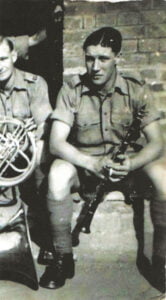
Donald Ewbank and his clarinet

He and Kathleen married in Surrey in early 1943. She had been born in Chertsey in Surrey in 1923, so was just 20 at the time while Donald was 23. They went on to have a daughter, Maureen A Ewbank. He seems to have coped well with his disturbed early childhood and developed into a handsome and pleasant young man. He was dearly loved by Kathleen, but sadly she was widowed when he died in the Battle of Overloon in 1944, about a year after Maureen was born. 

After Donald’s death, Maureen and her mother lived with her mother’s parents until her mother re-married in 1948 and went on to have 11 more children.

Occasionally Maureen and her mother visited Mrs Pinfold, but this was not frequent as it was more difficult to keep in touch in those times with less easy transport and limited use of telephones.

Oliver and Thurza Pinfold  were very upset to learn of his death and his name is commemorated on the Middleton Cheney War Memorials. His foster “brother”, Donald Wood had also joined up when the war was declared (regiment unknown) and lost a foot as a result of enemy action – he continued to visit the Pinfolds for many years after the war.

Maureen married John E Harenburg in 1963. Donald now has four grandchildren born between 1964 and 1973 and also eight great grandchildren who are making their way successfully in life.

Apart from knowing her father was dead, Maureen had little knowledge of him until late in life. Neither Maureen nor her mother had any contact with the Lucas family until very recently. However, in more recent times she has found out considerably more about his life both from her mother, her own research and also relatives who have studied the family history.

Maureen has visited Overloon Cemetery to see her father’s grave. She welcomes the idea that he will be included in the Overloon War Chronicles so that he is not forgotten.

Middleton-Cheney-War-Memorial

Middleton Cheney War Memorial

Donald Ewbank Memorial

Middleton Cheney War Memorial

Sources and credits

From FindMyPast website: Civil and Parish Birth, Marriage and Death Records; England Census and 1939 Register Records; Electoral Rolls; Military Records
Military records from ForcesWarRecords website
Royal Norfolk Regiment Museum website
Information from “Thank God and the Infantry – from D-Day to VE-Day with the 1st Battalion, the Royal Norfolk Regiment” by John Lincoln
Articles from the Hull Daily Mail
Photo and recollections from Mrs Maureen Harenburg (Donald’s daughter)
Photos of Middleton Cheney War Memorial from Middleton Cheney Historical Society and warmemorialsonline website

Additional information from Nancy E Long (Middleton Cheney Voluntary Village Archivist) with memories of Donald  from Mrs Josephine Harvey, great grand-daughter of Oliver and Thurza Pinfold

Research Elaine Gathercole

Continue reading

Drake Alfred Walter James

Drake | Alfred Walter James

  • First names

    Alfred Walter James

  • Age

    30

  • Date of birth

    04-08-1914

  • Date of death

    16-10-1944

  • Service number

    5118748

  • Rank

    Lance Corporal

  • Regiment

    Royal Norfolk Regiment, 1st Bn.

  • Grave number

    III. B. 10.

  • Alfred Walter James Drake

    Alfred Walter James Drake

    Alfred Walter James Drake

  • Grave Alfred Walter James Drake

    Grave Alfred Walter James Drake

    Grave Alfred Walter James Drake

Biography

Alfred Walter James Drake died in the Battle of Overloon on 16/10/1944 and is buried in the cemetery there. He was a Lance Corporal in the 1st Battalion of the Royal Norfolk Regiment (Service no. 5118748). He was aged 30.
 
The 1st Battalion of the Royal Norfolk Regiment was still in India on the outbreak of the Second World War. It remained there until July 1940, when it returned home. It landed in Normandy on D-Day (6 June 1944). In the ensuing campaign in North-West Europe, the regiment won two of its five Victoria Crosses of the war, the highest number for any single regiment. It suffered particularly heavy casualties in the Battle of Overloon.
 
In the book “Thank God and the Infantry – from D-Day to VE-Day with the 1st Battalion, the Royal Norfolk Regiment” by John Lincoln there are two references to Lance Corporal Drake’s death:
 
p116: Also in B Company, Lieutenant Balsom recalls:
“As we attacked, a German tank broke cover and started retreating towards Venraij and as it went it fired a series of Parthian shots in our direction; one unfortunately landed in the middle of L/Corporal Drake’s section, immediately killing him and wounding others in his section.”
 
P119: Lance Corporal Ernie Seaman MM, one of only three stretcher-bearers in the battalion who survived, unhurt, to the end of the campaign:
“ ….the big battle was Overloon and Venraij, a very sharp battle and bad conditions, very wet, a lot of casualties…..This was where I had my luckiest escape – L/Cpl Drake got a direct hit from an 88mm shell…”
 
Alfred was born on 4th August 1914 in Stepney in the East End of London.
 
His Father was Alfred Thomas Drake who was a lamplighter and his mother was Louisa Drake (nee Hinkley). They had married in 1896 in Tower Hamlets. Louisa was a tailoress at the time and her father was a Tinned Meat Examiner. Both were born in the East End of London. Alfred and Louisa had at 8 children (two sons and 6 daughters) between 1897 and 1914, of which Alfred was the youngest. All were born in the East End. The eldest child, John Alfred Drake, died in infancy and a daughter, Gladys, died aged 1.
 
Sadly, Alfred Thomas Drake died in Stepney in 1917 aged 42, so by the 1921 census Louisa was shown as a widow, aged 45. With her were her remaining son Alfred and five of her daughters plus her brother, James Hinkley, who was a 39 year old single window cleaner. The four eldest girls were all working – two in the clothing trade, one as a bar maid and the other as a grocer’s assistant.
 
By 1939 Alfred WJ Drake was living at 135 Parsloes Avenue, Barking & Dagenham, Essex. He was still single and working as a Stuff-over Frame Maker. He was also an ARP (Air Raid Precautions) First Aider. He was living with his widowed sister, Louisa E Robinson, who still worked in the clothing trade. There too was their uncle, James Hinkley, still single and a window cleaner.
 
At least three of his other sisters had married by this time and had also moved out of the East End to Harrow in Middlesex. They were all living in the same household along with their children and one of their husbands. Another of their husbands was still living in Stepney, living on his own and working at a steelworks there. Clearly, the three sisters had moved away from the East End of London, perhaps in response to advice to evacuate London, a wise precaution given the devastation of the East End that was to follow during the war.
 
In 1940 Alfred WJ Drake married Hilda P B Cox in Brentwood, Essex. In 1939 she had been living in Dagenham, Essex and was an upholsterer’s machinist, born on 20th August, 1918. After Alfred WJ Drake’s death in 1944, a probate record showed him as having lived in Ilford, Essex and his estate was administered by his widow, Hilda P Drake.
 
Alfred and Hilda had a son, also called Alfred in 1943 in Olney, Buckinghamshire. He married Dianne M Hannan in Redbridge, Essex in 1976. Alfred (Junior) died in 2018. They had no children. His widow, Dianne, believes that her husband’s father came home on leave and was able to see his son. He was very reluctant to go back to his regiment and had to be persuaded to do so by a local policeman.
 
Hilda went on to marry Cyril T Campbell at Ilford in Essex in 1949. They had one child, Shirley O Campbell in East Ham in 1950. Hilda Campbell died at Havering in Essex in 2005. Shirley Campbell is also now dead as is one of her two daughters.
 
Dianne Drake recalled that Alfred’s widow, Hilda, and his sister Ethel visited Overloon in 1946/7 with other family members – and Alfred and Dianne Drake had themselves visited the cemetery many times. His mother, Hilda, had asked that half her ashes should be spread on each of her husbands’ graves. Her son obtained special permission for this from the War Graves Commission who complied with this wish. Alfred (Junior) was a friend of the Overloon museum. The day they scattered Hilda’s ashes was the day the museum re-opened after expansion.
 
Emil Molineaux, Alfred’s great nephew, mentioned that his family had been bombed out of the East End of London and had relocated to Essex as a result.
 
Alfred’s nephew, James Molineaux, has provided a number of photos, including one of Alfred in uniform and several of his and Hilda’s wedding day. He recalled: “I can’t remember very much about his young days except perhaps a visit to us in Dagenham. He was very fond of a good cup of tea and my mum had a huge one pint mug just for him. Also he had an uproarious laugh, you know ha-ha-ha, ho-ho-ho.”

Family pictures

Young Alfred age 4 or 5

Young Alfred kneeling age 15
Young Alfred kneeling age 15 

Wedding Alfred Drake with Bridge Hilda Cox
Wedding Alfred Drake with Hilda Cox

Bruiloft Alfred Drake met zijn 5 zussen en moeder
Wedding Alfred Drake with his 5 sisters and mother

Familie Drake Hilda zittend rechts en Alfred Junior achter haar
Drake family, Hilda sitting on the right and Alfred Junior behind her

Sources and credits

From FindMyPast website: Civil and Parish Birth, Marriage and Death Records; England Census and 1939 Register Records; Electoral Rolls; Military Records
Military records from ForcesWarRecords website
Extracts from “Thank God and the Infantry – from D-Day to VE-Day with the 1st Battalion, the Royal Norfolk Regiment” by John Lincoln
Photos and recollections from James Molineaux (Alfred’s nephew)

Research Elaine Gathercole
Recollections and assistance from Dianne Drake (Alfred’s daughter in law) and Emil Molineaux (Alfred’s great nephew)

Continue reading

Shortland Leslie Joseph Horace

Shortland | Leslie Joseph Horace

  • First names

    Leslie Joseph Horace

  • Age

    25

  • Date of birth

    30-03-1919

  • Date of death

    19-10-1944

  • Service number

    5114581

  • Rank

    Gunner

  • Regiment

    Royal Artillery, 7 Field Regt.

  • Grave number

    II. B. 14.

Grave Leslie Joseph Horace Shortland

Grave Leslie Joseph Horace Shortland

Grave Leslie Joseph Horace Shortland

Biography

Leslie Joseph Horace Shortland was killed on 19 October 1944 at Overloon. He was a gunner with the Royal Artillery 7thField Regiment (soldier no. 5114581). He was born on 30 March 1919 in Stirchley which is adjacent to King’s Norton in Birmingham so was just 25 when he died.

No photo of Leslie Shortland has yet been found. Should anyone reading this have a photo of him or further information regarding him – or if they are aware of any errors in his biography below can they please contact the Foundation.

Military Career

Leslie Joseph Horace Shortland enlisted on 20 October 1939. He stated that he was born in King’s Norton, Birmingham on 30 March 1919. He gave his address as 323 Highfield Rd, Yardley Wood, Birmingham and named his mother, Mrs Lilian Mercy Fletcher, at the same address as his next of kin. He was described as 5ft 2in tall and weighed 159 ½ lbs. He had grey eyes and dark brown hair. He gave his occupation as House Painter and was declared Grade 1 medically fit. He gave his religion as Roman Catholic.
 
He initially joined the 9th Battalion of the Royal Warwickshire Regiment. He was appointed as Unpaid Lance Corporal on 29 October 1940. However, he was returned to the Army Reserves on 7 December 1940 for employment as a Slater and Tiler. It seems that at that time his skills in that trade were seen as more useful than his role in the Army.
 
He married Betty Baldwin on 3 February 1941 in King’s Norton, Birmingham. He then changed his next of kin from his mother to his wife at 118 Yaringale Road, King’s Heath Birmingham. She was informed of his death on 27 October 1944.
 
He rejoined from the reserves on 3 November 1941 and was assigned to the 11th Battalion of the Royal Warwickshires.
                          
On 20 October 1942 he was then transferred as a Gunner to No. 50 Anti Tank Training Regiment of the Royal Artillery and then to the 7th Field Regiment, Royal Artillery ten days later. He was appointed as Driver in charge on 26 March 1943. He was put on the X(ii) List from 24 April to 9 May 1944, possibly indicating some sort of injury – but was back with the 7 Field Regiment on 9 May. He embarked for Europe on 11 June 1944.
 
The 7th Field Regiment fought through the Battle for Normandy. By 1 September they were at the Forest of Halouse near Flers. On 3 September they moved from there, crossing the Seine on 4 September to reach Villers en Vixen near Les Andelays. Here they remained until 17 September when they moved on, reaching Lille St Hubert the following day. They received a warm welcome from the Belgian people. The War Diary notes that “the Lt. QM, a married man, stated that he had never been kissed so much in his life.” That night, they helped 9 Brigade cross the Escaut Canal.
 
The Regiment remained at call until 24 September when they crossed into the Netherlands, reaching Someren, east of Eindhoven. From here, they were able to fire in defence of the Asten bridgehead established by 11 Armoured Division. They remained in this vicinity supporting the infantry and harassing the enemy until 1 October.
 
On 1 October they moved across the Maas to an area South of Malden which is just south of Nijmegen. Initially they gave support to the American 82 Airborne Division and then 185 Infantry Brigade when they took over the front on 3 October. They remained in this location, harassing the enemy. They suffered some casualties on 7 October when shells and gun fire reminded them of the days they spent behind Lebisey Wood in Normandy.  
 
On 9 October, they moved southwards to a position south of Oploo. By this time, Operation Market Garden had failed to hold the bridge at Arnhem and the objective now was to widen the salient in which the Allies found themselves by pushing the enemy out of Overloon, Venray and Venlo. The War Diary states that on the night of 9 October the Regiment was “surrounded by one of the biggest concentrations of arty that we have seen since the early days of France”. The ground was described as sodden and most of the slit trenches were filled with water.
 
On 12 October, they fired in support of 8 Brigade who were given the task of capturing and consolidating Overloon. They fired counter battery and counter mortar tasks for one hour before H hour and from then onwards they had over two hours continuous firing on a barrage followed by concentrations. By 1330 hrs both forward battalions had elements in the outskirts of Overloon. The following day the infantry moved on through woods south of Overloon and on 14 October the aim was to move towards Venray with the Regiment in support. However, progress was slow. Their artillery barrage in support of the 1st Norfolks was lifted considerably faster than the infantry could move and so it had to be regularly halted. The stream called the Molenbeek between Overloon and Venray provided a formidable obstacle and could not be crossed that day.
 
The Regiment provided some support for 11 Armoured Division the following day as they attempted to clear the flank to the east of Overloon. During this day the Regiment moved forward to Overloon with the gun positions between the brick factory and the road from Oploo to Overloon. The aim was for the infantry to cross the Molenbeek in the hours of darkness. Preparations took place overnight with artificial moonlight. The crossing the next day proved easier than expected and by last light 2 Warwicks were consolidated immediately north of Brabander, just north of Venray, though the area had been thickly sown with mines. The battle for Venray continued on 17 and 18 October. Artillery support was given to neutralize mortars which were doing considerable damage. By the end of the 18th Venray had been taken. The Infantry had the unpleasant experience of reaching the Monastery in the south east of Venray where they found the cellars to be filled with refugees and patients of the Mental Hospital who throughout the previous week had hardly received sufficient food to keep them alive.
 
The 7 Field Regiment had suffered several casualties during this operation. However, it was on the following day, 19 October, that Leslie Shortland was killed in action. The death of one “Ordinary Rank” is mentioned in the war diary but the exact circumstances are not known.
 
He had served a total of 5 years and 1 day of which 331 days were in the Army Reserve and 130 days were in North West Europe. He was awarded medals as follows: 1939/45 Star, France & Germany Star, Defence Medal, War Medal 1939/45.

Family Background

Leslie Shortland, was the son of Horace Shortland and Mercy Lillian Shaw who had married at Stone in Staffordshire in 1917. Leslie was born on 30 March 1919 in Stirchley, adjacent to King’s Norton in Birmingham.
 
In 1921 Leslie was living with his parents in the house of his maternal grandparents, Richard and Annie Shaw, at 13, George Road, Selly Oak, which is south Birmingham. Richard was a bricklayer. A large number of his mother’s siblings were also present in what appeared to be a small terraced house.
 
Leslie’s mother was referred to as M Lillian Shortland who had been born in Stoke on Trent in 1895. His father was described as a “Discharged Soldier, Crippled” who had been born in 1897 in Leicester making him just 24 years old.
 
It is thought that Leslie Shortland’s father’s full name was Horace Alfred James Shortland who had served in the Oxford and Bucks Light Infantry in WW1 (service no. 28976). He enlisted on 7 December 1915 and was discharged on 26 July 1918 when still only 21. He was discharged under regulations relating to wounds which would seem to fit with his description in 1921.
 
It would seem that Leslie’s parents separated sometime before 1924 and both remarried.
 
Mercy Lillian Shortland married William John Fletcher in 1928 in Birmingham, but they seem to have been together from at least 1924. Leslie was living with them in 1939 at 323 Trittiford Road, Birmingham. He was 20 years old and described as a house painter. There too, however, was Stanley J Fletcher born 19 December 1924, described as a shop assistant. Stanley J Fletcher was born in 1924 and his mother’s maiden name was Shaw – so it is thought that he was their son, and so Leslie’s half brother. William J Fletcher died at Beoley, Redditch on 10 February 1959 and Mercy Lillian Fletcher on 9 April 1968, aged 72. They were buried together in St Leonard’s Churchyard in Beoley.
 
Leslie’s father is thought to have married again in 1924 in Stratford on Avon. They had a daughter in 1931 in Stratford on Avon. She was therefore probably Leslie’s half sister. By 1939 this family had moved to Sittingbourne in Kent. Horace AJ Shortland on 31 December 1982 in Sittingbourne.
 
As has been seen, Leslie enlisted on 20 October 1939. He married Betty Baldwin on 3 February 1941 in King’s Norton, Birmingham.
 
In 1939 Betty had been living with her family in Birmingham. Her parents were Robert Baldwin (born 29 December 1894 – a gravedigger) and Gladys Baldwin (born 22 August 1898). They appear to have had three girls: Betty born 10 June 1920; Mary born 26 Feb 1929 and Josephine born 15 May 1932. Also present was Sidney C Fox who was born on 4 April, 1909.
 
Leslie and Betty had no children.
 
Leslie Joseph Horace Shortland was killed on 19 October 1944 near Overloon.
 
On 19 October 1945, there were two notices regarding Leslie Shortland’s death in the Birmingham Mail as follows:
“Shortland (Leslie), – If all the world were ours to give, we’d give it, yes, and more, to see the face of one we loved, come smiling through the door. – Mom and pop Baldwin.”
 
“Shortland – Leslie, killed in action 1944, Time changes many things, but one thing changes never, the memory of those happy days, when we were all together. – Mary, Josie and Sid.”

Mary and Josie were the siblings of Betty Baldwin. It is thought that Sid may have been Sidney Fox who was with the family in 1939.
 
Betty Shortland went on to marry Walter R Whitbread in Autumn 1945 in Birmingham. They had a child in 1947 in Birmingham. Betty died on 17 December 2011 in Birmingham.

Sources and credits

From FindMyPast: Civil Birth, Marriage and Death Records; England Census and 1939 Register Records; Electoral Rolls; Military Records
Service Record for LJH Shortland from the National Archives ref number WO 423/52543
War Diary 7 Field Regiment Royal Artillery from Traces of War Website
Birmingham Mail of 19 October 1945 (Reach PLC)
 
Research Elaine Gathercole

Continue reading

Tomlinson Raymond

Tomlinson | Raymond

  • First names

    Raymond

  • Age

    22

  • Date of birth

    07-11-1921

  • Date of death

    14-10-1944

  • Service number

    6208073

  • Rank

    Lance Corporal

  • Regiment

    South Lancashire Regiment, 1st Bn.

  • Grave number

    I. A. 14.

  • Raymond Tomlinson

    Raymond Tomlinson

    Raymond Tomlinson

  • Grave Raymond Tomlinson

    Grave Raymond Tomlinson

    Grave Raymond Tomlinson

Biography

Raymond Tomlinson was killed in action on 14 October 1944. He was a Lance Corporal in the South Lancashire Regiment, 1st Bn. He was initially buried in the A. vd Wijst cemetery in Overloon and on 15 May 1947 he was reburied in grave I.A.14. at Overloon War Cemetery.

His tombstone reads: In loving memory of my dear husband, gone but not forgotten. Wife and baby.

FAMILY BACKGROUND

Raymond Tomlinson was born on 7 November 1921 in Brentford, Middlesex in the United Kingdom. His parents were Ezra Cecil Tomlinson (1896-1966) and Edna Mary Holder (1893-1964). He had one brother, Water Clive Tomlinson (1924-1997).
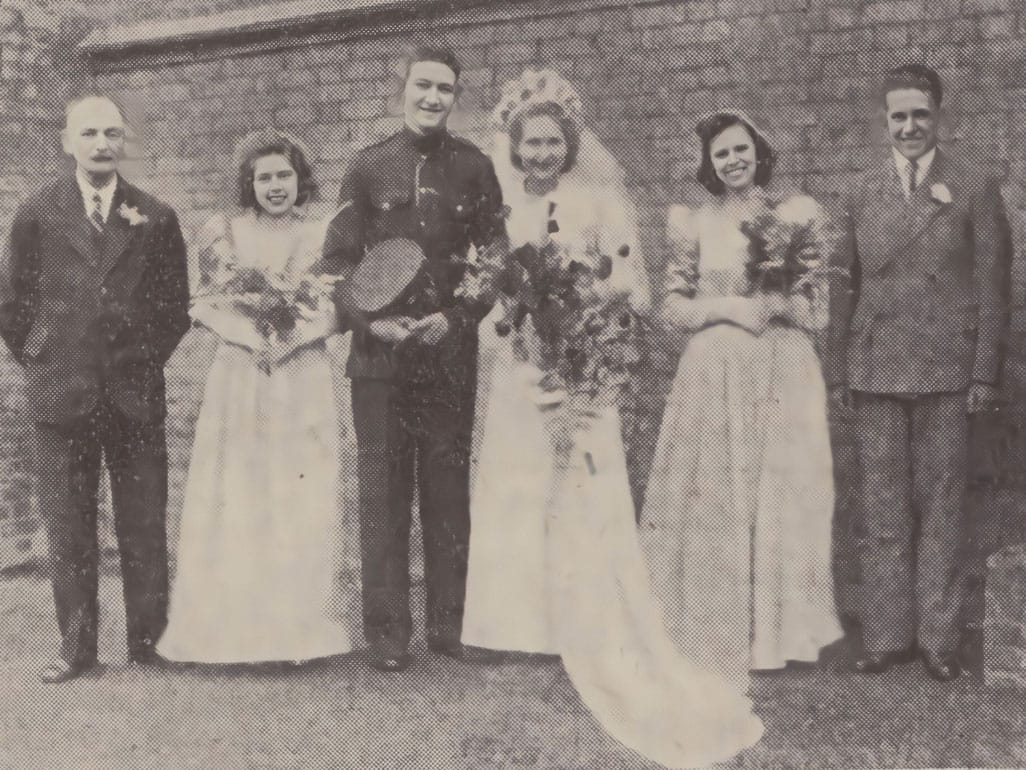
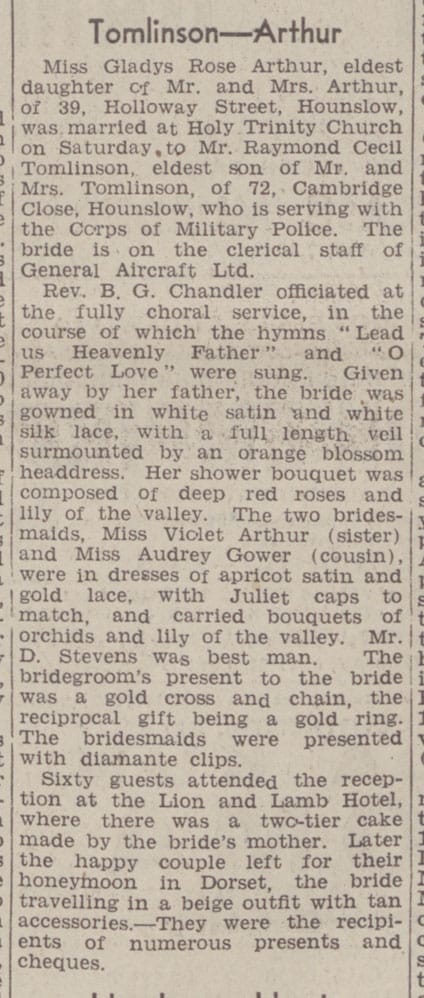
On 22 May 1943 he married Gladys Rose Arthur. At that time, Raymond was serving in the Corps of Military Police. Gladys worked in administration at General Aircraft Ltd.

Their daughter Glenys Tomlinson was born in 1945, but Raymond never got to know her.

MILITARY CAREER

Raymond began his career as a cadet in the Royal Fusiliers and before the war he joined ‘D’ Company of the Middlesex Regiment, Territorial Army.
When hostilities broke out, he was assigned to the Cheshire Regiment and later transferred to the Military Police Corps, where he served in Iceland.
At his own request, he was transferred to an infantry unit and went to France on D-Day (+3).
It is believed that he then joined the South Lancashire Regiment 1st Btn.

DUNKIRK 1940

At the start of the war with Germany, the 1st South Lancashire Regiment left for France with the 4th and 1st Division of the British Expeditionary Force (BEF) respectively. At the beginning of October 1939, the battalion had taken up positions along the Belgian border.
On 10 May 1940 the situation changed drastically when Germany invaded Belgium and the Netherlands. The British Expeditionary Force advanced towards Belgium, but the German blitzkrieg quickly overwhelmed the allied front. The British were forced into a series of strategic retreats and evacuations from Dunkirk back to the United Kingdom.
Churchill and his advisors had expected to rescue only 20,000 to 30,000 men, but a total of 338,000 troops were rescued from Dunkirk, a third of whom were French. Unfortunately, 90,000 men were left behind and taken prisoner, and the BEF was also forced to leave most of its tanks and heavy guns behind. The Dunkirk evacuation ended on 4 June 1940.

TRAINING

After returning to the United Kingdom, the 1st Battalion of the South Lancashire Regiment was transferred to the 8th Infantry Brigade (which also included the 1st Suffolk Regiment and the 2nd East Yorkshire Regiment) attached to the 3rd Infantry Division, nicknamed Monty’s Ironsides.
In mid-1943, the regiment took part in training exercises in the southeast of Scotland. In early 1944, they were also in Scotland to practice amphibious assaults.
This division landed on Sword Beach on D-Day (6 June 1944).

NORMANDY LANDINGS

On D-Day, 6 June 1944, the 1st South Lancashires, as one of the leading assault battalions of the 3rd Division, landed on Sword Beach at 7:20 in the morning. Despite heavy losses, including that of their commander, they pushed through the German defences and captured Hermanville by 9 a.m.
In the days that followed, they captured Plumetot, Cresserons, La Deliverande, the ‘Trout’ strongpoint and the famous Pegasus Bridge over the Orne.

CAEN

The battalion played a key role in the British advance on Caen and was confronted with intense fighting and considerable losses, especially on 22-23 and 26 June, near Le Londel.
In July, the battalion was involved in Operation Goodwood, a British offensive carried out from 18 to 20 July 1944 during the larger battle of Caen in Normandy. The operation was aimed at advancing south from the bridgehead near the Orne to secure the remaining parts of Caen and the Bourguébus ridge.

FALAISE

The offensive was in full swing and had pinned down a large part of the German army west of Falaise. On 11 August, the 1st South Lancashires led an advance into this pocket along the Vire-Tinchebray road. Meanwhile, on 12 August, the 1st East Lancashires captured Bois Halbout and advanced west of Falaise. On 19 August the encirclement was complete, which signalled the effective end of the battle for Normandy.

BELGIUM AND THE NETHERLANDS

From 16 to 18 September they marched through Belgium in three stages to reach Lille St Hubert, just south of the Dutch border south of Eindhoven. Here they needed to assist the East Yorkshire Regiment and the Suffolk Regiments in creating a bridgehead across the Scheldt Canal, which they crossed on 20 September to reach Hamont, just west of the Dutch border. On the 22nd they reached Weert in the Netherlands, despite the Allies encountering difficulties due to destroyed bridges.

They remained in this area until 25 September when C Company moved eastwards to Schoor as part of a plan to clear the western bank of a canal further to the east. The entire battalion was to participate the following day, but it was decided that they would march to Maarheeze that day, so only C Company took part. Their progress was slow, so they were ordered to retreat and join the rest of the battalion marching to Maarheeze. On 27 September they moved on again to reach Bakel, which lies just northeast of Eindhoven. The next day they moved a little further north to Mortel to allow the American 7th Armoured Division to occupy the area around Bakel. The Americans moved on to St Anthonis. The battalion remained in Mortel until 1 October, when they moved further north to Heumen, which lies just south of Nijmegen and north of Cuijk, and then to nearby Mook on 3 October.

By that time, Operation Market Garden further north had failed to capture the bridge at Arnhem. This left the Allies in a narrow corridor through the Netherlands. The American 7th Armoured Division attempted to widen this corridor on 30 September by attacking Overloon from their position at St Anthonis in an attempt to widen this corridor eastward to the river Maas, but this attack failed.
The 1st Battalion of the South Lancashire Regiment remained at Mook until 8 October when they moved south to Wanroij. It had been decided that the Americans would withdraw and leave the widening of the corridor through Overloon, Venray and Venlo to the British. The attack on Overloon was originally planned to begin on 11 October. However, this was postponed until 12 October due to the very wet weather and the condition of the ground.

The attack began on the afternoon of 12 October with a very heavy barrage of artillery. The 2nd East Yorkshire Regiment led the attack on what was described as Dog Wood to the west of Overloon, while the 1st Suffolk Regiment targeted Overloon itself. Both reached their objective by 15.00 hours, but some area clearance was still needed. The 1st South Lancashire Regiment was initially held in reserve, but at 17.00 hours A and D Companies were ordered to advance to clear a remaining area with one troop of the 3rd Grenadier Guards supporting each advanced company. B and C Companies and another troop of the Grenadier Guards were held in reserve. They encountered little resistance and by dusk they were in position at the front edge of a clearing. On this day, five soldiers from the battalion were killed in action.

On 13 October they continued on towards Overloon. During the attack towards the forests of Helder, the battalion was greatly hampered by minefields. The Peelkant and Peelkampsveld were cleared with air support from Typhoons.
The 9th Brigade moved through the battalion’s lines and took the area west of Overloon. The 2nd Royal Ulster Rifles and 2nd King’s Own Scottish Borderers continued the attack.
At the end of the day, the battalion withdrew to an area northeast of Overloon that was being explored by the quartermasters.

On 14 October, the battalion’s headquarters were established in a farmhouse northeast of Overloon (near the Rondweg – Holthesedijk – Vierlingsbeekseweg intersection).
The battalion came under heavy fire from Nebelwerfers and mortars. Reconnaissance took place in the direction of Vierlingsbeek to Halfweg, and later on to the railway line near Vierlingsbeek.
The hamlet of ‘Schaartven’ was also explored. There, an 88MM cannon damaged three tanks of the Grenadier Guards. The attack was launched under heavy fire and across minefields and prisoners of war were taken. Later that day, the Schaartven and Halfweg areas were cleared and the German troops withdrew to the woods south of the Vierlingsbeekseweg. Another 83 prisoners of war were taken.

It was on this day that Raymond Tomlinson was killed. He was buried with several other comrades in the A. vd Wijst Cemetery in Overloon. On 13 May 1947, he was reburied in grave I.A.14 at the Overloon War Cemetery.

On 14 October, the area south of Overloon up to the Molenbeek was captured by the British, at the cost of many lives.
The following day, the British troops reorganised for the upcoming attack on Venray.

A beautiful poem to Raymond, written by his wife Gladys, appeared in the Middlesex Chronicle on 13 October 1945:

Worth more than silver or gold,
It’s a picture of my dear husband,
whose memory will never grow old.
I often sit and think of you dear,
When no eyes can see me weep,
For many is the silent tear I shed,
When others are fast asleep.
Missed by your loving wife, Gladys, and baby.

The same newspaper also published a commemorative message from his parents and brother Clive:

In loving memory of our dear son Raymond, killed in action in N.W. Europe, October 14th 1944.
Deep in our hearts a memory is kept,
of him we loved and will never forget.
Mum Dad and Clive

  • Wedding photo of Raymond and Gladys

    Wedding photo of Raymond and Gladys

    Wedding photo of Raymond and Gladys

  • Middlesex Chronicle 15 May 1943 about the marriage of Raymond and Gladys

    Middlesex Chronicle 15 May 1943 about the marriage of Raymond and Gladys

    Middlesex Chronicle 15 May 1943 about the marriage of Raymond and Gladys

  • Gladys Rose Tomlinson

    Gladys Rose Tomlinson

    Gladys Rose Tomlinson

  • Middlesex Chronicle 11 November 1944 about the death of Raymond Tomlinson

    Middlesex Chronicle 11 November 1944 about the death of Raymond Tomlinson

    Middlesex Chronicle 11 November 1944 about the death of Raymond Tomlinson

  • In loving memory clips

    In loving memory clips

    In loving memory clips

Sources and credits

War Diaries South Lancashire Regiment 1st Bn
Ancestry various sources
Piet Peters for background information
Steven Tomlinson 1st cousin from Raymond Tomlinson for news clippings

Research Anny Huberts

Continue reading

Winter George Edwin

Winter | George Edwin

  • First names

    George Edwin

  • Age

    30

  • Date of birth

    1914

  • Date of death

    13-10-1944

  • Service number

    5249433

  • Rank

    Private

  • Regiment

    Royal Warwickshire Regiment, 2nd Bn.

  • Grave number

    III. D. 2.

  • George Edwin Winter

    George Edwin Winter

    George Edwin Winter

  • Grave George Edwin Winter

    Grave George Edwin Winter

    Grave George Edwin Winter

Biography

George Edwin Winter died of wounds on 13 October 1944 at Overloon. He was aged 30 and a Private in the 2ndBattalion of the Royal Warwickshire Regiment (Service No. 5249433). He was initially buried at the Maria Regina Monastery in Stevensbeek and transferred to Grave III. D. 2. at the current Overloon War Cemetery on 22nd May 1947.

Military Career

An obituary in the Gloucester Citizen of 28 October 1944 gives a brief indication of George Edwin Winter’s military career: “Private George Edwin Winters, youngest brother of Mr AE Winters of 17 Morpeth Street who has died of wounds in North West Europe. He joined the army in 1932 and served five years in India. From there he went to North Africa where he joined the 8th Army and took part in fighting in Sicily and Italy. After returning to England he went to France in July.”
 
In September 1942, the 2nd Battalion of the Royal Warwickshire Regiment was transferred to the 185th Infantry Brigade which was then incorporated in the 3rd Infantry Division which landed on D-Day on 6 June 1944 with the first assault on the Normandy beaches. It fought from the Battle for Caen and the break out from Normandy to the Rhine crossing. From D-Day until the end of the war, the 2nd Battalion, Royal Warwickshire Regiment lost 286 officers and men killed in action, with nearly another 1,000 all ranks wounded, missing or suffering from exhaustion.
 
The Battalion entered the Netherlands at Asten on 23 September, 1944. This is to the east of Eindhoven. At this time, the Allies were still pursuing Operation Market Garden – with ground and air forces aiming to capture as far as the bridge at Arnhem. However, by 26 September this operation had to be abandoned because of the failure to capture this bridge.
 
The new plan was for the US 7th Armoured Division to move south east through Overloon and Venray to the west bank of the Maas opposite Venlo while British forces, including the 3rd Division, would move eastward, across the German frontier, and capture the forest area known as the Reichswald, from which the Germans had been launching counter attacks.
 
On 1 October, in drenching rain, the 2nd Battalion of the Warwickshire Regiment moved north east to Malden which is between Nijmegen and the River Maas. However, by 9 October, the plan changed again. The attempt by the US 7thArmoured Division to take Overloon and Venray had lost many men and tanks without making much headway. Field Marshal Montgomery decided that he must postpone the Reichswald attack. He needed to clear the Scheldt estuary to open the badly needed port facilities of Antwerp and the lesser, but also essential, task of eliminating the German forces west of the Maas. The latter objective was entrusted to 8 Corps, including the 3rd Division. The 3rd Division was to attack south east to Venray, in the hope of drawing off enemy forces while three other divisions prepared to advance eastward to Venlo.
 
The Battalion was therefore diverted southwards and by 12 October they had moved to near Wanroy, a village south of the Maas and just north of Overloon. That day, 8th Brigade had succeeded in capturing Overloon but were unable to make progress through the woods south of it.
 
Sgt. George W A Davis later gave a vivid description of the conditions which were to come: “The last good, long, sleep we had was about the 10th or 11th of October. Our clothes were filthy, we were near exhaustion, due to lack of food and sleep. It was very cold and rain and sleet all the time, so we were all wet. There were shells, mortar bombs, machine gunning, Moaning Minnies, rockets and German snipers all over the place.”
 
The following day the Battalion moved to a position just 500 yds north west of Overloon with the aim, along with the 2nd Battalion of the King’s Shropshire Light Infantry, of clearing these woods and then allowing the 1st Norfolk Battalion to pass through and advance on Venray. The Battalion achieved its objective, but they had come under heavy fire from enemy mortars, artillery and small arms fire as well as two tanks when they reached the open ground south of the wood and it had taken longer than expected to clear the woods. By the time the objective was reached it was so late that it was decided not to put the 1st Norfolk Battalion through until the next day. The Warwickshires dug in on the southern edge of the woods.
 
On that day, Lt Douglas Brodie Brown and two other ranks were killed and Lt HTC Merryweather and 18 other ranks were wounded. This was the day on which George Edwin Winter died of wounds, most likely incurred that day.
 
As well as the obituary already mentioned above, another item appeared in the Gloucester Citizen of 13 October 1945. It said “ Winters: In loving memory of L/Cpl George E Winters, died of wounds October 13 1944. Gone but not forgotten – From a few friends.”  It is interesting to note that this gives his rank as Lance Corporal. The Grave Concentration report initially showed his rank as Lance Corporal but was amended to Private.

Family Background

George Edwin Winter was the son of George Winter and Laura Ellen Green who had married in 1895 in Winchcombe, Gloucestershire.

George Winter (Snr) was born in 1866 in Northleach, Gloucestershire while Laura was born in Winchcombe, Gloucestershire in 1877.

In 1901, George (Snr) and Laura were living in the High Street, Bisley, Stroud, Gloucestershire with their first two children: Gladys Ellen born 2 February 1898 and Reginald James born 12 November 1900. George was working as a shepherd on a farm. Gladys had been born in Miserden which is between Cirencester and Gloucester while Reginald was born in Bisley which is just east of Stroud, suggesting that the family had moved to Bisley between 1898 and 1900.

A further three children were born before 1911. Elsie Victoria A. was born on 2 August 1902 in Bisley, then Albert Edward Richard was born on 6 July 1905 in Daglingworth which is just north of Cirencester. Kate Matilda was born in 1909 in the Cirencester area but died in infancy. It seems therefore that the family had moved again between 1902 and 1905.

By 1911 they had moved once more as George and Laura were living at Corndean Farm Cottages, Winchcombe, Gloucestershire with children Gladys, Elsie and Albert. George was working as a Farm Labourer. Winchcombe is just north east of Cheltenham.  The address is where Laura had lived with her parents in 1881. At the time of the 1911 census, young Reginald was a patient in Cheltenham General Hospital.

George and Laura went on to have six more children by 1919. Lucy Mary was born on 15 June 1911 in Winchcombe, then George Edwin was born in 1914 and Dorothy V in 1913, both in Newent which is west of Cheltenham, showing that they had moved again. They seem to have moved to Gloucester district by 1917 as Monica Marjorie Irene was born there in 1917.

However, disaster seems to have struck the family from December 1919. First of all, George (Snr) died aged 53 and was buried on 13 December 1919. Following his death, in early 1920, Laura seems to have had twin boys. One seems to have died before being named, and it seems that Laura herself died then too, possibly in childbirth. She was buried on 15 March 1920 aged 42. The other twin, Leonard Kitchener, then also died and was buried on 5 April 1920 aged just 24 days. Finally, Monica Marjorie Irene died and was buried on 19 June 1920 aged just 2. All were buried in the parish of Quedgeley which is in the south western outskirts of Gloucester.

Gladys E Winter had married Reginald E Franklin in 1917 in Newent. Reginald had been born on 18 November 1894 in Aston, Warwickshire. They had a son, Montague Douglas Edwin on 1 December 1917, a daughter who died at birth in 1919 and another daughter, Doreen Laura Gladys on 7 March 1921, all born in Quedgeley.

In June 1921, their address was The Pitch, Quedgeley, Gloucestershire. Both Montague and Doreen were with them. Reginald was working as an Oil Cake Pressman for Foster Bros. Oil & Cake Mills. However, also there were two of Gladys’ sisters – Elsie V Winter and Mary L Winter (probably Lucy Mary). Elsie was working as a Shop Assistant for Haines Grocers and Mary was at school. It seems that Gladys had taken in two of her sisters after her parents’ death.

George and Laura’s eldest son, Reginald, was serving as a Private in the 1st Battalion of the Devonshire Regiment in the Infantry Barracks at Waterford in Ireland in June 1921. It isn’t known when he had enlisted but a hospital record shows that he was in that Regiment in December 1918.

Their second eldest son, Albert Edward Richard Winter, seems to have been in trouble with the law as in June 1921 he was an inmate of a Reformatory School at Hardwicke, Gloucestershire which is close to Quedgeley. He was just a month under 16. Reformatory Schools were a form of young offenders’ institution which tried to correct the behaviour of young people who had committed an often minor offence.

It isn’t known where their other two children, Dorothy V aged 8 or George Edwin aged 7, were in June 1921.

Several of George Edwin Winter’s brothers and sisters married over the next few years.

Reginald J Winter married Mary E Burlow in 1923 in Gloucester district. Mary was born on 1 January 1899. They had a son, George Winter, on 18 July 1923. Elsie V A Winter Married Victor C Mashford in 1929 in Cheltenham. She seems to have moved to Newbury in Berkshire as two children were born there: Anthony A J in 1931 and Amanda R in 1935. Albert E R Winter married Doris E White in 1929 in Gloucester. Doris had been born on 2 September 1907. They had a child, Barbara Helen Winter, on 28 June 1930 in Gloucester. Lucy M Winter married Albert Dickerson in 1938 in Gloucester. Albert was born on 8 January 1914.

As has been seen, George Edwin Winter joined the Army in 1932 aged 18.

In September 1939 his eldest sister Gladys Franklin and her husband Reginald were living at 21 Victoria Street, Gloucester with their two children. Reginald was working as a Refiner at a Seed Crushers. Montague was a general labourer and Doreen was a Machinist in a Toy Works.

His brother Reginald was living with his wife at Little Cugley, Newent, Gloucestershire with their son George and also Edwin T Clayton, a 51 year old Farm Carter. Reginald was working as a Cowman. 

His sister, Elsie, was living at 23 Priory Road, Newbury, Berkshire, however, her marriage appears to have broken down as she was living with Stanley J Mosson (born 11 January 1899) and referring to herself as Elsie V A Mosson. Stanley was the Head Waiter at the Chequers Hotel. Four unnamed children were present, presumably including Anthony and Amanda, and also a 13 year old school girl called Barbara L Pitt. Elsie later married Stanley in 1942 and the two children, Anthony and Amanda, were re-registered with his name at that time.

His brother, Albert, was living at 17 Morpeth Street, Gloucester with his wife and child. However, two other unnamed children seem to have been present. It isn’t known who these were. Albert was working as a Lorry Driver.

His sister, Lucy,  was living with her husband Albert at 24 Slaney Street, Gloucester. Albert was working as a Confectioner (Cake Maker). They had no children as yet. Two single men were living with them: Edward Doyle born 28 February 1911 who was a builder’s labourer and Reginald Gale born 12 August 1920 who was an Aero Engine Fitter. These were probably lodgers.

Again, it isn’t known where his other sister Dorothy was at this time.

In 1939,  George’s sister Gladys’ son, Montague Franklin, had joined the Royal Artillery as a Gunner (Service No. 965113). He married Kathleen Julienne Dee in 1942 in Gloucester and they had a daughter, Christabel Marie Sandra Franklin on 21 July 1942. However, Montague died on active service in India on 24 July 1943, just a few days after his daughter’s first birthday. He is commemorated at the Kirkee War Cemetery in India.

Gladys’ daughter Doreen married Philip J Rust in Gloucester also in 1942 and had a child, Wendy Doreen Rust, on 13 December 1943 in Gloucester. They were living with Gladys at 21 Victoria Street at the time.

However, Gladys’ husband had died in 1941, meaning she had lost both her husband and son during the war.

She re-married on 31 March 1943 at All Saint’s Church, Gloucester. Her husband was Hubert George Cornwall of the Gloucestershire Regiment who came from Cheltenham.

During the war, in 1940, George’s sister Lucy (who called herself Mary) and her husband also had their first child Diana A Dickerson.

As has been seen, George Edwin Winter died of wounds on 13 October 1944 near Overloon.

After the War

After the war, George’s sister, Lucy Mary Dickerson, and her husband had two more children in Gloucester: Patrick Charles 11 January 1949 and Keith A 1952.

George’s brothers and sisters died between 1957 and 1980: Albert who still lived at 17 Morpeth Street Gloucester on 1 March 1957, Gladys who still lived at 21 Victoria Street Gloucester on 21 February 1964, Lucy Mary in 1970, Reginald in 1978 and Elsie in 1980. Elsie died in Newbury, Berkshire while the others all died in Gloucester.

Sources and credits

From FindMyPast website: Civil and Parish Birth, Marriage and Death Records; England Census and 1939 Register Records; Electoral Rolls; Military Records
Traces of War Website for Royal Warwickshire Regiment War Diaries
History of the Royal Warwickshire Regiment 1919-1955 by Marcus Cunliffe
Account of Sgt George W A Davis of the Royal Warwickshires                                  
Wikipedia for information on the Royal Warwickshire Regiment
Gloucester Citizen of 02 April 1943, 16 December 1943, 28 October 1944, 24 July 1945, 13 October 1945 and 11 January 1949  

Research Elaine Gathercole

Continue reading

Cass James

Cass | James

  • First names

    James

  • Age

    32

  • Date of birth

    13-09-1911

  • Date of death

    14-10-1944

  • Service number

    4349579

  • Rank

    Private

  • Regiment

    Lincolnshire Regiment, 2nd Bn.

  • Grave number

    I. C. 11.

  • James Cass

    James Cass

    James Cass

  • Grave James Cass

    Grave James Cass

    Grave James Cass

Biography

James Cass was killed in action on 14 October 1944 in the vicinity of Overloon. He was aged 32 at the time. He was a Private in the 2nd Battalion of the Lincolnshire Regiment (Service No. 4349579). He was initially buried at Cemetery De Kleffen in Overloon and re-interred on 15 July 1946 in grave I.C.11. in the Overloon CWG Cemetery. The inscription on his grave reads: Beloved husband of Freda. At the setting of the sun, we will remember them.

James was the son of William and Hannah Ellen Cass, husband of Freda Cass (nee Brown).

Trouwfoto James Cass
Wedding James Cass and Freda Brown

James (Jim) and Freda married at a Methodist church in Hull on 25th February 1941, only 3 years & 8 months before his death and they had no children.

He was one of 8 children of William & Hannah Ellen and although his father had been involved in the fish trade, having moved down the coast from Scarborough to Hull around 1900, Jim’s job is listed in 1939 as “Wood Box Maker”.

His siblings were: George (1895-?), Faith (1897-?), Ellen (Nellie) (1900-?), John William (1902-?), Joseph Henry (1904-1914), Mary Elizabeth (Lizzy) (1906-?) and Annie (1914-1989).

Military career

It is not known exactly when James was enlisted and joint the Lincolnshire Regiment, 2nd Bn. 

The 2nd Battalion of the Lincolnshire Regiment had taken part in the D-Day landings on 6 June, 1944 and was engaged throughout the Normandy Campaign, taking part in Operation Charnwood and Operation Goodwood.

The Battalion war diary states that from 20 to 31 August the Battalion was not in contact with the enemy who were withdrawing to the River Seine and beyond. During this period, reinforcements were received bringing the unit to full strength in men but below strength in Subaltern Officers. It states that the majority of reinforcements were personnel from 59 Division which was disbanded and some Lincolnshire men wounded early in the campaign who now rejoined the Regiment. 

The 2nd Lincolnshires entered Belgium on 16 September. It was stated that the civil population were very enthusiastic, particularly in the area of the Belgian frontier. They entered the Netherlands on 25 September.

Following the failure to take the bridge at Arnhem in Operation Market Garden in late September 1944, the Allied Forces were left in a very precarious narrow salient through the Netherlands. It was the aim of Operation Aintree to widen this salient by heading south from Nijmegen to take Overloon and then Venray before finally eliminating a German bridgehead on the River Maas near Venlo.

During October 1944 the 2nd Battalion of the Lincolnshire Regiment played their part in capturing Overloon and Venray in terrible conditions of rain and wet ground.  A particularly bad day for the Battalion was the 14th of October when it suffered very heavy casualties from intense artillery and mortar fire on the approach to a stream between Overloon and Venray. A total of 32 men from this Battalion are buried at Overloon, and the vast majority of these men were killed that day. It was on this day that James sadly was killed in action. 

Initially he was buried along with several other comrades at Cemetery De Kleffen in Overloon and re-interred on 15 July 1946 in grave I. C. 11. in the Overloon CWG Cemetery. 

Sources and credits

Richard Wriglesworth
Bryan Johncock for the photo

Research Anny Huberts

Continue reading

Follow us

e-mail: overloonwarchronicles@gmail.com
address:
Holthesedijk 2 a, 5825JG Overloon

Chamber of Commerce: 83346422
Bank: NL04 RBRB 8835 3869 69
Stichting Overloon War Chronicles
BIC / SWIFT code RBRBNL21

©2021 Overloon War Chronicles